Table of Contents
Frequently Asked Questions
1. How long does it take to relocate to Dubai with Meydan Free Zone?
Setup can be remarkably fast. Your trade license can be issued in under 60 minutes through Fawri, and Emirates ID, medicals, and biometrics typically wrap within 7 to 10 working days through mResidency, allowing you to complete your move in a matter of weeks.
2. Do I need to pay personal income tax after moving to Dubai?
No. Dubai has no individual income tax, which is one of the main reasons it attracts global talent. However, businesses are subject to Corporate Tax at 9% on taxable income above AED 375,000, and a 5% VAT applies to most goods and services.
3. Can I sponsor my family when relocating to Dubai?
Yes. Once you have a valid UAE residency, you can sponsor your spouse, children, and in some cases parents. Through mResidency, Meydan Free Zone manages the full dependent visa process, including documentation, medicals, biometrics, and Emirates ID issuance for each family member.
4. What documents do I need when relocating to Dubai?
You'll need your passport, Emirates ID once issued, passport-sized colour photos with white backgrounds, an NOC from your sponsor or employer where applicable, and Arabic translations of binding documents. Birth or marriage certificates, licenses, and other supporting records may also be required.
5. Do I need to know Arabic to live and do business in Dubai?
No. English is the primary business language across Dubai, and most government services offer English support. However, official Arabic documents are legally binding, so business contracts and government forms often require Arabic translations.
Topic Summary
1. Residency and Visa Requirements
Understanding the latest residency and visa regulations is crucial. Dubai offers various visa options, including employment visas, investor visas, and the recently introduced retirement and remote work visas. Ensure you meet the eligibility criteria and are familiar with the application processes to secure your legal status.
2. Cost of Living and Accommodation
Dubai has a diverse range of housing options, from luxury apartments to more affordable residences. However, the cost of living can be high, particularly in central areas. It is important to budget for rent, utilities, healthcare, and schooling if applicable, to maintain your desired lifestyle.
3. Employment Opportunities and Business Environment
With its diversified economy, Dubai continues to attract international businesses and entrepreneurs. The city is known for sectors such as technology, finance, tourism, and trade. Research the job market relevant to your skills or explore the regulatory requirements if you plan to establish a business.
4. Cultural Etiquette and Legal Framework
Familiarise yourself with Dubai’s cultural norms and legal framework. Respect for local customs, traditions, and laws, including those related to behaviour, dress code, and consumption of alcohol, is essential for a harmonious integration into society.
5. Infrastructure and Quality of Life
Dubai boasts world-class infrastructure, including advanced transport networks, healthcare facilities, and educational institutions. Consider factors such as traffic conditions, public transport availability, healthcare insurance, and access to international schools if moving with family.
Top Things To Consider When Moving To Dubai in 2026
Dubai is a dynamic hub for work and life, offering a thriving economy and a superior standard of living that makes it a magnet for career-driven individuals. Recognised as a top choice for expats looking to set up businesses, this city has seen rapid growth, thanks to its shift from an oil and real estate-centric economy. Its skyline, adorned with architectural marvels and innovative projects, reflects its ambition.
International expat satisfaction surveys consistently place the UAE among the world's top destinations to relocate, work, and settle.
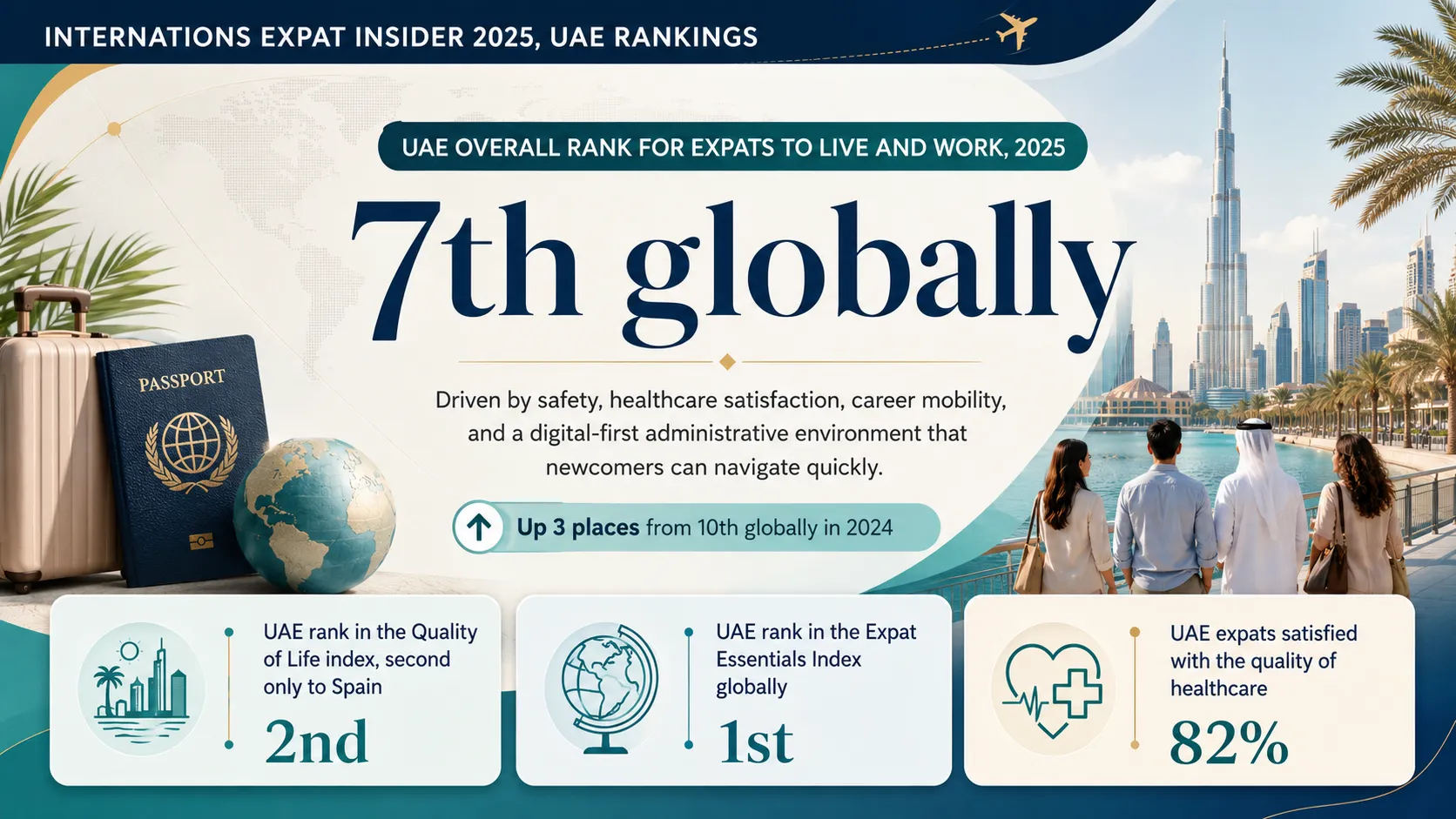
Source: InterNations Expat Insider 2025 Survey, polling 12,543 expats across 174 nations, via The National.
According to the Dubai Statistics Center¹, Dubai's population exceeded 4 million residents in 2025, growing at close to 5 percent annually, a historic milestone driven by an influx of expatriates, investors, and global talent. And according to the latest UAE Population data², expats now account for 88.5 percent of the UAE's 11.5 million residents, totalling more than 10 million people who have made the country their home, making the UAE one of the most internationalised societies in the world.
This guide will walk you through everything you need to know before making the move, from visas and cost of living to taxation, cultural norms, and how Meydan Free Zone simplifies your setup from day one.
The Checklist for Moving to Dubai
Before you move, there are four core considerations every relocating professional should plan for. Here's what each one involves.
- Visa Requirements
For those looking to relocate to Dubai, the UAE offers a versatile visa policy catering to investors, students, professionals, remote workers, and retirees. Once a resident, you can sponsor immediate family members. A valid residency is essential for obtaining an Emirates ID card, opening a bank account, getting a UAE driving license, renting property, registering for Etisalat or Du services, and accessing other local amenities.
- Cost of Living
Dubai's cost of living reflects its position as a global business hub, offering options across budgets, from modest housing to luxury living. According to Mercer's 2025 Cost of Living Survey³, Dubai ranks 15th globally, ahead of major European and Asian cities, but the city's tax-free salaries and competitive rental market continue to attract expatriates. Housing solutions remain quick to access, and the overall lifestyle delivers strong value when measured against equivalent salaries in other major cities.
- Business Hub
Strategically located, Dubai serves as the primary trading hub for the Middle East, Africa, and beyond. The influx of multinational corporations, especially in IT, telecoms, manufacturing, and healthcare sectors, has opened ample opportunities for expats. The import-export business thrives here, with zones like Meydan Free Zone offering advanced logistics support. The real estate market spans development, property management, and brokerage.
Dubai Industrial Strategy 2030 highlights 'Pharmaceuticals and Medical Equipment' as a key subsector, pointing to opportunities in health-tech innovation, health tourism, and increasing local healthcare demand.
- Healthcare
Dubai boasts an excellent healthcare system with state-of-the-art hospitals and clinics accessible to locals and expats. While public hospitals offer quality care, many expats opt for private facilities. English is widely spoken, and a significant portion of the medical staff are foreign-trained.
Documents You'll Need
This is the documentation that comes up most often during relocation:
| Document | Purpose |
|---|---|
| Passport | Required for nearly all procedures, including visa, banking, and property |
| Emirates ID | Official UAE ID card with personal details; ensure originality |
| Photos | Passport-sized colour photos with white backgrounds for applications |
| NOC (No Objection Certificate) | Sponsor or employer letter for activities like renting or purchasing |
| Arabic Translations | Many UAE forms require Arabic; Arabic documents are legally binding |
| Pay Slip | Officially stamped income proof on company letterhead for some services |
| Additional Documents | Birth or marriage certificates, licenses, records, divorce papers, or power of attorney as needed |
Navigating Taxation in Dubai
People are drawn to Dubai for many reasons, including career opportunities, tax-free income, luxurious hotels, and year-round sunshine. Many also incorrectly assume that Dubai is completely tax-free because of the absence of personal income tax and the emirate's many economic free zones, which offer business incentives such as exemption from corporate tax, zero customs duties, and full repatriation of capital and profits.
The reality is more nuanced. Here's how UAE taxation is structured in 2026.
| Tax Type | Rate | Applies To |
|---|---|---|
| Corporate Tax | 0% / 9% | 0% on taxable income up to AED 375,000; 9% above Qualifying Free Zone Persons enjoy 0% on Qualifying Income |
| Value Added Tax (VAT) | 5% | Most goods and services at point of sale Voluntary registration available if supplies and imports exceed AED 187,500 |
| Excise Tax | 50% / 100% | 50% on carbonated and sugary drinks; 100% on tobacco, energy drinks, electronic smoking devices, and liquids used in them |
| Personal Income Tax | None | No individual income tax in Dubai |
| Import Tax (Free Zones) | None | Goods imported into Free Zones until transferred to the local market |
| Export Tax | None | No export tax in Dubai |
Dos & Donts in Dubai
Dubai is a modern and cosmopolitan city, but it is also a Muslim country with a conservative culture. To ensure a smooth and enjoyable move, it's important to be aware of and respect the local customs and laws. Here are the key etiquette considerations grouped by context.
[blockFaqsCategory]
Why Meydan Free Zone Makes Your Move Easier
Meydan Free Zone offers a complete business setup environment built for entrepreneurs relocating to Dubai. Everything you need to launch your business and secure your residency comes together in one streamlined process:
- Trade license in under 60 minutes through Fawri, our instant business license
- Flexi-desk included with your license for a registered Dubai business address and visa eligibility
- Investor and employee visa sponsorship without needing to register with Ejari or MoHRE
- End-to-end residency support through mResidency, covering visa issuance, Emirates ID processing, medicals, biometrics, and dependent visa applications
- Fully digital setup process that lets you manage your company from anywhere in the world
- Dedicated support team to guide you through every step, from license to bank account opening
In Conclusion
Moving to Dubai in 2026 means joining one of the world's fastest-growing global cities, where tax-free salaries, world-class infrastructure, and a thriving expat economy combine to deliver a lifestyle few destinations can match. From understanding visa pathways and budgeting for cost of living, to respecting cultural norms and navigating taxation, the right preparation makes all the difference.
With Meydan Free Zone, your business setup and residency come together in one streamlined process, so you can focus on building your life in Dubai from day one.
Citations
¹ Dubai Statistics Center, via Di Salvo Realty, "Dubai toward 2026: population growth at 5 percent annually and its structural impact on real estate," 26 January 2026.
² Dubai Statistics Center, via Global Media Insight, "United Arab Emirates (UAE) Population Statistics 2026," 2026.
³ Mercer, "Cost of Living City Ranking," June 2025.