

Table of Contents
Frequently Asked Questions
How much can a UK SME save by setting up in a Dubai free zone?
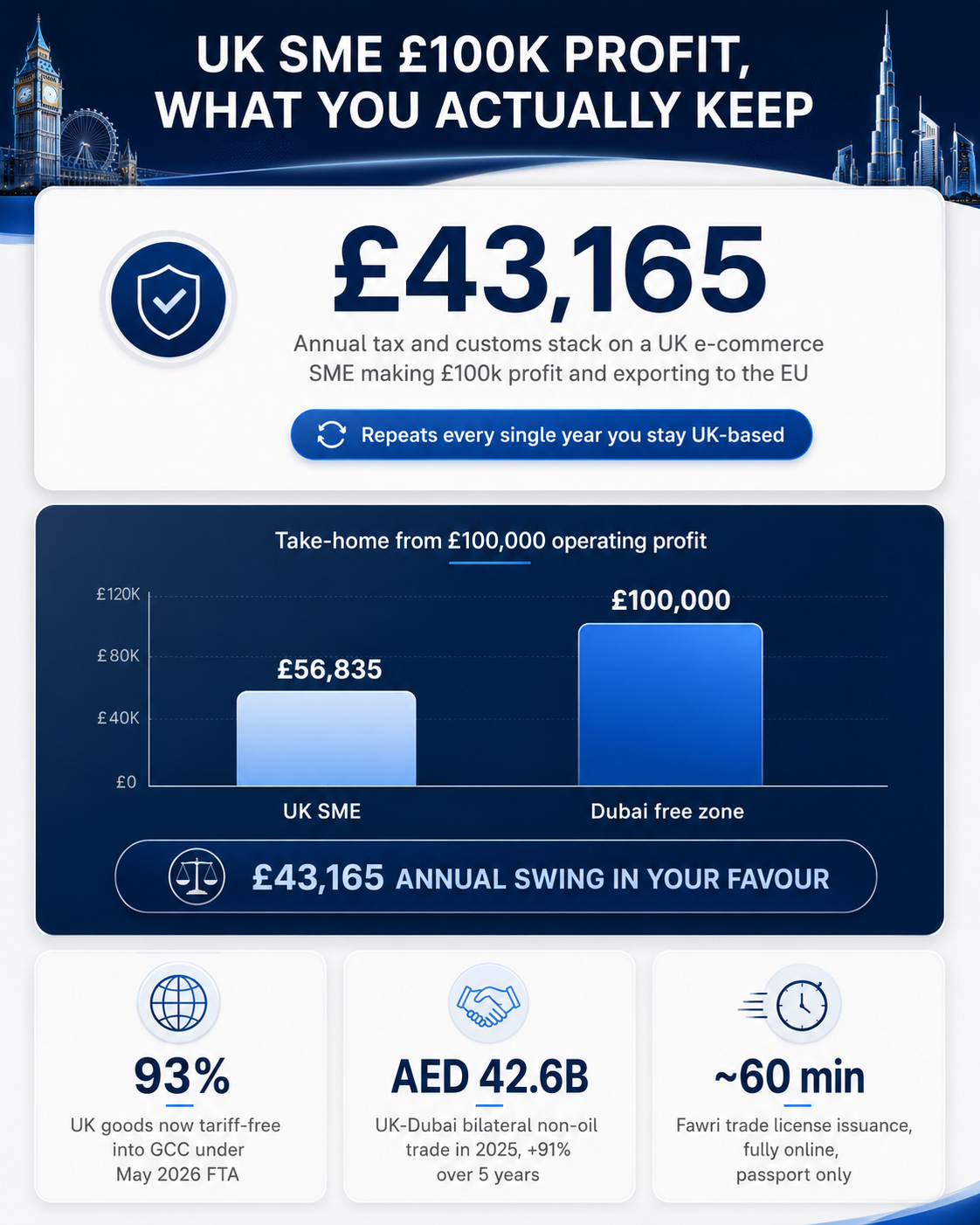
A UK e-commerce SME with £100k profit and EU goods exposure pays around £43,165 a year in UK tax and customs admin. Through Meydan with QFZP status, that stack runs to zero.
How long does a Dubai free zone business setup take?
Meydan Free Zone issues a Fawri instant trade license in as little as 60 minutes. The process runs fully online, passport as the only document required.
Does the UK-GCC Free Trade Agreement change the case for relocating?
Yes. The May 2026 FTA removes tariffs on 93% of UK goods exports to the Gulf and adds clearer visa and customs commitments, making Dubai a faster regional base for UK SMEs serving GCC markets.
Is the 0% corporate tax UAE free zone rate available to every company?
No. Only Qualifying Free Zone Person companies earning qualifying income receive the 0% rate. Failing the substance, audit or de minimis tests means 9% on all taxable income for five years.
Can a UK SME keep a UK entity after setting up in Dubai?
Yes. Many UK SMEs retain a UK entity for domestic operations while running international revenue through a Dubai free zone company, with the UK-UAE Double Tax Treaty allocating taxing rights between the two.
Topic Summary
1. Increased Tax Burden Post-Brexit
UK SMEs face a heavier tax load with corporation tax rates set to rise to 25% by 2026, combined with increased employer National Insurance and dividend tax rates. This significantly reduces net profits, compelling many businesses to seek tax-friendly environments.
2. Customs Union Complications and Costs
Leaving the EU Customs Union has introduced new customs duties, paperwork, and delays for UK SMEs trading internationally. These additional administrative burdens increase operational costs and impact profitability, pushing companies to explore smoother trade regimes.
3. Rising Bank of England Interest Rates
The Bank of England’s base rate holding at 3.75% as of June 2026 has increased borrowing costs for SMEs. Higher interest payments strain cash flow and investment capacity, motivating businesses to consider relocating to economies with more favourable financial conditions.
4. Dubai’s 0% Tax Free Zones Offer Attractive Alternatives
Dubai’s free zones provide 0% corporate and personal taxation, along with simplified customs procedures. This financial environment appeals to UK SMEs looking to maximise retained earnings and streamline cross-border trade.
5. Strategic Relocation for Growth and Stability
Relocating to Dubai enables SMEs to mitigate the impacts of Brexit-related trade barriers and the UK’s rising tax and interest rates. By leveraging tax-free incentives and a business-friendly regulatory framework, SMEs aim to enhance competitiveness and ensure long-term growth.
Brexit, Customs Union & Rising BoE Rates: Why UK SMEs Are Relocating to Dubai's 0% Tax Free Zones
That £100,000 your business made? After corporation tax, employer NI, dividend tax and customs admin at 2026 rates, you keep a lot less than you think. Now run the same maths on the next £100,000 you'll make.
UK SMEs are under pressure on every side. The Bank of England held its base rate at 3.75% on 18 June 2026, per the BoE Monetary Policy Committee.¹ Dividend tax rose by two percentage points in April 2026 per HMRC.²
Frozen personal allowances continue to pull income into higher bands. Post-Brexit customs admin runs at roughly £180 per declaration, per HMRC's own impact assessment.³
Yet the route out of the UK has never been more open. On 20 May 2026, the UK signed its first ever Free Trade Agreement with the Gulf Cooperation Council, projected to add £3.7 billion a year to GDP, per the Department for Business and Trade.⁴
Source: HMRC 2026-27 Rates and Allowances, Bank of England June 2026 Monetary Policy Summary, UK Department for Business and Trade UK-GCC FTA, and Dubai Chamber of Commerce, via UK Government
With a business setup in a Dubai free zone through Meydan Free Zone, you can register a company in under 60 minutes and tap into one of the most tax-efficient bases for UK SMEs.
The Cost of Running a UK SME in 2026
The operating environment in 2026 isn't the one most founders modelled. Borrowing is expensive, dividend bands have moved, and post-Brexit customs admin has settled in as a permanent cost line.
Here's what that looks like on the ground:
- SME working capital facilities are pricing at 7-8% against a BoE base of 3.75%¹
- Corporation tax runs up to a 25% main rate above £250k profit, with marginal relief tapering between £50k and £250k, per HMRC⁵
- Dividend tax now sits at 10.75% at basic rate and 35.75% at higher rate from April 2026²
- The personal allowance is frozen at £12,570 until April 2031, pulling more income into higher bands every year it stays in place²
- Employer NI rose to 15% on salary above the £5,000 secondary threshold in April 2025²
Run those numbers on a UK e-commerce SME with £100,000 of pre-tax operating profit, shipping goods to EU customers. The founder takes a £12,570 salary and distributes the balance as dividends, on a UK tax year 2026/27.
That's £43,165 taken from your £100k by the UK tax and customs stack, leaving you with £56,835. And that's before financing: every £10,000 of borrowed stock funding costs roughly £750 a year at current SME pricing, sitting on top of the tax bill.
How a Dubai Free Zone Changes the £100k Maths
Same business, same £100,000 of operating profit, now running through a Meydan Free Zone trade license holding Qualifying Free Zone Person (QFZP) status, with the founder relocated and UAE tax-resident under HMRC's Statutory Residence Test.
You keep the full £100,000. The annual swing against the UK position is £43,165, repeating every year you stay.
How UAE Corporate Tax Actually Works
UAE federal corporate tax sits at 9% on taxable income above AED 375,000. Companies set up in Meydan Free Zone, a designated QFZP-eligible free zone, pay 0% on qualifying income instead.
What that means in practice:
- Qualifying income covers B2B revenue with other free zone entities, international clients, and most cross-border flows
- Non-qualifying income is mainly UAE mainland customer revenue, taxed at 9% above AED 375,000
- QFZP conditions require real UAE substance, audited accounts, and arm's-length transfer pricing
- Failing any condition strips QFZP status for five years, meaning 9% across the period
What a UK SME Should Look for in 2026
For UK SMEs looking to move business from UK to Dubai after Brexit, the GCC isn't a hypothetical growth market anymore:
- UAE non-oil GDP grew 4.7% in the first nine months of 2025 to AED 355 billion, per Dubai DET⁶
- UK-Dubai bilateral non-oil trade hit AED 42.6 billion in 2025, up 91% over five years, per Dubai Chamber of Commerce⁷
- GCC e-commerce is forecast to reach $50 billion by 2028, growing at a 13% CAGR, per Mordor Intelligence⁸
- UK SMEs are landing contracts in fintech, B2B SaaS, sustainability and clean energy, food and beverage, professional services, and D2C brands across all six GCC markets
To tap into that, you need six things to fall into place:
In Conclusion
The numbers a UK SME owner runs in 2026 aren't the numbers they ran in 2019. Borrowing is expensive. Dividend bands moved. Post-Brexit customs admin hasn't gone away. Dubai free zones like Meydan Free Zone now offer UK SMEs a faster, cleaner route to international growth, built on a UK-UAE Double Tax Treaty in force since 2016, a QFZP regime that delivers 0% on qualifying income, and a license that takes 60 minutes to issue.
For a company relocating to Dubai, this isn't an escape. It's the smart structural choice. Book a setup consultation with a Meydan Free Zone setup advisor and start your business in Dubai, the smart way.
Citations
¹ Bank of England, Monetary Policy Summary and Minutes, June 2026, 18 June 2026.
² HM Revenue & Customs, Rates and Allowances: Income Tax, Dividends and National Insurance 2026/27, updated April 2026.
³ HM Revenue & Customs, Customs Declaration Service Impact Assessment, per-declaration admin cost figures for SME exporters.
⁴ UK Government Department for Business and Trade, UK and Gulf Strike Historic Multi-Billion-Pound Trade Deal, 20 May 2026.
⁵ HM Revenue & Customs, Rates and Allowances: Corporation Tax (Marginal Relief), updated April 2026.
⁶ Dubai Department of Economy and Tourism, Dubai GDP Q1-Q3 2025, 2025.
⁷ Dubai Chamber of Commerce, UK-Dubai Bilateral Non-Oil Trade, 2025 figures.
⁸ Mordor Intelligence, GCC E-Commerce Market Size and Share Outlook to 2030, 2026.