
Table of Contents
Frequently Asked Questions
Is healthcare in Dubai free for French residents?
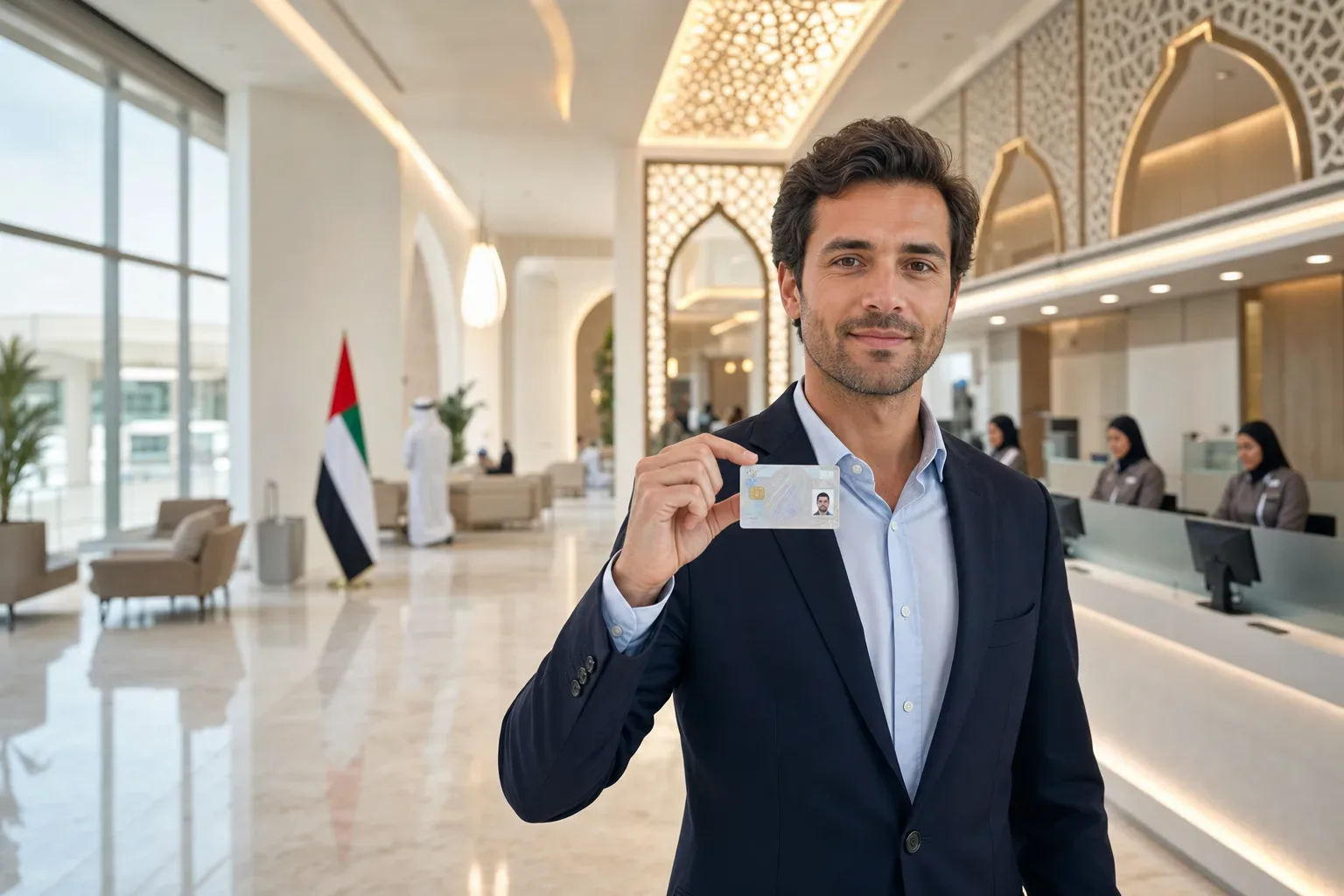
No. Healthcare in Dubai operates on a mandatory private insurance model regulated by the Dubai Health Authority (DHA). There is no universal public system for expatriates. As a French resident, you are in the private network and must carry a DHA-compliant policy before your Emirates ID is issued.
How much does health insurance cost in Dubai?
Dubai healthcare cost varies by tier. Basic cover starts from a few hundred dirhams a year, aimed at lower-income workers rather than French professionals. The usual choice for a French founder or freelancer is a mid-tier plan with outpatient, GP, and specialist access, running AED 5,000–12,000 annually. Premium plans with international cover run upwards of AED 15,000.
Can French nationals keep their Sécurité Sociale when moving to Dubai?
Deregistering from French social security ends your entitlement to Sécurité Sociale reimbursements. The Caisse des Français de l'Étranger lets you keep a French-style cover voluntarily, but at full self-funded premium. The one real risk in that switch is a coverage gap, so you cross over without a period of no cover by arranging a DHA-compliant policy alongside your residency process.
How much does a GP visit cost in Dubai without insurance?
A GP consultation in Dubai runs AED 200–500 depending on clinic tier, and a specialist visit typically costs AED 400–1,200 out of pocket. Emergency room visits start around AED 500–1,500 before insurance. Prescription medication is broadly comparable to French pharmacy prices, and sometimes lower for generics.
Does a Meydan Free Zone Trade License include health insurance?
A Trade License from AED 12,500 does not include health insurance, but it is the prerequisite that unlocks your right to purchase a DHA-compliant policy as a resident. Without an active Trade License triggering your residency, you cannot legally access the private healthcare network as a resident. Meydan Free Zone's mResidency service supports medical insurance selection alongside the full residency process.
How long does the medical fitness test take in Dubai?
The medical fitness test is required for everyone aged 18 and over applying for UAE residency. It screens for communicable diseases and is conducted at DHA-approved centres, with results typically issued within 24–48 hours in qualifying cases. The test can be booked immediately once residency is stamped, and the result feeds directly into Emirates ID issuance.
How does Dubai's healthcare quality compare to France?
Private facilities are strong, with multiple DHA-licensed hospitals holding Joint Commission International (JCI) accreditation — the global benchmark for hospital quality. Private clinic GP appointments in Dubai are typically same-day, against specialist wait times of 50–80 days for certain disciplines in France. Dubai also removes the GP referral step, so direct specialist booking is standard.
Topic Summary
Dubai Runs on Mandatory Private Insurance
Healthcare in Dubai is regulated by the Dubai Health Authority (DHA), which accredits providers and requires every resident to carry a DHA-compliant policy. There is no universal public system for French nationals — coverage is private by default, and it must be in place before your Emirates ID is issued.
France's Sécurité Sociale Ends When You Leave
Registering as a UAE resident ends your entitlement to French social security reimbursements. The Caisse des Français de l'Étranger lets you keep a French-style cover voluntarily, but at full self-funded cost. The one real risk in that switch is a coverage gap — so arrange your DHA-compliant policy alongside your residency, not after.
Dubai Healthcare Cost Starts Well Below France
Dubai healthcare cost is priced from a few hundred dirhams a year for basic cover, rising to AED 15,000–25,000 upward for premium plans with international cover and direct specialist access. The usual choice for a French founder is a mid-tier plan with outpatient, GP, and specialist visits — comparable to a mutuelle, often cheaper net of 0% income tax.
Private Facilities Match European Standards
Dubai's private facilities are strong, with major groups like Mediclinic and other DHA-licensed hospitals and clinics operating across every district. Multiple facilities carry JCI accreditation — the global benchmark — and specialist wait times in private clinics are typically 24–72 hours, against 50–80 days for certain disciplines in France.
Your Trade License Is the Gateway to Coverage
A Trade License is the legal foundation that enables your UAE residency, and residency is what gives you access to Dubai's healthcare system as a resident. Without an active Trade License, you cannot hold a residence visa, which means you cannot legally purchase a DHA-compliant policy.
The Medical Fitness Test Is a Required Step
A medical fitness test is required for everyone aged 18 and over applying for UAE residency. It screens for communicable diseases at DHA-approved centres, and results feed directly into the Emirates ID process. Getting the order right — Trade License, medical fitness test, insurance, Emirates ID — prevents costly delays.
Dependent Cover Requires Its Own Policy Per Person
Each family member on your sponsorship must carry their own DHA-compliant insurance policy. Group plans from insurers often reduce the per-head cost compared to individual policies. Meydan Free Zone's mResidency service manages dependent visas, medical fitness scheduling, and insurance guidance in one coordinated timeline.
Healthcare in France vs Dubai: Costs, Quality and Care Comparison
France's top personal income tax rate reaches 45%, per the Direction Générale des Finances Publiques; the UAE applies 0%.¹ That single contrast is what stops many French entrepreneurs mid-sentence when they first encounter it.
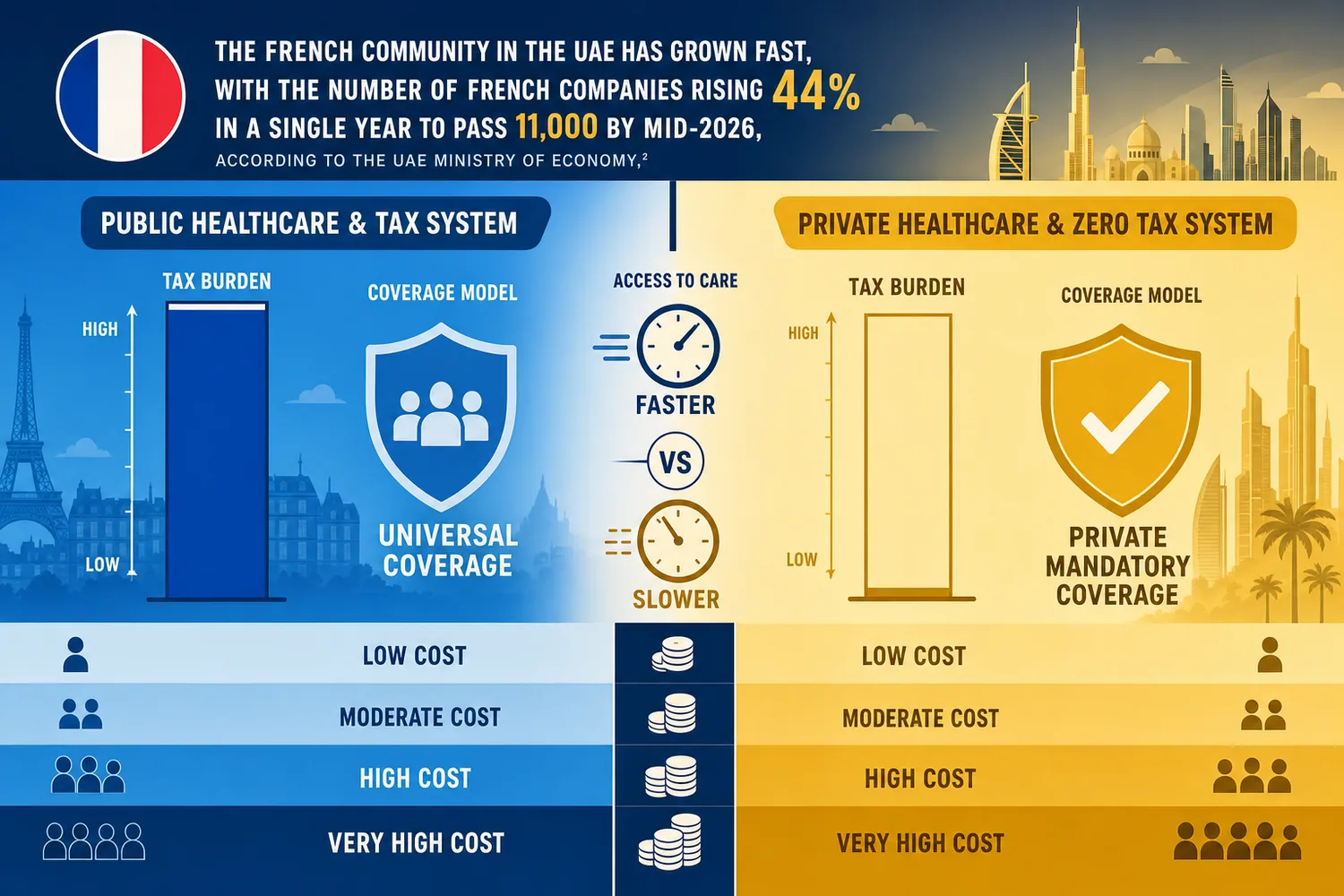
The French community in the UAE has grown fast, with the number of French companies rising 44% in a single year to pass 11,000 by mid-2026, according to the UAE Ministry of Economy,² as founders realise the emirate offers not just a tax structure but a functioning ecosystem: private clinics under a mandatory insurance model, short specialist wait times, and a 60-minute trade license at Meydan Free Zone that unlocks residency, and with it, access to Dubai's healthcare system as a resident.
This guide compares the two systems honestly, what each does well, what a French resident actually pays in Dubai, and how coverage fits into the move through Meydan Free Zone.
France vs Dubai: How Each Healthcare System Works
France and Dubai approach healthcare in almost opposite ways, and each has genuine strengths.
France, universal and public:
- Runs on the Sécurité Sociale, funded through payroll and social contributions
- Reimburses most of a GP visit or hospital stay, usually 70% or more, with a top-up mutuelle covering the rest
- Near-automatic for residents and workers, with low out-of-pocket costs
- Comprehensive, but tied to living and working in France, so it does not travel with you
Dubai, mandatory and private:
- Runs on a private-insurance model regulated by the Dubai Health Authority
- No universal public system for expatriates; public healthcare is mainly for UAE nationals
- Every resident must hold a DHA-compliant policy, with care delivered through private hospitals and clinics
- You pay a premium, but access is fast and the private facilities are strong
Healthcare in France vs Dubai: Key Comparison
| Feature | France | Dubai |
|---|---|---|
| System Type | Universal public (Sécurité Sociale) with optional mutuelle top-up | Mandatory private insurance; no universal public system for expatriates |
| Mandatory Coverage | Automatic for legal residents and employed workers via URSSAF contributions | DHA-compliant policy required before Emirates ID is issued; enforced since 2016 |
| Average Insurance Price (Annual) | Employer-funded via payroll; self-employed pay approx. €1,500–3,000/year via URSSAF | Mid-tier private plan: AED 5,000–12,000/year; premium: AED 15,000–25,000+/year |
| GP Wait Time | Typically 3–10 days for a GP appointment in urban areas | Same-of-month or next-of-month at most private clinics |
| Specialist Wait Time | 50–80 days average for dermatology, rheumatology, and other high-demand disciplines | 24–72 hours at private specialist clinics; no GP referral required |
| Personal Income Tax Impact on Net Price | Income taxed at up to 45%; insurance premiums paid from post-tax income | 0% personal income tax; full premium paid from gross earnings, reducing real-terms price |
The Role of the Dubai Health Authority
The DHA regulates all hospitals, clinics and practitioners in Dubai, and licenses the insurers that operate here. A few things a French national should know:
- Insurance is mandatory: It has applied since Dubai Law No. 11 of 2013, phased in fully by 2016, so there is no grace period for a new resident.
- AED 150,000 minimum benefit: Every compliant policy must provide at least this in annual cover.
- Benefits expanded in 2025: The DHA added dental cover among others, pushing premiums up roughly 10 to 20%.
- It gates your residency: You cannot finish your residence visa or Emirates ID without a valid policy, it is a required step, not optional paperwork.
When you set up your company through Meydan Free Zone, that compliance check is built into the residency process rather than left to you to chase.
Public vs Private: What a French Resident Actually Uses
As a French resident, you are in the private system, and it is a strong one:
- Your providers: Care runs through private groups like Mediclinic, the American Hospital and other DHA-licensed hospitals and clinics, not the government facilities, which mainly serve UAE nationals.
- The quality: Several Dubai hospitals hold Joint Commission International accreditation, the global benchmark for hospital quality, with particular depth in cardiology, oncology and fertility.
- The access: You can usually book a specialist directly, without the GP referral step the French system requires.
France's universal coverage is hard to beat on cost and security. Dubai's edge is private-standard care, fast, on a policy you hold yourself.
Leaving the French System
The Sécurité Sociale is one of the things French residents value most at home, and moving abroad means giving it up. When you deregister from the French system, your reimbursements end.
The Caisse des Français de l'Étranger lets you keep a French-style cover voluntarily, but at a full self-funded premium, so most people switch to a Dubai policy once settled.
The one real risk in that switch is a gap between the two systems, a window where you have left the French one but not yet joined the Dubai one. Handled through Meydan Free Zone, there isn't one: your DHA-compliant policy is arranged alongside your residency, so you cross over without a period of no cover.
What Health Insurance Costs in Dubai
Health insurance in Dubai is priced by tier, above the mandatory AED 150,000 minimum benefit:
- Basic (Essential Benefits Plan): the mandatory minimum, from a few hundred dirhams a year. Limited outpatient cover, aimed at lower-income workers rather than professionals.
- Mid-tier plans: the usual choice for a French founder or freelancer, with outpatient, dental and optical cover. Roughly AED 5,000 to 12,000 a year.
- Premium plans: international cover and direct specialist access, from around AED 15,000 upwards.
Out of pocket, a GP consultation runs roughly AED 200 to 500, and a specialist visit AED 400 to 1,200 without insurance. Prescriptions are broadly comparable to French pharmacy prices, with generics sometimes cheaper.
Here is what changes the maths: a mid-tier policy at AED 9,000 costs exactly that in Dubai, paid from income taxed at 0%. In France, funding the same AED 9,000 from a salary taxed up to 45% means earning close to double that gross before you even reach the premium.
It is the same cover either way, but the money that pays for it has been taxed very differently on its way there, which is why a good Dubai policy costs less in real terms than the price on paper suggests.
How Insurance Coverage Fits Into Your Move
In Dubai, health insurance is not a separate errand, it is a required step in getting your residency, and your residency comes from your company. For a French founder, that turns what could be a stressful scramble in a new country into one coordinated process.
- A company gives you residency. A Meydan Free Zone trade license, from AED 12,500, lets you sponsor your own investor visa. If you want to move faster, Fawri issues the license in under 60 minutes, from AED 15,000.
- Insurance is a required gate: You cannot complete the medical fitness test, Emirates ID or residence visa without a valid, DHA-compliant policy in place. It is checked automatically.
- As an investor, you arrange your own cover: Employers insure their staff and sponsors insure their dependents, but a business owner is responsible for their own policy, and mResidency initiates that medical insurance with an approved provider on your behalf, aligned with the visa process.
- The policy certificate unlocks the rest: Once the insurer issues your certificate, it feeds directly into the residency steps, the medical test, the Emirates ID, the visa, so nothing stalls waiting on cover.
- Your family is handled the same way: Dependents you sponsor, a spouse or children, have their cover and visas arranged under the same company, in the same coordinated process.
Rather than researching insurers and DHA rules alone in a new country, a French founder has the policy, the medical test and the Emirates ID handled together, and the coverage stays valid for as long as the residency does.
In Conclusion
France and Dubai offer two honest versions of good healthcare. France gives universal, low-cost coverage you lose when you leave. Dubai gives fast, private-standard care on a policy you hold yourself, and, for a working resident, one that costs less in real terms with no income tax in the way.
The one thing to plan for is that Dubai's cover is mandatory and tied to residency. Handled through Meydan Free Zone, that becomes a single step rather than a scramble: the company, the visa, and the insurance that legally comes with it, arranged together.
To talk through how it would work for you, book a free consultation with a setup advisor at Meydan Free Zone.
Footnotes
¹ Direction Générale des Finances Publiques, Barème de l'impôt sur le revenu, France's top marginal personal income tax rate is 45%, 2026.
² UAE Ministry of Economy, via Gulf News, UAE and France expand ties as French companies surge 44%, French companies in the UAE rose 44% in a year to pass 11,000 by mid-2026, 2026.