
Table of Contents
Frequently Asked Questions
Is there a French embassy in Dubai?
No. France's embassy to the UAE is in Abu Dhabi. Dubai has the Consulate General of France, in the Al Habtoor Business Tower, Dubai Marina, which serves French nationals living in Dubai.
What does the French Consulate in Dubai do?
It handles passports, national ID cards, civil status certificates, notarial acts, consular registration, voter registration and emergency assistance for French nationals living in or relocating to Dubai.
Should I register with the French Consulate in Dubai?
It is not mandatory, but strongly advisable. Registering on the Registre des Français établis hors de France speeds up document requests, enables voting from abroad, and provides consular protection.
Does the consulate help with setting up a Dubai company?
Not directly, but it certifies French documents, like powers of attorney and passport copies, that a UAE company or bank may require. The company setup itself runs through a free zone like Meydan Free Zone.
Does a UAE company end my French tax residency?
Not automatically. France assesses where your home, main activity and economic interests genuinely sit. Take cross-border tax advice before restructuring, holding a license alone does not end French tax obligations.
Topic Summary
Register With the French Consulate First
Registering on the Registre des Français établis hors de France unlocks consular protection, electoral participation, and emergency assistance. French nationals who skip this step contact the wrong institution for the wrong service and face delays when certified documents are needed urgently.
Embassy vs. Consulate: Two Different Roles
The French embassy in Abu Dhabi manages bilateral trade policy and government-to-government coordination. The French consulate Dubai delivers citizen-facing services: passport renewals, civil status documents, powers of attorney, and voter registration. Private individuals need the consulate, not the embassy.
Prepare Apostilled Documents Before You Arrive
UAE banks and free zone authorities request apostilled birth certificates, marriage certificates, and police clearance certificates at multiple stages. Gathering these in France before departure reduces post-arrival admin load significantly and prevents cascading delays that push your whole relocation back by weeks.
A Trade License From AED 12,500 Triggers Residency
A Dubai Trade License from AED 12,500 at Meydan Free Zone is the legal foundation. It gives you 100% foreign ownership, opens the Immigration File, and triggers the investor visa process — the residence visa your spouse and children's dependent visas depend on.
Tax Residency Requires a Genuine Move
The France-UAE double taxation treaty exists to prevent being taxed twice, but it is not automatic. France looks at where your home, economic activity, and civil life are concentrated. A founder who only moves the company on paper, keeping their main home in France, remains a French tax resident.
Medical Insurance Is Mandatory Before Emirates ID
All Dubai residents must hold valid medical insurance in Dubai — it is a required condition of UAE residency. DHA-approved coverage must be in place before Emirates ID is issued. Meydan Free Zone's mResidency service manages the medical fitness test, insurance, and Emirates ID as one coordinated process.
The Setup Runs Remotely From France
French nationals do not need to travel to Dubai at the Trade License stage. The entire process runs completely online. With a Fawri License, the license can be issued in under 60 minutes for eligible activities — so a founder arrives into an established ecosystem with documentation already in hand.
French Embassy in Dubai, UAE: The Complete Guide for Citizens
More than 3.9 million people live in Dubai, drawn from over 200 nationalities, according to the Dubai Statistics Centre,¹ and the French community is a well-established part of that mix, with over 600 French-registered companies operating across the UAE, per the French Consulate.² For a French citizen relocating or already settled, one institution handles the paperwork that keeps your French life in order.
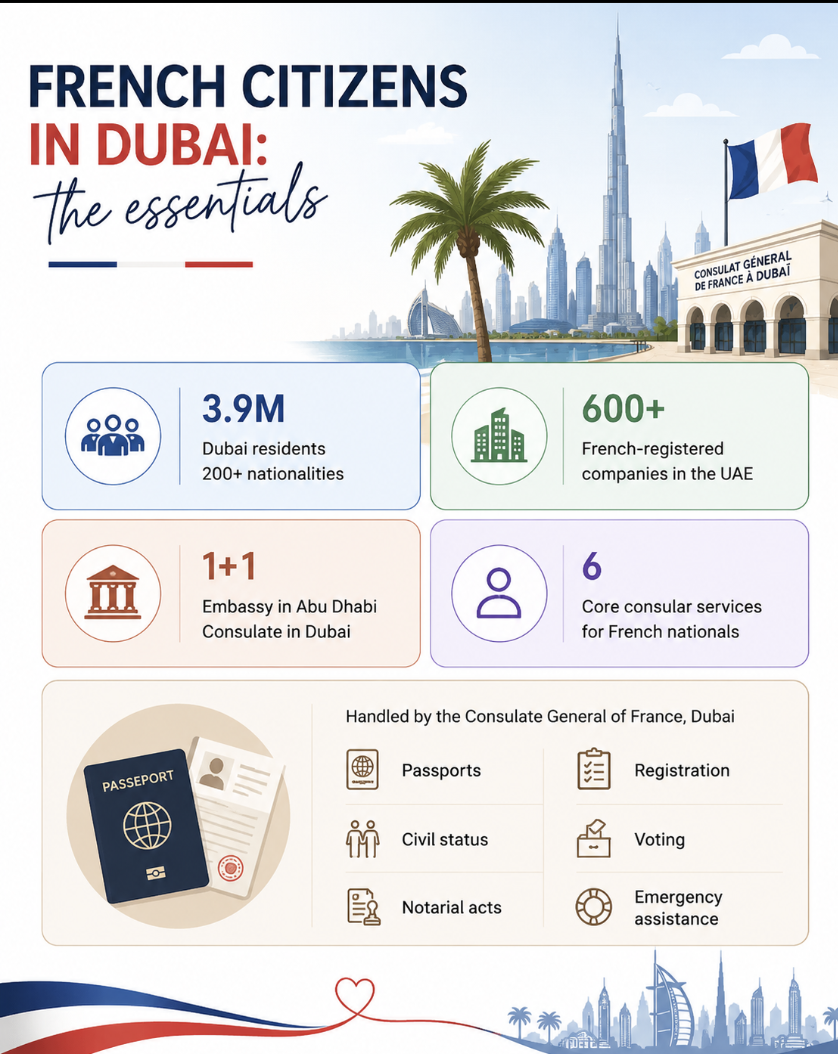
If you are looking for the French Embassy in Dubai, the office you actually need is the Consulate General of France, in Dubai Marina. France's embassy sits in Abu Dhabi and deals with diplomatic matters, but for passports, certificates and registration, the Dubai consulate is your point of contact.
This guide covers what the consulate does, why registering with it matters, and how the documents it certifies feed into the practical side of relocating, including setting up a company and residency through Meydan Free Zone
French Embassy Dubai vs French Consulate Dubai: Service Comparison
France runs two offices in the UAE. The Embassy is in Abu Dhabi and handles diplomatic relations between the two countries. The Consulate General is in Dubai and handles everything for French nationals living here: passports, civil status, certifications and registration.
What the Consulate Does
The Consulate General handles the administrative services that keep your status as a French national current while you live abroad:
- Passports and national ID cards, renewals and replacements, by appointment. Allow several weeks for processing.
- Civil status documents, requesting or transcribing French birth, marriage and death certificates.
- Notarial acts, powers of attorney, certified copies and declarations, with fees set on a fixed national schedule.
- Consular registration, enrolment on the Registre des Français établis hors de France.
- Voter registration, so you can vote in French elections from abroad.
- Emergency assistance, including emergency travel documents in qualifying cases.
For exact requirements, appointment booking and current processing times, always check the consulate's official page, service details change, and the consulate is the only authoritative source.
Why Registering With the Consulate Matters
Registering on the Registre des Français établis hors de France is not strictly mandatory, but it is the single most useful administrative step a French resident can take. It creates the official record that unlocks the rest.
Registration gives you:
- Faster access to documents like civil status certificates and consular cards.
- The ability to vote in French elections from Dubai.
- Consular protection and a point of contact in an emergency.
- A clean administrative trail for anything requiring proof of French residency abroad.
The gap tends to show up at the worst moment, when you need a certified document quickly for a residency renewal or a company matter, and the record is not in place. Registering early avoids that.
How This Connects to Setting Up in Dubai
Here is where the consulate meets the practical side of relocating. Setting up a company and residency in the UAE sometimes calls for French documents in an official, certified form, and that certification is a consular job.
Depending on your situation, you may need the consulate to certify or legalise:
- A power of attorney, if someone will act for you in a UAE transaction while you are still in France.
- Certified copies of your passport or civil status documents.
- Legalised documents requested by a UAE bank or authority, often needed before a corporate account is approved.
Once those are in hand, the UAE side is where Meydan Free Zone takes over, and there are two routes in:
- The regular trade license at AED 12,500, the standard, cost-efficient route, issued online within a day.
- The Fawri instant license at AED 15,000, issued in under 60 minutes for when you need to move fast.
Either way, the license gives you a UAE company that covers up to three business activity groups from over 2,500 options, with 100% foreign ownership. That company then sponsors your own residence visa, and mResidency handles the rest as one process: the medical fitness tests, Emirates ID applications (delivered to your door) and medical insurance, whether the visa is for you, an employee you are bringing on, or dependents like your spouse and children.
The two sides sit in sequence: the consulate certifies your French paperwork, and Meydan Free Zone builds the UAE company and residency it feeds into. Handled in order, the whole relocation moves without the delays that come from doing them out of order.
What a Move Actually Requires for Tax Purposes

One thing worth flagging, because it catches people out. Setting up a UAE company and holding a residence visa does not, on its own, end your French tax residency. What matters is where your life genuinely sits:
- Your home: Where your main residence and family base actually are.
- Your main activity: Where you genuinely work and run the business from.
- Your economic interests: Where your income, assets and financial ties are centred.
Holding a license while keeping your main home and life in France can leave you taxed as a French resident regardless. The France-UAE double taxation treaty exists to prevent being taxed twice, but it is not automatic, and it rewards a genuine move with real substance in Dubai. Anyone restructuring their affairs around a UAE company should take proper cross-border tax advice before doing so.
In Conclusion
For a French citizen in Dubai, the consulate is the anchor of your administrative life: passports, civil status, certifications and the all-important consular registration. Get registered early, keep your documents current, and the rest of a relocation, including the company and residency, has a clean foundation to build on.
When you reach the UAE side, Meydan Free Zone handles the company and residency in one place. Explore trade license options or book a free consultation to plan your setup.
Footnotes
¹ Dubai Statistics Centre, Population Clock, Dubai's resident population exceeds 3.9 million across more than 200 nationalities, 2026.
² French Consulate / France Diplomatie, France and the United Arab Emirates, over 600 French-registered companies in the UAE, 2026.