

Table of Contents
Frequently Asked Questions
1. What's the difference between hiring household staff directly versus using an agency in Dubai?
A direct hire means you, the family, act as the legal sponsor, handling the visa, contract, and all legalities yourself. Using an approved agency (like Tadbeer centres) means the agency sponsors the worker and manages the legal process, while you pay a fee for their services. Direct hire offers more control but involves more admin, whereas agencies simplify the process but may cost more upfront.
2. What are the legal requirements for a British expat to sponsor a nanny in the UAE?
To sponsor domestic help, the head of the household (sponsor) typically needs a minimum monthly salary (e.g., AED 25,000) and must hold a valid UAE Residence Visa. The process involves obtaining an entry permit for the employee, followed by an in-country medical fitness test, and securing an Emirates ID and residence visa, all managed through official government channels (1).
3. What is the step-by-step sequence for hiring household help in Dubai?
To hire domestic staff in Dubai, start by defining the role and setting a clear budget for salary and benefits. Next, use reputable hiring platforms or agencies to source and screen suitable candidates. Once shortlisted, conduct interviews and verify references and documents before moving forward. Many employers also choose to run a paid trial period before issuing a formal employment contract. After hiring, you must complete the official sponsorship and visa process and properly onboard the employee into your household.
4. What documents should I ask for when interviewing a candidate?
During the verification stage, you must see their original passport and current visa (if they are already in the UAE). It's also wise to request copies of previous employment visas, reference letters with contact details, and any educational or training certificates relevant to the role. Never proceed to the offer stage without verifying these key documents.
Topic Summary
1. Know Your Hiring Options: Agency vs. Direct Hire
As a British expat, you can either directly sponsor your domestic help or use a government-approved Tadbeer agency. Direct sponsorship means you manage the visa and contract yourself, offering more control. Agencies handle all legalities for a fee, providing a simpler, albeit more expensive, route to hiring a nanny in Dubai for UK expats.
2. Define the Role and Budget in Detail
Before your search begins, create a precise job description outlining duties, working hours, and whether the role is live-in or live-out. Research current market salaries and budget for mandatory costs like visa fees, health insurance, and an annual flight ticket home for your employee. This clarity prevents misunderstandings later on.
3. Use Scorecards for Objective Screening
Move beyond gut feelings by using a simple interview scorecard. Rate candidates consistently on key criteria: relevant experience, communication skills, reliability, and safety awareness. This structured approach helps you compare applicants fairly and objectively, ensuring you identify the best long-term fit for your family’s specific needs and household dynamic.
4. Always Conduct Practical Trials and Reference Checks
An interview only shows part of the picture. Arrange a paid, in-person trial for a few hours or a day to observe a candidate’s practical skills and interaction with your family. At the same time, be diligent about contacting at least two previous employers to verify their work history, punctuality, and character.
5. Formalise Everything with the Official MOHRE Contract
In the UAE, all domestic worker employment is regulated by the Ministry of Human Resources and Emiratisation (MOHRE). You must use their official, unified contract. This legal document is crucial as it protects both you and your employee by clearly stipulating salary, leave entitlements, and duties according to UAE Labour Law (1).
Hiring a Nanny, Driver, or House Help in Dubai, UAE as a British Expat Family
When you hire house help in Dubai, you'll choose between two routes. Direct hire means you become the sponsor, you manage the worker's visa directly through MOHRE and ICP. Agency supply means a MOHRE-licensed agency holds the visa file and supplies the worker to your family under a service contract. Agency supply doesn't require the employer to hold full visa sponsorship, but it comes with less control over substitution and renewal timing.
Roles Families Commonly Fill
Three roles cover most household needs. A nanny covers infant feeding, bottle sterilisation, nursery tidying, but excludes deep cleaning and driving duties. A housekeeper handles cleaning, laundry, cooking, household management. A Driver operates under a different contract structure and doesn't require the employer to hold full visa sponsorship in the same way, there's no separate licensing regime for household drivers, but they're still governed by MOHRE and ICP.
- Nanny: childcare, feeding, nursery tidying, school pickup
- Housekeeper: cleaning, laundry, cooking, household management
- Driver: family transport, school runs, airport transfers
What You Should See at This Stage
Before you contact any candidate, confirm your sponsor eligibility, gather your housing proof showing adequate space for a live-in worker if applicable, and verify you meet the salary threshold. You should see a clear role brief, a document checklist, and a budget range before the process starts.
Prerequisites Before You Start
Tools
You need a written role brief, an interview scorecard, a document checklist, and a budget range covering government fees, health insurance, and any agency or recruitment costs, not just entry fees. Prepare passport copies, proof of tenancy, and your housing proof showing adequate space for a live-in workerout terms, cooking expectations, language needs, and child safety practices. Know whether you're directly sponsored or using agency supply, affects documents, renewal timing, and cost control from day one.
Time
Plan two to six weeks for sourcing to visa stamping. Budget for government fees, health insurance, and any agency or recruitment costs. Reserve funds for renewal cycles, visa renewal every two years, health insurance renewal, and annual return ticket obligations add to the total annual spend.
Step-by-Step Process to Hire the Right Person
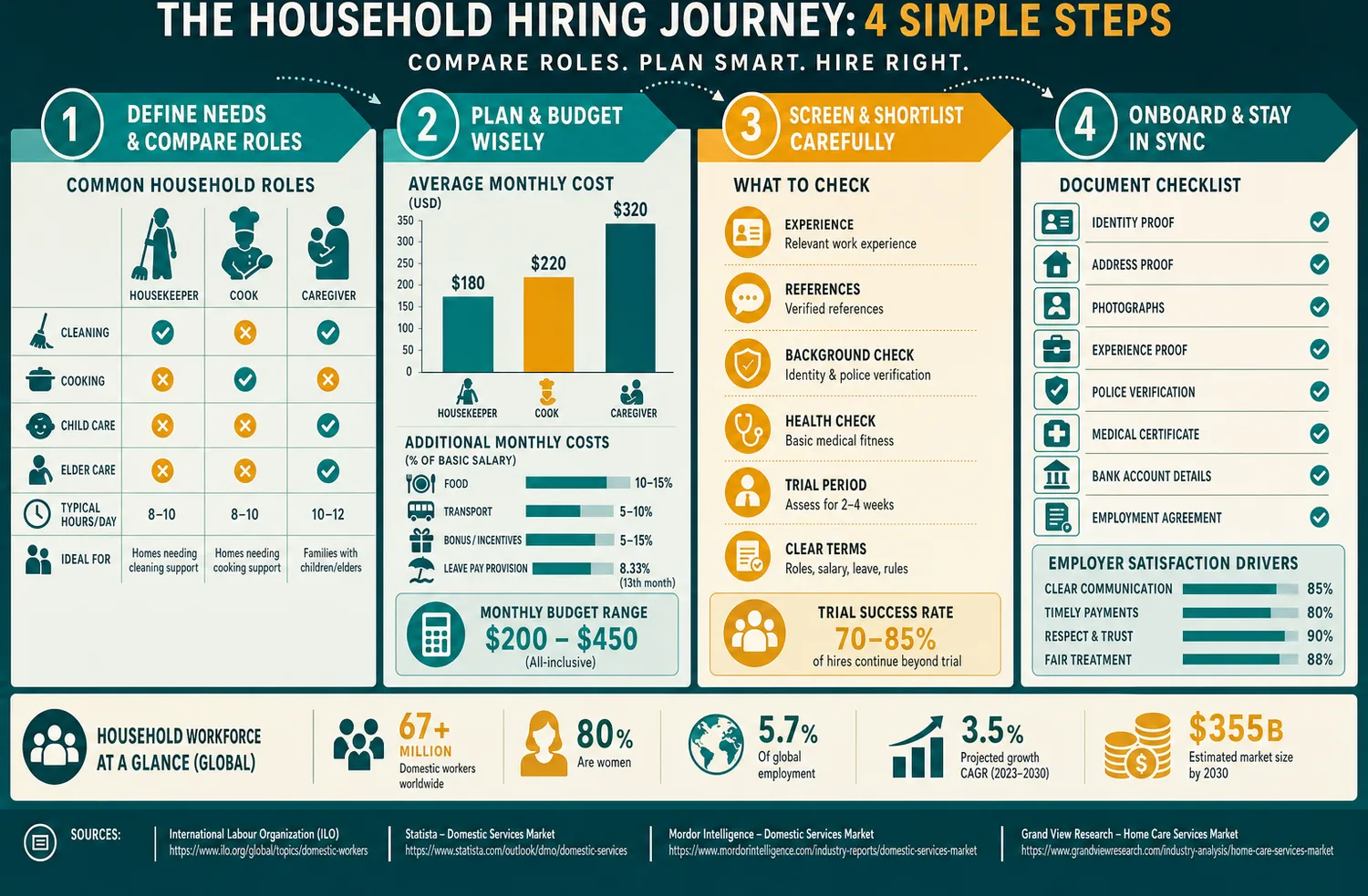
1. Define the Role
A clear role states infant care, feeding, bottle sterilisation, nursery tidying, but excludes deep cleaning and driving duties. Write a scope covering childcare, driving, cleaning, cooking, or household management. Don't blend role duties without writing it down, blending role duties without a signed contract creates financial consequences.
2. Set Compensation and Terms
Next, set salary, notice terms, and live-in versus live-out terms in writing before discussing a start date. The contract must cover annual leave (30 days), working hours, reasons for contract end, and child safety practice expectations. Put notice terms into writing, AED 1,500–4,500 for housekeepers and AED 2,000–4,000 for nannies is the standard market range.
3. Source and Screen Candidates
Sourcing a candidate through a MOHRE-licensed agency. Unlicensed operators expose you to real legal risk. Check their current visa status, verify their current employer, and whether they hold an active MOHRE-compliant contract, but trial periods are not a substitute for proper verification.
4. Interview, Verify, and Trial
For a nanny, ask about infant feeding schedules, and child safety practice. Verify references by phone, not just by message. Run a paid trial period of three days before the worker begins employment. Each step must be completed in order, do not proceed to the next stage if any checkpoint fails.
Interview Scorecards, Considerations, and Risk Control
Build a Scorecard
Rate each candidate across five criteria: experience, reliability, communication, safety awareness, and role fit. A total score below 35 should trigger a pause. Use written discussions if performance slips, protects you if a hiring dispute arises later.
Use What You Should See Considerations
After each stage, confirm what you should see: complete documents at the document stage, consistent references at the interview stage, punctual attendance during trial, and performance under pressure during the paid period.
Control Common Hiring Risks
Two most common risks: hiring a worker whose visa status is uncertain, and blending role duties without a compliant contract. Avoid informal verbal terms for salary. Keep reliable wage records from day one.
Table and Infographic for Faster Decision-Making
Table: Role Comparison at a Glance
| Role | Key Duties | Live-In Fit | Typical Monthly Salary (AED) |
|---|---|---|---|
| Nanny | Infant care, feeding, bottle sterilisation, nursery tidying, school pickup | Common | 2,000–4,000 |
| Housekeeper | Cleaning, laundry, cooking, household management | Common | 1,500–2,500 |
| Driver | School runs, family transport, airport transfers | Rare. Vehicle provided | 3,000–4,500 |
Offer, Onboarding, Success Criteria, and Next Steps for Hiring a Nanny in Dubai for UK Expats
Issue the Offer and Set Expectations
Issue the offer in writing, confirming the employment relationship is legally formed before they begin. The contract must cover salary, notice terms, annual leave (30 days), working hours, and child safety practice expectations. For hiring a nanny in Dubai for UK expats, this isn't a casual arrangement, a signed contract creates financial consequences if skipped.
Onboard During the First Week
Cover household routines, emergency contacts, visitor policy, school logistics, and child safety practices during the first week. Create a written first-week Plan covering from day one.
Success Criteria and Next Steps
The process is complete when the worker holds a stamped UAE residence visa, live health insurance card, and a physical Emirates ID card. Keep a one-line tracker showing submission date, ID issuance, and renewal timing. Set calendar reminders 90, 60, and 30 days before each renewal date. Track each milestone: contract signed, Emirates ID process initiated, health insurance active, and renewal timing confirmed.
References
Full citation list:
- MOHRE UAE – Domestic Worker Sponsorship Rules. Available at Ministry of Human Resources and Emiratisation (MOHRE)
- Federal Authority for Identity, Citizenship, Customs and Port Security (ICP). Available at icp.gov.ae
- Federal Decree-Law No. 10 of 2017 on Domestic Workers. Available at mohre.gov.ae
- Dubai Health Authority (DHA) – Mandatory Health Insurance. Available at Dubai Health Authority (DHA)
- Gov.ae – UAE Official Portal. Available at The United Arab Emirates Government Portal