Table of Contents
Frequently Asked Questions
1. What license does a setup British recruitment agency Dubai need to operate?
It depends on the model. Executive search and HR consultancy can operate under a standard free zone professional services license. Labour supply and temporary staffing require a MOHRE-issued recruitment license and a mainland entity.
2. Can a free zone company in Dubai offer staffing and manpower services?
No. Labour supply, where the agency directly employs and deploys workers, requires MOHRE licensing and a mainland company structure. Free zone entities are permitted for consultancy, executive search, and advisory services but not for direct manpower supply.
3. What are the MOHRE bank guarantee requirements for a recruitment license?
A brokerage license requires a bank guarantee of AED 300,000 payable to MOHRE, plus a license fee of AED 50,000. A temporary recruitment license requires AED 1,000,000 as a bank guarantee and a license fee of AED 100,000.
4. What corporate tax applies to set up a British recruitment agency in Dubai?
A free zone advisory practice qualifying as a QFZP pays 0% on qualifying income. The 9% rate applies above AED 375,000 on non-qualifying income. UK corporation tax may still apply if HMRC determines the entity is centrally managed from the UK.
5. Do British recruitment qualifications carry weight in Dubai?
Yes. British-trained consultants are well-regarded in the UAE, particularly in financial services, legal, technology, and professional services sectors, all areas with significant hiring volume in Dubai.
6. Is a physical office required to set up a British recruitment agency in Dubai?
For the MOHRE licensed route, yes. A physical registered office is mandatory and virtual offices are not accepted. For a free zone consultancy operating in the executive search model, a flexi-desk arrangement is typically sufficient to begin.
7. How long does it take to set up a recruitment consultancy in a Dubai free zone?
A Fawri license issues in under 60 minutes digitally. The standard free zone route typically completes within one working day once documentation is ready.
8. What is the UK-UAE Double Taxation Agreement?
A treaty in force since 2016 that prevents the same income being taxed in both jurisdictions. It requires a Tax Residency Certificate to apply and does not resolve cases where HMRC contests a company's residency under the central management and control test.
Topic Summary
1. Understand and Comply with Local Regulations
British HR and recruitment firms must familiarize themselves with Dubai's Labour Law and the specific regulations set by the Dubai Department of Economic Development (DED) and the Ministry of Human Resources and Emiratisation (MOHRE). Compliance with these laws is essential for legally providing recruitment services in the region.
2. Establish a Local Presence
To operate effectively, consultancies often need to set up a local entity or partner with a UAE-based sponsor to obtain the necessary trade licenses. Dubai's Free Zones, such as Meydan Free Zone, offer streamlined licensing options that allow foreign companies to maintain full ownership.
3. Adapt to Cultural and Market Nuances
Operating in Dubai requires an understanding of the multicultural workforce and local hiring practices. British consultancies should tailor their recruitment approaches to align with Emirati labour market expectations, which may differ significantly from the UK’s model.
4. Leverage Technology and Digital Platform
Digital recruitment methods and applicant tracking systems that have proven effective in the UK can be adapted for the Dubai market. Utilizing online job portals and LinkedIn remains critical for sourcing candidates across diverse sectors prevalent in Dubai’s economy.
5. Build Relationships with Local Stakeholders
Success in Dubai’s recruitment market is often dependent on establishing strong networks with government bodies, corporations, and industry associations. Consistent engagement helps British consultancies navigate regulatory changes and enhances their reputation within the local business community.
How British HR And Recruitment Consultancies Can Operate in Dubai, UAE
The UK recruitment sector has spent the last two years contracting. According to the Recruitment and Employment Confederation's Recruitment Industry Status Report, permanent placements fell 33.5% in 2024, dropping to 536,400 from 806,400 the previous year.¹
Pre-pandemic, the industry was placing close to a million candidates a year on a permanent basis. The same REC report shows sector GVA fell from £44.4 billion in 2023 to £40.6 billion in 2024, with 42% of UK recruitment firms reporting that cashflow pressure has directly constrained their growth.¹
The structural case for British recruiters in Dubai is a simple mismatch: the home market is contracting while the UAE staffing sector is expanding at nearly 10% a year.
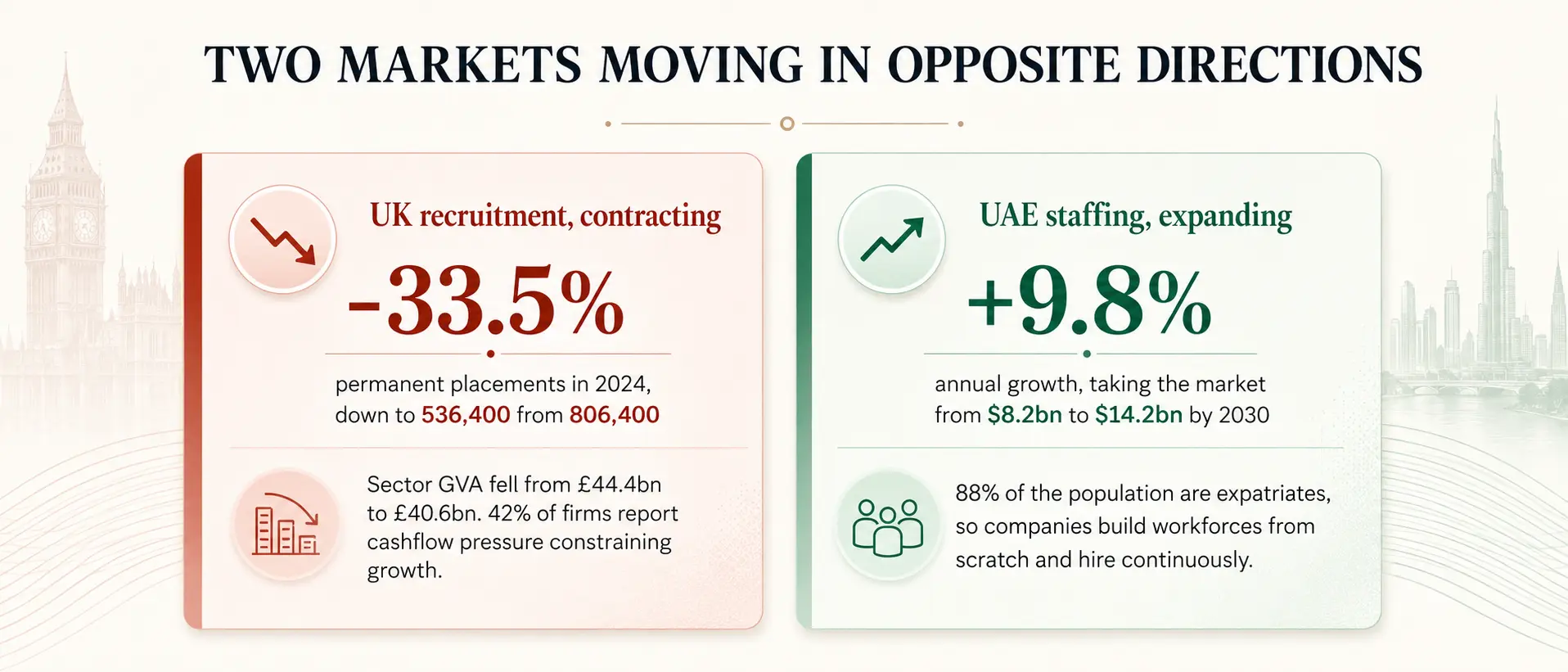
Sources: Recruitment & Employment Confederation (2025); P&S Intelligence (2025).
Dubai's hiring market is moving in the other direction. PSMarketResearch values the UAE staffing services market at USD 8.2 billion in 2024, projected to grow at 9.8% CAGR through 2030 to reach USD 14.2 billion.² The structural driver is straightforward: Global Media Insight reports 88% of the UAE's population are expatriates,³ companies are continuously building workforces from scratch, and there is no established preferred supplier list culture of the kind that locks UK agencies out of mid-market clients for years at a time.
For a British recruitment consultancy looking to extend its service footprint, British recruitment agency setup in Dubai is a commercially serious option, provided the structure chosen matches the services being offered.
What the UAE Hiring Market Looks Like in Practice
Dubai is an import-led talent market.
Most companies are not drawing on a domestic graduate pipeline; they are recruiting internationally, across time zones, with visa timelines to manage and relocation logistics to coordinate.
This creates ongoing demand for consultancies that understand cross-border hiring, know how to manage candidate expectations across cultures, and can advise on offer structuring in a market where package components, including housing allowance, school fees and flights, carry as much weight as base salary.
Gulf News identifies the sectors with the highest hiring activity as technology, financial services, professional services, construction and real estate, healthcare, and hospitality.⁴
These mirror the sectors where British recruitment firms have deep specialist networks. A consultancy that has spent ten years placing senior finance candidates in London has directly transferable knowledge in Dubai, where the same global firms have regional offices.
The distinction from the UK market is behavioural as much as structural. Decision cycles are shorter. Hiring managers expect responsiveness within 24 hours.
Without a local entity and a UAE phone number on your profile, many procurement managers will not engage at all.
The Structural Decision When You Setup British Recruitment Agency Dubai
This is the most important operational question for any British firm entering this market, and it is the one most commonly misunderstood.
The UAE regulates two different business models under separate licensing frameworks.
| Service Model | Setup Required | Key Conditions |
|---|---|---|
| Executive search, talent acquisition advisory, HR consultancy | Free zone entity | Agency introduces candidates without directly employing or sponsoring them; no MOHRE recruitment license required; professional services license covering HR consultancy and executive search is sufficient |
| Labour supply and temporary staffing | Mainland entity | Agency directly employs workers under its own sponsorship and deploys them to client companies; MOHRE-issued recruitment license required; structurally different business with significantly higher setup costs, capital requirements, and regulatory obligations |
Executive search covers the vast majority of what British white-collar recruitment firms actually do.
British firms that enter the market assuming their free zone entity covers labour supply will find they are operating outside their permitted activities. The MOHRE's licensing framework treats these as distinct categories, not interchangeable ones.
Most British recruitment consultancies, including executive search, professional services placement, and specialist sector agencies, operate on the consultancy model. The free zone route is the appropriate entry structure for this group.
The MOHRE Route: Licensing Requirements
For firms that do need the licensed route, including those whose model involves temporary staffing, outsourced headcount, or manpower supply, the requirements are substantive.
According to the The British Chamber of Commerce Dubai's guide to recruitment agency licensing, here are the key conditions you need to know:
- The fee for a brokerage license is AED 50,000, with a bank guarantee of AED 300,000 payable to MOHRE for the full license term.
- A temporary recruitment license costs AED 100,000, with a bank guarantee of AED 1,000,000.
Beyond the financial requirements, MOHRE updated its licensing conditions in April 2025, introducing six formal criteria all applicants must meet:
- Clean criminal record (no convictions for dishonesty, human trafficking, or labour offences)
- Financial stability and evidence of reliability
- A physical registered business address (virtual offices are not accepted)
- Valid documentation throughout the application
- No current or close-family connection to MOHRE employees
- Submission via UAE Digital Identity system with a formal service request
A physical office is non-negotiable under the MOHRE framework for the licensed route. Firms planning to operate primarily from the UK with occasional UAE visits will not satisfy these requirements.
Tax Treatment
A free zone consultancy qualifying as a QFZP pays 0% corporate tax on qualifying income. The 9% rate applies on income above AED 375,000 that does not qualify. VAT at 5% applies on taxable supplies within the UAE domestic market.
UK founders need to apply the same analysis as any other UAE expansion: HMRC's central management and control test means that a Dubai-registered company directed from the UK may be treated as a UK tax resident regardless of where it is incorporated.
A UAE residence visa does not change that calculation.
The UK-UAE Double Taxation Agreement, in force since 2016, prevents double taxation where income is genuinely taxed in one jurisdiction, but it does not resolve contested residency, and it does not apply automatically. Founders should be familiar with HMRC's Statutory Residence Test before structuring the transition.
Setting Up Through Meydan Free Zone
For those looking to set up a British recruitment agency in Dubai in the executive search and HR advisory space, Meydan Free Zone supports 2,500+ business activities, including HR consultancy, executive search, and recruitment advisory, and selecting the correct activity scope at setup determines whether the business remains within permitted free zone operations or inadvertently moves into regulated manpower supply territory under MOHRE. The setup process is fully digital, 100% foreign ownership, and passport-based, with no physical visit required during incorporation.
For firms that do relocate or begin building a local team, mResidency supports investor and employee visas through a digital process. This becomes relevant not just for internal hires, but also for consultancies that need to advise placed candidates on UAE documentation and relocation timelines.
For British consultancies that regularly need to assist placed candidates with UAE documentation, Meydan Free Zone's employment visa guidance covers the process in detail.
The Fawri license issues in under 60 minutes digitally, starting at AED 15,000. The standard license starts from AED 12,500. Both routes include a guaranteed IBAN pathway through Meydan Free Zone’s banking partner network. This allows founders to establish a functional payment layer early, which is critical for invoicing UAE clients and receiving international payments.
In Conclusion
The case to set up a British recruitment agency in Dubai rests on a straightforward structural mismatch: a UK sector with 33.5% fewer permanent placements in 2024 than the year before per the REC,¹ facing a UAE market with a USD 8.2 billion staffing sector growing at nearly 10% annually per PSMarketResearch.² British firms with specialist sector depth, existing networks, and an understanding of cross-border hiring are structurally well-positioned to compete on knowledge and responsiveness rather than price.
The firms that will struggle are those that assume the model they run in the UK translates automatically: that a UK client list will convert, that operating remotely is sufficient, or that a free zone entity covers all recruitment activities regardless of whether they involve direct labour deployment.
The firms that may benefit are specialist white-collar consultancies with sector depth in technology, finance, legal or professional services: markets where Dubai has real hiring volume and where British credential and network recognition carries weight.
Meydan Free Zone's cost calculator gives you a clear breakdown of license, visa, and operational fees before making a commitment. Check your preferred company name and start your application today.
Ready to Launch Your Business in Dubai?
Let's ConnectCitations
¹ Recruitment and Employment Confederation, "Recruitment sector contributes more than £40 billion a year to the UK economy despite tough job market," 2025.
² PSMarketResearch, "UAE Staffing Service Market," 2024.
³ Global Media Insight, "UAE Population Statistics 2026," 2026.
⁴ Gulf News, "Looking for a job? These sectors will hire the most in Dubai and Abu Dhabi in 2026," 2025.