

Table of Contents
Frequently Asked Questions
1. Can a UK citizen open a bank account in Dubai without a UAE residence visa?
No. UAE banks will not open personal or corporate accounts for visitors or those on tourist entry. A residence visa stamped inside your passport is mandatory before any bank process can proceed.
2. How long does it take to open a corporate bank account in Dubai for a UK entrepreneur?
Allow 4–8 weeks from Trade License issuance to a functional corporate account. Personal accounts often move faster, typically 1–2 weeks once residency is stamped, provided a complete document pack is submitted.
3. What do UAE banks require beyond a Trade License for a corporate account?
UAE banks require evidence of real business substance beyond a Trade License, including a business plan, signed client contracts, three to six months of UK bank statements, and a professional email domain. Applications lacking client contracts or credible revenue projections are commonly rejected.
4. What is the minimum balance required for a UAE corporate bank account?
Minimum balance requirements vary by bank and account tier, running from AED 25,000 to AED 100,000. Failing to meet these thresholds triggers monthly price deductions or account restrictions, confirm the exact figure before activation.
5. How does UK tax residency affect a UK entrepreneur banking in Dubai?
HMRC uses the Statutory Residence Test to determine whether UK tax obligations continue after relocation. UK-source income remains subject to UK tax even with UAE residency established, so entrepreneurs with complex income structures should address cross-border tax planning before the move.
6. Should UK entrepreneurs choose a Free Zone or Mainland company for UAE banking purposes?
A Free Zone is often a perfect fit as it allows 100% foreign ownership and mandatory virtual or flexi-desk office arrangements that keep setup costs manageable. A Mainland company is the appropriate structure only if the business needs to trade directly within the local UAE market or take on government contracts.
Topic Summary
1. Residency Before Banking, Always
UAE banks will not open personal or corporate accounts without a residence visa stamped inside your passport. UK entrepreneurs who treat banking as an afterthought after company formation add unnecessary weeks to their timeline.
2. A Trade License Alone Is Not Enough
UAE banks need documented business substance, signed client contracts, a business plan, and expected revenue sources. Account applications without these face rejection; the same founder with documented client contracts moves through review significantly faster.
3. What Most UK Expats Discover Too Late
Submitting documents in stages rather than as a complete package causes delays of two to four weeks. Having a UAE phone number ready, a local address confirmed, and minimum balance funds available before submission avoids the most common compliance checkpoint failures.
4. Choose the Right Bank for Your Setup
Emirates NBD and Mashreq suit most Free Zone corporate accounts; HSBC UAE works well for UK entrepreneurs maintaining existing HSBC UK banking relationships. Digital-first options like Liv. open personal accounts within 48 hours of visa stamping.
5. Free Zone or Mainland Determines Banking Complexity
Free Zone companies are often a perfect fit as they allow 100% foreign ownership and mandatory virtual or flexi-desk office arrangements. A Mainland company is the appropriate structure only when the business needs to trade directly within the local UAE market or take on government contracts.
6. UAE and UK Tax Obligations Run Simultaneously
A federal Corporate Tax of 9% applies to taxable profits above AED 375,000 annually, and VAT at 5% is mandatory once revenue thresholds are met. HMRC also uses the Statutory Residence Test (SRT) to assess ongoing UK tax exposure, making early cross-border tax advice essential before structuring operations.
7. Allow Four to Eight Weeks for Corporate Accounts
Corporate account opening can add another two to four weeks beyond Trade License issuance when compliance reviews are thorough. Personal accounts move faster, often one to two weeks once residency is stamped, making a digital account the practical bridge while the corporate process runs.
How UK Entrepreneurs Can Open Corporate and Personal Bank Accounts in Dubai, UAE
UK entrepreneurs relocating to Dubai often assume that holding a Trade License and a residence visa is enough to walk into a bank and leave with an account. It isn't. UAE banks operate under strict anti-money laundering (AML) frameworks, and the due diligence applied to new applicants with UK business backgrounds is substantial. The founders who get approval fast treat banking as a structured process, not an afterthought. Allow 4–8 weeks from Trade License issuance to a functional corporate account. Personal accounts move faster, often 1–2 weeks, once residency is stamped.
Prerequisites Before You Start the Banking Process
To open a bank account in Dubai for UK citizens, the foundation must be in place first. For a corporate account, you need a valid Trade License from a recognized Free Zone authority or the Department of Economic Development, an Establishment Card (Immigration File) confirming the company is legally formed, a Memorandum of Association covering ownership, and at least one director with a UAE residence visa stamped inside their passport. A Trade License alone rarely gets approval.
For a personal account, you need a UAE residence visa, an Emirates ID or the ICP application receipt, proof of UAE address (tenancy contract or utility bill), and employment confirmation or a Trade License if self-sponsored.
What UAE Banks Require More Than a Trade License
UAE banks need documented business substance. A short business plan covering activities, target markets, and projected annual revenue is standard. Key client contracts or even a letter of intent demonstrate genuine commercial activity. So having a professional online presence isn't optional, it signals legitimacy to compliance teams.
Banks will also ask for UK bank statements covering the previous three to six months as source-of-funds evidence. If you hold a UK limited company in parallel with your UAE entity, expect additional beneficial ownership questions. What most UK expats discover too late: applying without a UAE phone number ready and a confirmed local address pauses the application at the first compliance checkpoint.
Choosing the Right Bank for UK Entrepreneurs
For corporate accounts, Emirates NBD and Mashreq are the most commonly used options for Free Zone companies, with dedicated business banking teams and digital onboarding portals. RAKBANK suits smaller setups with more accessible minimum balance requirements. HSBC UAE is worth considering if you already hold an HSBC UK relationship, the international referral process reduces onboarding friction.
For personal accounts, Liv. (by Emirates NBD) offers account opening within 24–48 hours of residence visa stamping. This gives you a functional UAE account for daily transactions while your corporate application runs its course.
A Numbered Process: How to Open a Corporate Bank Account
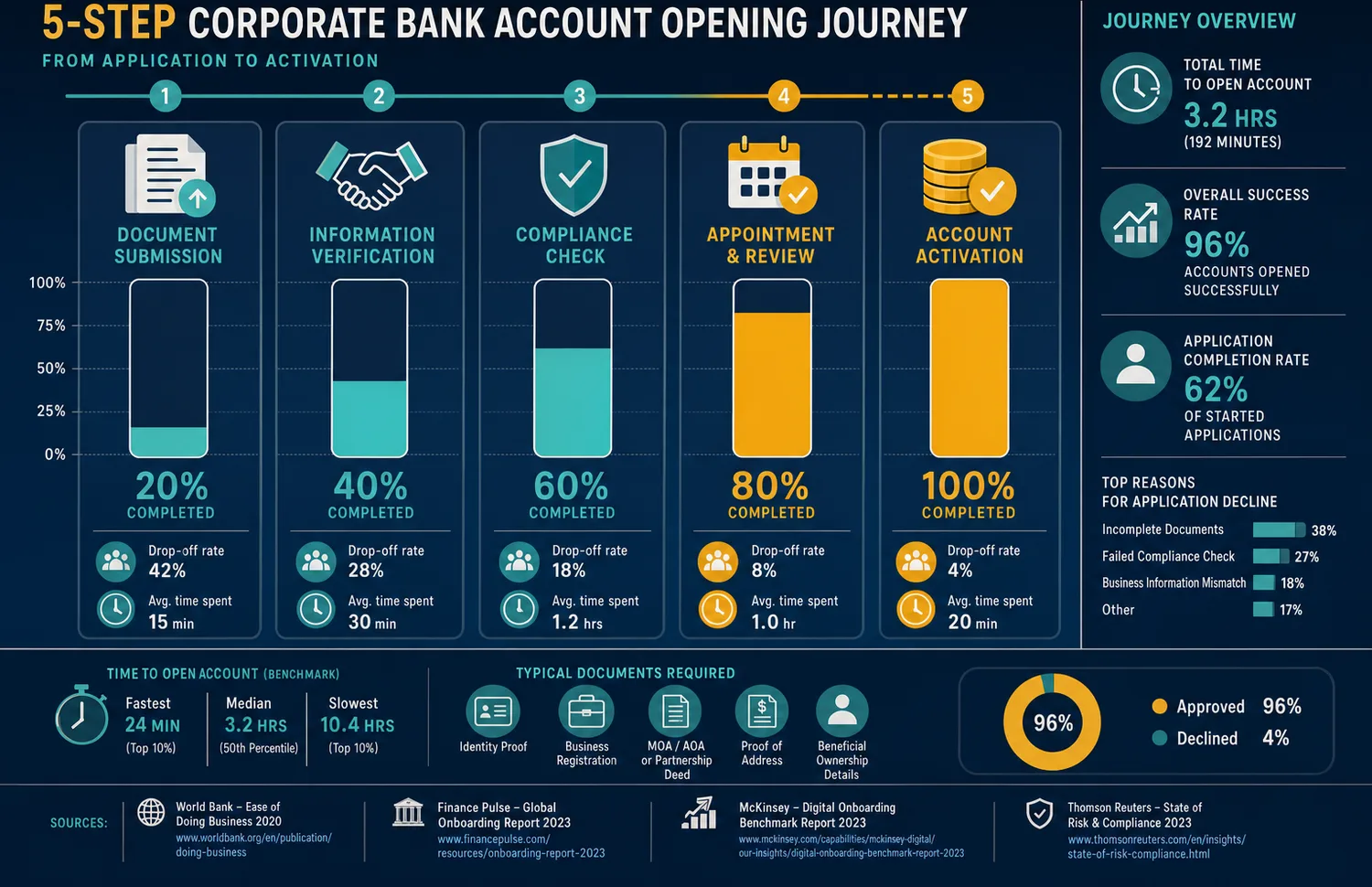
Follow this sequence precisely:
- Step 1: Confirm the Establishment Card is issued, without the Immigration File opened and functional, no corporate account process starts.
- Step 2: Assemble a complete document pack: Trade License, Memorandum of Association, passport copies of all shareholders, Emirates ID receipts, UK bank statements, business plan, and signed client contracts.
- Step 3: Submit everything in one go. Documents submitted in stages create compliance review delays of two to four weeks.
- Step 4: Attend the compliance interview. Most UAE banks require at least one meeting before approving a corporate account.
- Step 5: Meet the minimum opening balance, confirm the exact threshold before the activation appointment.
Tax Considerations and Ongoing Administration
As of June 2023, a federal Corporate Tax of 9% applies to taxable profits above AED 375,000 annually (Gov.ae, 2023). Businesses with annual revenues over AED 375,000 must also register for VAT at 5%. Free Zone companies can access a 0% rate on qualifying income from activities outside the UAE, but only with genuine substance, not just a registered address.
On the UK side, HMRC applies the Statutory Residence Test (SRT) to determine whether you remain a UK tax resident. UK-source income, including rental income and dividends from a retained UK company, remains taxable even after UAE residency is established. This should be reviewed with a cross-border adviser before initiating the banking process, particularly for founders with multi-jurisdiction income.
| Tax / Obligation | Rate / Threshold | Who It Applies To | Key Consideration |
|---|---|---|---|
| UAE Corporate Tax | 9% on taxable profits above AED 375,000 annually | All UAE-registered companies (as of June 2023) | Profits at or below AED 375,000 are taxed at 0%; applies to Mainland and Free Zone entities on non-qualifying income |
| UAE VAT | 5% — mandatory registration threshold: AED 375,000 annual revenue | Businesses with annual revenues over AED 375,000 must register for VAT at 5% | Voluntary registration available below threshold; failure to register on time triggers fines from Gov.ae |
| Free Zone Qualifying Income Rate | 0% on qualifying income from activities outside the UAE | Free Zone companies meeting substance requirements | Requires genuine substance — not just a registered address; income from UAE Mainland customers does not qualify |
| UK Statutory Residence Test (SRT) | Determined by HMRC — governs whether you remain a UK tax resident | UK nationals who have relocated to the UAE | UAE residency alone does not automatically end UK tax residency; the SRT applies specific day-count and tie tests |
| UK-Source Income (Post-Relocation) | Subject to UK tax regardless of UAE residency status | UK entrepreneurs retaining rental income, dividends from a UK corporate, or UK employment income | Seeking specialist advice from a cross-border adviser before the banking process starts is not optional for complex income structures |
Free Zone vs. Mainland: What It Means for Banking
A Free Zone is often a perfect fit as it allows 100% foreign ownership, packages tailored to consultants and tech entrepreneurs, and mandatory virtual or flexi-desk office arrangements. A Mainland company is the appropriate structure when you need to trade directly within the local UAE market or take on government contracts, but this comes with higher setup costs and more complex requirements.
Conclusion
Opening a bank account in Dubai for UK citizens is a structured process with clear prerequisites. The Trade License and residence visa are the foundation. The corporate account requires documented business substance, contracts, revenue projections, a credible business story. Tax compliance on both sides is non-negotiable from day one. Contact a UAE company formation specialist to get a detailed, itemized cost breakdown for your specific jurisdiction and license activity, and have your UK tax position reviewed before committing to any structure.






.webp)