

Table of Contents
Frequently Asked Questions
What is the cheapest way to transfer money from the UK to Dubai?
Compare the amount that arrives, not the fee. A specialist platform or multi-currency account usually beats a high-street bank, which often hides a 3 to 5 percent margin in the exchange rate.
How long does a transfer from the UK to Dubai take?
Usually one to two working days by SWIFT, sometimes same day if sent early. Larger sums can take two to three days for compliance checks, and the mismatched UK and UAE weekends can add delay.
Why did less money arrive than I expected?
Most likely the exchange rate margin, plus intermediary deductions on SWIFT transfers. Correspondent banks can each take a small cut, so the amount arriving is less than the headline fee suggested.
Can I hold pounds in a Dubai business account?
Yes. Multi-currency accounts through Meydan Free Zone's partner banks hold GBP alongside AED and USD, so you can keep pounds and convert when the rate suits you rather than on every transfer.
Can I send business money through my personal account?
You should not. Business income belongs in your company account, backed by invoices matching your licensed activity. Routing it through a personal account creates compliance and accounting problems.
Topic Summary
Use a Specialist FX Platform, Not Your Bank
High-street UK banks apply a 2–4% exchange rate margin on GBP-to-AED transfers. Specialist providers like Wise or OFX commonly achieve under 1% all-in, saving roughly AED 4,000 on a £20,000 transfer — enough to cover a quarter of a Trade License.
The AED Peg Removes Currency Volatility
The dirham is pegged to the US dollar at 3.6725, so GBP/AED volatility is effectively GBP/USD volatility. Watch the pound-to-dollar rate rather than the dirham, and use forward contracts to lock in a favourable rate for predictable UAE company expenses.
Always Include a Clear Transfer Reference
Missing purpose-of-transfer codes or invoice references trigger AML holds at UAE receiving banks, delaying Trade License renewals or payroll by 48–72 hours. Always cite your Trade License number and invoice reference on every business transfer.
Prepare Documentation Before You Send
Business transfers attract greater scrutiny than personal remittances. UAE banks require an IBAN (23 characters beginning AE), a SWIFT/BIC code, and a purpose declaration. Having these ready before initiating the transfer prevents costly delays.
Batch Payments to Reduce Per-Transfer Costs
Consolidating multiple smaller payments into one larger monthly transfer reduces per-transaction fees and exchange rate spreads. Align transfer timing with UAE payroll cycles — typically mid-month — and negotiate volume-based pricing above £50,000 monthly.
Hold a Multi-Currency Account to Convert on Your Terms
A multi-currency account holding GBP alongside AED removes the forced conversion markup on every incoming payment. You receive pounds as pounds, convert when the rate suits you, and avoid paying a second margin unnecessarily.
Maintain a Clean Documented Trail for Tax Compliance
The UAE Federal Tax Authority requires financial records held for a minimum of seven years. Log every transfer with date, GBP amount, AED received, and provider used. Accurate FX reconciliation is essential for compliant corporate tax filing and bank account reviews.
Money Transfer UK to Dubai: Costs, Timelines, and Methods
Sooner or later, every British founder in Dubai moves money between the UK and the UAE. Paying yourself, settling a UK invoice, moving savings across, sending profit home. It sounds simple, and the banks would like you to think it is. It is not.
The trap is that the fee you see is rarely the cost you pay. The real cost hides in the exchange rate, in the margin a bank quietly adds when it turns your pounds into dirhams. On a large transfer, that margin can cost you hundreds of pounds that a better setup would have saved. This guide shows you what a UK-Dubai transfer really costs, how long it takes, and how to stop losing money on every payment.
Key Facts at a Glance
| The hidden cost | The exchange rate margin, not the upfront fee |
|---|---|
| Bank FX margin | Often 3 to 5 percent above the real rate |
| Platform FX margin | Usually 0.4 to 0.7 percent |
| Typical timeline | One to two working days by SWIFT, sometimes same day |
| The smartest fix | Hold GBP and AED in one account and convert when you choose |
Where the Money Really Goes
To send money well, you need to see where the cost actually sits. A UK-Dubai transfer has three parts, and only one is obvious.
- The transfer fee: The upfront charge you see, often small, sometimes zero. This is the part banks advertise.
- The exchange rate margin: The percentage a provider adds to the real rate when converting your pounds. This is where most of the cost hides, and it is invisible unless you check.
- Intermediary deductions: When money moves by SWIFT, correspondent banks in the chain can each take a small cut, knocking a further AED 30 to 100 off the amount that arrives.
The AED is pegged to the US dollar at a fixed rate, so the pound-to-dirham rate really moves with the pound against the dollar. Watch GBP to USD, not the dirham, if you want a sense of where your rate is heading.
What a Transfer Really Costs
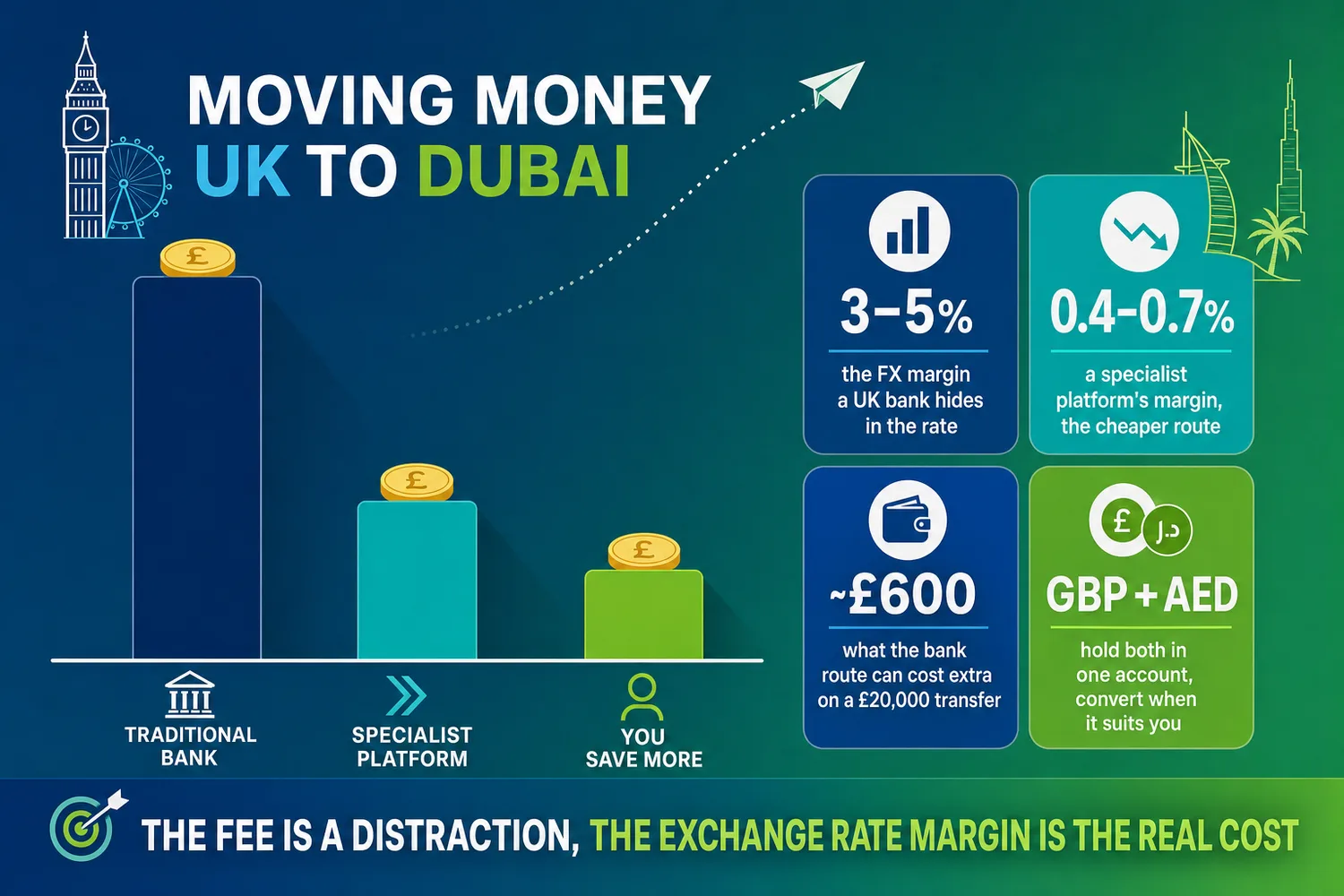
Take a founder moving GBP 20,000 from the UK to Dubai, comparing a high-street bank against a specialist platform.
| Method | Typical FX margin | Rough cost on GBP 20,000 |
|---|---|---|
| UK high-street bank | 3 to 5 percent | Around GBP 600 to 1,000 |
| Specialist platform | 0.4 to 0.7 percent | Around GBP 80 to 140 |
| Multi-currency account | Convert at a rate you choose | Lowest, you time the conversion |
On a single GBP 20,000 transfer, the bank route can cost several hundred pounds more than a platform, for exactly the same money arriving. Do that a few times a year and the difference funds a real chunk of your business.
Free Business Setup Cost Calculator
Calculate NowHow Long Transfers Take
Speed is usually the smaller worry, but it is worth knowing.
- Bank SWIFT transfers: One to two working days is normal, and larger sums can take two to three while compliance checks run.
- Specialist platforms: Often faster, sometimes within hours, occasionally near-instant for smaller amounts.
- Weekend timing: UK and UAE working weeks do not line up. The UK runs Monday to Friday, and the UAE weekend falls on Saturday and Sunday, so a Thursday-evening transfer can sit until the new week.
A quick tip that saves headaches: the most common cause of a held transfer is a name mismatch. Send under the name that matches your Emirates ID and your bank records exactly, and check the recipient details letter for letter.
Best Practices for Moving Money
A few habits make a real difference over a year of transfers.
- Compare the landed amount, not the fee, since what matters is the figure that actually arrives.
- Hold a multi-currency account so you can keep pounds and dirhams side by side and convert when the rate suits you.
- Send fewer, larger transfers, because fixed costs take a bigger bite out of small, frequent ones.
- Use a licensed provider, not an airport or hotel counter, where the convenience hides a poor rate.
- Keep your documentation ready, invoices and proof of the source of funds, as banks will ask and it prevents delays.
- Keep business money out of personal accounts, which avoids both compliance questions and accounting mess.
How Meydan Free Zone Helps You Move Money Smarter
Here is the structural fix behind most of those habits: stop converting on every transfer. If you can hold both currencies in one account, you convert once, when the rate is good, instead of paying a margin every time money moves.
That is exactly what a Meydan Free Zone company gives you access to. Through the mCore Bank Account service, your license opens the door to a guaranteed IBAN pathway across a network of 26+ partner banks, with multi-currency accounts that hold GBP, USD and AED together.
- Hold pounds and dirhams in one place, so you convert on your terms, not the bank's.
- Reach both payment rails, with SWIFT access for international transfers built in.
- Start from the UK, since partners like CBI support digital KYC, so onboarding can begin online, with the account finalised once your residency and Emirates ID are in place.
For a founder still invoicing UK clients while building in Dubai, holding GBP alongside AED removes a conversion from every transaction. Over a year of client payments, that is where the saving quietly compounds.
Business Money vs Personal Money
Personal transfers, living costs, moving your own savings, are straightforward. Business money needs more attention.
Payments into your UAE company account should match your licensed activity and be backed by an invoice or contract in the company's name. Money going out, to suppliers or as your own pay, needs the same clarity. Banks watch this closely, especially in a new account's first months, so keep business and personal money in separate accounts from day one.
Conclusion
Moving money between the UK and Dubai is only expensive if you let the bank do it the default way. The fee is a distraction. The exchange rate margin is the real cost, and it is the one most people never check.
Compare the landed amount, use a platform or a multi-currency account rather than a high-street bank, send fewer and larger transfers, and keep your paperwork ready. Better still, hold both currencies in one account so you convert when it suits you. Do that, and the money you save on transfers stays where it belongs, in your business.
Ready to Launch Your Business in Dubai?
Let's Connect