

Table of Contents
Frequently Asked Questions
Are there American schools in Dubai?
Yes, around 33 to 42 schools offer the American curriculum. They follow US Common Core and lead to a high school diploma, often with AP courses and SAT preparation, so children can stay on a familiar US track.
How are schools rated in Dubai?
The KHDA, Dubai's education regulator, inspects every school and gives a public rating from Outstanding to Weak. This lets you compare quality openly before applying, which is a real help when moving from abroad.
How much does an American school in Dubai cost?
Annual fees range from about AED 15,600 to 93,300, roughly USD 4,250 to 25,400, depending on the school. Extras like registration, uniforms and transport add to this, though annual increases are capped by the KHDA.
Will my child's education transfer easily from the US?
Usually, yes. An American-curriculum school keeps your child on US Common Core, so the transition is smooth. You will need school records and reports, and some schools run an assessment to place your child correctly.
What do I need in place before my child can enroll?
Your family's residency. Once you set up a company and become a resident, you sponsor dependant visas for your children, each with an Emirates ID. Schools ask for that ID, so the visa process and school search often run together.
Topic Summary
Start with school, not housing
The smartest move for American parents is to shortlist schools first, then choose a neighborhood around the best fit. In Dubai, commute time can change a good school into a daily headache, so compare curriculum, travel time, and total annual cost before signing a lease.
Know the curriculum options
Dubai gives families real choice: American, British, IB, and other curricula across the city. If your child may return to the US or apply to US colleges, compare graduation pathways, transcript style, and counseling support early instead of relying on brand names or glossy marketing.
Budget beyond headline tuition
Tuition is only the starting figure. American parents should map the all-in cost for each option: registration, deposits, transport, uniforms, technology, meals, and activities, because two schools with similar tuition can land very differently once the extras are added.
Prepare documents before applying
Applications move faster when your paperwork is ready from the outset. Gather passports, recent school reports, immunization records, and any transfer records, then track deadlines in a simple spreadsheet so admissions calls, tours, and follow-ups do not turn into avoidable delays.
Apply early and keep a backup
Popular Dubai schools fill quickly, especially in key entry years. A strong plan is to keep one first-choice school and one live backup active until a place is confirmed, because waiting lists, assessments, and document checks can stretch longer than parents expect.
Use KHDA ratings wisely
KHDA inspections are a useful filter, not the whole decision. Use ratings to narrow the list, then look deeper at classroom feel, support services, campus location, and whether the school actually suits your child’s age, personality, and long-term plans in Dubai.
Everything American Parents Need to Know About Education in Dubai
Moving to Dubai with school-age children raises one big question first: what about their education? The good news for American families is reassuring. Dubai has a large, well-regulated school system, dozens of American-curriculum schools, and standards that will feel familiar. Your children can stay on a US track, right through to a high school diploma.
This guide is the overview for American parents. It covers how the system works, the curriculum options, quality, cost, and how enrollment fits your move, with links to focused guides on enrollment, transfers and fees.
Key Facts at a Glance
| Point | Detail |
|---|---|
| American schools | Dubai has around 33 to 42 American-curriculum schools |
| Regulator | The KHDA inspects and rates every school |
| Curriculum | US Common Core, leading to a high school diploma |
| Fees | Roughly AED 14,000 to 93,000 a year, about USD 3,800 to 25,300 |
| Start age | The American curriculum begins KG1 at age four |
How the Dubai School System Works
Dubai's private school system is one of the largest in the world, and it is built for an international population. A few things are worth knowing up front:
- Almost all children attend private schools, and families choose by curriculum.
- The KHDA, the education regulator, inspects every school and rates it publicly.
- Ratings run from Outstanding down to Weak, so quality is easy to check.
- You are not tied to one national system, you pick what suits your child.
For most American families, that choice points to the American curriculum, which keeps a child on a familiar track.
The Curriculum Options
Dubai offers several curricula side by side. Here is how the main ones compare for an American family.
| Curriculum | What it offers | Best for |
|---|---|---|
| American | US Common Core, high school diploma, AP and SAT | Staying on a US track |
| British | IGCSEs and A-Levels | Families wanting the English system |
| International Baccalaureate | The IB programme, alone or paired | A globally recognised route |
| Indian and others | CBSE and other national systems | Serving specific communities |
For most American parents, the American curriculum is the natural fit. It keeps your child aligned with the US system, which makes a later move back straightforward.
American Schools and Their Quality
Dubai has a strong choice of American-curriculum schools, and quality is easy to check.
- Around 33 to 42 schools offer the American curriculum across the city.
- Ratings run from Outstanding, the top tier, through Very Good, Good and Acceptable.
- Many hold US accreditation, through bodies like NEASC and Cognia.
- Some offer a dual American and IB pathway for older students.
Because every school is inspected and rated publicly, you can compare quality openly before choosing. That takes much of the guesswork out of a move.
What It Costs
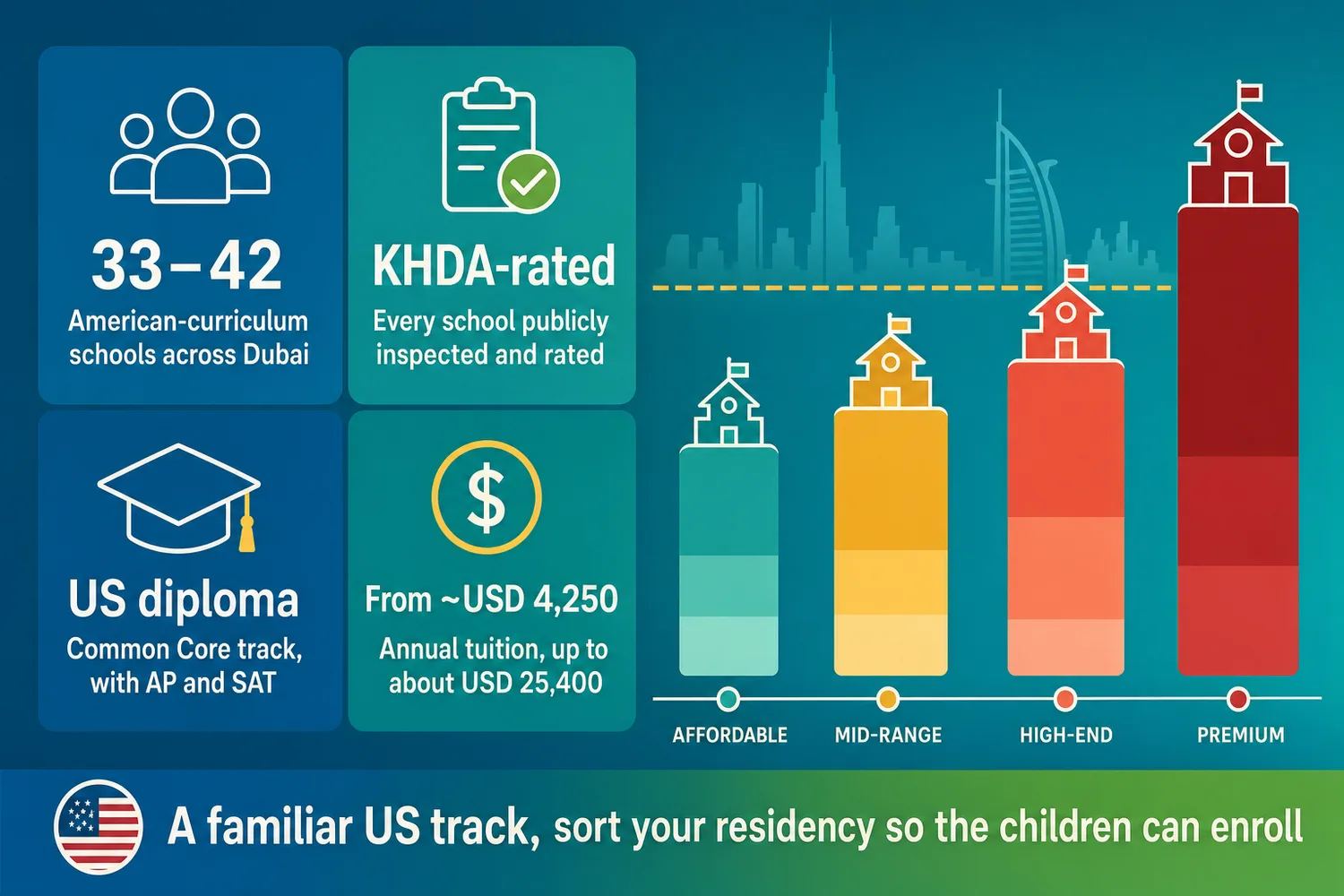
School fees are a major part of the budget, so it helps to know the range early. American-curriculum tuition in Dubai spans a wide range, and it helps to see real examples across the tiers.
| School | KHDA rating | Indicative annual tuition |
|---|---|---|
| Dubai International Private School | Good | From about AED 15,600 (USD 4,250) |
| Mirdif American School | Good | Around AED 53,500 (USD 14,600) |
| American School of Dubai | Good | AED 60,600 to 89,300 (USD 16,500 to 24,300) |
| GEMS Dubai American Academy | Outstanding | AED 66,200 to 93,300 (USD 18,000 to 25,400) |
A few things shape where you land in that range:
- Fees rise with grade level, so high school costs more than kindergarten.
- Extras include registration, a deposit (often 10% of tuition), uniforms, books and transport.
- Annual increases are capped by the KHDA, which keeps costs relatively stable.
Getting Your Child Enrolled
Enrollment is straightforward once you know the steps.
- You submit an application to your chosen school.
- Your child takes an assessment or interview.
- You provide school records, plus your child's passport and visa.
- A place is offered, and you secure it with a deposit.
Popular schools fill early, so it pays to apply ahead. For the full step-by-step process, and how a mid-year move works, see our guides on school enrollment and transferring schools in Dubai.
How Your Move Makes It Possible
Here is where the family side connects. To enroll your child as a resident, your whole family needs UAE residency, and that usually starts with a company. The chain works in a clear order:
- You set up a company. A Meydan Free Zone trade license, issued in under 60 minutes with Fawri, makes you eligible for a residence visa.
- You get your residency first. mResidency arranges the entry permit, medical, biometrics and Emirates ID, so you become a UAE resident.
- As a resident, you can then sponsor dependant visas for your spouse and children, subject to the standard income and documents.
- Each child's dependant visa comes with an Emirates ID, the credential schools ask for at enrollment.
- With visas and IDs in place, your children can enroll as UAE residents and be added to the school's records.
Because the visa process and the school search take time, most families run them side by side, starting the company setup as soon as the move is decided.
Conclusion
For an American family, education in Dubai is one of the easier parts of the move. The city has a wide choice of American-curriculum schools, a public rating system that makes quality clear, and a track that keeps your child aligned with the US system.
Shortlist schools by rating and location, plan for the fees, and sort your residency so the children can enroll. To set up the company and residency behind your family's move, book a free consultation with a setup advisor at Meydan Free Zone.