
Table of Contents
Frequently Asked Questions
Is health insurance mandatory for American expats in Dubai?
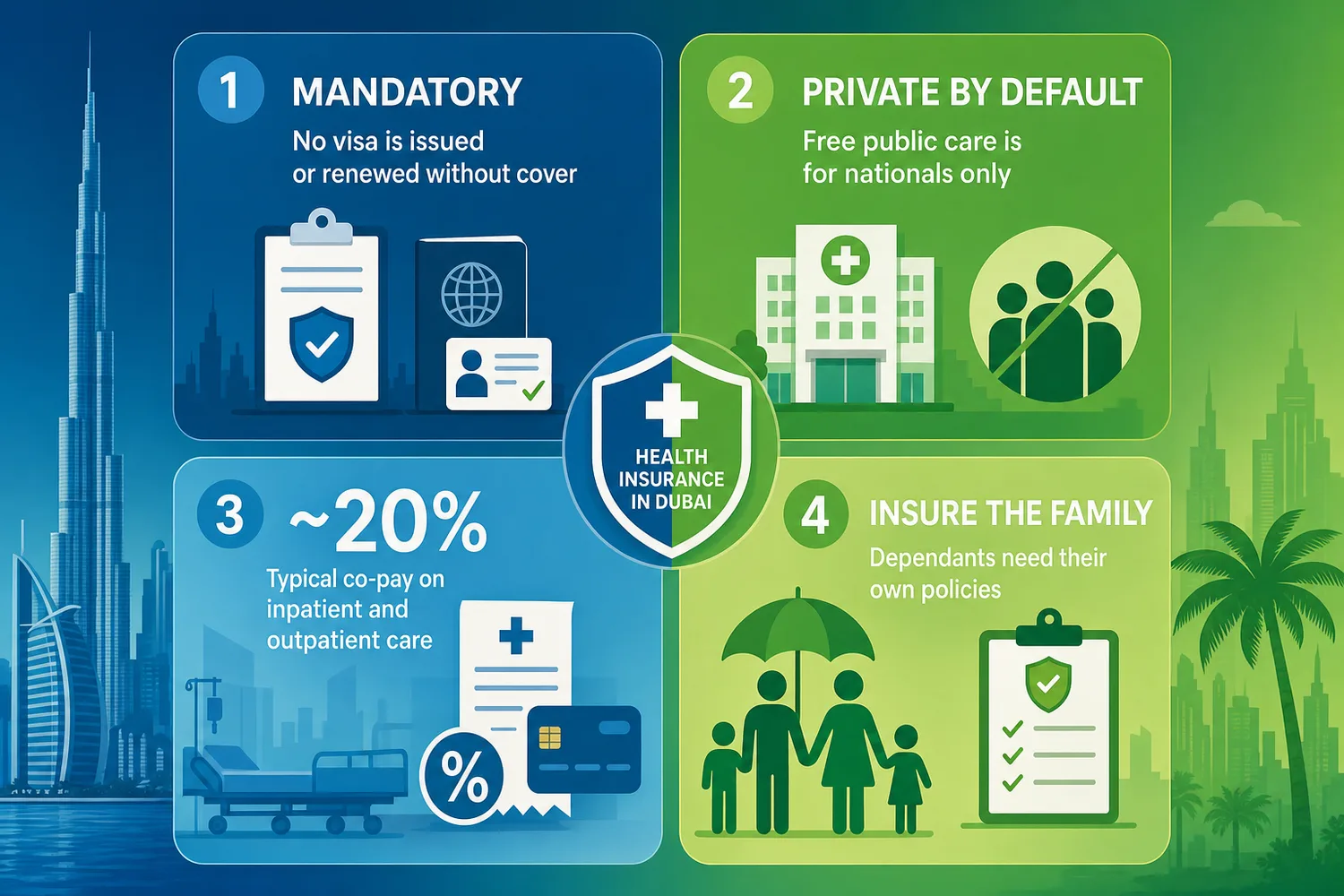
Yes. Every resident must hold a valid policy that meets Dubai Health Authority standards. No residence visa is issued or renewed without it, so cover is tied directly to your right to live in Dubai.
Can American expats get free public healthcare in Dubai?
No. Free government healthcare is only for Emirati nationals. American expats buy private insurance and use private hospitals. Public hospitals can be used via a paid health card or in emergencies, but not for free.
Do American expats use public or private hospitals in Dubai?
Most use private hospitals as their default, accessed through their insurance network. Public hospitals, such as Rashid and Latifa, are mainly used for emergencies and specific needs, via a paid health card.
Do I have to insure my family separately in Dubai?
Yes. Your employer may cover you, but sponsors must insure their own dependants. Your spouse, children and any domestic staff each need a valid policy for their visas to be issued or renewed.
How much does health insurance cost for a US expat in Dubai?
Comprehensive individual plans commonly run from around USD 310 to 1,010 a month, depending on the deductible. The basic Essential Benefits Plan costs far less but carries gaps, co-pays and lower limits.
Topic Summary
Start With Residency Cover
For american expats, health insurance in Dubai starts with active residency and a UAE-compliant policy. Before booking care, confirm your member status, save your digital card, and check that your Emirates ID details and policy dates align so you avoid desk-side surprises.
Private Care Is the Default
Most expats use private hospitals and clinics because access is faster, English is common, and direct billing is easier. In practice, the real decision is not just public versus private, but which network your insurance supports, what your co-pay is, and whether specialist care needs approval.
Know When Public Care Fits
Public healthcare in Dubai still matters, especially for emergencies and some resident services, but it is not the main route most american expats use day to day. Use government facilities when urgency comes first, and use your plan network for routine visits, follow-ups, imaging, and elective care.
Stay Inside the Right Network
Do not assume a famous hospital is covered just because the name is familiar. Check the exact branch, tier, and specialty in your insurer app before you book, because one out-of-network visit can turn a simple appointment into a reimbursement claim or a full out-of-pocket bill.
Check Costs Before Treatment
Details matter. Review your deductible, co-pay, referral rules, pharmacy cover, and any waiting periods for maternity, dental, optical, or chronic-condition care before you need them. A lower premium can still be the more expensive choice if specialist visits, scans, and preferred hospitals sit outside the useful network.
Review Claims and Renewal Dates
Once treatment is done, review what the provider billed to insurance and what you were charged personally. Keep itemised invoices, authorisation numbers, and renewal reminders in one place, especially if you change jobs, add dependents, or move between sponsors, because continuity gaps can happen faster than many expats expect.
How American Expats Can Use Health Insurance in Dubai: Public vs Private Healthcare Explained
For an American arriving in Dubai, health insurance works differently from home. It is not tied to your employer in the same way, and it is not optional. Every resident must have a policy, and you cannot get or renew a visa without one. The good news is that the system is simpler than the US model, and the private care is excellent.
This guide explains how it all fits together. It covers the difference between public and private healthcare, what your insurance actually covers, and how to choose a plan. If you are moving to Dubai, this is how to use the system with confidence.
Key Facts at a Glance
| Point | Detail |
|---|---|
| Is insurance mandatory? | Yes. No visa is issued or renewed without it |
| Regulator | The Dubai Health Authority (DHA) |
| Public vs private | Most expats use private hospitals as their default |
| Basic plan | The Essential Benefits Plan, for lower-income residents |
| Family | Dependants must be insured separately by the sponsor |
How Health Insurance Works in Dubai
Health insurance in Dubai is a legal requirement for every resident.
- Cover is mandatory. The immigration authority will not issue or renew a visa without a valid policy.
- It is tied to your residence visa, not locked to a single employer the way US cover often is.
- Employers must insure their employees. They cannot deduct the premium from your salary.
- Sponsors insure their own dependants. So you cover your spouse and children yourself.
For an American, the key shift is that cover follows your residency. Let a policy lapse, and you create visa problems, so it is not something to leave to chance.
Public vs Private Healthcare
This is the part Americans most want to understand, and one point matters up front. There is no free government insurance for expats. That is only for Emirati nationals. As an American, you buy private insurance, and that is what you use.
Public hospitals still exist and you can use them, but not for free.
| Feature | Public hospitals | Private hospitals |
|---|---|---|
| Who runs them | Government, such as Rashid and Latifa | Private groups, such as American Hospital |
| Access for expats | A paid health card, or emergencies | Your insurance network |
| Cost to you | Lower rates, but not free | Covered by insurance, subject to co-pay |
| Wait times | Longer for non-emergencies | Short, often within days |
| Most expats use | For emergencies and specific needs | As their everyday default |
For an American, the takeaway is simple. You are on private insurance, and private hospitals are your default. Public hospitals are a lower-cost option for emergencies or specific needs, accessed through a paid health card, but they are not a free public system like some Americans expect.
Free Business Setup Cost Calculator
Calculate NowWhat Your Insurance Actually Covers
Coverage depends on your plan tier, and the gap between basic and comprehensive is wide.
The Essential Benefits Plan, or EBP, is the mandatory minimum. It is designed for residents earning under AED 4,000 a month and their dependants. It costs around AED 550 to 800 a year and has an annual limit of AED 150,000. It covers basic GP visits, limited specialist referrals, essential medicines, emergency care and basic maternity.
But the EBP does not cover premium hospitals, full maternity, dental or optical. It also carries co-pays, typically around 20% on inpatient and outpatient care, and more on some medicines. Higher earners are not eligible for the EBP and must buy broader plans that meet DHA standards.
For most Americans, a mid-tier or comprehensive plan is the sensible choice. It gives wider hospital access, lower co-pays and better maternity and specialist cover.
Choosing a Plan as an American
Picking a plan is about matching cover to your needs, not just chasing the lowest premium. A few things to check.
- The hospital network: Make sure your preferred private hospitals are included.
- Maternity cover: If you plan to have children, check the limits and any waiting period.
- Co-pays and limits: Look at what you pay per visit and the annual cap.
- Pre-existing conditions: Confirm how they are treated, as terms vary.
- Dependants: Remember you insure your spouse and children separately.
For a US expat, comprehensive individual plans commonly run from around USD 310 to 1,010 a month, depending on the deductible. It is worth using a broker, since the market is wide and terms differ.
Insuring Your Family
Your employer may cover you, but your family is your responsibility. Every dependant needs their own valid policy that meets DHA standards.
That includes your spouse, your children and any domestic staff you sponsor. Their cover must be active for their visas to be issued or renewed, exactly like yours. So budget for the whole family, not just yourself.
How Your Insurance Connects to Residency
In Dubai, your health insurance is not a separate errand. It is part of getting your residence visa, and it cannot be issued without one. So the real starting point is residency, and for a founder, residency starts with a company.
This is where Meydan Free Zone fits. Setting up a company is what makes you eligible for the residence visa in the first place, and mResidency then runs the whole chain that your insurance depends on:
- The company and visa: A Fawri license is issued in under 60 minutes, which makes you eligible for the investor visa.
- The medical and Emirates ID: mResidency coordinates your entry permit, medical fitness test, biometrics and Emirates ID in one managed process, the same steps your insurance is tied to.
- The family: Because sponsors must insure dependants separately, mResidency also handles your spouse's and children's visas, so their cover can be arranged alongside yours.
Get the company and residency in place, and your mandatory insurance slots in behind them, for you and your family together.
Conclusion
Using health insurance in Dubai is simpler than the US system once you understand it. Cover is mandatory and tied to your visa. Most expats rely on private hospitals, backed by a mid-tier or comprehensive plan, while public hospitals serve emergencies and specific needs.
Choose a plan that matches your family's needs, remember to insure your dependants, and keep your cover active for your visas. Set up your residency first, and the insurance falls into place behind it. To set up the company and residency behind your move, book a free consultation with a setup advisor at Meydan Free Zone.
Ready to Launch Your Business in Dubai?
Let's ConnectReferences