

Table of Contents
Frequently Asked Questions
What documents do American expats need to enroll a child in Dubai?
Your child's passport and residence visa, Emirates ID once issued, parents' passport and visa copies, the last two school reports, an attested transfer certificate, a photo and vaccination records. The transfer certificate needs attestation, so start it early.
What is a transfer certificate and why does it matter?
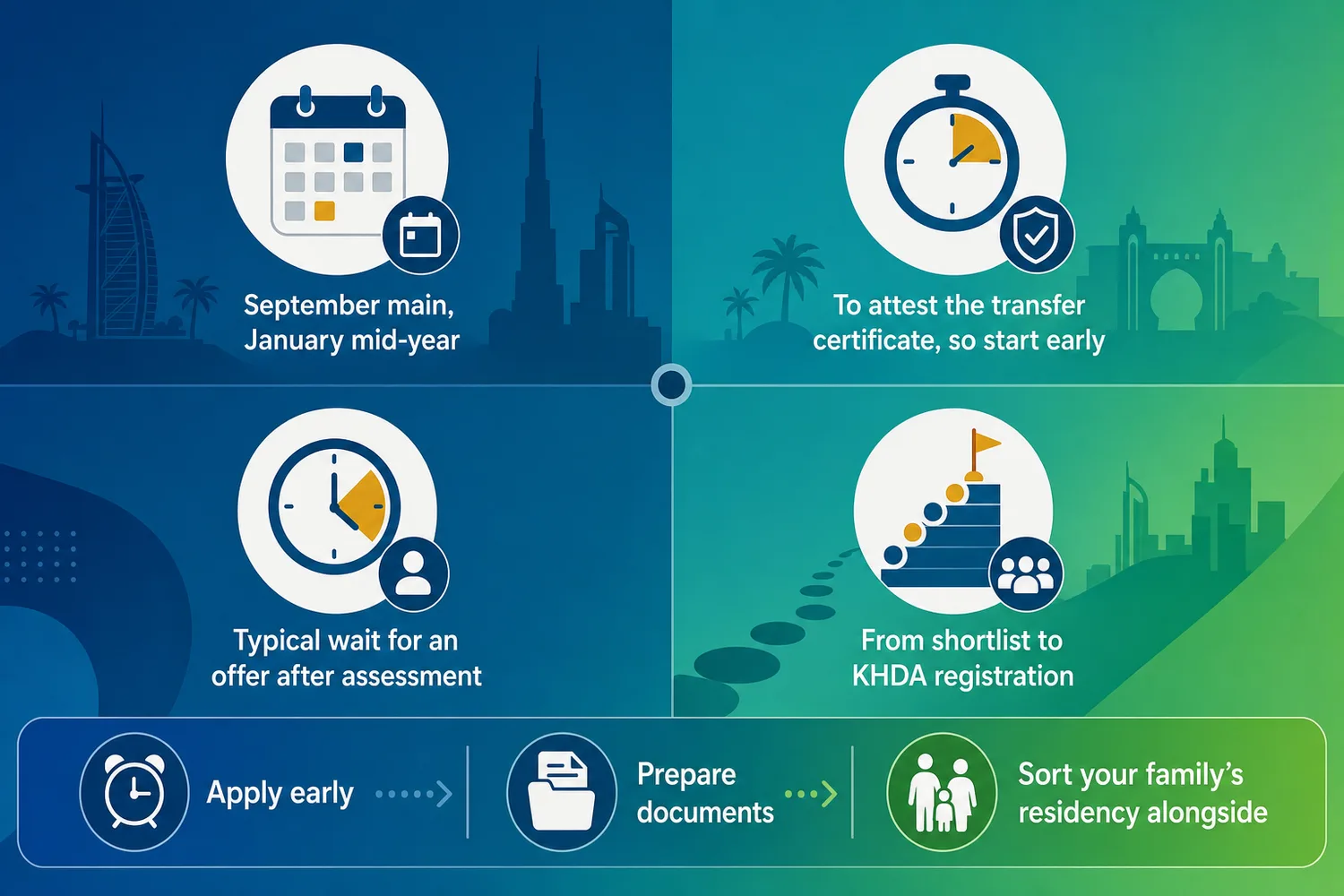
It confirms your child's completed grade and good standing at their US school. Dubai schools require it, attested through your home country, the UAE Embassy and the Ministry of Foreign Affairs. It also sets your child's grade placement, and attestation takes 6 to 8 weeks.
When should I apply to a Dubai school?
As early as possible. The main intake is September, with a smaller one in January. Popular schools open applications 12 to 18 months ahead, so apply as soon as your move is confirmed, especially for a mid-year start.
Is the school assessment a pass-or-fail test?
No. It helps the school place your child in the right grade and support level. For Grade 2 and above it usually covers English and Maths, while younger children have a play-based observation. Schools use it alongside past reports.
Does my child need a visa before enrolling in a Dubai school?
Effectively, yes. To enroll as a resident, your child needs a residence visa and Emirates ID. These come through your family's residency, set up via a company and arranged by mResidency, so most families run the visas and school search together.
Topic Summary
Understand Dubai’s school landscape
Dubai works differently from the USA: most expat children attend private school, and parents compare curricula, commute, fees, and KHDA ratings rather than relying on zoning. Start with how the system works, then narrow choices fast.
Choose curriculum before campuses
For Americans, the first filter is usually curriculum. An American-curriculum school keeps grade progression and transcripts more familiar, while British or IB options can still suit mobile families planning future moves.
Use KHDA ratings smartly
KHDA publicly inspects and rates private schools in Dubai, giving parents an easy first screen before tours. Use ratings to cut weak-fit options, then compare location, support services, and culture rather than chasing brand name alone.
Budget beyond headline tuition
The published tuition fee is only the start. Add registration, deposits, uniforms, transport, books, meals, and activities, then build a side-by-side total for each child so your real annual cost is clear before you commit.
Prepare records early
Admissions moves faster when your file is ready from the start. Keep passports, recent report cards, immunization records, photos, and any transfer paperwork in one shared folder so each school gets a complete first submission.
Align school timing with residency
Many schools will begin reviewing a child before all move paperwork is finished, but final steps often depend on your family's residency status in Dubai. That is why early shortlisting matters: it keeps the school side moving while the wider move catches up.
Step-by-Step School Enrollment Guide for American Expats in Dubai
Enrolling your child in a Dubai school is a clear, well-defined process, once you know the order of the steps. For an American family, the main things to get right are the timing, the documents and the assessment. Miss the paperwork and a place can slip away. Get it right and enrollment is smooth.
This guide walks through the enrollment process step by step, from choosing a school to confirming a place. It covers what you need, when to apply, and how the assessment works, so you can move from application to confirmed seat without surprises.
Key Facts at a Glance
| Point | Detail |
|---|---|
| Main intakes | September is the main window, January is a smaller one |
| Key document | An attested transfer certificate from the current school |
| Assessment | English and Maths for Grade 2 and above |
| Offer time | Usually 5 to 10 working days after the assessment |
| Deposit | A seat deposit of 5 to 10% of annual tuition |
When to Apply
Timing matters more than anything else, so start early. Places at good schools fill fast.
- The main intake is September, with a smaller mid-year intake in January.
- Some American schools also offer a March transfer slot.
- Popular schools open applications 12 to 18 months ahead.
- For a September start, aim to have your paperwork ready by early summer.
If you are moving mid-year, apply as soon as your move is confirmed, since mid-year places are more limited.
The Documents You Need
Getting the paperwork ready early is the single best thing you can do. Schools ask for a consistent set of documents.
- Your child's passport, with the UAE residence visa or entry permit.
- Your child's Emirates ID, once it is issued.
- Parents' passport and visa copies.
- The last two school reports or report cards.
- An attested transfer certificate from the current school.
- A recent passport photo and vaccination records.
The transfer certificate is the one to start early, since it needs attestation. More on that below.
The Transfer Certificate, Explained
This is the document American families most often overlook, so it deserves its own step. A transfer certificate confirms your child's current grade and that they are leaving their US school in good standing.
For a move from the US, it must be attested: authenticated at home, then by the UAE Embassy, then by the UAE Ministry of Foreign Affairs. This takes around 6 to 8 weeks in total, so begin it well before the deadline. For a September start, start by June. Your child's grade placement in Dubai is set from the completed grade on this certificate.
Free Business Setup Cost Calculator
Calculate NowThe Step-by-Step Process
Here is the enrollment process from start to finish.
- Step 1, shortlist schools: Choose by curriculum, KHDA rating, location and fees.
- Step 2, check availability: Contact the schools to confirm seats in your child's grade.
- Step 3, apply: Submit the application form and your documents, and pay any application fee.
- Step 4, assessment: Your child sits an assessment, usually English and Maths, or an observation for early years.
- Step 5, offer: A place is offered, usually within 5 to 10 working days.
- Step 6, accept and pay: Pay the seat deposit, sign the parent-school contract, and confirm the place.
- Step 7, registration: The school registers your child with the KHDA to complete enrollment.
Done in order, the process is predictable. The parts that take time are the documents and the assessment, so prepare for both early.
The Assessment, and What to Expect
The assessment worries some parents, but it is not a pass-or-fail exam. It helps the school place your child correctly.
For Grade 2 and above, it usually covers English and Maths, often through a standard test like CAT4. For younger children, it is a play-based observation instead. Schools rarely give a score, they use it, alongside the school reports, to confirm the right grade and support level. Prepare your child lightly, and treat it as placement, not a test to cram for.
Getting Your Family Ready to Enroll
One practical point ties the whole thing together. To enroll as a resident, your child needs a residence visa and, ideally, an Emirates ID, and those depend on your family's residency. This is where Meydan Free Zone fits your move:
- You set up a company at Meydan Free Zone. A trade license is issued digitally, in under 60 minutes with Fawri, and makes you eligible for a residence visa.
- mResidency then handles your residency end to end. It coordinates your entry permit, medical, biometrics and Emirates ID in one managed process, rather than a series of separate errands.
- As a resident, you sponsor your family. mResidency arranges the dependant visas for your spouse and children, each of which comes with an Emirates ID, the credential schools ask for at enrollment.
- With visas and IDs in place, your child can be enrolled and registered as a UAE resident.
Because the visa process and the school search both take time, most families run them together, starting the Meydan Free Zone setup as soon as the move is decided.
Conclusion
For an American family, enrolling in a Dubai school comes down to sequence and paperwork. Apply early, prepare your documents, start the transfer certificate attestation in good time, and treat the assessment as placement rather than a test.
Get your residency underway alongside the school search, so your child can enroll as a resident once a place is offered. To set up the company and residency behind your family's move, book a free consultation with a setup advisor at Meydan Free Zone.
Ready to Launch Your Business in Dubai?
Let's Connect