

Table of Contents
Frequently Asked Questions
Do Americans pay tax in Dubai?
Not on personal income, since the UAE charges 0% income tax. But US citizens still file US taxes on worldwide income. The FEIE excludes about USD 132,900 of earned income in 2026, with the rest exposed to US rates.
Why are US business owners moving to Dubai?
Mainly for the lighter tax and regulatory load. Dubai has no personal income tax, no capital gains tax and low corporate tax, plus fast setup, a global location and a stable, dollar-pegged economy.
Does moving to Dubai end my US taxes?
No. US citizenship-based taxation means you file every year on worldwide income. Dubai's zero rate is a genuine benefit up to the exclusion, but income above it, and passive income, stays taxable by the US.
How do I set up a business in Dubai as a US owner?
Through a free zone like Meydan Free Zone. A trade license is issued in under 60 minutes with Fawri, then mResidency handles your visa and Emirates ID. You also get access to a guaranteed IBAN and full ownership of the company.
Is there capital gains tax in Dubai?
Not for individuals. The UAE has no personal capital gains, inheritance or wealth tax. However, US citizens still report capital gains to the IRS, as these are not covered by the Foreign Earned Income Exclusion.
Topic Summary
Rising U.S. Cost Pressure
Founders are reacting to more than headline rates. Federal, state, payroll, insurance, legal, and admin costs stack up fast, so the real question becomes how much of each dollar you actually keep.
Dubai Changes the Math
Dubai attracts U.S. business owners because the appeal is structural, not just tax-driven. Lower overhead, faster setup, ownership control, and a residency-linked company framework can make expansion feel commercially cleaner.
Relocation Means More Than Moving
A flight ticket is not a relocation strategy. In practice, founders need the right company structure, residency steps, corporate bank account access, and enough real operating substance to make the setup credible.
U.S. Filing Basics Still Apply
Moving to Dubai does not erase U.S. tax basics. U.S. citizens still file on worldwide income, and foreign account reporting can still matter, so cross-border tax advice should come before any restructuring.
Free Zones Suit Many Founders
For service-led, cross-border, and digital Businesses, free zones are often the practical starting point. They can reduce setup friction, keep fixed costs lean, and give Founders a cleaner base for international clients.
Banking Rewards Clean Execution
Banks care less about slogans than coherent records. Prepare contracts, ownership documents, source-of-funds evidence, and a simple business story early; Digital banks like Mashreq NeoBiz are fastest.
Audit Before You Act
The smartest next step is a quick cost audit. Total your current taxes, regulatory fees, payroll burden, insurance, and founder admin time, then compare that drag against what a Dubai structure could realistically improve.
Rising Taxes & Regulatory Costs: Why U.S. Business Owners Are Relocating to Dubai
More American business owners are looking at Dubai than ever before. The reasons are easy to understand. US founders face high combined taxes, rising compliance costs, and a growing regulatory load. Dubai offers a very different environment: no personal income tax, low corporate tax, and light regulation. For a growing number, the move is worth a serious look.
But the picture deserves an honest telling. Moving to Dubai changes a lot for an American owner, though not everything, and US citizens carry tax duties that follow them abroad. This guide covers the pressures driving the trend, what Dubai actually offers, and the parts every US owner should understand before deciding.
Key Facts at a Glance
| Point | Detail |
|---|---|
| UAE personal income tax | 0%, on salary and business distributions |
| UAE corporate tax | 9%, only on profits above AED 375,000 |
| Capital gains tax | None for individuals in the UAE |
| The US catch | US citizens still file and may owe US tax on worldwide income |
| The relief | The FEIE excludes about USD 132,900 of earned income in 2026 |
The Pressures Pushing US Owners to Look Abroad
Start with why the conversation is happening. Several pressures stack up for a US business owner.
- High combined taxes: Federal, state and self-employment taxes together can take a large share of profit.
- State-level burden: High-tax states add another layer, and some pursue departing residents hard.
- Rising compliance costs: Filing, reporting and professional fees keep climbing as rules grow.
- Regulatory load: More rules across more agencies mean more time and money spent staying compliant.
None of this means the US is a bad place to build. It just explains why many owners now weigh alternatives they once ignored.
What Dubai Offers Instead
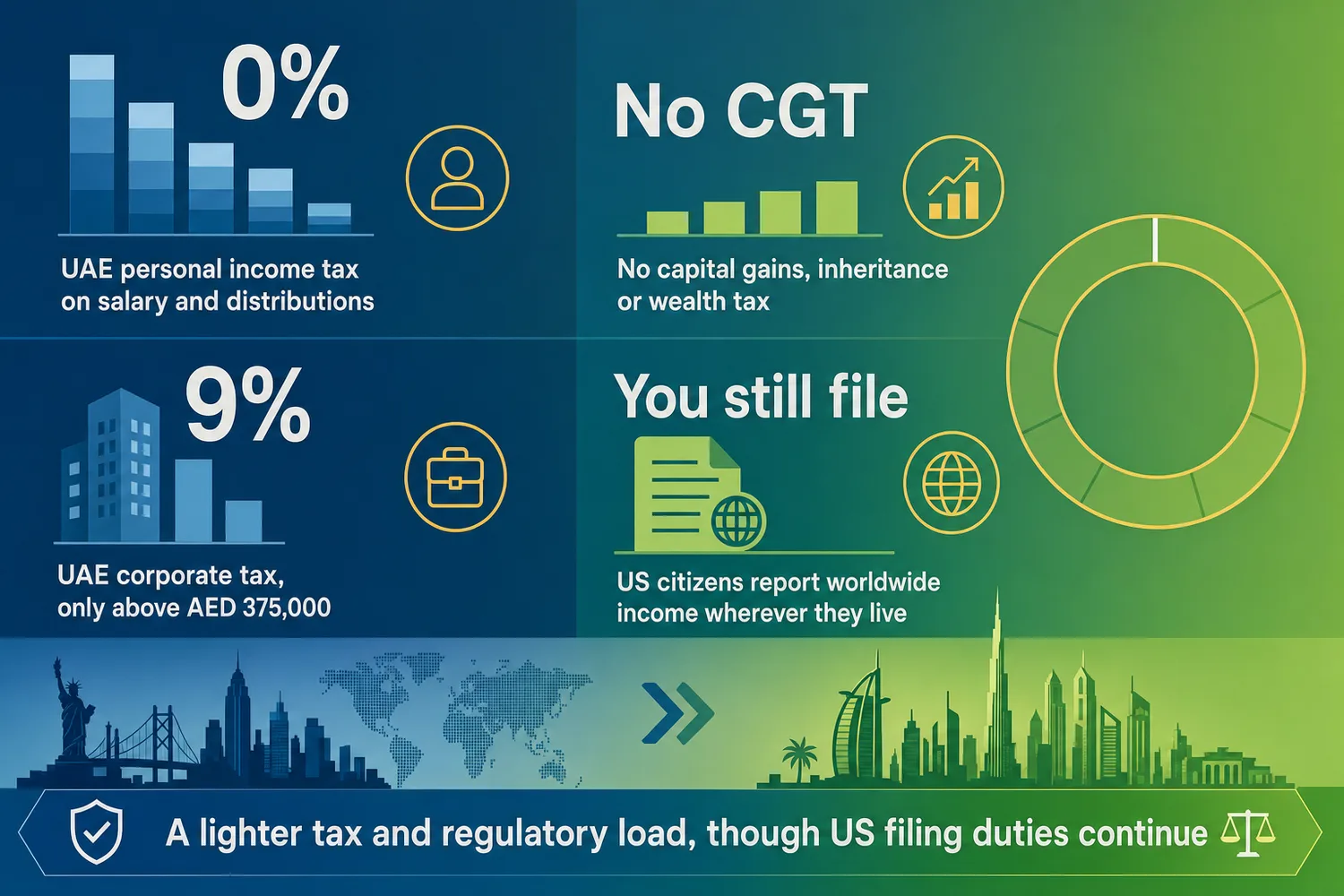
Dubai's appeal is straightforward, and the headline numbers are genuinely low. Here is how the two compare on the basics.
| Feature | United States | Dubai |
|---|---|---|
| Personal income tax | Up to 37% federal, plus state | 0% |
| Capital gains tax | Up to 20% plus state | None for individuals |
| Corporate tax | 21% federal, plus state | 9% above AED 375,000 |
| Business setup | Varies by state, often slow | Often within days |
On top of the low rates, Dubai has no capital gains, inheritance or wealth tax for individuals. Business setup is fast, ownership is full, and the regulatory touch is lighter. For an owner used to a heavy compliance calendar, the change of pace is real.
Free Business Setup Cost Calculator
Calculate NowThe Honest Part: What Moving Does and Does Not Change
Moving to Dubai does not end your US tax obligations.
- You still file every year: The US taxes citizens on worldwide income, wherever they live. Your Form 1040 duty continues.
- The FEIE helps, up to a point: You can exclude about USD 132,900 of earned income in 2026. Income above that is still exposed to US rates.
- No foreign tax credit here: Because the UAE has no income tax, there is nothing to credit, so income above the exclusion is fully taxed by the US.
- Passive income stays taxable: Dividends, interest, rental income and capital gains are not covered by the exclusion.
- State ties can linger: Some states hold you as a resident until you properly cut ties.
Up to the exclusion, and on income the US would tax anyway, Dubai's zero-rate environment is a genuine advantage. It simply is not a total escape, and this is not tax advice, so plan with a US tax professional.
Beyond Tax: The Other Reasons Owners Relocate
Tax is only part of the story. For many owners, the wider case is just as strong.
- A global hub: Dubai sits between the Americas, Europe, Asia and Africa, ideal for international business.
- Stability and safety: A stable currency pegged to the dollar, low crime and strong infrastructure.
- Talent and lifestyle: A large, international talent pool and a high-quality lifestyle draw founders and staff.
- Speed of setup: A company can be running in days, not weeks, with full foreign ownership.
For a founder building internationally, these often matter as much as the tax rate.
How a Move Actually Works
Relocating your business life to Dubai starts with a company, which is what unlocks residency. Setting one up at Meydan Free Zone gives you the full foundation:
- A trade license fast: Issued in under 60 minutes through Fawri, with more than 2,500 activities and up to three activity groups on one license.
- Residency handled: mResidency coordinates your visa, medical and Emirates ID, so you become a proper UAE resident.
- Banking built in: Access to a pool of more than 26 partner banks with a guaranteed IBAN, plus multi-currency accounts holding USD and AED.
- Tax and accounting support: mAccounting handles corporate tax registration, VAT and bookkeeping, which matters for holding your position cleanly.
- 100% ownership: You keep full ownership of the company, with no local partner required.
One honest point: to hold the tax position, you need real substance here, genuine activity and time in the country, not just a license on paper. Once that is in place, you have a proper base to run your business from, with banking, residency and a low-tax environment all set up.
Conclusion
For a US business owner, Dubai offers a genuinely lighter tax and regulatory environment, and that is why more are making the move. Zero personal income tax, no capital gains tax, low corporate tax and fast setup are a real change from the US load.
The honest caveat is that US citizens keep filing and may still owe US tax above the exclusion, so the move is powerful but not a clean escape. Weighed fairly, with the lifestyle and hub benefits added in, Dubai is a strong option for the right owner. To explore setting up a company and residency, book a free consultation with a setup advisor at Meydan Free Zone.
Ready to Launch Your Business in Dubai?
Let's ConnectReferences