
Table of Contents
Frequently Asked Questions
How much is import duty from the USA to Dubai?
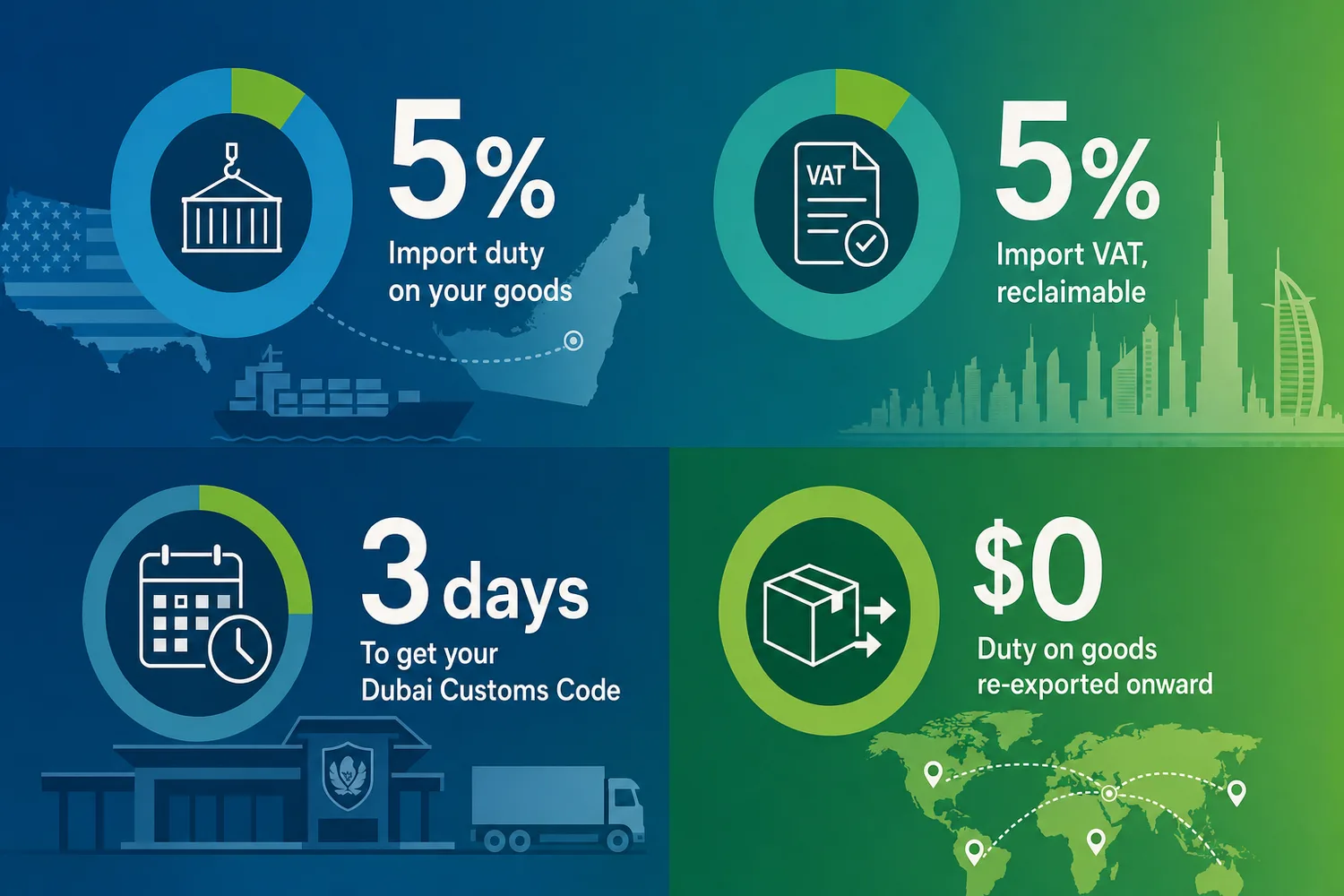
The standard rate is 5% of the CIF value, the cost of goods plus insurance and freight. A further 5% VAT applies, though VAT-registered importers can usually reclaim it, leaving the duty as the main cost.
Can a US business import goods into Dubai directly?
Not on its own. You need a UAE-licensed business and a Dubai Customs Code to clear goods. US exporters ship to a UAE entity, which acts as importer of record and handles customs clearance.
How long does it take to get a Dubai Customs Code?
About three working days. Once your UAE trade license is active, Meydan Free Zone's mPlus service processes your Dubai Customs Code, the importer ID needed to clear goods at ports like Jebel Ali or DXB.
Can I re-export goods through Dubai without paying extra duty?
Yes. Goods re-exported through Dubai to countries like Saudi Arabia, Qatar or India leave without UAE customs duty. You pay duty only in the destination country, which makes Dubai a strong distribution hub.
What documents do I need to import into Dubai?
A commercial invoice, packing list, bill of lading or airway bill, and certificate of origin. Regulated goods like food or medicines also need specific permits, arranged before shipping.
Topic Summary
Start with HS Classification
Before you book anything, classify the product correctly. The HS code drives duty, VAT, permit checks, and customs review in Dubai, so a wrong code can trigger holds, storage, and costly document rewrites.
Build a Clean Customs File
Your commercial invoice, packing list, origin data, and consignee details must align line by line. Most delays come from inconsistent values, vague descriptions, or quantity mismatches, not from the shipment itself.
Check Permits Before Dispatch
Food, cosmetics, electronics, health items, and other controlled goods often need extra approvals or labeling checks. Do not assume U.S. compliance means automatic entry into Dubai customs.
Choose the Right Mode
Use air for urgent or higher-value cargo, and sea for heavier, margin-sensitive shipments. The right transport choice reduces landed cost pressure and lowers the chance of storage charges if customs timing slips.
Price the Landed Cost Early
Budget freight, duty, VAT, broker fees, handling, inspection exposure, and local delivery before you sell. Incoterms matter here because they decide who manages costs and customs responsibility at destination.
Send Data Before Arrival
Give the broker or clearance team the full file before the cargo lands. Pre-arrival review catches missing origin entries, permit gaps, and naming issues early, which is often the difference between smooth release and expensive delay.
Turn First Shipments into Templates
Once a shipment clears, save the final documents, charges, and customs notes as your master file. That simple habit makes repeat Trade faster, cleaner, and easier to control across future import and export cycles.
Import & Export from the USA to Dubai: Customs, Rules & Best Practices
Dubai is one of the world's great trade hubs, and it sits at the centre of routes between the Americas, Europe, Asia and Africa. For a US business, that makes it a powerful base for selling into the Gulf and beyond. Goods move in from the States, and out again across the region, through some of the busiest ports on the planet.
But moving goods into Dubai has rules. There are duties, taxes, documents and a few traps that catch new importers out. This guide explains how US to Dubai trade works, what customs actually costs, and the one decision that changes everything: whether your goods land on the mainland or in a free zone.
Key Facts at a Glance
| Point | Detail |
|---|---|
| Standard import duty | 5% of the CIF value, under the GCC tariff |
| Import VAT | 5%, often reclaimable if you are VAT-registered |
| Re-export | Goods re-exported through Dubai leave without UAE duty |
| Who clears the goods | A UAE company with an import license and customs code |
| Customs code | Processed via mPlus in as little as three working days |
Why Dubai Is a Trade Gateway for US Businesses
Before the rules, it helps to see why Dubai works so well for US trade. The advantage is location plus infrastructure.
- Dubai connects to more than 190 countries through its ports and airports.
- Jebel Ali is one of the largest ports in the world, built for high-volume trade.
- A single UAE base can serve the whole Gulf, then Africa and Asia beyond it.
- US goods carry a strong quality reputation across the region.
For an American business, this turns one setup into regional reach, rather than selling into a single country.
Understanding Customs Duties and VAT
This is the part most US businesses want to get right. The UAE system is refreshingly flat, but the details matter.
- Standard customs duty is 5% of the CIF value, the cost of goods plus insurance and freight.
- Import VAT is a further 5%, charged on the value including the duty.
- If your UAE company is VAT-registered, you can usually reclaim that import VAT. So the real residual cost is often just the 5% duty.
- Some goods differ sharply. Alcohol carries 50% duty, tobacco 100%, while many essentials and medicines are zero-rated.
Duty and VAT are calculated from the HS code of your goods, so classifying them correctly is essential.
Free Business Setup Cost Calculator
Calculate NowThe Documents You Need
Missing paperwork is the leading cause of clearance delays. Have these ready before you ship.
- A commercial invoice showing the value and details of the goods.
- A packing list describing the contents of each shipment.
- A bill of lading or airway bill from your carrier.
- A certificate of origin, confirming where the goods were made.
- Any special permits, for regulated goods like food, medicines or cosmetics.
Get these right and clearance is usually quick. Get them wrong and you risk delays, fines or extra scrutiny.
The Re-Export Advantage
Here is where Dubai earns its name as a trade gateway. It is not just a market to sell into. It is a hub to ship through.
Goods that enter the UAE and are then re-exported to another country, say Saudi Arabia, Qatar or India, can leave without paying UAE customs duty. You pay duty only in the final destination country. This is why so many businesses route goods through Dubai rather than shipping direct.
For a US business, that turns Dubai into a regional distribution base. Bring goods in, then serve the whole Gulf and beyond from one location. Duty on the mainland applies only to goods sold inside the UAE itself.
What You Can and Cannot Import
Most goods move freely, but some need approval and a few are banned. Check your products before you ship.
- Freely imported: electronics, machinery, textiles, furniture, most consumer goods.
- Need approval: food, medicines, cosmetics, and similar regulated categories.
- Prohibited: narcotics, counterfeit goods, and other restricted items.
If your goods need a permit, arrange it before shipping, not after they arrive.
Why You Need a UAE Company to Import
You cannot simply ship goods to Dubai and clear them yourself from the States. To clear anything through Dubai Customs, you need a UAE-licensed business and a Dubai Customs Code, the importer ID that appears on every customs document.
This is where Meydan Free Zone fits a US trade business. It gives you the company, the customs registration and the banking you need to import, all set up remotely.
- A trade license in your name: Issued digitally in under 60 minutes with Fawri, with more than 2,500 activities and up to three activity groups on one license.
- Your Dubai Customs Code, handled for you: Through mPlus, the customs code is processed in as little as three working days.
- Help securing a corporate bank account: You get access to a pool of more than 26 partner banks, so whether you want a traditional, neo or Islamic bank, the option is there. Meydan Free Zone sends your file to multiple banks, coordinates your appointments with their reps, and helps you secure an account.
With the license, customs code and account in place, you can act as importer of record and trade in and out of Dubai.
Best Practices for US Importers
A few habits keep US to Dubai trade smooth and cheap.
- Classify your goods correctly with the right HS code, since it sets your duty.
- Decide mainland or free zone before you ship, not after.
- Keep your documents complete and consistent across every shipment.
- Register for VAT if your UAE sales pass the threshold, so you can reclaim import VAT.
- Use a customs broker for complex or high-value shipments.
Conclusion
Trade between the USA and Dubai is well worn and well supported. The customs system is simple once you know it: 5% duty, 5% reclaimable VAT, and a free-zone route that lets you defer or avoid duty entirely on re-exports.
The key is having the right UAE company to import through. Set that up first, decide where your goods land, and keep your paperwork clean. To set up the company and license behind your trade, book a free consultation with a setup advisor at Meydan Free Zone.
Ready to Launch Your Business in Dubai?
Let's Connect