
Table of Contents
Frequently Asked Questions
Is healthcare cheaper in Dubai than the USA?
Yes, usually. Private procedures in Dubai commonly cost 50 to 80 percent less than in the US, with comparable quality. Specialist visits, scans and surgery are all significantly lower than typical American prices.
Does my health insurance stay tied to my employer in Dubai?
No. In Dubai, health insurance is tied to your residence visa, not your job. It stays with you as a resident, which is a major change for Americans used to employer-linked cover.
Is healthcare quality in Dubai as good as the USA?
For private care, yes. Dubai has the most JCI-accredited hospitals per capita in the region, many US-trained doctors, and short wait times. American Hospital Dubai is part of the Mayo Clinic Care Network.
Is health insurance mandatory in Dubai for Americans?
Yes. Every resident must hold insurance meeting the Dubai Health Authority minimum. It is tied to your residence visa, so you cannot complete residency without a valid policy.
How much does health insurance cost in Dubai for a US expat?
Comprehensive plans commonly start around USD 369 a month for an individual and USD 1,195 for a family. Basic DHA-compliant plans cost far less but carry co-payments and coverage limits.
Topic Summary
Start with total out-of-pocket
Do not compare headline procedure quotes alone. Add consultations, scans, medication, follow-up care, travel, hotel stays, lost work time, and the chance of a second trip, because the cheapest first price can become the more expensive full journey.
Insurance rules decide everything
For Americans, healthcare choices often hinge on whether your US plan covers overseas care, requires preapproval, or reimburses only part of the bill. Before you commit to Dubai, get written confirmation on surgery, imaging, pharmacy costs, and post-op care.
Speed is Dubai’s big advantage
Dubai private hospitals often move faster for consultations, MRIs, dental care, eye care, and elective procedures. If your main problem is waiting weeks for referrals or insurer approvals in the USA, Dubai can look far more practical.
Quality needs proof, not polish
Judge quality by hospital accreditation, physician credentials, procedure volume, infection-control standards, and aftercare systems. A beautiful lobby and fast service feel reassuring, but they do not tell you whether the clinical outcome will be better.
Match the procedure type
Cross-border care works best for routine imaging, dental work, eye procedures, orthopedics, and selected elective surgery. Be far more cautious with oncology, transplants, or multi-stage chronic care, where continuity and local specialist relationships matter more than speed.
Plan records and aftercare first
Before booking anything, build one digital file with diagnosis notes, scans, lab results, medications, and prior consults. Then confirm who handles wound checks, rehab, urgent questions, and record transfer to your US doctor once you are back home.
Healthcare in the USA vs Dubai: Costs, Quality and Procedures for Americans
Most Americans moving abroad do not worry about waiting for care. They worry about the bill. A single trip to the emergency room can cost thousands. Insurance is tied to a job. Lose the job, and you can lose the cover. That is the real anxiety behind the question: what happens to my healthcare if I move to Dubai?
Dubai answers it differently from what most Americans expect. Care is world-class, often costs a fraction of the US price, and your insurance is no longer linked to an employer. This guide compares the two systems on the things that actually keep Americans up at night, and shows where the trade-offs lie.
Key Facts at a Glance
Here is the quick picture for an American expat.
| Point | Detail |
|---|---|
| Cost of care | Procedures often cost 50 to 80 percent less than in the US |
| Insurance model | Tied to your residency, not your job |
| Quality | Most JCI-accredited hospitals per capita in the region |
| Doctors | Many are US and Western trained, and multilingual |
| The catch | Insurance is mandatory, and it starts with residency |
The Three Things That Matter Most to Americans Expats
The US healthcare system creates three specific fears. Dubai handles each one differently. That is the clearest way to compare them.
- The cost of a single emergency: In the US, one hospital stay can wipe out savings. In Dubai, the same care costs far less, and insurance is built to cover it.
- Insurance tied to your job: In the US, leaving a job can mean losing cover, or paying high COBRA rates. In Dubai, your insurance follows your residency, not your employer.
- Surprise bills and deductibles: In the US, even insured patients face large out-of-pocket costs. In Dubai, private care is cheaper to begin with, so the gaps hurt less.
For many Americans, moving here is less about better hospitals and more about lower financial risk.
What the Same Procedure Actually Costs
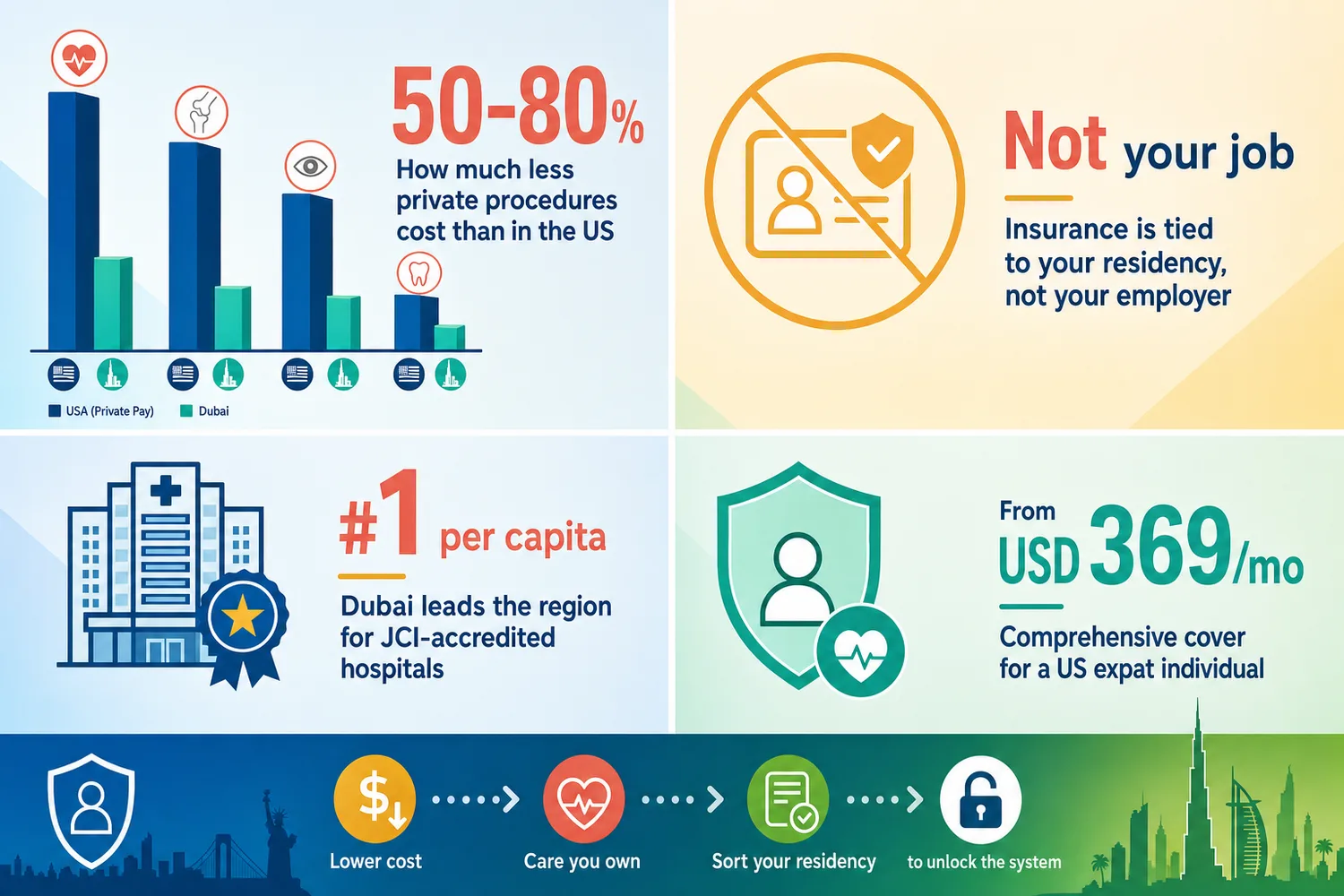
The same procedure often costs a fraction of the US price. Here is a rough comparison.
| Care type | United States | Dubai |
|---|---|---|
| Specialist visit | USD 150 to 400 | USD 55 to 135 |
| MRI scan | USD 1,000 to 3,000 | USD 300 to 800 |
| Appendectomy | USD 30,000 or more | USD 5,400 to 9,500 |
| Childbirth (uncomplicated) | USD 15,000 or more | USD 2,200 to 4,600 |
The pattern holds: Dubai's private care commonly costs 50 to 80 percent less than the US for comparable quality.
Free Business Setup Cost Calculator
Calculate NowYour Insurance Is No Longer Tied to Your Job
In the US, health insurance usually comes through your employer. Change jobs, and your cover can lapse. Start a business, and you are suddenly on your own.
In Dubai, insurance works differently. Your health cover is tied to your residence visa, not to any employer. It stays with you as long as you are a resident. For a founder or freelancer, that removes one of the biggest reasons Americans feel locked into a job at home.
Your residency comes from holding a UAE company, which is why the entrepreneur route suits so many Americans. Setting up your own company is what unlocks residency, and this is where Meydan Free Zone fits in.
A Meydan Free Zone trade license establishes your company and makes you eligible for the residence visa, the visa that carries your health cover. So the insurance that felt fragile in the US becomes something you own, tied to your own business, not an employer.
Hospitals Built to International Standards
For an American used to high standards, the private hospitals here feel familiar. Modern, well-run, and internationally accredited.
- Dubai has the most JCI-accredited hospitals per capita in the Middle East, the global standard for safety.
- Many physicians are trained in the US, UK, Germany and India, and most facilities are multilingual.
- American Hospital Dubai was the first in the region to earn JCI accreditation. It is part of the Mayo Clinic Care Network.
- Wait times are short. A specialist or scan is often available within days.
The Catch: Insurance Is Mandatory Here
In Dubai, health insurance is not optional. Every resident must hold a policy that meets the Dubai Health Authority minimum.
- Cover is mandatory and tied to your residence visa. You cannot complete residency without it.
- Employers cover their employees, but you insure your dependants yourself.
- For US expats, comprehensive plans commonly start around USD 369 a month for an individual. Family plans start around USD 1,195.
- Basic DHA-compliant plans cost far less, though they carry co-payments and limits.
Compared with US premiums and deductibles, most Americans still find the total lower. And unlike at home, you are never uninsured by accident, because the system will not let you be.
How Americans Get Access
Full access to the system runs on two documents: your residence visa and your Emirates ID. Visitors can pay out of pocket at private hospitals, but resident life, and the mandatory insurance, depends on both.
That is the last piece of the Meydan Free Zone connection. Setting up a company is what starts your residency, and mResidency handles the rest.
- A Meydan Free Zone company makes you eligible for residency: A Fawri license can be issued in under 60 minutes if you want to move fast.
- mResidency handles the process: It runs your entry permit, medical, biometrics and Emirates ID in one place, and helps arrange the mandatory health insurance your residency requires.
Once residency is in place, your insurance is set up and the full system opens to you.
Conclusion
For an American, moving to Dubai changes the whole shape of healthcare. The fear of a ruinous bill fades. Insurance stops depending on a job. And the private care is world-class, often at half the US price or less.
The trade-off is that cover is mandatory, and it all starts with residency. Sort that first, through a company and your Emirates ID, and quality care becomes simple to access. To set up the company and residency behind your move, book a free consultation with a setup advisor at Meydan Free Zone.
Ready to Launch Your Business in Dubai?
Let's Connect