
Table of Contents
Frequently Asked Questions
Is there a South African school in Dubai?
Not as a campus school. South African families in Dubai usually choose British or Cambridge schools, which are familiar and widely available. The South African CAPS or IEB curriculum, leading to the NSC matric, is available through online providers for families who want to stay on the home system.
Will my child's Dubai qualification be accepted by South African universities?
Yes, with planning. A Levels from a British-curriculum school are recognised through the USAf equivalency process, which converts them to APS points. The IB is also recognised. If you keep your child on CAPS or IEB online, the NSC matric gives direct entry to South African universities.
Can my child stay on the South African curriculum in Dubai?
Yes, online. There is no South African campus school in Dubai, but SACAI-registered CAPS and IEB pathways are available through online providers, both leading to the same NSC matric certified by Umalusi. This keeps your child on the home system and their path to a South African university open.
How much does schooling cost in Dubai for a South African family?
Roughly AED 25,000 to 120,000 a year, around ZAR 110,000 to 528,000, depending on age and curriculum. Budget also for registration, uniforms and transport. The KHDA caps annual increases. The rand moves against the dirham, so treat conversions as a guide.
Do I need residency to enrol my child in school?
Yes. Enrolling a child requires UAE residency, as their school visa links to your family sponsorship. This starts with your own residence visa, which a Meydan Free Zone license makes you eligible for, with mResidency handling the family visas that follow.
Topic Summary
Start With School First
For South African parents, the smartest first move is to shortlist schools before choosing where to live. Compare location, curriculum, KHDA rating, and commute together, so your child’s place and your family routine line up from the start.
Know Dubai’s School Model
Most expat families use private, fee-paying schools in Dubai, and you apply directly to each school rather than being assigned one by area. That makes research more important, but it also gives you real choice across British, American, IB, Indian, French, and other options.
Choose the Right Curriculum
Curriculum choice shapes daily learning style, exam pressure, and future university pathways. South African parents should decide early whether they want continuity, an English-medium international path, or a whole new system for their child.
Budget Beyond Tuition
Many parents compare headline tuition and stop there, and that is where budgets go wrong. Add registration charges, deposits, school bus costs, devices, uniforms, meals, and activities to reach the real yearly figure before you commit.
Prepare Documents Early
Build a complete folder for each student with passport copies, recent school reports, vaccination records, and transfer papers. Starting early matters because missing records, translations, or attestations can slow the whole process just when places in popular year groups are filling.
Follow the Admissions Sequence
The clearest path is simple: shortlist schools, send records, complete assessments, compare offers, and confirm the place. At each stage, look for a clear next step such as an acknowledgement email, assessment date, offer letter, contract, and payment receipt.
Support the Transition Well
The right school is not only about academics; it is also about how well your child will settle in. Ask about orientation, learning support, language help, and buddy systems, then keep the first term focused on adjustment as much as grades.
Everything South African Parents Need to Know About Education in Dubai, UAE
Moving to Dubai with children raises one question above all others. Where will they go to school, and will their education still count back home? For South African parents, the news is reassuring. Dubai has one of the widest choices of schools anywhere. The British system many South African families know is everywhere, and its qualifications lead to universities at home and abroad.
This guide covers how the system works, the curriculum choices, and what it costs in rands. It also covers how to keep the path to a South African university open.
Two things shape the whole decision. First, schooling in Dubai is private and fee-paying for expat families, so fees are the main thing to plan for. Second, the curriculum you choose decides which universities recognise the result. Here is what you need to know.
Key Facts at a Glance
| Who regulates schools | The KHDA, which inspects and rates every private school |
| Schooling for expats | Private and fee-paying, as public schools are for Emiratis |
| The common choice | British and Cambridge schools, familiar to South Africans |
| The South African curriculum | Available online, not as a campus school in Dubai |
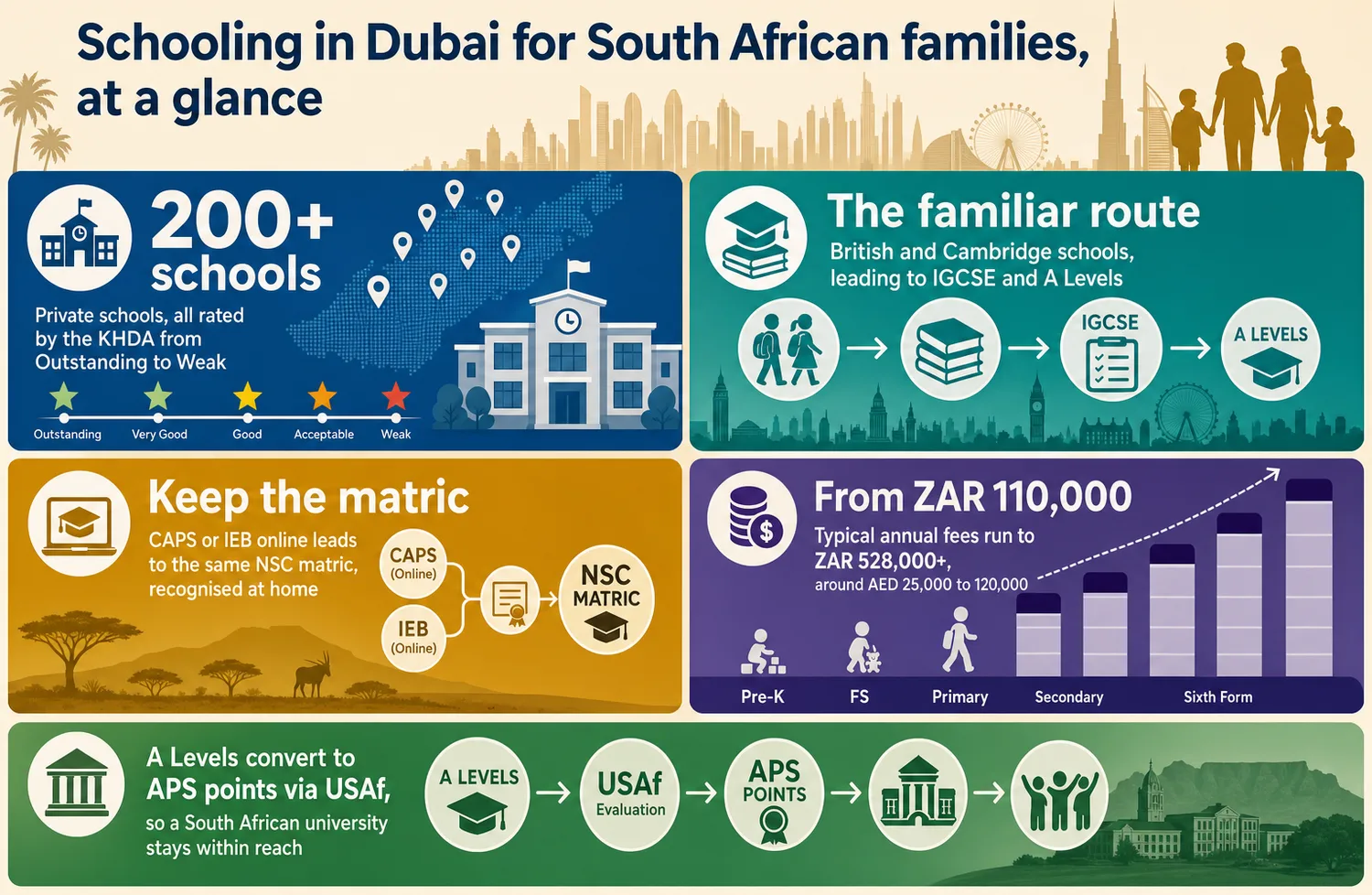
| Typical fees | Roughly AED 25,000 to 120,000 a year, around ZAR 110,000 to 528,000 |
How the School System Works
Dubai's schooling is built around private education, and it is more organised than many parents expect. Public schools are for Emirati nationals, so expat families choose a private school and pay tuition.
The upside is choice and quality control. There are more than 200 private schools, regulated by the KHDA, the Knowledge and Human Development Authority. The KHDA inspects every school each year and publishes a rating, from Outstanding down to Weak.
So you can judge a school on an independent standard before you apply. For a South African parent, that rating works like a trusted school reputation back home, only official and published.
The Curriculum Choices
Dubai offers more curricula than almost any city in the world. For a South African family, a few stand out.
- British and Cambridge: The most common and familiar choice, leading to IGCSE and A Levels. Dubai has more British-curriculum schools than any city outside the UK.
- International Baccalaureate: A globally portable programme, popular with families who move often.
- American: Advanced Placement and a US diploma, for families looking towards US universities.
- South African, online: The CAPS and IEB pathways to the NSC matric are available through online providers, not a campus school in Dubai.
For most South African families, a British or Cambridge school is the natural fit: familiar, and the qualification travels well.
Keeping a South African University Open
This is the question that matters most to many South African parents, so it is worth being clear. Your child's Dubai qualification can still lead to a South African university.
A Levels from a British-curriculum school are recognised by South African universities through the USAf process, which converts the grades into APS points. It does require careful subject choice and meeting the exemption rules, so plan the subjects early.
If you would rather your child stay on the South African system, the CAPS or IEB route to the NSC matric is available online. It leads to the same matric and direct university entry at home. Either way, a path back to a South African university stays open.
The South African Curriculum Route, Online
If keeping your child on the South African system matters to you, this is the option to understand. There is no South African campus school in Dubai, but the full curriculum is available online.
Two pathways lead to the same National Senior Certificate, the NSC matric. SACAI-registered providers offer the national CAPS curriculum.
The IEB pathway uses the CAPS framework with its own assessment style. Both are certified by Umalusi and give direct entry to South African universities, with no separate exemption certificate needed.
The teaching is online and teacher-led, so your child sits the same matric they would at home, from Dubai. One honest caveat: the online IEB matric track record is still building, as IEB has only recently become available online.
Which Route Fits Your Family?
The choice comes down to what you want for your child's future, and how mobile your family is likely to be.
| Your priority | The route that fits |
|---|---|
| Keep the South African matric | CAPS or IEB, online |
| A globally portable qualification | A British or Cambridge school |
| Likely to move countries again | British, Cambridge or the IB |
| Direct entry to a South African university | The NSC matric, online, or A Levels via USAf |
There is no single right answer. A family planning to return to South Africa, or wanting the familiar matric, often chooses the online route. A family staying internationally mobile usually prefers a British, Cambridge or IB school, which travels anywhere.
What School Fees Look Like
Fees are the biggest part of the budget, so it helps to know the ranges. These are 2026 guide figures, and they vary by school and curriculum.
| Stage | Rough annual fee | Around, in ZAR |
|---|---|---|
| Kindergarten | AED 25,000 to 55,000 | ZAR 110,000 to 242,000 |
| Primary | AED 35,000 to 75,000 | ZAR 154,000 to 330,000 |
| Secondary | AED 55,000 to 120,000+ | ZAR 242,000 to 528,000+ |
On top of tuition, budget for a registration fee, usually AED 1,000 to 5,000, plus uniforms and books. School transport runs roughly AED 5,000 to 12,000 a year. The KHDA caps annual fee increases, which helps with planning.
Free Business Setup Cost Calculator
Calculate NowApplying and Getting a Place
Two things catch South African families out here: the school calendars do not line up, and your documents need attesting first.
- Mind the calendar gap: South Africa's school year runs January to December, Dubai's September to June, so a mid-year move affects placement and waitlists.
- Attest documents early: School reports and birth certificates from South Africa need attesting before a Dubai school will accept them. Start before you move.
- Expect placement by age: A South African grade does not map exactly onto a British year, so schools place children by age.
- Apply well ahead: Popular schools have waiting lists, so shortlist on KHDA ratings and apply early.
Settling In as a South African Family
Beyond the paperwork, Dubai is an easy city for a South African family. It is safe, English is the working language, and the expat community is large and welcoming.
There is an established South African community, with familiar sports, churches and social networks, so your children will find others like them. The shared language also makes the move gentler than for many nationalities. Your child steps into an English-medium school with no language barrier to cross first.
How Meydan Free Zone Fits In
Enrolling your children in Dubai depends on residency, which is the practical link to Meydan Free Zone. To sponsor your family and enrol a child, you need to be a resident with an Emirates ID, and that starts with your own status.
- Your license first: A Meydan Free Zone license, issued online in under 60 minutes through Fawri, makes you eligible for a residence visa, which you complete in Dubai.
- Then your family: Once you are a resident, mResidency can handle sponsoring your spouse and children, the sponsorship a school enrolment depends on.
- Then enrolment: With the family visas in place, you can enrol your children, at a British school or on the South African curriculum online.
Conclusion
For a South African family, Dubai offers a familiar British system, a huge choice of schools, and qualifications recognised at home and abroad. Fees are the main thing to plan for, from around AED 25,000 a year. The South African matric route stays open online if you want it. Apply early, get your residency in place, and your children's schooling can be settled before you move.
Whether you choose a British school or keep your child on the South African curriculum online, the path to a good university stays open. To set up the company and residency that lets you sponsor your family, book a free consultation with a setup advisor at Meydan Free Zone.
Ready to Launch Your Business in Dubai?
Let's Connect