
Table of Contents
Frequently Asked Questions
When should a South African family start the Dubai school enrollment process?
Six to eighteen months ahead for sought-after schools. Because South African and Dubai school years differ, your child often joins mid-year, and seats are more limited then. Starting early also gives you time for document attestation, which can take four to eight weeks.
What documents do I need to enrol my child?
The child's passport and residence visa, Emirates ID, an attested birth certificate, the last two years of school reports, a Transfer Certificate from the previous school for Year 3 and up, and vaccination records. The birth certificate and Transfer Certificate need attesting, so prepare them early.
What is a Transfer Certificate and do I need one?
It is a document from your child's current school confirming their enrollment and year group. It is required for children entering Year 3 and above, and must be attested when coming from South Africa. Request it from your South African school early, as some need a term's notice.
Will my child have to sit a test?
Usually. Young children in the early years have a play-based observation, while children from Year 3 up typically sit an assessment such as CAT4 or an English and Maths test. It determines the right year group, so it is about placement rather than passing or failing.
Does my child need a residence visa to enrol?
Generally yes. A child usually needs a UAE residence visa and Emirates ID to complete enrollment, sponsored as a dependant of a parent. This is why families often arrange the parent's residency first, then the children's, before finalising a school place.
Topic Summary
1. Residency Comes Before the School Search
A UAE residence visa is the gate document for enrollment. South African families who form their Meydan Free Zone company first can run the school application in parallel with the visa process, securing a confirmed place and residency at the same time.
2. Start the Transfer Certificate Early
The transfer certificate from your child's South African school must be attested through the Department of Basic Education, then International Relations, then the UAE Embassy. This chain takes four to eight weeks, so request it before you leave.
3. British and Cambridge Schools Are the Natural Fit
Dubai has no South African campus school, but British and Cambridge curriculum schools offer IGCSE and A Levels that feed directly into South African and international universities. The transition is manageable and the qualifications travel well.
4. Apply to Three to Five Schools at Once
Popular schools fill early and waitlists at Outstanding-rated campuses can run six to twelve months. Apply to several schools simultaneously to keep options open, and time your applications for the September intake by January or February at the latest.
5. The South African Curriculum Route Stays Open Online
Families planning to return within one to three years can keep children on SACAI or IEB pathways through online providers, preserving the NSC matric track. Families settling long-term typically choose British or Cambridge schools for broader global recognition.
6. Budget the Full Cost, Not Just Tuition
British-curriculum school fees run roughly AED 25,000 to AED 120,000 a year depending on year group and KHDA rating. Registration fees, uniforms, transport, exam fees, and devices can add 15 to 25 percent on top of the headline tuition figure.
7. The KHDA Makes School Quality Easy to Check
The Knowledge and Human Development Authority inspects and rates every private school on a five-tier scale from Outstanding to Weak. Reports are free to download from the KHDA website and are the most reliable starting point for any school shortlist.
Step-by-Step School Enrollment Guide for South African Expats in Dubai
Enrolling your child in a Dubai school is very doable, but more structured than in South Africa, and the timing catches many families out. Dubai schools run a competitive, regulated admissions process, with assessments, attested documents, and a legally binding contract signed through the government portal.
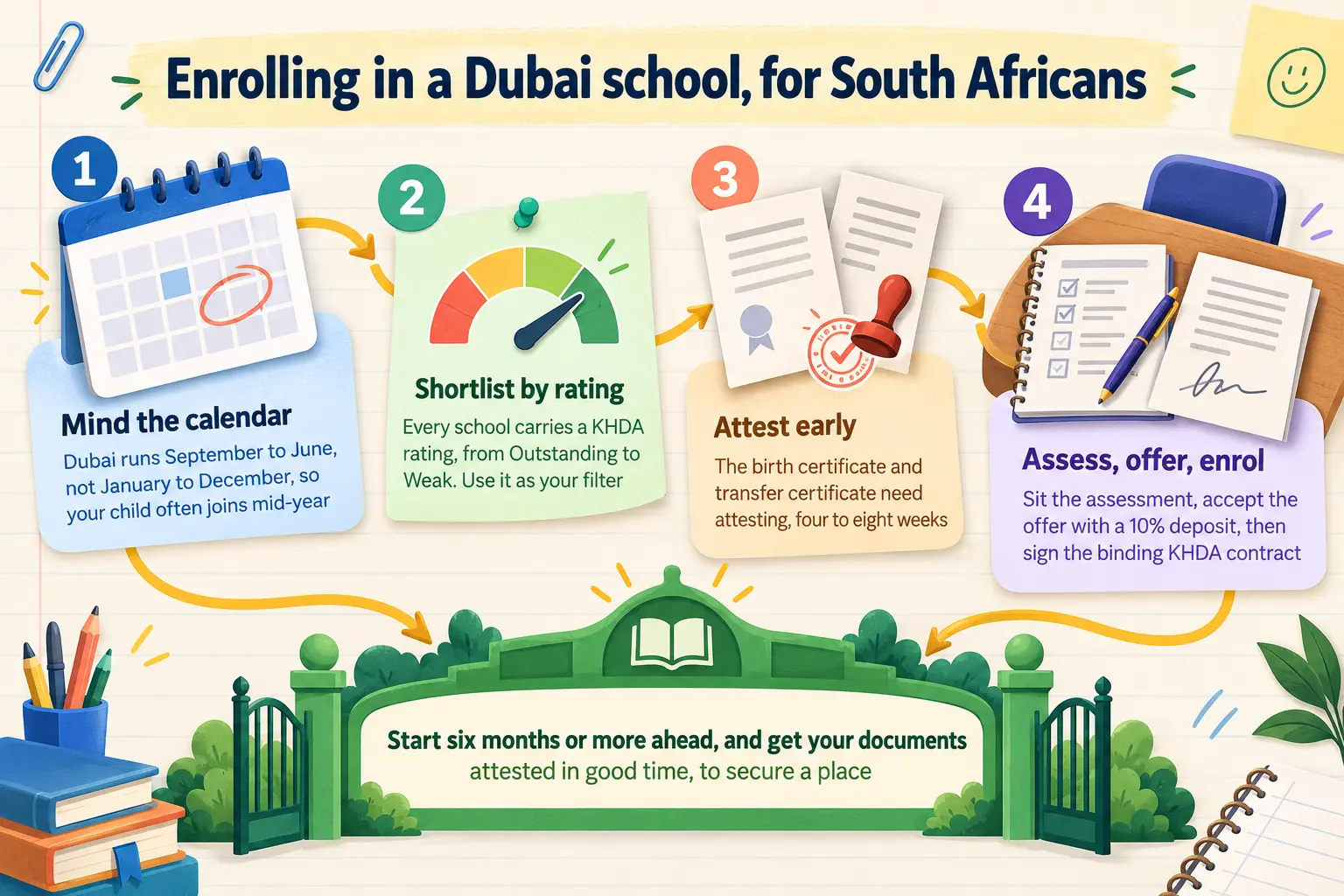
For a South African family, the extra wrinkle is the calendar. The school year here runs from around September to June, not January to December, so your child often joins mid-year. This guide walks through the enrollment process step by step, so you know what to do and when.
The good news is that the process is clear once you see it laid out. Start early, get your documents attested in time, and each step follows smoothly. Here is how it works.
Key Facts at a Glance
Before You Start: Timing For South African Families
One thing shapes everything for a South African family, so it is worth understanding first. The school years do not line up.
South Africa runs its school year from January to December. Dubai runs from around September to June. So your child will often move across mid-year, rather than at a clean start. Mid-year places exist, but seats are limited once term has begun. The best windows are after the October half-term or at the start of Term 2 in January. Plan around this early, and avoid arriving mid-exam-period, when transfers are hardest.
Step 1: Research and Shortlist Schools
The first step is choosing where to apply, and Dubai gives you plenty of choice: over 200 private schools across many curricula. Quality varies, so filter carefully.
Every school is rated by the KHDA, from Outstanding to Weak, and those ratings are public. Use them as your first filter, alongside curriculum, fees and location. Most South African families choose British or Cambridge schools, the closest fit and widely available. The South African curriculum itself is only offered online. Shortlist a few schools rather than one, since the best-rated ones have waiting lists.
Step 2: Check Age and Availability
Before applying, two quick checks save wasted effort. Not every year group will have space.
Dubai uses an age cutoff of 31 December to set your child's year group, which may differ from home. Confirm which year your child falls into, then check seat availability at each shortlisted school. This matters for popular schools and mid-year entry. A great school with no seat in your child's year is not an option this year.
Step 3: Apply and Submit Documents
Once you have your shortlist, you apply online. The application fee is around AED 500 to 1,000, about ZAR 2,200 to 4,400 per school. This is where preparation pays off.
Having your documents scanned and ready before you apply shortens the process a lot. Here is what Dubai schools typically ask for.
The Transfer Certificate and birth certificate catch South African families out, because both need attesting, and the attestation chain takes weeks. Request the Transfer Certificate from your South African school early, as some require a term's notice.
Step 4: The Assessment
Most schools assess a child before offering a place, to check the year group is right. The format depends on age.
Young children usually have a play-based observation rather than a test. From Year 3 up, children typically sit an assessment such as CAT4, or an in-house English and Maths test. Older students may also need references from current teachers. It is worth reassuring your child that this is about placement, not passing or failing.
Step 5: The Offer and Deposit
If the assessment goes well, the school makes an offer, and now the clock starts. Offers do not stay open long.
You typically have 7 to 14 days to accept and pay a deposit, usually around 10% of annual fees. This deposit is non-refundable if you cancel, but it is credited against your first term's tuition once enrolled. So accept promptly, especially for a sought-after school where the seat will not be held long.
Step 6: Sign the KHDA Contract and Enrol
The final step is the official one, and it is a genuine requirement, not a formality. Your child cannot attend until it is done.
Dubai requires a parent-school contract, issued by the KHDA and signed online through the KHDA Parent Portal, using your Emirates ID or UAE Pass. It sets out the fees, refund rules and responsibilities of both sides. Once you have signed it, paid the first invoice and completed any medical and consent forms, the school finalises enrollment with the KHDA. At that point your child is officially enrolled and can start.
How Meydan Free Zone Fits In
School enrollment is something you handle with the school directly, but the link to Meydan Free Zone is worth noting. It comes down to residency.
- Residency starts with your license: A Meydan Free Zone trade license, which can be issued in under 60 minutes through Fawri, is what makes you eligible for a UAE residence visa.
- Your visa is arranged for you: Through mResidency, your residence visa, medical and Emirates ID are handled in one place.
- You then sponsor your children: Once you are a resident, you can sponsor your children as dependants, giving them the residence visa and Emirates ID they need to enrol.
So Meydan Free Zone puts the family residency in place that makes enrollment possible.
Conclusion
For a South African family, enrolling is a clear six-step process. Shortlist by KHDA rating, check age and availability, apply with attested documents, sit the assessment, accept the offer with a deposit, and sign the KHDA contract. The two things to get right early are document attestation, which takes weeks, and the mid-year timing, since terms differ from home.
Start six months or more ahead, get the Transfer Certificate and birth certificate attested in good time, and the rest follows smoothly. To put the family residency in place behind it, book a free consultation with a setup advisor at Meydan Free Zone.