
Table of Contents
Frequently Asked Questions
1. How does a South African get a services/finance visa in Dubai through a company?
In essence, your own business provides the legal basis for you to live and work in the country. Once the company's Trade License is issued, it can open its Immigration File, also known as the Establishment Card stage, & company can apply for your entry permit. You then complete the fitness test, biometrics, & stamping, typically valid for two years.
2. What is the difference between a Free Zone or Mainland company for South Africans relocating to Dubai?
A Free Zone offers 100% foreign ownership, packages tailored to consultants & tech entrepreneurs with international clients, while a Mainland company allows you to trade directly within the local UAE market & take on government contracts. Each has distinct rules regarding ownership, office space, & visa allocation, the right choice depends entirely on your business model.
3. How long does the full business setup & purposes process take from South Africa?
Company corporate setup typically takes 5–10 business days for a simple Free Zone application. The Immigration File & entry permit add 3–7 business days, & in-country purposes steps including the fitness test, biometrics, & stamping, typically valid for two years, take another 5–10 business days, making the full sequence approximately 6–10 weeks.
4. Do South Africans pay tax in both South Africa & the UAE after relocating to Dubai?
As of June 2023, a federal Corporate Tax of 9% applies to taxable profits exceeding AED 375,000 annually, with dividends drawn from your UAE company are yours to keep at the personal level. However, South Africa taxes residents on worldwide income, so formally ceasing SARS tax purposes & understanding your exit obligations before you relocate is essential.
5. Can a South African sponsor their spouse & children for Dubai purposes through their company?
Yes, once your services/finance visa is stamped & your Emirates ID is issued and in your possession, you can sponsor dependents. These typically include attested marriage & birth certificates from South Africa, & each dependent follows the same in-country sequence of entry permit, fitness test, & stamping, typically valid for two years.
Topic Summary
1. Your Company Sponsors Your Services/Finance Visa
In essence, your own business provides the legal basis for you to live & work in the UAE, the company acts as your sponsor. Choose jurisdiction (Free Zone or Mainland), secure your Trade License, & the residency sequence begins.
2. Free Zone or Mainland: Choose Correctly
Each has distinct rules regarding ownership, office space, & visa eligibility. A Free Zone offers 100% foreign ownership, packages tailored to management consultant profiles & tech entrepreneurs, while a Mainland company lets you trade directly within the local UAE market.
3. The Setup Sequence Unlocks Everything
Following these steps in the correct order is crucial for South Africans relocating to Dubai. Without a Trade License, the company can open its Immigration File, & without that, it cannot sponsor anyone.
4. Budget Accurately for Year One Fitness Test Fees
The primary cost drivers are the jurisdiction's fees, the visa package, & license activity. A simple setup with one visa often costs between AED 15,000 & AED 25,000, but more complex setup requirements can cost over AED 50,000.
5. Family Sponsorship Requires Active Status First
Your services/finance visa is stamped & your Emirates ID is issued and in your possession before dependent applications proceed. These typically include attested South African documents, marriage Certificate & phone number details for each dependent.
6. SARS Obligations Don't Stop at the Border
South Africa taxes on worldwide income, & ceasing tax purposes requires formal SARS notification. South Africans with ongoing obligations must maintain documentation proving UAE purposes, this evidence is essential if status is ever questioned.
7. Annual Renewals & Tax Compliance Maintain Status
You must stay on top of compliance: the Trade License is renewed annually, the services/finance visa every two years, & register for taxes if required. Avoid penalties by understanding obligations from day one.
Moving from South Africa to Dubai: Residency & Business Setup Guide
South Africans are among the fastest-growing expat communities in Dubai, and the mechanics driving that growth are less about lifestyle and more about how the UAE's company-sponsored residency system functions. The structure is sequential: business setup opens up residency, residency enables family sponsorship, and each stage builds on the last. This guide covers the process accurately, jurisdiction selection, license activity, family sponsorship, SARB controls, and SARS exit obligations, so you can assess the move with real data.
What Moving from South Africa to Dubai Actually Involves
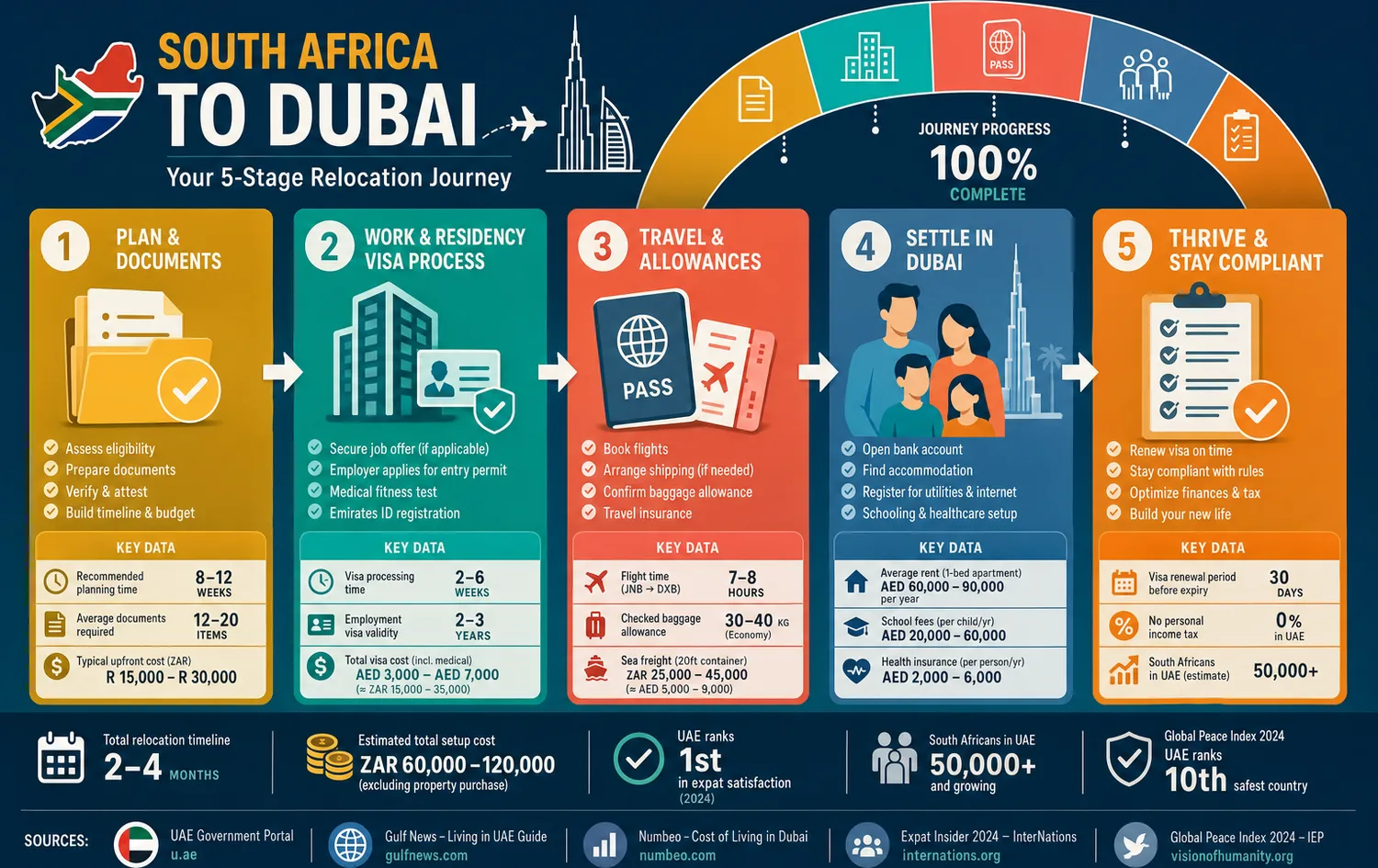
Moving from South Africa to Dubai requires forming a UAE company, obtaining a trade license, opening an immigration file, and securing a residence visa through company sponsorship. Family visas follow once the sponsor's residence visa is stamped. The full process typically takes 6–10 weeks.
In essence, your own business provides the legal basis for you to live and work in the UAE, the company acts as your sponsor for the residence visa. South African passport holders don't require a prior UAE entry visa to begin; the entry permit issued through the company covers initial entry.
The sequence matters. Without a trade license, the company cannot open an immigration file. Without the immigration file, it cannot apply for your entry permit. Attempting to arrive on a tourist visa and convert status mid-stay creates delays and additional fitness test requirements, a common mistake among Johannesburg-based founders who try to shortcut the process.
Defining Your Business Activity and Jurisdiction
You must select a specific business activity from a government-approved list and choose between a Free Zone or Mainland company. This choice determines license cost, visa allocation, office requirements, and the scope of business you can conduct.
A Free Zone company offers 100% foreign ownership, packages tailored to consultants and tech entrepreneurs, and is often a perfect fit for those with international clients. A Mainland company allows you to trade directly within the local UAE market and take on government contracts, but comes with more complex setup requirements. A Durban-based logistics trader needing direct access to UAE suppliers, for example, would likely need Mainland over a Free Zone.
You can't just pick a generic "consulting" license; you must select a specific activity from a government-approved list. A Pretoria-based developer choosing between "IT Consultancy" and "Software Development" faces distinct license fees and compliance requirements under each classification.
Free Zone vs. Mainland at a Glance
How the Business Setup Process Works
- Prepare a clear, colour copy of your passport (with at least six months' validity)
- Have a high-quality digital photograph with a white background ready
- You should also have your current address, professional email, and phone number ready
- Reserve your proposed company names before submitting the process
- Select a specific license activity from a government-approved list
- Choose jurisdiction: Free Zone (ease of setup and operate from any location) or Mainland
- Pay the jurisdiction's fees to obtain your Trade License and Memorandum of Association
- Open your Immigration File once the Trade License is issued
Securing Your Dubai Residence Visa
Once you enter Dubai on a company-issued entry permit, you must complete a medical fitness test, submit biometrics, and undergo visa stamping. The residence visa is typically valid for two years and is stamped into the passport. Emirates ID is issued separately.
The process requires you to complete a fitness test, which screens for communicable diseases, followed by biometrics at an approved center. An Emirates ID application is submitted at the biometrics stage, with the physical card arriving within 5–10 business days. Your passport is submitted for the final visa stamping, the page in your passport confirming legal residence status.
Realistic timeline for South African applicants: company formation takes 5–10 business days for a Free Zone; the immigration file and entry permit take 3–7 business days; in-country residency steps including fitness test, biometrics, and visa stamping take another 5–10 business days. The full process from document submission to Emirates ID runs approximately 6–8 weeks.
Sponsoring Family Visas from South Africa
A UAE resident from South Africa can sponsor a spouse and children once their own residence visa is stamped and their Emirates ID is issued. Dependents follow the same in-country sequence as the primary visa holder.
These typically include a copy of the sponsor's passport and Emirates ID, the dependent's passport, marriage certificate (for a spouse), and birth certificates (for children), all attested. Attestation of South African documents for UAE use requires authentication through the South African Department of International Relations and Cooperation (DIRCO) and the UAE Embassy in Pretoria.
Dubai schools require a valid UAE residence visa and Emirates ID for enrollment, families should factor the dependent visa timeline into school start date planning. Medical insurance for dependents is mandatory and must be in place at visa issuance. A Johannesburg family of four planning a September school start needs to work backward from enrollment deadlines to set their dependent visa application timeline accordingly.
Cost Breakdown: What to Budget
A South African setting up a Free Zone company in Dubai with one visa should budget between AED 15,000 and AED 30,000 for year one, covering license fees, immigration file, entry permit, fitness test, and Emirates ID. Family visa costs and medical insurance add to this figure.
The primary cost drivers are the jurisdiction's fees, the visa package, and the number of visas required. A simple Free Zone setup with one visa often costs between AED 15,000 and AED 25,000 all-in; however, more complex setup requirements can cost over AED 50,000. Request an itemized proposal, fees for opening the immigration file, fitness test, Emirates ID, and visa stamping are often excluded from headline license quotes.
South African residents must account for South African Reserve Bank (SARB) foreign exchange controls when transferring funds to the UAE. Individual annual allowances apply under the Single Discretionary Allowance and the Foreign Investment Allowance. Tax clearance from SARS may be required for larger transfers. Given rand volatility, model all UAE-denominated costs at conservative exchange rates, a 10% buffer is a prudent starting point.
Tax Considerations for South Africans in Dubai
The UAE does not levy personal income tax. As of June 2023, a federal Corporate Tax of 9% applies to taxable profits exceeding AED 375,000 annually, with a 0% rate for qualifying income below this threshold (Federal Tax Authority, 2023). VAT at 5% is mandatory for businesses with annual revenues over AED 375,000, register with the Gov.ae portal and account for reporting obligations from day one.
South Africa taxes residents on worldwide income. Ceasing tax residency requires formal notification to SARS and may trigger an exit charge on unrealized capital gains, a deemed disposal event. South Africans who retain property or business interests in South Africa will continue to have SARS reporting obligations on South Africa-sourced income even after relocating. Engage a South African tax practitioner before initiating the UAE setup, do not assume departure equals automatic non-residency.
Your Completion Checklist and Next Steps
You've successfully completed moving from South Africa to Dubai when your trade license is active, your residence visa is stamped, your Emirates ID is issued and in your possession, a corporate bank account is opened and functional, and your family visas are approved.
You must stay on top of compliance: the trade license is renewed annually, the residence visa every two years, and the Emirates ID on the same cycle, missing deadlines incurs fines. South Africans with ongoing SARS obligations must file any necessary final tax returns and maintain documentation proving UAE residency, this evidence is essential if your status is ever questioned.
To build momentum this week: define your business activity and target jurisdiction, gather your corporate documents organized with passport copy and business description, and contact a licensed corporate services provider for a detailed fee proposal covering license, immigration file, visa, fitness test, and Emirates ID. Use the Meydan Free Zone Setup Cost Calculator to get a clear cost estimate for your specific activity and visa requirements before committing to a jurisdiction.
The move is entirely executable when the sequence is right, the costs are understood accurately, and the SARB and SARS obligations are addressed before you proceed, not after.