

Table of Contents
Frequently Asked Questions
What does a computer systems consultancy licence in Dubai actually cover
A computer systems consultancy licence falls under activity code 6202.9 and covers advisory and analytical services including systems analysis, IT architecture advisory, technology strategy, software selection guidance, and integration planning.
The licence is specifically structured around consultancy and advisory delivery — not software development, coding, or product reselling. Those activities sit under separate activity codes, so it is important to confirm your intended scope before applying.
In practice, this positions your business as an independent expert advising clients on what systems to implement, how to structure their IT environment, and how to align technology with business objectives.
Why is Dubai a strong market for computer systems consultancy right now
Several structural forces are driving demand simultaneously. UAE Vision 2031 and the Smart Dubai initiative are channelling sustained public-sector spend into systems upgrades, data infrastructure, and smart government services, creating a consistent pipeline of advisory opportunities.
The broader UAE IT services sector is also growing steadily through 2030, underpinned by enterprise cloud adoption, cybersecurity investment, and ERP modernisation across both public and private sectors, according to IMARC Group.
For international founders specifically, the removal of mandatory local partnership requirements under the free zone model has lowered the barrier to entry considerably, making the timing particularly favourable.
Which client sectors generate the most demand for computer systems consultants in the UAE
Active demand pools span a wide range of industries. Government entities undergoing digital transformation represent a large and consistent source of project work, supported directly by national digitalisation policy.
Beyond the public sector, strong demand comes from financial services firms managing compliance-driven system upgrades, healthcare providers integrating clinical platforms, and logistics operators modernising fleet and warehouse management systems.
Retail groups consolidating ERP and e-commerce infrastructure, as well as SMEs lacking in-house IT leadership and seeking fractional CTO-level guidance, also represent significant segments of the addressable market.
What are the main revenue models for a computer systems consultancy in Dubai
Established consultancies in Dubai typically operate across three core models. Retainer-based advisory arrangements provide predictable recurring revenue, making them attractive for cash flow stability, particularly when serving SME clients who need ongoing fractional IT leadership.
Project-based engagements with defined deliverables suit larger enterprise clients commissioning independent systems reviews or transformation programmes. Staff augmentation — supplying specialist expertise on a time-and-materials basis — rounds out the model and can be highly lucrative during peak demand periods.
Most established firms combine all three approaches, which diversifies revenue and reduces dependence on any single client relationship or engagement type.
What are the advantages of setting up through Meydan Free Zone specifically
Meydan Free Zone offers 100% foreign ownership, meaning international founders do not need a local sponsor or Emirati partner — a significant structural advantage compared to mainland licence arrangements.
The licence structure also provides the right to invoice internationally and access to UAE residency visas, all within a single licence. Licence issuance typically takes 3–5 working days, making it one of the faster setup routes available in the UAE.
For a computer systems consultancy, which is inherently low-overhead and high-value, the free zone model aligns well with the business structure — minimising fixed costs while maximising operational flexibility.
What are the key tax and VAT obligations for a computer systems consultancy in Dubai
The UAE corporate tax rate is 9%, but this only applies on net profit above AED 375,000. Businesses earning below that threshold are not subject to corporate tax, which is a meaningful benefit for early-stage or smaller consultancies.
VAT registration becomes mandatory once taxable turnover exceeds AED 375,000 annually. At that point the business must register with the Federal Tax Authority and charge VAT at the standard rate of 5% on applicable supplies.
It is advisable to engage a UAE-registered accountant early to ensure correct classification of services, particularly where engagements involve international clients, as the VAT treatment of exported services can differ from domestic supply.
Does a free zone computer systems consultancy licence allow working with UAE mainland clients
Free zone entities can generally invoice UAE mainland clients for consultancy and advisory services, as these are service-based engagements rather than physical goods requiring import into the mainland.
However, if a significant portion of your business involves on-site work or contracts with federal government entities, it is worth reviewing whether a mainland licence or dual-licence structure might be more appropriate. Regulatory requirements can vary depending on the nature and volume of mainland activity.
For most computer systems consultancies delivering advisory services remotely or on a project basis, the free zone structure is operationally sufficient and commercially advantageous.
What regulatory body oversees digital and technology services in the UAE
The Telecommunications and Digital Government Regulatory Authority (TDRA) oversees the broader digital infrastructure framework in the UAE. Its regulatory posture actively supports investment in technology advisory services as part of the national digital economy agenda.
Digital Dubai coordinates many of the emirate-level smart government and digitalisation initiatives that generate public-sector demand for systems consultancy work. Understanding both bodies is useful context for consultancies targeting government or quasi-government clients.
For free zone businesses, day-to-day regulatory interaction is primarily managed through the free zone authority itself — in this case Meydan Free Zone — rather than directly through national technology regulators.
How to Start a Computer Systems Consultancy Business in Dubai
Dubai's push to become a fully digital economy has created steady, well-funded demand for computer systems consultants who know how to deliver, not just advise. Government digitisation programmes, smart city infrastructure, and private sector modernisation are all generating real project budgets. The consultants winning that work are the ones who set up correctly from day one.
This guide covers the license you need, where to set up, what clients expect, and how to get trading without wasting time on the wrong decisions.
What a Computer Systems Consultancy License Covers
The computer systems consultancy activity covers systems analysis, design, integration, and advisory work. In plain terms, you can assess a client's technology environment, design a solution, and guide its implementation. You can advise on architecture, integration between platforms, and systems performance.
What it does not automatically cover is hands-on software development, cybersecurity services, or managed IT support. If your work regularly crosses into those areas, you need to add the relevant activity codes before you start. Getting this wrong creates problems later, particularly when a client asks to see your license scope before signing a contract.
Check the Meydan Free Zone business activities list to confirm which codes apply to your specific service mix before you commit to a structure.
| Activity | Computer Systems Consultancy |
|---|---|
| Permitted scope | Systems analysis, design, integration, and advisory services |
| Foreign ownership | 100% in Meydan Free Zone; 100% on the mainland subject to Invest in Dubai guidelines |
| Minimum share capital | No statutory minimum in Meydan Free Zone |
| Additional codes to consider | Software development, cybersecurity consulting, IT managed services |
Mainland or Free Zone: Making the Right Call
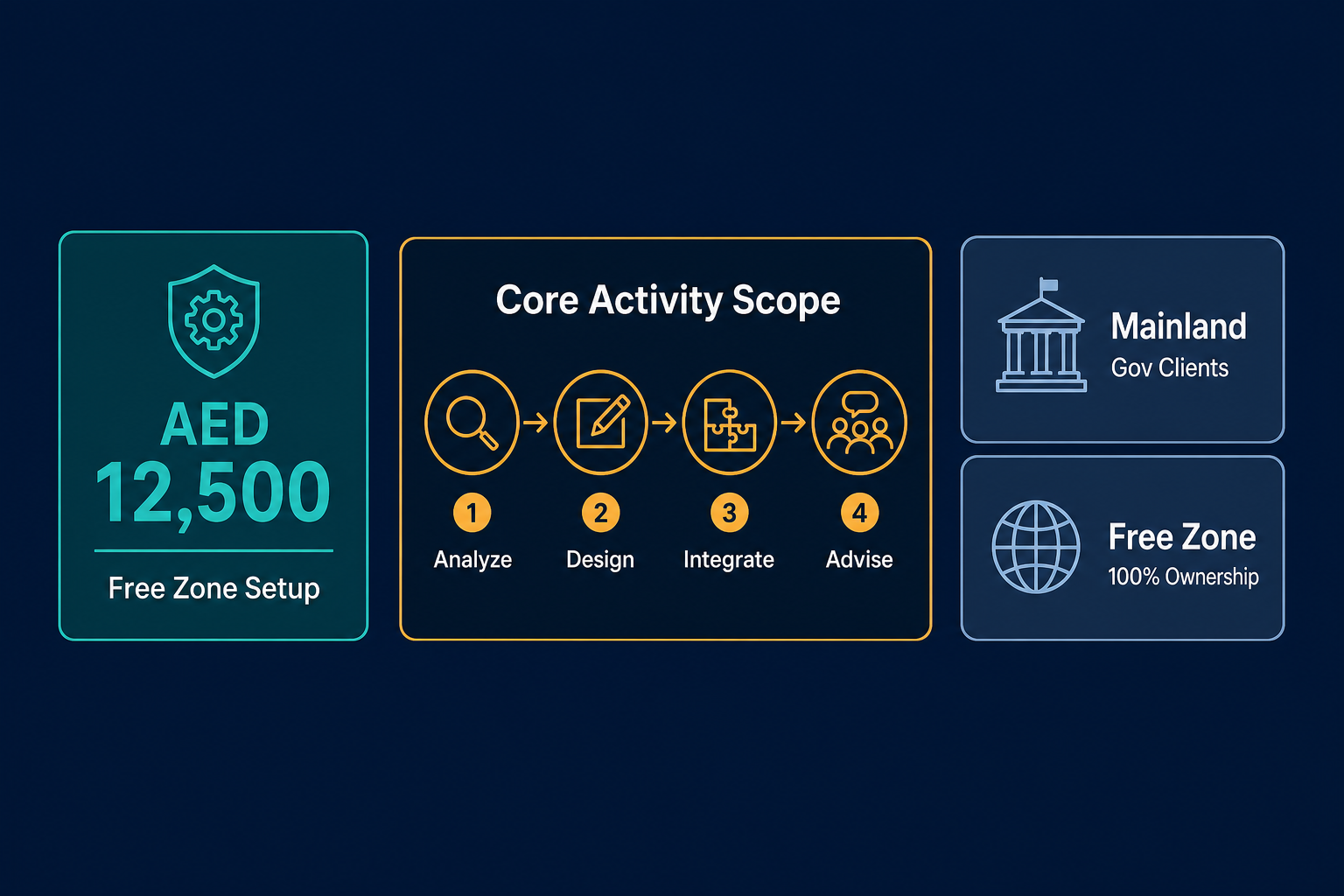
This is the biggest choice you will make when setting up. Let your clients decide it, not the fee difference.
Mainland via DET
A mainland license from the Dubai Department of Economy and Tourism lets you work directly with UAE government bodies and large enterprise clients who require a local trade license from their vendors. If your pipeline is built around public sector contracts, smart city projects, or government-linked entities, a mainland setup is the right call. You will need a physical office address, and the setup cost is generally higher.
Meydan Free Zone
Meydan Free Zone gives you 100% foreign ownership, flexi-desk options, and a lower cost to get started. It suits consultancies focused on international clients, regional businesses, or private sector organisations that do not require a mainland license from their suppliers. You can also start a business remotely through Meydan Free Zone without needing to be on the ground during setup.
The honest answer is that many computer systems consultancies start in a free zone and add a mainland presence later when a specific client or contract needs it. That is a workable path, but plan for it rather than being forced into it mid-project.
| Factor | Mainland (DET) | Free Zone (Meydan Free Zone) |
|---|---|---|
| Client access | Open UAE market including government | Mainly private sector and international clients |
| Foreign ownership | 100% in most activities | 100% |
| Office requirement | Physical office required | Flexi-desk options available |
| Visa allocation | Based on office size | Packages from one visa upward |
| Setup cost | Higher | Lower; Dubai Trade License from AED 12,500 |
Free Business Setup Cost Calculator
Calculate NowStep-by-Step Setup Guide
The process is more predictable than most people expect. Delays happen at specific points, and knowing where they are lets you plan around them.
- Step 1, book your trade name: Use the DET e-services portal for a mainland company, or the Meydan Free Zone portal for a free zone one. Use the company name check tool to confirm availability before you go further. Names must not duplicate existing registrations and must avoid restricted words.
- Step 2, confirm your activity code: Make sure the code covers all the services you plan to sell. If you need more than one code, add them now. Changing your activity scope after setup costs time and money.
- Step 3, submit your setup documents and get initial approval: For a free zone setup, this typically means passport copies, a completed application form, and your chosen company structure. Initial approval from Meydan Free Zone usually comes through quickly.
- Step 4, secure your office or flexi-desk: Your license cannot be issued without a registered address. A flexi-desk arrangement through Meydan Free Zone satisfies this requirement at a lower cost than a dedicated office.
- Step 5, get your establishment card: This is the document that lets you process visas. Do not skip this step or leave it until you need it urgently.
- Step 6, apply for investor and employee visas: The investor visa process runs through the General Directorate of Residency and Foreigners Affairs. Allow two to four weeks for a standard application once your establishment card is in place.
- Step 7, open your corporate bank account: This is where most consultancies lose time. Start the bank application as early as possible, ideally before your license is issued, so the process runs in parallel.
The total timeline from name booking to a live bank account is typically six to ten weeks. The bank account is almost always the longest part.
Compliance, Banking, and Tax
Corporate tax
The UAE introduced a federal corporate tax in June 2023. You need to register with the Federal Tax Authority once your business meets the relevant revenue thresholds. Free zone companies can qualify for a 0% rate on qualifying income, but this depends on your activity and how you structure your operations. Get proper advice on this before you start trading, not after your first year of revenue.
VAT
You must register for VAT once your taxable turnover reaches AED 375,000 in a twelve-month period. Voluntary registration is available from AED 187,500. Most consultancies reach the mandatory threshold faster than they expect once a couple of contracts are running. Build VAT compliance into your accounting from day one rather than retrofitting it later. Meydan Free Zone's VAT registration support services can handle the filing process for you.
TDRA registration
If your consultancy work touches telecoms infrastructure, digital networks, or regulated digital services, you may need to register with the Telecommunications and Digital Government Regulatory Authority. This applies to a minority of computer systems consultancies, but it is worth checking early if your service scope includes network design or digital government projects.
Banking
UAE banks take compliance seriously, and new companies go through thorough due diligence. You will need your trade license, memorandum of association, passport copies for all shareholders, proof of address, and a clear description of what your business does and who your clients are. Some banks also ask for a business plan or projected financials. The process takes four to eight weeks at most institutions. Meydan Free Zone's business banking support service helps you prepare the right documents and approach the right institutions for your business profile.
Bookkeeping and audit
Free zone companies are not always required to file audited accounts, but keeping clean books from the start protects you when a client asks for financial references or when your bank reviews the account. Use bookkeeping services in Dubai to keep this running without it becoming a distraction from client work.
Market Opportunity and Who Your Clients Will Be
Dubai is not a market where technology consulting is a nice-to-have. The government has committed to large-scale digital transformation across health, transport, finance, and public services. That creates funded, recurring demand for consultants who can design and integrate systems at scale.
According to IMARC Group, the UAE IT services market has been growing steadily, driven by government digitisation programmes and private sector modernisation across banking, logistics, and healthcare. That growth is real and it is not slowing.
Client types
The main client categories for a computer systems consultancy in Dubai are government agencies and government-linked entities, banks and financial services firms, healthcare groups, logistics operators, and large regional businesses running legacy systems that need modernising. Each of these sectors has budget, long project cycles, and a genuine need for external expertise.
How procurement works here
Nobody here buys consultancy on a phone call. Government and large enterprise clients run formal tender processes. They want you on their approved vendor list before a project opens. They check your license, your insurance, your references, and your financial standing. Approval cycles are long. Budget for three to six months from first contact to a signed contract on your first major engagement.
Positioning against established players
Large global consultancies are active in Dubai. You will not out-resource them. What wins work for a smaller consultancy is deep sector knowledge, faster response times, and a willingness to engage at a level of detail that larger firms price out of. Pick one or two verticals and build a track record there rather than trying to compete across the board from day one.
Practical steps before you start selling
Get your vendor registration done with your target client organisations before you need it. Keep your license documents, insurance certificates, and company profile updated and ready to send. Use meeting rooms in Dubai for client presentations rather than working from a flexi-desk when the relationship is at a sensitive stage. First impressions matter in this market.
Conclusion
A computer systems consultancy in Dubai is a workable business with real demand. The setup choices you make early, jurisdiction, activity code, banking, shape how quickly you can trade and who you can trade with. Get those decisions right and the rest follows a clear path.
Use the cost calculator to get a fee breakdown for your specific setup, then speak to the Meydan Free Zone team to confirm the right activity code and structure before you commit.
Ready to Launch Your Business in Dubai?
Let's Connect