
Table of Contents
Frequently Asked Questions
What does activity code 1812.08 cover for a litho stone and woodblock business in Dubai
Activity code 1812.08 — "Artistic Work Including Preparation Of Litho Stones And Prepared Woodblocks" — falls within the printing and reproduction of recorded media classification rather than purely fine arts. This distinction is important for both licensing and operational planning.
In practice, the activity covers preparing lithographic stones and woodblocks as print matrices, producing original artwork through these media, and delivering commercial print preparation services to third parties. It is broad enough to support both a product-led and a service-led business model under a single licence.
Which free zone is recommended for licensing a litho stone and woodblock business in Dubai
Meydan Free Zone is identified as a suitable licensing jurisdiction for operating under activity code 1812.08. Free zone structures offer specific advantages for this type of business, particularly around importing raw materials.
Materials such as inks, lithographic stones, and prepared wood can be imported without customs duty within the free zone, which reduces input costs and supports competitive pricing for both product and service offerings.
Who are the main customers for a litho stone and woodblock print business in Dubai
The primary customer segments include galleries, interior designers, hospitality procurement teams, private collectors, and educational institutions running arts programmes. Each represents a distinct revenue channel that can be developed independently.
B2B commission work — producing limited-edition print runs for galleries or publishers — provides predictable recurring revenue. Dubai's high-end hospitality and real estate sectors also represent strong demand, as bespoke artwork is standard in luxury fit-outs. Export opportunities into GCC gallery networks add a further commercial layer.
Is there much local competition in the litho and woodblock printmaking market in Dubai
The supply gap in this niche is described as real and significant. Specialist printmaking services — particularly lithography and woodblock — are not well represented locally, with most fine art print work either imported or produced abroad.
A licensed operator in this space therefore faces minimal direct local competition, which represents a meaningful commercial advantage, especially given the consistent institutional and collector demand present in Dubai's creative economy.
What role does the Dubai Culture and Arts Authority play in supporting this type of business
The Dubai Culture and Arts Authority actively supports the growth of creative industries through dedicated programmes covering visual arts, cultural production, and creative enterprise. This institutional backing translates into tangible procurement opportunities.
Public spaces, hospitality venues, and cultural institutions regularly commission original and limited-edition works, creating a consistent demand pipeline for businesses operating in specialist print disciplines such as lithography and woodblock production.
What services can a business operating under activity 1812.08 legitimately offer
Under activity code 1812.08, a business can offer a coherent range of services including original lithographic prints, woodblock editions, bespoke commissions for commercial or private clients, and studio-based workshops for artists or institutions.
Each revenue stream is distinct and can be scaled independently. The combination of direct art sales, B2B commission work, and educational workshops means the business model is diversified without requiring multiple licences.
What is the VAT registration threshold relevant to a Dubai-based art print business
The VAT registration threshold in the UAE is AED 375,000 in annual turnover, as set by the Federal Tax Authority. Businesses operating below this threshold are not required to register for VAT, though voluntary registration is possible.
For a litho stone and woodblock business, tracking turnover across product sales, commissions, and workshop income is important to determine when the threshold is approached. Exceeding the threshold without registering carries penalties, so financial monitoring should be built into operations from the outset.
What does the broader market outlook look like for art and craft businesses targeting the Middle East
The global art and craft market is projected to grow steadily through 2030, with the Middle East specifically identified as an emerging collector region according to IMARC Group data cited in the article. Dubai's positioning as a regional cultural hub reinforces this trajectory.
Dubai hosts over 80 galleries and a growing calendar of international art fairs, generating consistent demand for original and limited-edition print works. Combined with the UAE creative economy's contribution to non-oil GDP, the structural conditions for a specialist print business are considered favourable over the medium term.
How to Start a Litho Stone and Woodblock Artwork Business in Dubai
Dubai buys a great deal of art. Hotels, offices, villas and public buildings all need work on the walls, and most of the printed pieces that end up there were made somewhere else. Lithography and woodblock printing are old, slow crafts, and almost nobody practises them here.
That is the opening. This guide covers what activity code 1812.08 lets you do, who buys the work, what you owe the tax authority, and how to get licensed through Meydan Free Zone. There is no sector regulator to satisfy on top of the trade license, which makes this one of the simpler activities to set up in Dubai.
Key Stats at a Glance
| Activity code | 1812.08 |
|---|---|
| What it covers | Artistic work including the preparation of litho stones and prepared woodblocks |
| Where it is filed | Printing and reproduction of recorded media, not fine arts |
| Sector permit needed | None beyond the trade license |
| VAT threshold | AED 375,000 taxable turnover a year – Federal Tax Authority |
| VAT rate | 5% standard rate on goods and services under this activity |
| Galleries in Dubai | More than 80, plus a growing calendar of international art fairs |
| Market outlook | Global art and craft market set to grow steadily through 2030, with the Middle East an emerging collector region – IMARC Group |
| Creative economy | Contributes a meaningful share of non-oil GDP – Invest in Dubai |
| Foreign ownership | 100% in Meydan Free Zone |
What This License Covers

Activity code 1812.08, artistic work including the preparation of litho stones and prepared woodblocks, is filed under printing and reproduction of recorded media rather than fine arts. That sounds like a technicality. It is not, and it shapes how you plan the business.
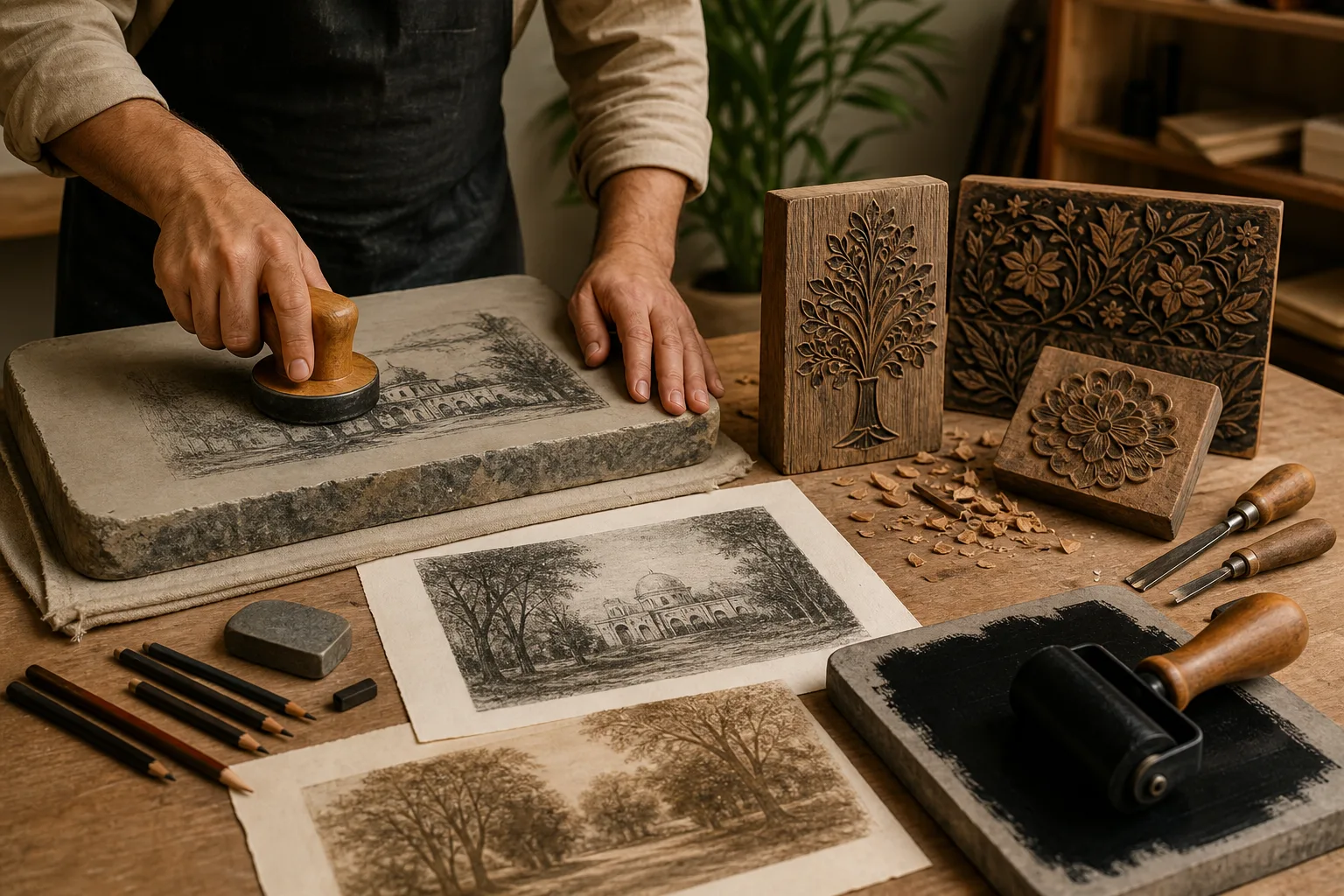
In practice the code covers three things: preparing lithographic stones and woodblocks as print matrices, making original artwork through those media, and doing commercial print preparation for other people. It sits across the line between craft and useful output, which is why one license can carry both a product business and a service business.
Who Your Clients Will Be
You are selling to a mix of trade buyers and private ones.
- Galleries commissioning limited-edition print runs
- Interior designers and hospitality procurement teams fitting out hotels and restaurants
- Publishers who need hand-prepared print media
- Advertising studios after artisanal textures
- Private collectors, many of them international residents
- Schools and colleges running arts programmes
- Independent artists who want studio access or technical help
Money comes from four places: direct sales of original lithographic prints and woodblock editions, bespoke commissions for commercial and private clients, B2B edition work for galleries and publishers, and studio workshops. The commission work is the steady part, because galleries and publishers come back. Each of these streams can grow at its own pace, and none of them needs a second license.
Mainland or Free Zone
| Factor | Mainland (DET) | Free Zone (Meydan Free Zone) |
|---|---|---|
| Who you sell to | Open UAE market | UAE mainland buyers and export markets |
| Foreign ownership | Set by DET rules for the activity | 100% yours, no local sponsor |
| Importing materials | Standard mainland customs route | Inks, stones and prepared wood come in duty free within the zone |
| Studio space | Premises needed from the start | Flexi-desk covers the address at the outset |
| Setup route | Apply through DET | Apply online, remote setup possible |
The free zone route suits this business well, mostly because of the materials. Limestone blocks, prepared wood and inks are heavy and they come from abroad, and bringing them into the zone without duty takes real cost out of every edition you print. Let your buyers decide it, not the price. If you plan to run a public studio with walk-in sales from day one, look at the mainland instead.
[blockCTACostCalculator]
Step by Step Setup Guide
- Step 1, book your trade name: Pick a name and check it against UAE naming rules through the Meydan Free Zone portal.
- Step 2, confirm your activity code: Check that 1812.08 sits on the approved activity list, and add any related codes you want alongside it now rather than later.
- Step 3, send in your setup documents: Passport copies for every shareholder, the application forms, and a short description of what you intend to make and sell.
- Step 4, get the trade license: Meydan Free Zone issues the license, usually within a few working days of approval. That is your commercial green light.
- Step 5, handle the follow-on steps: Visa eligibility, Emirates ID and a corporate bank account all come after the license is in hand.
Meydan Free Zone supports remote setup, so you can get through the first stage without flying to Dubai. Flexi-desk options cover the address rule while you decide whether a full studio lease is worth it.
Compliance and What You Need in Place
No sector permit
There is no body governing printmaking as a profession in the UAE, and no extra approval to chase. The trade license is the operative permission. That is unusual and it is worth knowing, because it removes the step that slows most other activities down.
VAT and books
Register for VAT with the Federal Tax Authority once your taxable turnover passes AED 375,000 a year. Both goods and services under this activity carry the standard 5% rate. Track product sales, commissions and workshop income together, because it is the combined figure that crosses the line, and going over without registering brings penalties. Register before your first taxable supply, not after.
Importing materials
Inks, limestone blocks and prepared wood are all imported under standard customs procedures. Read up on port and import protocols through the Ports, Customs and Free Zone Corporation before your first shipment. Free zone status makes this much easier for goods that stay in the zone or leave again for export.
Workspace
You do not need a physical studio to hold the license at the start, which keeps early overheads low. A press, stones and a safe place to store solvents come later, when the order book justifies them.
Market Opportunity
The demand side is institutional as well as private. The Dubai Culture and Arts Authority backs the creative industries through programmes covering visual arts, cultural production and creative enterprise, and that backing turns into real procurement. Public spaces, hospitality venues and cultural institutions commission original and limited-edition work on a regular basis. Dubai hosts more than 80 galleries and a growing calendar of international art fairs on top of that.
The supply side is thin. Specialist printmaking, lithography and woodblock in particular, is barely represented locally, and most fine art print work is either imported or made abroad. A licensed operator here faces very little direct competition. The global art and craft market is set to grow steadily through 2030, with the Middle East picked out as an emerging collector region, and export routes into GCC gallery networks add another layer on top of local sales.
Conclusion
This is a low-competition niche in a city with money and wall space. The activity code is clear, the demand is real, and the regulatory path is clean in a way that few other activities are.
A Meydan Free Zone license gives you full ownership, duty-free materials inside the zone, and a workspace arrangement you can scale when the work arrives. Two things decide how smoothly it goes: VAT registration at the right moment, and a materials supply chain you have actually costed. Sort those and the rest is craft.
[blockCTAContact]
References
- Dubai Culture and Arts Authority
- Invest in Dubai
- IMARC Group
- Federal Tax Authority
- Ports, Customs and Free Zone Corporation