
Table of Contents
Frequently Asked Questions
What is activity code 3314.02 and what services does it cover in Dubai
Activity code 3314.02 refers to the Repair and Maintenance of Electric Motors, Generators, and Motor Generator Sets. It falls under ISIC Revision 4 Division 33, which covers repair and installation of machinery and equipment.
The scope includes rewinding stator and rotor coils, reconditioning armatures, overhauling generator sets, dynamic balancing, insulation testing, and performance verification. Both AC and DC machines across industrial voltage ranges are covered.
This classification determines your licence category, facility requirements, and the regulatory framework you must follow when setting up in Dubai.
Why is Dubai a strong market for electric motor and generator repair businesses
Dubai's manufacturing, construction, utilities, and energy sectors all depend heavily on rotating electrical machinery. When motors and generators fail, specialist repair is significantly cheaper than full replacement, making this a structurally resilient service category regardless of economic cycles.
Dubai alone hosts over 5,000 active industrial establishments requiring ongoing electrical equipment maintenance, according to the Dubai Statistics Centre. Regional infrastructure projects — including data centres, desalination plants, and power generation facilities — create multi-year service contract pipelines.
Long-term demand is further reinforced by UAE Vision 2031 industrial diversification targets, making this a maintenance-driven sector with predictable, recurring revenue rather than a speculative market.
Who are the main target customers for an electric motor and generator repair business in Dubai
The primary customer base is B2B industrial clients, which typically offer stronger margins and longer contract terms than consumer-facing work. Key segments include industrial manufacturers, processing plants, and construction contractors operating heavy plant and site generators.
Marine and port operators represent a significant segment given Dubai's trade infrastructure through DP World and Jebel Ali. Data centre operators requiring uninterruptible power system maintenance are also a growing customer category.
Additional clients include utilities, district cooling providers, and facilities management companies managing large commercial real estate portfolios — all of which require ongoing electrical equipment servicing.
What revenue models are available for this type of repair business
There are three primary operating models to consider. The first is a fixed-workshop repair facility where customers bring equipment in for bench servicing. The second is a field service model where technicians are dispatched to customer sites. Many businesses combine both approaches in a hybrid model.
Beyond job-based repair billing, preventive maintenance contracts and emergency callout retainers provide recurring income that stabilises cash flow. These contract structures are particularly attractive when serving industrial manufacturers and facilities management companies.
B2B positioning with long-term service agreements tied to major infrastructure projects can further strengthen revenue predictability and margin quality.
What is the difference between setting up through Meydan Free Zone versus a mainland DED licence for this activity
A Meydan Free Zone licence permits you to operate within the free zone, serve international clients, and trade across borders. It is generally faster and more straightforward to establish than a mainland entity.
However, providing on-site field services directly to mainland UAE clients may require either a mainland DED (Department of Economy and Tourism) licence or a formal commercial agency arrangement. The Dubai DED e-Services portal provides guidance on mainland activity classifications.
It is important to clarify your intended service geography before selecting your business structure, as the choice directly affects which clients you can legally serve and how you can deliver on-site work.
What global market trends support long-term growth in the electric motor repair sector
The global electric motor repair and rewinding market is forecast to grow steadily through 2030, driven primarily by industrial automation and energy infrastructure investment, according to IMARC Group.
The UAE's industrial sector accounts for approximately 14% of GDP, with manufacturing output expanding year-on-year, as reported by the UAE Government Portal. This underpins sustained domestic demand for specialist repair services.
Regional energy infrastructure projects and data centre expansion, highlighted by Mordor Intelligence, create multi-year service pipelines. These structural drivers make the sector attractive for both operators and investors targeting UAE industrial services.
What qualifications or background are suited to starting this business
This business is well suited to experienced electrical engineers with hands-on knowledge of rotating machinery, as technical credibility is important when bidding for industrial service contracts. Workshop operators already active in electrical maintenance who want to expand regionally are also well positioned.
Investors without a technical background can participate by hiring qualified technicians and positioning themselves in a management or commercial development role. Labour compliance when hiring specialist staff is a key operational consideration.
Regardless of background, understanding the regulatory framework, including activity classifications and free zone versus mainland scope, is essential before committing to a structure.
What facility and compliance requirements apply to activity code 3314.02
Because 3314.02 is classified as an industrial and technical service activity, it carries specific facility requirements that differ from standard commercial or trading licences. The classification under ISIC Revision 4 Division 33 determines both the licence category and the physical workspace standards you must meet.
Hiring qualified technicians requires adherence to UAE labour compliance standards, including appropriate visa categories and skills verification for specialist roles. Workshop facilities must be capable of safely handling industrial electrical equipment across relevant voltage ranges.
Operators planning to deliver field services to mainland clients should confirm whether their free zone licence is sufficient or whether a supplementary mainland structure or agency arrangement is required before commencing operations.
How to Start an Electric Motor and Generator Repair Business in Dubai
Dubai's construction boom, industrial base, and reliance on backup power mean electric motors and generators are everywhere. Factories, hospitals, data centres, and hotels all run on this equipment, and when it fails, the cost is immediate. Someone has to keep it running. That someone can be you.
This guide covers the license you need, how to structure your setup, and what the market actually looks like for a repair business in this space.
What This License Covers and Who Your Clients Are
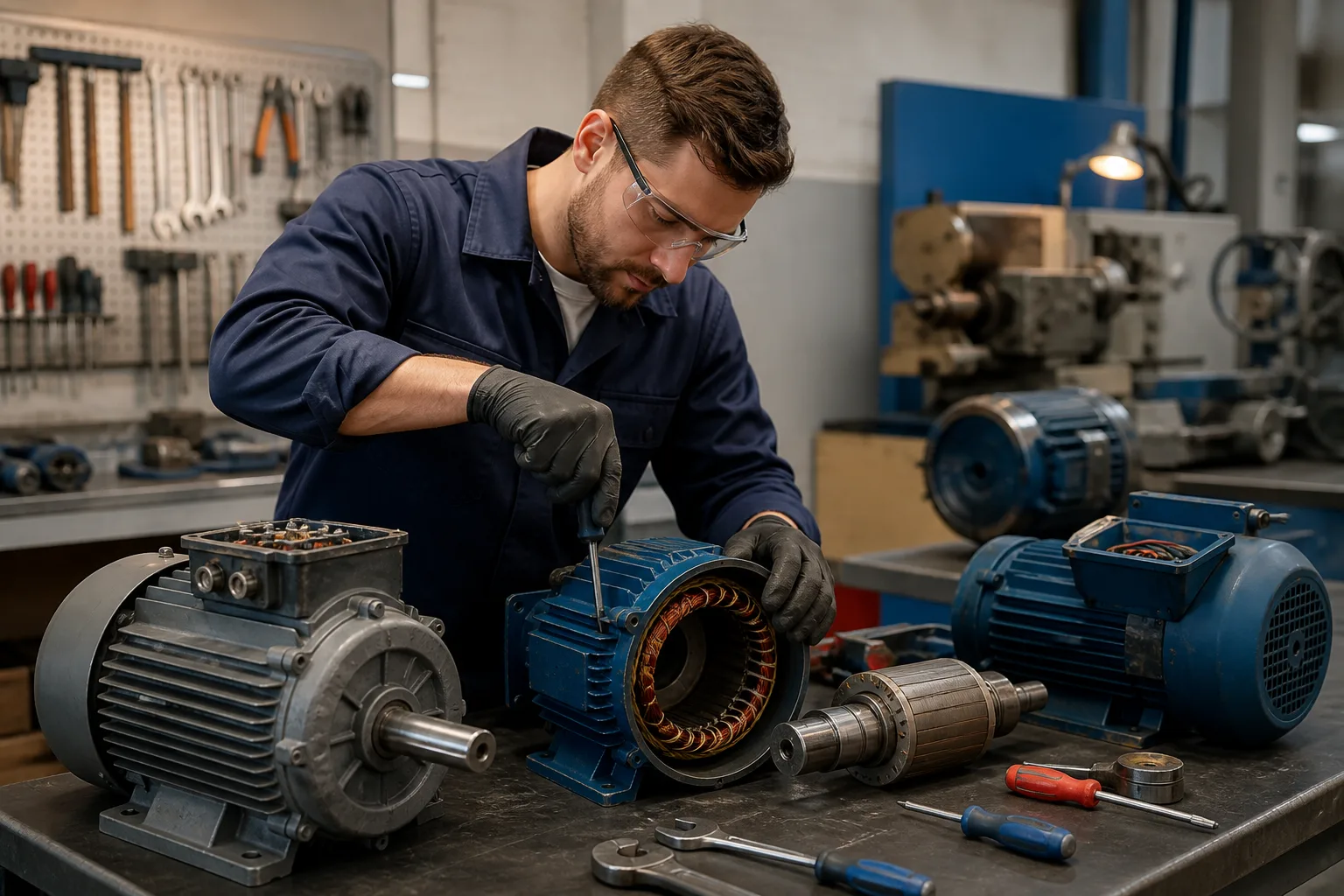
The electric motor and generator repair activity covers rewinding, overhauling, and testing electric motors, generators, and alternators. That includes fault diagnosis, coil rewinding, bearing replacement, insulation testing, load testing, and general mechanical overhaul. If it spins, generates, or converts electrical energy, this license covers the work.
Your clients will come from across the industrial and commercial base. Construction firms need motors for cranes, hoists, and pumps. Data centres run on generator backup and cannot afford downtime. Hospitals have legally mandated backup power requirements. Hotels, warehouses, and manufacturing plants all carry rotating electrical equipment that needs regular servicing. Demand is steady because equipment failure is expensive and unplanned downtime is worse. Most serious operators in these sectors run preventive maintenance contracts rather than waiting for a breakdown.
Key Stats at a Glance
| Activity | Electric motor and generator repair |
|---|---|
| Typical activity code | Electrical equipment repair and maintenance (confirm exact code with DET or Meydan Free Zone at point of application) |
| Foreign ownership | 100% permitted – mainland and free zone – Invest in Dubai |
| VAT registration threshold | AED 375,000 annual turnover – Federal Tax Authority |
| Typical free zone setup cost | From AED 12,500 depending on visa allocation and package selected |
| Workshop requirement | Required for this activity – mainland or leased external space for free zone operators |
Mainland or Meydan Free Zone: Which Setup Works for You

This is the biggest choice you will make when setting up. Let your target clients decide it, not the cost.
A mainland license from the Dubai Department of Economy and Tourism (DET) lets you work directly with UAE government bodies, semi-government entities, and local contractors without restriction. Since the 2021 ownership reforms, you no longer need a local Emirati partner for most commercial activities. You can hold 100% of the business yourself. The trade-off is cost and compliance overhead. Mainland requires a physical premises approval, which for this activity means a properly fitted workshop that meets Dubai Municipality safety standards for electrical work. That adds to your setup and running costs.
Meydan Free Zone suits operators who are focused on regional and international clients, who want to import and re-export parts and equipment, or who need to keep overheads low in the early months. Free zone companies can use a flexi-desk for the registered office, but you will still need a workshop. Most free zone operators lease external workshop space separately, either in an industrial area or through a third-party facility. That is workable, but factor it into your cost model from day one.
One thing that does not change between the two structures: workshop space is not optional for this activity. Clients will ask to visit your facility. Insurers will want an address. Municipality approvals are tied to the physical space. Do not try to run this as a purely mobile operation from a flexi-desk address.
| Factor | Mainland (DET) | Free Zone (Meydan Free Zone) |
|---|---|---|
| Client access | Open UAE market including government contracts | Mainly private sector and international clients |
| Foreign ownership | 100% for most activities since 2021 | 100% always |
| Office requirement | Physical premises required | Flexi-desk available; external workshop leased separately |
| Workshop approval | Dubai Municipality | Free zone authority plus external landlord |
| Visa allocation | Tied to office or workshop size | Packages available from one visa upward |
| Cost profile | Higher setup and annual costs | Lower entry cost; workshop lease is separate |
Free Business Setup Cost Calculator
Calculate NowStep-by-Step Setup Guide
The process is similar whether you go mainland or free zone. These are the steps in order.
- Step 1, book your trade name: Use the DET e-services portal for a mainland company, or the Meydan Free Zone portal for a free zone setup. The name must not duplicate an existing registered business. You can check your company name availability before you apply.
- Step 2, select your activity code: Confirm the exact code covers electrical motor and generator repair in your chosen jurisdiction before you go further. Codes vary slightly between mainland and free zone registers. Getting this wrong delays everything.
- Step 3, get initial approval: Submit your application with passport copies, proposed trade name, and selected activity. This is the authority's confirmation that your activity is permitted. It is not yet a license.
- Step 4, secure your premises: Sign a lease for your workshop space and, if applicable, your office. For mainland, get the tenancy contract attested through Ejari. For free zone, sign the flexi-desk or office agreement with Meydan Free Zone, then arrange your external workshop lease separately.
- Step 5, submit your Memorandum of Association (MOA): For mainland companies, this goes through a notary. For free zone companies, Meydan Free Zone handles this as part of the setup process.
- Step 6, get workshop approval: Apply to Dubai Municipality (mainland) or the relevant free zone authority for approval of your workshop premises. You will need to show the space meets electrical safety and fire safety standards. This step takes time. Start it early.
- Step 7, collect your trade license: Once premises are approved and fees are paid, your license is issued. Keep a digital copy. Clients and banks will ask for it.
- Step 8, register with the Federal Tax Authority: If your projected or actual annual turnover exceeds AED 375,000, you must register for VAT. Do this before you start billing at that level. The Federal Tax Authority handles registration online.
- Step 9, open a business bank account: Banks in the UAE want to see your trade license, MOA, and proof of premises before they open an account. Allow four to eight weeks. If you need support navigating this, Meydan Free Zone's mCore service includes business banking support for free zone companies.
- Step 10, hire your technicians: Register employment contracts with the Ministry of Human Resources and Emiratisation (MOHRE). Apply for residency visas through the immigration authority. Your visa allocation is set at license stage, so make sure you applied for enough.
Compliance, Kit, and Staff Requirements
This is not a business you can run light on compliance. Clients in the sectors you are targeting, hospitals, data centres, and industrial facilities, will check your credentials before they sign anything.
Workshop standards
Your workshop must meet Dubai Municipality safety requirements for electrical work. That covers ventilation, fire suppression, electrical earthing, storage of flammable materials, and emergency access. Get a copy of the relevant standards before you fit out the space. Retrofitting is expensive.
Technician qualifications
Your staff need verifiable electrical or electromechanical qualifications. Clients will ask for CVs and certificates before awarding maintenance contracts. Some government-linked clients run their own vendor qualification process and will inspect your facility and team before approving you as a supplier. Plan for this from the start.
VAT
Repair services are subject to VAT at 5%. Once your turnover hits AED 375,000 in any 12-month period, registration with the Federal Tax Authority is mandatory. You can register voluntarily before that threshold if it helps your B2B credibility. Most of your clients will be VAT-registered themselves and will expect a proper tax invoice.
MOHRE duties
Employment contracts, wages, and end-of-service benefits are governed by MOHRE. As you scale, Emiratisation targets apply. The thresholds and ratios change as your headcount grows, so track them carefully. Breaking the rules here carries financial penalties and can affect your ability to add visas.
Insurance
Professional indemnity and public liability insurance are expected by most B2B clients in this space. Some will make it a contract condition. Get both before you start pitching for work. If a motor you repaired causes a fire or a generator fails during a critical event, you need cover in place.
Test equipment and parts inventory
Your workshop needs proper test kit: insulation resistance testers, load banks, winding resistance meters, and vibration analysis tools at minimum. Clients judge you on turnaround time. If you have to wait two weeks for a spare part, you lose the contract. Build a parts inventory for the motor and generator brands most common in your target sectors.
Market Opportunity and How to Win Work
The UAE's industrial and construction sectors drive consistent demand for motor and generator maintenance. According to IMARC Group, the Middle East generator market continues to grow, supported by infrastructure investment, data centre expansion, and the region's dependence on cooling systems that run continuously in the Gulf climate. That is a structural demand driver, not a cyclical one.
Target facility managers, not procurement departments
Preventive maintenance contracts are worth a lot more than one-off repairs. A facility manager who trusts you will put you on an annual contract covering all rotating equipment in their building. A procurement department will put you through a tender every year and push you on price. Get to the facility manager first. Offer a free initial audit. Show them what you found. That is how you convert a repair call into a retainer.
Data centres and hospitals are your best clients
These sectors run on guaranteed uptime. A data centre that loses generator power loses money by the minute. A hospital has regulatory obligations around backup power. Both will pay a premium for a reliable contractor who responds fast and keeps records properly. They are also repeat clients. Once you are on their approved vendor list, you stay there as long as you perform.
Win on speed and parts, not price
The operators who compete purely on price in this market are usually the ones who take longest to deliver. Position on turnaround time and parts availability. If you can guarantee a 48-hour turnaround on standard motor overhauls and you stock the bearings and windings for the most common frame sizes, you can charge more and win more. Clients in critical sectors will pay for certainty.
Build your vendor registrations early
Government-linked facilities, utilities, and large developers all run formal vendor registration processes. Getting on these lists takes time, sometimes months. Start the applications as soon as your license and workshop approval are in place. You cannot bid for work until you are registered, and you cannot register until you have a valid license and premises.
Conclusion
Electric motor and generator repair is a workable, low-glamour business with real recurring revenue potential in Dubai. The setup is not complicated, but you need to get the workshop approval right and target clients who value reliability over price. The market is there. Industrial Dubai does not stop, and the equipment that keeps it running needs constant attention.
If you want to explore the free zone route, a Dubai trade license is available from AED 12,500, and the Meydan Free Zone team can confirm your activity code and walk you through the full cost breakdown before you commit to a structure. You can also use the cost calculator to get a quick estimate based on your visa and office requirements.
Ready to Launch Your Business in Dubai?
Let's Connect