Table of Contents
Topic Summary
Understand Exactly What License 4669.78 Covers
Activity code 4669.78 permits the collection, colour sorting, crushing, and wholesale of glass cullet to UAE and regional manufacturers. It spans three segments: container glass from hospitality streams, flat glass from building retrofits, and multi-grade cullet production for specification-grade supply.
Know Your Buyers and Why They Pay
Glass manufacturers buy cullet because it melts at lower temperatures than raw materials, directly cutting their energy costs and CO2 emissions. This makes colour-sorted UAE cullet a cost input for GCC and regional plants, not just a sustainability gesture.
Master Colour Sorting to Protect Your Margin
High-purity cullet sorted into clear, green, and amber grades commands premium prices over mixed or contaminated glass waste. Your profit margin lives in sorting discipline, not collection volume — contaminated material shifts costly processing work onto your buyer and lowers what they will pay.
Compare Mainland and Free Zone Before Choosing
A mainland DET license gives you direct access to hospitality and construction waste streams, which is where the feedstock originates. Meydan Free Zone offers 100% foreign ownership, zero corporate tax on qualifying income, and a fully digital licensing process, making it better suited to export-focused or wholesale operations.
Take Advantage of a Straightforward Approval Process
Glass waste trading under code 4669.78 requires no third-party regulatory approval and is exempt from AML compliance obligations. This removes two common friction points and allows faster setup compared with many other waste-sector activities.
Position Within a Fast-Growing Policy-Backed Market
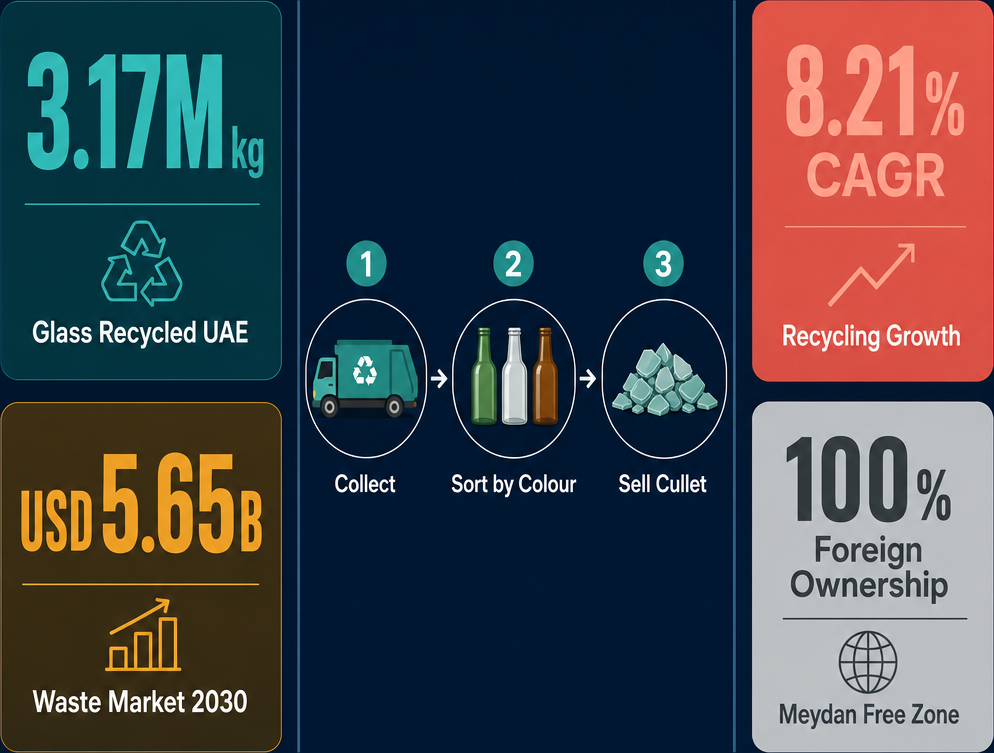
The UAE industrial waste management sector is projected to reach USD 5.65 billion by 2030 at a 6.68% CAGR, with the recycling and material recovery segment growing at 8.21% CAGR. Dubai's Waste Management Strategy 2041 and Abu Dhabi's 80% landfill diversion target by 2030 provide strong long-term policy tailwinds for the sector.
How to Start a Glass Waste Trading Business in Dubai with Meydan Free Zone
A beer bottle from a Dubai hotel bar and a window pulled out of a tower retrofit end up in the same place if somebody sorts them properly: a glass furnace, melted back into new product. Activity code 4669.78 is the license for moving that material.
This guide covers what the license allows, who buys from you, how mainland and free zone compare, and the steps to get set up. No third-party approval applies, and the whole business turns on one operational discipline.
Key Stats at a Glance
What This License Covers
Code 4669.78 lets you trade glass waste, covering collection, colour sorting, crushing and wholesale of cullet to UAE and regional glass manufacturers and recyclers.
Three segments sit inside it. Container glass covers bottle waste from hospitality, food service and beverage collection streams, sorted into clear, green and amber and supplied as cullet to container manufacturers. Flat glass covers material from tower retrofits, facade replacement and commercial fit-out cycles, which needs specialised handling. Multi-grade cullet production covers crushing, grading and contamination control to supply specification-grade recycled glass to regional plants.
The word doing the work throughout is cullet. You are not simply collecting broken glass, you are producing a raw material to a specification, and that is what your buyers are paying for.
Who Your Clients Will Be
Glass manufacturers and cullet processors, in the UAE and across the wider region.
They buy for a reason that has nothing to do with sustainability reporting. Cullet melts at a lower temperature than raw materials, so every tonne of it in a furnace cuts energy consumption and CO2 emissions. That makes it a cost input rather than a green gesture, and it is why colour-sorted UAE cullet finds ready buyers at GCC and regional glass plants.
The pricing follows directly from quality. Colour-sorted, high-purity cullet commands premium prices over mixed glass waste, because mixed or contaminated material forces the buyer to do work you should have done. Your margin therefore sits in your sorting discipline rather than in your collection volume, which is the opposite of how most waste businesses are assumed to work.
Mainland or Free Zone
A mainland license from the Department of Economy and Tourism gives you direct access to the collection side, where the feedstock actually comes from. Hospitality venues, facilities managers and construction contractors are the sources, and dealing with them directly is simpler on the mainland.
Meydan Free Zone gives you full foreign ownership, zero corporate tax on qualifying income and a digital process. It suits an operator focused on export to regional glass plants, or one building buyer relationships before scaling collection.
Yard space decides more than either license does. Sorting, crushing and grading need physical room and equipment, and cullet is heavy and low-value per tonne until it is properly graded. Work out your processing footprint before you sign anything.
[blockCTACostCalculator]
Step by Step Setup Guide
- Step 1, secure your buyer relationships: Confirm which glass plants will take your cullet and to what specification. Everything upstream is built to meet that spec.
- Step 2, line up feedstock sources: Hospitality groups, facilities managers and construction contractors are where the volume sits. Collection agreements come before equipment.
- Step 3, choose your jurisdiction: Mainland through DET for direct collection agreements, or Meydan Free Zone for export and wholesale.
- Step 4, book your trade name: Check availability through the DET portal or the Meydan Free Zone portal, following UAE naming conventions.
- Step 5, secure yard space and processing equipment: Sorting, crushing and grading infrastructure is the core of the business, not an accessory to it.
- Step 6, collect your license and open a bank account: Banks will want a clear explanation of where material comes from and who buys it.
- Step 7, register for VAT: Register with the Federal Tax Authority once taxable turnover passes AED 375,000.
Compliance and What You Need in Place
No third-party approval
This activity needs no third-party approval and is exempt from AML duties, which makes it one of the quicker waste-adjacent categories to license.
Staying inside the code
The boundary that matters is transformation. This code covers collection, sorting, crushing and wholesale. Processing waste into secondary raw material through a real transformation process sits outside it, as does treatment of waste aimed at disposal rather than onward industrial use. Crushing glass to cullet specification is trading. Melting it is manufacturing.
Colour sorting
Clear, green and amber must be kept separate. Mixed colour streams are worth substantially less because a container plant making clear bottles cannot use green cullet. This single discipline is the difference between a premium price and a marginal one.
Contamination control
Ceramics, stones, metal caps and labels all degrade a load. A furnace cannot melt a ceramic fragment, and a contaminated batch can cost a buyer far more than the cullet is worth. Rejected loads are the fastest way to lose an account in this trade.
Flat glass handling
Tower retrofit and facade glass needs specialised handling and often carries coatings or laminates that affect whether a buyer will take it. Confirm the specification before you commit to a project.
VAT
Register with the Federal Tax Authority once taxable turnover passes AED 375,000.
Market Opportunity
The feedstock side is unusually favourable here. UAE hospitality, food service and beverage consumption generate large and continuous volumes of container glass, while tower retrofits and commercial fit-out cycles push flat glass into the waste stream on their own schedule. Emirates Environmental Group has recycled 3.17 million kg of glass cumulatively through its Glass Collection Campaign, which shows the sorting culture already exists.
Policy is pushing in the same direction. UAE recycling and material recovery is projected at 8.21% CAGR through 2030, anchored by the Dubai Waste Management Strategy 2041 and Abu Dhabi's 80% landfill diversion target by 2030. The wider industrial waste management market is growing at 6.68% CAGR to USD 5.65 billion by 2030.
The buyer side completes the picture. Regional glass manufacturers treat cullet as a high-value input that reduces energy consumption and emissions in furnace operations, so demand for colour-sorted UAE material is commercial rather than sentimental. Feedstock, policy and buyer demand all pointing the same way is a reasonable basis for a business.
Conclusion
Glass waste trading under code 4669.78 sits in the middle of a circular materials economy that UAE policy is actively expanding, with feedstock and buyers both already in place.
The licensing is simple. No third-party approval, no AML duties, and a digital process through Meydan Free Zone with full foreign ownership.
The business is won on discipline rather than scale. Colour sorting, contamination control and consistent specification are what earn premium pricing, and a trader who gets those right will hold accounts that a higher-volume competitor cannot. Speak to the Meydan Free Zone team to confirm the right structure for your model.
[blockCTAContact]