Table of Contents
Frequently Asked Questions
What does this activity cover?
It covers cafeteria-style food service serving meals for immediate consumption on-premises, including neighbourhood cafeterias, mall food court operations, specialty coffee shops, and third-wave cafes.
Is this for neighbourhood, mall, or specialty coffee formats?
All three. The activity covers residential neighbourhood cafeterias, mall and office cafeterias, and specialty coffee shops and third-wave cafes.
Who are the typical clients?
Construction workers on early shift, office workers on lunch, mall shoppers, coffee enthusiasts, brunch and remote work customers, across the UAE.
Does this include karak cafeterias and third-wave cafes?
Yes. Karak cafeterias, breakfast counters, specialty coffee shops, brunch cafes, and industrial catchment cafeterias are all part of this cafeteria activity.
Does this include the concession operation of eating facilities?
No. The concession operation of eating facilities is a separate activity under classification 5629. This activity covers cafeteria-style food service to customers.
Topic Summary
Understand What Activity Code 5610.02 Covers
This license allows you to run cafeteria-style food service where meals and drinks are prepared and consumed on-site. It covers neighbourhood cafeterias, mall food courts, and specialty coffee shops, but excludes concession-operated eating facilities.
Know Your Three Core Customer Groups
Your market splits into neighbourhood regulars like construction workers and residents, mall and office workers needing quick counter service, and specialty coffee enthusiasts seeking artisan brews. With 42% of UAE residents drinking two cups of coffee daily, demand is both broad and consistent.
Choose Between Mainland and Free Zone Setup
Mainland registration through DET suits operators who want a direct, standard commercial route. Meydan Free Zone offers 100% foreign ownership, zero corporate tax on qualifying income, and a fully digital licensing process starting from AED 12,500.
Secure Your Trade Name Early
Check trade name availability through DET or your chosen free zone authority before anything else. Confirm that activity code 5610.02 is listed and eligible for your specific application.
Prepare the Right Documents Upfront
You will need passport copies for all shareholders and directors, a clear description of your intended cafeteria format, and a business plan summary. Having these ready speeds up the digital licensing process significantly.
Get Dubai Municipality Approval After Licensing
Dubai Municipality sign-off is required, but it comes after your trading license is issued rather than before. This sequencing keeps your initial setup timeline straightforward and avoids delays at the start of the process.
Tap Into a Fast-Growing Market
The UAE foodservice market is valued at USD 23.21 billion in 2025 and projected to reach USD 61.21 billion by 2031. Independent operators already hold nearly 60% of that market, making this a strong environment for a new cafeteria business.
Start a Cafeterias Business in Dubai with Meydan Free Zone
At six in the morning the karak is already flowing. A neighbourhood cafeteria in Karama serving construction workers breakfast before their shift, a mall food court counter feeding office workers through a lunch rush, a specialty coffee shop in Al Quoz serving artisan brews to a brunch crowd: all three run on the same license, built around ready-to-eat food served for immediate, on-site consumption.
This guide covers what activity code 5610.02 lets you do, who your clients will be, and how you set the business up in Dubai.
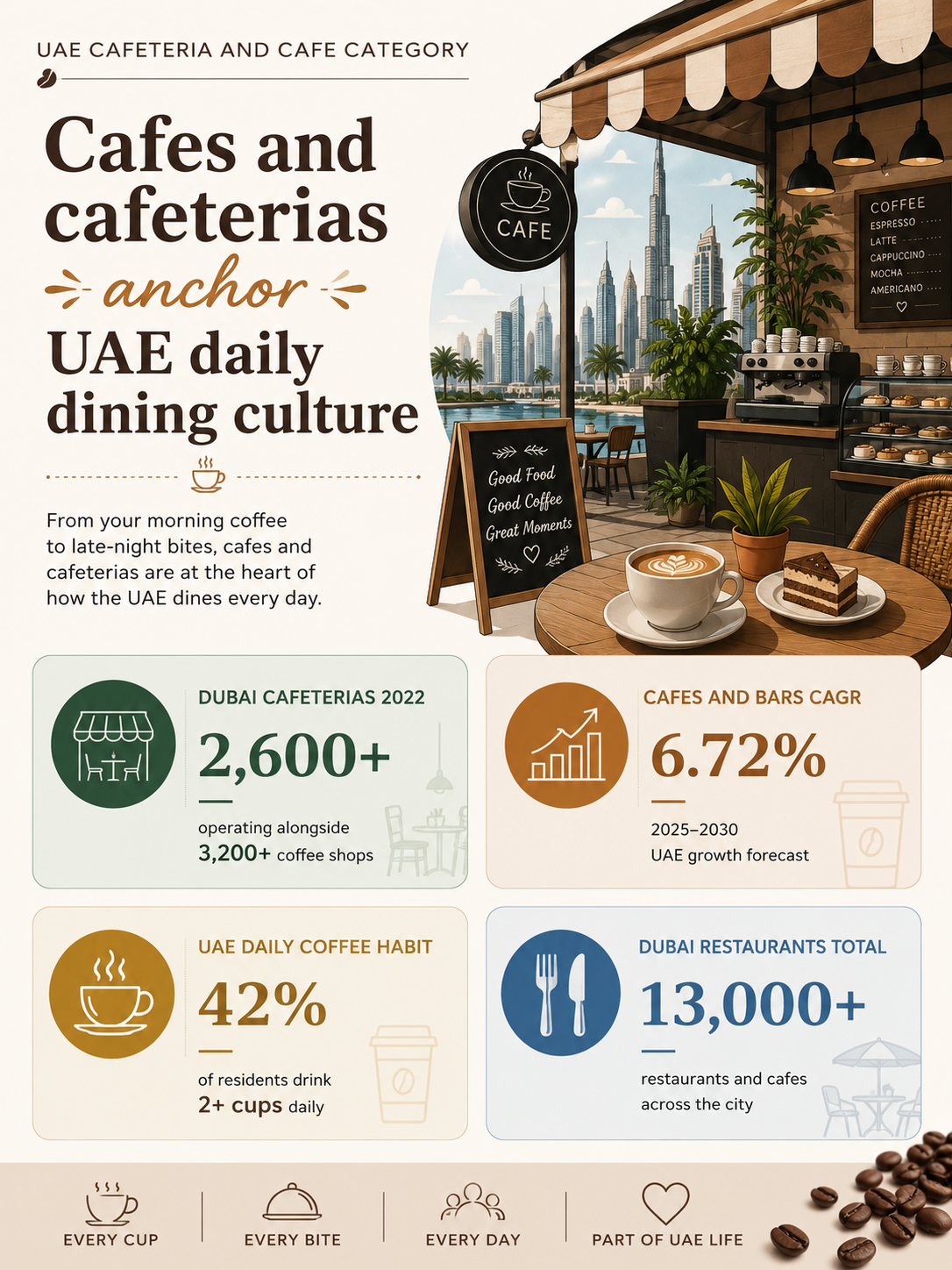
Key Stats at a Glance
What This License Covers
Activity code 5610.02 licenses you to run cafeteria-style food service serving meals for immediate consumption on the premises, whether that means a neighbourhood cafeteria, a mall or office food court counter, or a specialty coffee shop or third-wave cafe.
The scope covers residential neighbourhood cafeterias, mall food court and business district cafeterias, and specialty coffee shops and third-wave cafes serving breakfast counters, karak, brunch, and artisan coffee. It excludes the concession operation of eating facilities, which falls under its own activity code. If you serve ready-to-eat food and drink for on-site consumption, this is the code you need.
Who Your Clients Will Be
Your customer base splits into three groups: neighbourhood cafeteria customers, construction workers, taxi drivers, and residents in areas such as Karama, Deira, and Al Barsha, buying karak, paratha, and shawarma from early morning through late night, mall and office cafeteria customers, shoppers, office workers, and school-run parents needing quick counter service, and specialty coffee and cafe customers, coffee enthusiasts and remote workers seeking artisan coffee and brunch in areas such as Alserkal Avenue and Al Wasl.
The UAE foodservice market is worth USD 23.21 billion in 2025 and rising to USD 61.21 billion by 2031, per Mordor Intelligence, with cafeterias and independent operators already holding 59.60% of that market, and 42% of UAE residents drinking two cups of coffee daily, giving a cafeteria operator a market with both scale and genuinely consistent daily demand.
Mainland or Free Zone
Mainland registration through DET suits an operator running a cafeteria directly under standard commercial rules. Meydan Free Zone offers 100% foreign ownership, zero corporate tax on qualifying income, and a fully digital licensing process starting from AED 12,500, and Dubai Municipality approval follows after your license is issued rather than before, which keeps your initial setup timeline simple.
[blockCTACostCalculator]
Step-by-Step Setup Guide
- Step 1, book your trade name: Check availability through DET or your chosen free zone authority, confirming activity code 5610.02 is listed for your application.
- Step 2, prepare your setup documents: Passport copies of shareholders and directors, your intended cafeteria format, neighbourhood, mall and office, or specialty coffee, and a business plan summary.
- Step 3, get your initial approval and license: Meydan Free Zone's fully digital process moves quickly once your documents are complete.
- Step 4, get your Dubai Municipality approval: Apply for Dubai Municipality sign-off once your trading license is issued, since this activity needs that approval before you start serving food commercially.
- Step 5, secure your premises: A location matched to your format, a residential catchment, a mall unit, or a lifestyle district, is central to this activity.
- Step 6, register with MOHRE if you employ staff: This sets your visa quota and puts your team under Wage Protection System compliance from the outset.
Compliance and What You Need in Place
Third-party approval
You need Dubai Municipality approval after your trading license is issued and before you start commercial food service, so build that step into your timeline right after licensing rather than treating it as optional.
Anti-money laundering compliance
This activity is exempt from anti-money laundering compliance duties, keeping your ongoing regulatory load lighter than higher-risk trading categories.
Food safety and hygiene standards
Every item you serve needs to meet UAE food safety rules, so build clear sourcing, storage, and hygiene practices into your daily operations from the outset, particularly for a cafeteria serving food across long operating hours.
Format-specific operating standards
A neighbourhood cafeteria running from dawn to midnight needs different staffing and stock planning than a mall counter working a concentrated lunch rush, so build your operating hours and supply chain around your specific format rather than applying a one-size-fits-all approach.
Ongoing renewals
Renew your license every year, keep your Dubai Municipality approval current, and keep your MOHRE registrations up to date if you employ staff.
Market Opportunity
The UAE foodservice market is worth USD 23.21 billion in 2025 and is projected to rise to USD 61.21 billion by 2031, per Mordor Intelligence, with cafeterias and independent operators already holding 59.60% of that market rather than being squeezed out by large chains. Dubai alone had over 2,600 cafeterias and more than 3,200 coffee shops as of 2022, per Restroworks, within a wider market of over 13,000 restaurants and cafes serving a population of 200 nationalities.
Cafes and bars are projected to grow at a 6.72% CAGR through 2030, and with 42% of UAE residents drinking two cups of coffee daily, demand for this category runs consistently across the day rather than being tied to a single meal period. An operator who picks the right format, neighbourhood, mall and office, or specialty coffee, for their target catchment is well placed to capture a share of a market that keeps growing while staying dominated by independent operators rather than chains.
Dubai's population of over 200 nationalities also gives a cafeteria operator a genuinely diverse customer base to build a menu around, whether that means South Asian and Middle Eastern staples for a neighbourhood catchment or artisan brunch fare for a lifestyle district crowd. Getting the menu and format right for a specific catchment tends to matter more to long-term success than location alone.
Conclusion
A Cafeterias license under activity code 5610.02 is a workable business anchored in one of the most consistent, footfall-driven categories in UAE food service. Meydan Free Zone's foreign ownership, tax position, and digital setup process give an operator a practical route to serve residents, workers, and visitors across Dubai.
[blockCTAContact]
References







%20Business%20in%20Dubai.webp)