Table of Contents
Topic Summary
Choose the Right License Code First
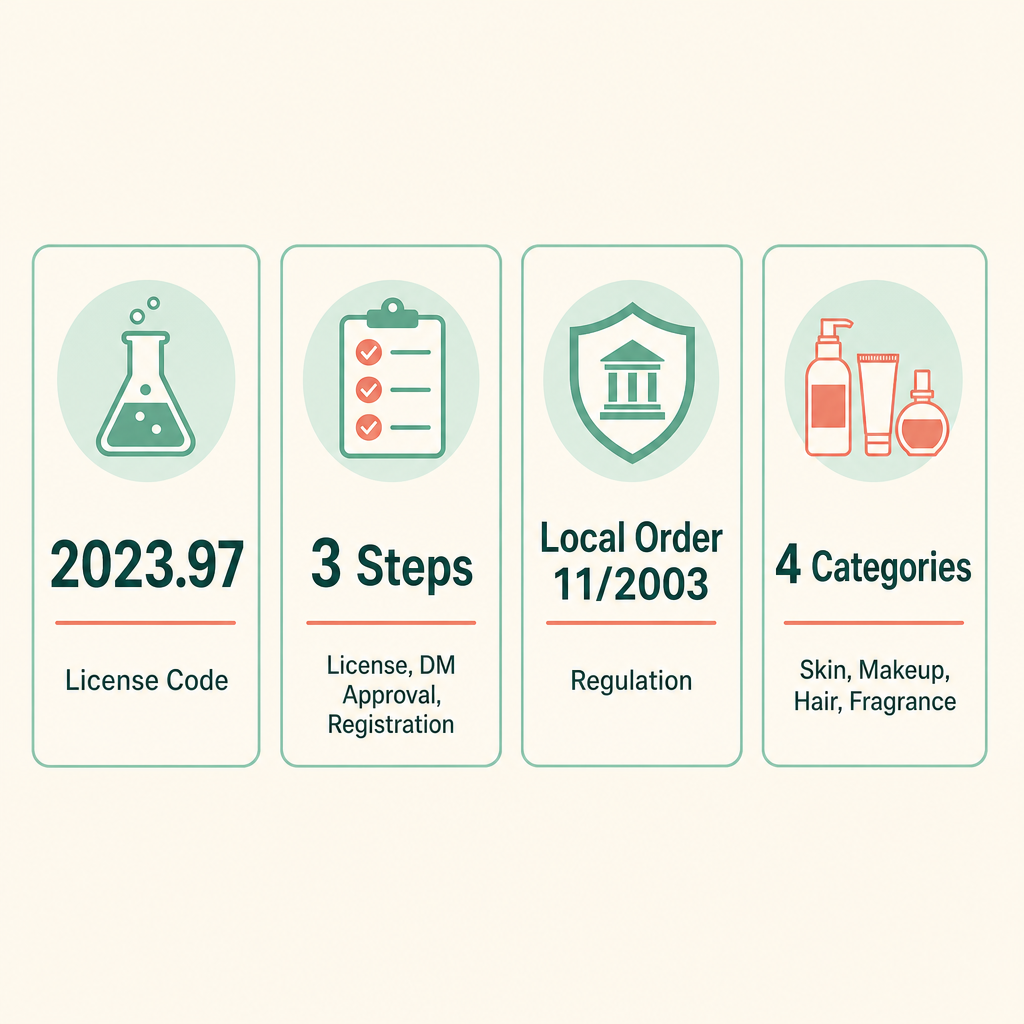
Cosmetics manufacturing falls under code 2023.97, while preservatives manufacturing falls under 2023.99, both classified under manufacture of chemicals and chemical products. Picking the correct code shapes every decision that follows, from premises to approvals.
Mainland Route Is Your Only Option
Both activity codes are permitted in the UAE but cannot be selected in Meydan Free Zone, making a mainland DET license the only viable path for cosmetics manufacturers. Committing to premises or plant before confirming this will cost you time and money.
Dubai Municipality Approvals Are Non-Negotiable
After your license is issued and before you begin production, you must secure approvals from Dubai Municipality's Environment Department and Health and Safety Department. Local Order No. 11 of 2003 governs the manufacture, sale, and importation of cosmetics across the emirate.
Register Every Product in Montaji Before Launch
No cosmetic product can legally reach the Dubai market without first being registered in the Montaji system. This step applies to every individual product, not just your company as a whole.
Pick a Business Model Before You Build
Under code 2023.97, you can either develop your own brand or offer contract manufacturing for other labels, with contract work typically delivering more reliable revenue. Under 2023.99, your customers are businesses in the cosmetics and pharmaceutical sectors, not end consumers.
Understand What Your Preservatives License Covers
Code 2023.99 permits production of ingredients like parabens, sodium benzoate, optiphen, and suttocide, which protect cosmetic products from bacteria, yeast, mould, and fungi. It is a narrower, technical market, but technical suppliers tend to have stronger client retention.
Compliance Burden Is Lower Than Expected in Some Areas
Both activity codes are exempt from Economic Substance Return requirements and are not subject to anti-money laundering regulations. The real compliance weight sits with Dubai Municipality product registration and facility approvals, not financial reporting obligations.
How to Start a Cosmetics Manufacturing Company or Cosmetic Products Business in Dubai?
Start with the thing that decides everything else. The two manufacturing codes below are permitted in the UAE, but neither is available for selection in Meydan Free Zone. If you want to make cosmetics or their preservatives, your route is a mainland license with Dubai Municipality approvals on top.
This guide covers what those two codes permit, the registration process every product has to pass, and the safety rules you work to. Dubai Municipality controls this sector tightly, so the compliance section is the real content here.
Key Stats at a Glance
What These Licenses Cover
Cosmetics Manufacturing, 2023.97
This covers producing cosmetics: body creams and lotions, eye make-up and facial cosmetics. In practice you can formulate, develop, manufacture and package skincare, make-up, hair care, fragrances, toiletries and other beauty items. You can work on your own formulations or offer contract manufacturing for other brands, which is often the steadier business.
Cosmetics and Personal Care Preservatives Manufacturing, 2023.99
This covers the chemicals that protect cosmetic and personal care products from microbial contamination, including parabens, sodium benzoate, optiphen and suttocide. These inhibit bacteria, yeast, mould and fungi, which would otherwise degrade a product's quality, effectiveness and safety.
Neither is available at Meydan Free Zone
Worth repeating because it changes your whole plan. The UAE permits both activities, but you cannot select either one in Meydan Free Zone. Check the mainland route before you commit to premises or plant.
Who Your Clients Will Be
Two models sit under 2023.97. You can build your own brand and sell it, which means carrying the marketing and the registration work yourself. Or you can manufacture under contract for other brands, where somebody else owns the label and you own the production capacity. The second is less glamorous and usually pays more reliably.
Under 2023.99 your buyers are the cosmetics and pharmaceutical industries, because preservatives are a business-to-business input rather than a consumer product. That is a narrower client list but a technical one, and technical suppliers get replaced less often.
Mainland or Free Zone
There is no real choice to make here. Manufacturing cosmetics or their preservatives in Dubai means a mainland license, because that is the only route where the activity codes exist.
If your interest is in the sector rather than in manufacturing specifically, there is a different conversation worth having. Trading, distribution and brand-owning models sit under other codes, and those are worth checking against the Meydan Free Zone activity list before you settle on making the product yourself.
[blockCTACostCalculator]
Step by Step Setup Guide
- Step 1, confirm the route: Neither code is available in Meydan Free Zone, so plan for a mainland license from the start rather than discovering it at application stage.
- Step 2, apply under the right parent category: Both activities sit under Manufacture of chemicals and chemical products. Pick 2023.97 for cosmetics or 2023.99 for preservatives, or both if you plan to do both.
- Step 3, satisfy the applicant condition: To register products later you need a company incorporated in Dubai, or a warehouse in Dubai plus a trade license that names cosmetics activities.
- Step 4, get Environment Department approval: After your license is issued, Dubai Municipality's Environment Department has to approve you before you begin manufacturing.
- Step 5, prepare your registration and permits package: This goes to the Health and Safety Department of Dubai Municipality, and you work to their technical guidelines for cosmetic and personal care products.
- Step 6, register every product in Montaji: Nothing can be manufactured, imported, exported, advertised, sold or distributed in Dubai until it is registered.
- Step 7, get advertising pre-approval before you promote anything: Campaign material goes through Montaji too.
Compliance and What You Need in Place
Product registration
Consumer safety is the principle behind all of it. Registration gives the Registration and Permits Section enough information to assess whether a product is safe, and the Consumer Products Safety Section reviews it. No product reaches the Dubai market without going through this first.
Who applies
Whoever imports or locally manufactures the product is responsible for registering it. Local manufacturers deal with the Registration and Permits Section directly. For foreign-made goods the importer carries the registration duty. Agents in both cases must make sure products are registered before anything is placed on the market or shipped in.
Laboratory test report
You need a document setting out the laboratory test results in detail, issued by a certified lab using accredited test methods. Not a summary, and not from an unaccredited lab.
Extra documents by claim
What you print on the label decides what else you have to prove. A Halal logo means a valid Halal certificate from a recognised Islamic society in the country of origin. Organic or vegan claims need certificates from recognised bodies. Specific claims or statistics on the label need clinical studies behind them. A safety assessment report may be asked for on an ingredient or on the whole product.
Safety and quality specifications
Products may contain only the active substances listed on the label and no human-derived substances. They must stay inside the limits for microbial contamination and toxic heavy metals, and outside the restricted substances list. They must meet quality standards on stability, shelf-life, packaging and labelling, follow Good Manufacturing Practice, and never be made or stored in unsanitary conditions.
Advertising
Promotional activity needs pre-approval through Montaji, covering brochures, newspapers and magazines, campaigns, social media and television advertising indoors and out. Two things fall outside it: sales subject to conditions such as gifts, prizes or discount coupons, and free distribution of samples of already registered products.
Substance and AML
Both activities are exempt from the Economic Substance Return, and neither is subject to AML regulations.
Market Opportunity
Cosmetics is one of the world's fastest-growing consumer industries, and Dubai's mix of nationalities and spending power makes it a natural market for beauty products.
The regulated categories are wide. Dubai Municipality's guidelines cover body, face, hand, foot, eye and lip care, make-up, sunscreen, shaving products, depilatories, nail and cuticle products, oral hygiene, baby products, and hair and scalp products including dyes and straightening treatments. That breadth is where a specialist can pick a niche.
The registration burden is worth reading as a filter rather than a wall. Lab reports, certificates and safety assessments cost time and money, which keeps casual entrants out and rewards anyone willing to build the documentation properly once and reuse the process for every product after that.
Conclusion
Cosmetics manufacturing in Dubai is a real business with a real market, but it is a mainland business. Codes 2023.97 and 2023.99 are permitted in the UAE and are not available for selection in Meydan Free Zone, so start the conversation there rather than at the end of a license application.
Three things decide how smoothly this goes: Environment Department approval before you manufacture, Montaji registration before anything reaches the market, and label claims you can actually document. Sort those and the rest is routine.
[blockCTAContact]