
Table of Contents
Frequently Asked Questions
How long does a local cheque usually take to clear?
The time depends on the banks involved, the deposit cut-off and whether the cheque is local or drawn on an overseas bank. Each bank sets its own cut-off times and hold policies under the Central Bank of the UAE's framework. Ask your bank for its clearing timeline in writing before you rely on the funds.
Can I withdraw money straight after depositing a cheque?
Not safely. A deposit shows that the bank has accepted the cheque, not that the funds are usable. You can withdraw or pay out only after the cheque clears and the paying bank has settled, so plan payroll and supplier payments around cleared funds.
Why do banks return cheques?
Common reasons include insufficient funds, a signature that does not match bank records, an incorrect or stale date, and a mismatch between the amount in words and figures. The paying bank returns the cheque with a stated reason. The beneficiary must then ask the issuer for a replacement or another form of payment.
Do weekends and public holidays delay cheque clearing?
Yes. Only working banking days count towards processing. A cheque deposited after the cut-off, or late on a Friday, is processed on the next banking day, and public holidays extend the wait further.
Is a post-dated cheque valid in the UAE?
Landlords, contractors and trade counterparties commonly accept post-dated cheques as payment commitments. The bank will normally not honour the cheque before the date written on it. The issuer should still treat it as a binding obligation and keep enough funds in the account to cover it.
What happens if a company cheque bounces?
The issuer can face bank return charges, possible account restrictions and damaged relationships with suppliers and landlords. Since 2022, a cheque returned for insufficient funds is mainly treated as a debt the holder can enforce. Criminal penalties remain for acts such as bad faith or fraud. Founders should avoid issuing any cheque they cannot cover.
Do cheques from overseas banks take longer to clear?
Generally yes. Overseas cheques pass through correspondent banking, which adds steps compared with a local cheque. Banks may also place holds before releasing the funds, so avoid committing money that depends on a foreign cheque until it has cleared.
Can a Meydan Free Zone company issue and deposit cheques?
Yes, once the company has an operating corporate bank account. A Meydan Free Zone company banks under the same federal rules as other UAE companies, so clearing follows the bank's own process. Meydan Free Zone's mCore service provides business bank account support, although the bank makes the final approval decision.
Topic Summary
What Cheque Clearing in the UAE Means
Cheque clearing in the UAE is the interbank process that moves money from the account of the person who wrote a cheque to the account of the person who deposited it. A cheque counts as cleared only after the paying bank confirms the funds and the signature, and settlement is complete. Clearing time is the gap between your deposit and that point.
Who Regulates Cheque Clearing
The Central Bank of the UAE regulates banks and oversees the payment and clearing systems they use, including the Image Cheque Clearing System (ICCS). ICCS exchanges cheque images electronically between banks. Each bank applies its own cut-off times, account checks and hold policies on top of this framework, so the experience can differ between banks.
How the Cheque Clearing Process Works
When you deposit a cheque, your bank sends its image and details electronically to the paying bank. That bank checks signature, date and available funds. If everything is in order, settlement occurs and your account is credited. If not, the cheque is returned with a stated reason.
Factors That Affect Clearing Time
Cheque clearing time in the UAE depends on the issuing bank, deposit cut-off, weekends and public holidays, cheque amount, and whether the cheque is local or drawn on an overseas bank. Errors such as an incorrect date or mismatched signature add further delay.
Risks of Returned and Bounced Cheques
A returned cheque can carry bank charges, delayed supplier payments and legal exposure for the issuer. Since 2022, a cheque returned for insufficient funds is mainly treated as a debt the holder can enforce directly. Criminal penalties remain for acts such as bad faith or fraud. Treat each cheque as a binding commitment, and don't issue one you can't cover.
Cheque Clearing for Meydan Free Zone Companies
A Meydan Free Zone company banks under the same Central Bank rules as any other UAE company, so clearing follows the bank's process. Meydan Free Zone's mCore service provides business bank account support, helping you get the account in place before you issue or receive cheques.
Conclusion
Cheque clearing time in the UAE is set by bank process, cut-offs and cheque accuracy, not by the date on the cheque. Plan cash flow around cleared funds, treat every issued cheque as a binding commitment, and use transfers where timing matters.
Cheque Clearing in the UAE: How It Works and How Long It Takes
Landlords, contractors and trade counterparties in the UAE still ask for cheques, often post-dated, as routine security. Many founders treat a deposited cheque as cash, but the money is only usable once the cheque clears, and cash-flow plans that ignore that gap can leave payments short.
This guide explains how cheques clear between UAE banks, what affects the clearing time and what a returned cheque can cost your business.
What Cheque Clearing in the UAE Means
Cheque clearing in the UAE is the interbank process that moves money from the account of the person who wrote a cheque to the account of the person who deposited it. A cheque counts as cleared only after the paying bank confirms the funds and the signature, and settlement is complete. Clearing time is the gap between your deposit and that point.
Deposit, Clearing and Cleared Funds
Deposit is when your bank accepts the cheque. It does not mean the money is usable. Clearing is the verification and settlement between the two banks. Cleared funds are the point at which you can withdraw or pay out.
Say a trader deposits a supplier's cheque on Monday and books the money as available. The cheque hasn't cleared, and a payroll run planned around it falls short.
Why Cheques Still Matter for UAE Businesses
Cheques remain common for rent, contractor payments and security deposits. Post-dated cheques act as payment commitments. Digital transfers haven't replaced them in every commercial relationship.
A founder leasing workspace, for example, is often asked for post-dated cheques covering the lease period. Each one is a firm obligation on a fixed date.
Who Regulates Cheque Clearing
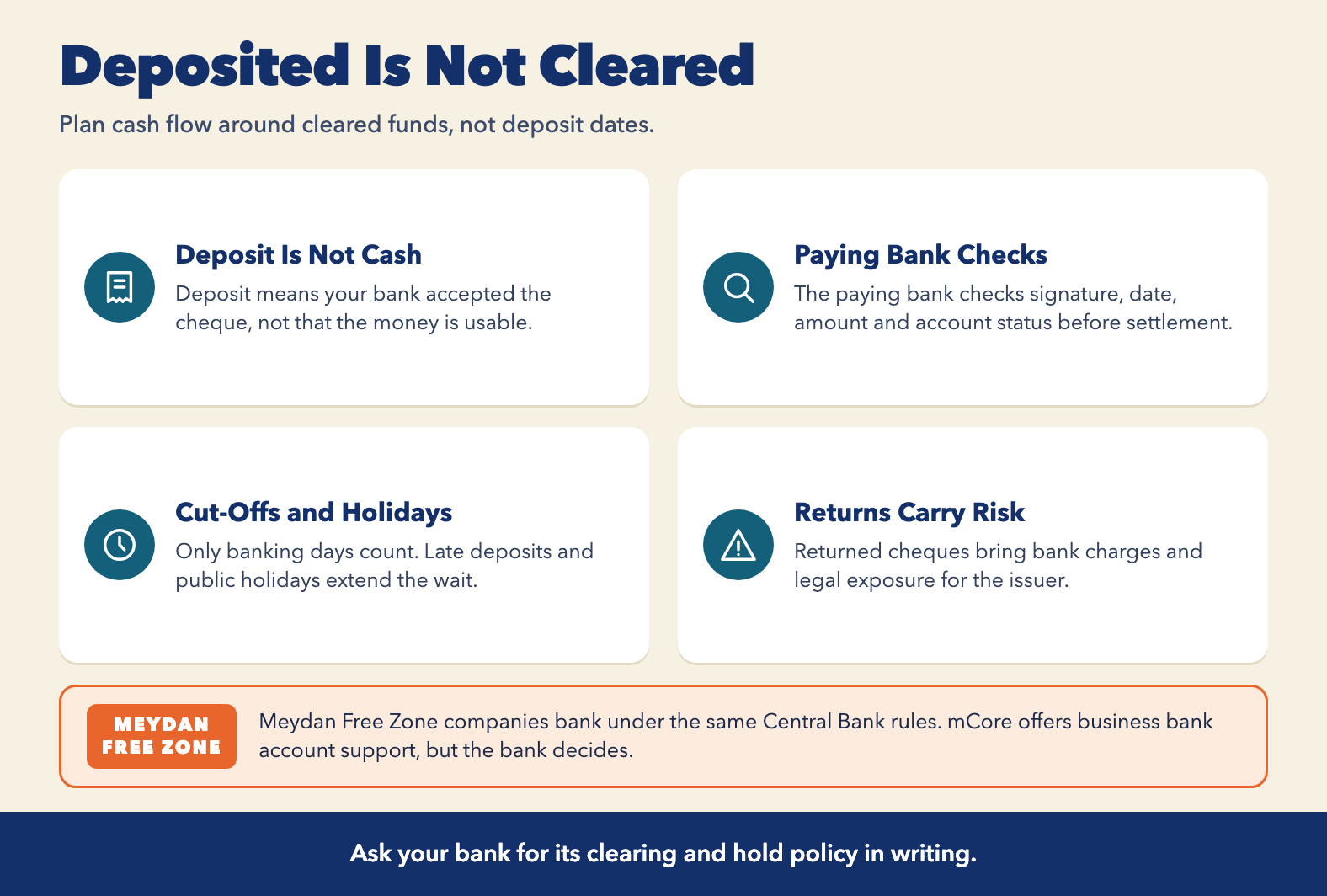
The Central Bank of the UAE regulates banks and oversees the payment and clearing systems they use, including the Image Cheque Clearing System (ICCS). ICCS exchanges cheque images electronically between banks. Each bank applies its own cut-off times, account checks and hold policies on top of this framework, so the experience can differ between banks.
The Central Bank's Role
The Central Bank is the federal regulator for banks and payment systems. It sets the framework in which banks exchange and settle cheques. Free zone companies bank under the same federal rules as everyone else.
A UK founder with a Meydan Free Zone company shouldn't expect a different clearing regime from a mainland competitor. The bank's process is what you deal with.
Where Bank Policy Takes Over
- Cut-off times are set by each bank.
- Account holds and limits on uncleared funds are bank decisions.
- Newer accounts and large cheques often attract closer review.
- Ask for the written policy, not a verbal estimate.
How the Cheque Clearing Process Works
When you deposit a cheque, your bank sends its image and details electronically to the paying bank. That bank checks signature, date and available funds. If everything is in order, settlement occurs and your account is credited. If not, the cheque is returned with a stated reason.
Step 1: Deposit and Image Capture
- You deposit at a branch, ATM or through mobile deposit.
- The bank captures the cheque image and key details.
- Cut-off times decide which business day processing starts.
Step 2: Presentment to the Paying Bank
- Image and details move electronically between banks.
- The paying bank checks signature, date, amount and account status.
Step 3: Settlement or Return
- Funds settle between banks if the cheque is honoured.
- A return carries a reason: insufficient funds, signature mismatch or a stale date, or presentation before the date written on the cheque.
- Your bank then credits the account or reverses the entry.
Picture a contractor whose cheque is returned for a signature mismatch. They must request a replacement before work continues.
Factors That Affect Clearing Time
Cheque clearing time in the UAE depends on the issuing bank, deposit cut-off, weekends and public holidays, cheque amount, and whether the cheque is local or drawn on an overseas bank. Errors such as an incorrect date or mismatched signature add further delay.
Banking Days, Cut-Offs and Holidays
Only working banking days count toward processing. A cheque deposited late on a Friday afternoon is processed on the next banking day. Public holidays extend the wait further, so build that into any payment date.
Cheque Type, Amount and Accuracy
- Manager's cheques and company cheques are treated differently by banks.
- Large amounts may trigger extra verification.
- Date, amount in words and figures, and signature must match records.
Local Versus Foreign Cheques
Overseas cheques go through correspondent banking, so they take longer to clear. Banks may also place holds before releasing funds. If a foreign client pays you this way, get the bank's timeline in writing before relying on the money.
Clearing Factors at a Glance
| Factor | Effect on Clearing |
|---|---|
| Deposit cut-off time | A cheque deposited after cut-off starts processing on the next banking day. |
| Weekends and public holidays | Non-banking days don't count, so the wait extends. |
| Local versus overseas cheque | Overseas cheques pass through correspondent banks and take longer. |
| Cheque errors or signature mismatch | The cheque is returned, and you restart with a replacement. |
| Bank hold policy on large or new-account cheques | Funds may stay unavailable until the bank's review ends. |
Risks of Returned and Bounced Cheques
A returned cheque can carry bank charges, delayed supplier payments and legal exposure for the issuer. Since 2022, a cheque returned for insufficient funds is mainly treated as a debt the holder can enforce directly. Criminal penalties remain for acts such as bad faith or fraud. Treat each cheque as a binding commitment, and don't issue one you can't cover.
Consequences for the Issuer
Expect bank return charges and possible account restrictions. Legal exposure sits under the Commercial Transactions Law (Federal Decree-Law No. 50 of 2022), and the guide to penalties for non-compliance in the UAE shows how seriously the system treats defaults. Suppliers and landlords also remember.
Consider a company that issues a post-dated rent cheque before a client payment arrives. The client pays late and the cheque is returned. The landlord relationship suffers even if the money arrives days later.
Protecting Cash Flow Against Delays
- Track cheques by deposit date and expected clearing, not invoice date.
- Keep a buffer before committing uncleared funds.
- Use bank transfers for time-critical payments.
- Don't issue a post-dated cheque against income you haven't received.
Cheque Clearing for Meydan Free Zone Companies
A Meydan Free Zone company banks under the same Central Bank rules as any other UAE company, so clearing follows the bank's process. Meydan Free Zone's mCore service provides business bank account support, helping you get the account in place before you issue or receive cheques.
Getting the Account in Place First
Clearing depends on an operating corporate account. mCore covers business bank account support, company stamps, business cards and e-commerce setup. It doesn't guarantee approval, because the bank decides. Review the bank requirements for Meydan Free Zone company setup first.
A new founder should wait for the account to open before accepting a client's cheque.
Decision Points for Founders
- Decide which payments need cheques and which can use transfers.
- Confirm the bank's clearing and hold policy before relying on funds.
- Read the guide to opening a corporate bank account in Dubai for the basics.
Free Business Setup Cost Calculator
Calculate NowConclusion
Cheque clearing time in the UAE is set by bank process, cut-offs and cheque accuracy, not by the date on the cheque. Plan cash flow around cleared funds, treat every issued cheque as a binding commitment, and use transfers where timing matters.
Meydan Free Zone's mCore offers business bank account support to help get your account in place. Then confirm the bank's clearing and hold policy before relying on cheque payments.
Ready to Launch Your Business in Dubai?
Let's Connect