Table of Contents
Frequently Asked Questions
Is a verbal warning enough to discipline an employee in the UAE?
A verbal warning alone is weak protection. If a dispute escalates, the employer carries the burden of proof, so the warning should be written, dated and signed or acknowledged by the employee. Written records show the breach, the response and the penalty applied.
What disciplinary penalties can a private-sector employer apply for misconduct?
Article 39 of Federal Decree-Law No. 33 of 2021 lists the penalties. They range from a written caution or warning to a deduction of up to five days' wage in a month, or suspension without pay for up to 14 days. It also allows denial of an increment or promotion, and dismissal with end-of-service gratuity. The penalty must match the offence and follow an investigation.
Does an employee have the right to respond before a sanction is applied?
Yes. The employer should notify the employee of the allegation in writing and allow a fair chance to reply, in writing or at a meeting. Record the reply, even if the employee refuses to give one. Skipping this step weakens the employer's position in a labour dispute.
Can an employer deduct pay as a disciplinary penalty?
Yes, but only as a listed penalty: a deduction of up to five days' wage in a month. Each deduction must be recorded in payroll, and wages must still be paid on time. Only one penalty may be applied for one violation, so a suspension plus a deduction for the same offence exposes the employer to a claim.
When can an employer dismiss an employee without notice in the UAE?
Dismissal without notice applies only to the grounds listed in Article 44 of Federal Decree-Law No. 33 of 2021. They include serious misconduct and unexcused absence beyond set limits. The employer must first carry out a written investigation. A wrongful dismissal can lead to a compensation claim.
Do Meydan Free Zone companies follow the same disciplinary rules as mainland employers?
Yes, in substance. The federal Labour Law is the baseline in most free zones, so a Meydan Free Zone employer should run the same fair, documented process. The difference is administrative: permits and visas run through the free zone, not MOHRE. Keep contracts, warnings and responses in one signed file.
What records should an employer keep after a disciplinary hearing?
Keep the written notice of the allegation, investigation notes with dates and witnesses, the employee's response, and the signed decision. Store them with the employment contract and any policy annex. Payroll entries for any deduction should match these documents.
Where can an employee complain about an unfair disciplinary sanction?
An employee can start with the employer's internal grievance process. If it remains unresolved, a mainland employee can complain to MOHRE, while free zone disputes start within the free zone structure. The employer will then need to produce its dated records.
Topic Summary
What Disciplinary Action Under UAE Labour Law Means
Disciplinary action is the set of penalties an employer may apply to a private-sector employee who breaks the law, the work rules or the employment contract. Federal Decree-Law No. 33 of 2021 and its Executive Regulations (Cabinet Resolution No. 1 of 2022) require written notice, an investigation and a chance for the employee to respond.
Free Zone Employers and Disciplinary Procedure
A Meydan Free Zone company still needs a fair, written disciplinary process. Meydan Free Zone issues employment visas and permits for its companies directly, rather than MOHRE, and disputes start within the free zone structure. Keep every warning, response and decision in writing, because an undocumented process gives you little protection.
Disciplinary Penalties and Their Limits
Article 39 of the Decree-Law lists the penalties an employer may use. They start with a written caution and a written warning. Next come a deduction of up to five days' wage in a month and suspension without pay for up to 14 days. The list also covers denial of a periodic increment or promotion, and dismissal with end-of-service gratuity. Each penalty must match the offence and follow a recorded investigation.
Running a Fair Disciplinary Procedure
A fair disciplinary procedure in the UAE follows a clear order: identify the breach, investigate, notify the employee in writing, hear the response, decide a proportionate penalty and record the outcome. Each step needs a dated document, because the employer carries the burden of proof if the matter escalates.
Pay Deductions, Gratuity and Cost Risks
Disciplinary decisions can affect pay, notice and end-of-service gratuity, so mistakes are costly. Deductions must stay within legal limits and appear in payroll. Wrongful sanctions invite compensation claims.
Common Employer Mistakes
The most common mistakes are verbal-only warnings, skipping the employee's right to respond, disproportionate penalties and missing records. In a labour dispute, documented process often matters more than the offence itself, and an undocumented procedure is hard to defend.
Decisions for a Founder
Write a short disciplinary policy, attach it to every employment agreement and follow the same process each time. Consistent records make decisions on warnings, suspension or dismissal easier to defend.
Disciplinary Procedures for UAE Employers
A conduct problem in a small team rarely comes at a good time, and a rushed warning or dismissal can turn into a costly labour claim. Founders often ask whether a verbal warning is enough, or whether a signed contract lets them dismiss without a process. This guide explains how disciplinary action works under UAE labour law, which penalties are allowed and how to document each step.
What Disciplinary Action Under UAE Labour Law Means
Disciplinary action is the set of penalties an employer may apply to a private-sector employee who breaks the law, the work rules or the employment contract. Federal Decree-Law No. 33 of 2021 and its Executive Regulations (Cabinet Resolution No. 1 of 2022) require written notice, an investigation and a chance for the employee to respond.
The Legal Basis for Employer Sanctions
Federal Decree-Law No. 33 of 2021 governs private-sector employment, and the Ministry of Human Resources and Emiratisation (MOHRE) publishes guidance on it. The law replaced Federal Law No. 8 of 1980, so anything built on the old law is out of date. Sanctions must follow the law, your work policy and the agreement. Say a founder issues a written warning for repeated unexplained absence and cites the attendance clause. That warning stands on firmer ground than a verbal reprimand.
Misconduct Versus Poor Performance
Misconduct covers absence, breach of confidentiality or harassment. Performance gaps usually call for review and warning first. A sales employee who misses targets belongs on a documented improvement plan. An employee who leaks client details faces a formal misconduct process. Treating the two alike weakens your position in a dispute.
Free Zone Employers and Disciplinary Procedure
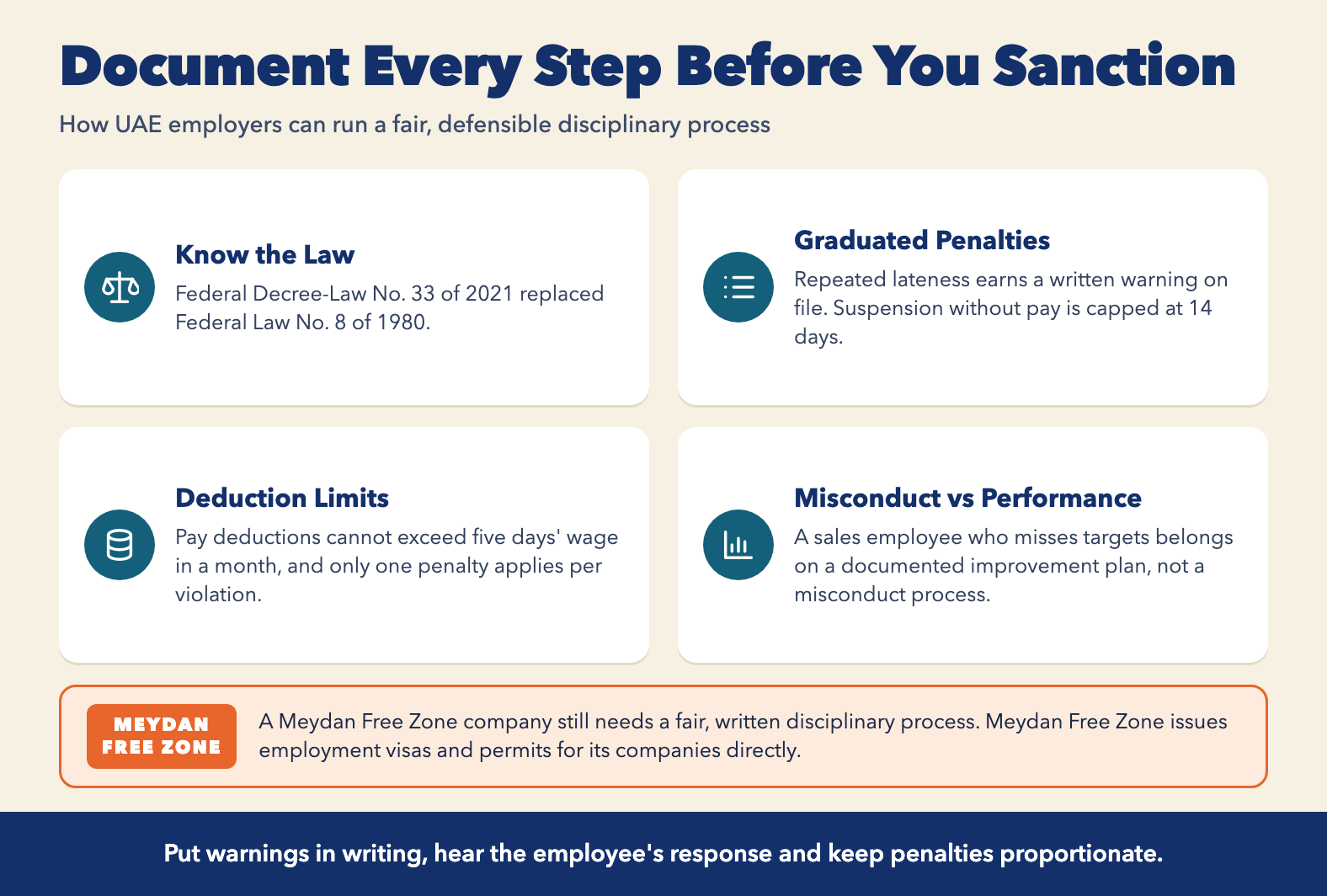
A Meydan Free Zone company still needs a fair, written disciplinary process. Meydan Free Zone issues employment visas and permits for its companies directly, rather than MOHRE, and disputes start within the free zone structure. Keep every warning, response and decision in writing, because an undocumented process gives you little protection.
How Federal Rules Apply to Free Zone Employers
The federal law is the baseline in most free zones, while the Dubai International Financial Centre (DIFC) and Abu Dhabi Global Market (ADGM) have their own employment laws. Don't assume a mainland authority holds your records, because permits and visas run through the free zone. You still owe employees a fair, documented process. A Meydan Free Zone founder with three employees might keep each warning in a signed file beside the employment agreement.
Where mResidency and mAccounting Fit In
mResidency handles residence visas, Emirates ID and medical insurance, all of which are affected when employment ends. mAccounting supports bookkeeping, so any deduction or final settlement should be reflected accurately in the accounts. Neither service manages discipline itself. Check your own payroll record before applying a deduction.
Free Business Setup Cost Calculator
Calculate NowDisciplinary Penalties and Their Limits
Article 39 of the Decree-Law lists the penalties an employer may use. They start with a written caution and a written warning. Next come a deduction of up to five days' wage in a month and suspension without pay for up to 14 days. The list also covers denial of a periodic increment or promotion, and dismissal with end-of-service gratuity. Each penalty must match the offence and follow a recorded investigation.
Warnings, Suspensions and Deductions
- First late arrival: an informal reminder, noted on file.
- Repeated lateness: a written warning on file.
- Serious or repeated breach: suspension without pay for up to 14 days.
- Pay deductions: no more than five days' wage in a month.
Disciplinary Steps and the Record Each One Needs
| Step | Stage | Record Required |
|---|---|---|
| Breach identified | Manager logs three unexcused absences | Dated attendance log |
| Investigation | Facts and witnesses are checked against the policy | Investigation note, kept apart from the decision |
| Written notice | Employee is told of the allegation | Signed notice with date of delivery |
| Employee response | Reply in writing or at a meeting | Written reply or meeting minutes, including a refusal |
| Final decision | Proportionate penalty is chosen | Signed written decision filed with the employment agreement |
When Dismissal Becomes a Risk
Dismissal without notice is limited to the grounds in Article 44 of the Decree-Law, and it requires a written investigation first. Dismiss a worker without investigation and you can face a compensation claim. Read the guide on redundancy and dismissal under UAE labour law before ending any employment.
Penalties Employers Cannot Apply
- Sanctions missing from the law or the agreement.
- Penalties applied after the permitted time limit.
- Two penalties for one breach, such as suspension plus a pay deduction for one absence. The law allows only one penalty per violation.
Running a Fair Disciplinary Procedure
A fair disciplinary procedure in the UAE follows a clear order: identify the breach, investigate, notify the employee in writing, hear the response, decide a proportionate penalty and record the outcome. Each step needs a dated document, because the employer carries the burden of proof if the matter escalates.
Step 1: Record the Breach and Investigate
- Write down facts, dates and witnesses.
- Check the agreement and policy for the rule breached.
- Keep the investigation separate from the decision.
Step 2: Notify the Employee and Hear Their Response
- Issue a written notice describing the allegation.
- Allow a fair reply, written or in a meeting.
- Record the reply, even a refusal. Attach any explanation to the file.
Step 3: Decide the Penalty and Record the Outcome
- Choose a sanction proportionate to the breach.
- Issue a signed written decision, filed with the agreement.
- Note the complaint route, as set out in employee grievance procedures in the UAE.
Pay Deductions, Gratuity and Cost Risks
Disciplinary decisions can affect pay, notice and end-of-service gratuity, so mistakes are costly. Deductions must stay within legal limits and appear in payroll. Wrongful sanctions invite compensation claims.
Payroll Records and Wage Protection
A deduction needs a legal basis and a clear record. Say a deduction for damaged equipment is logged in payroll with the employee's signed acknowledgement. Wages must still be paid on time, whatever the dispute.
Gratuity and Final Settlement After Dismissal
Gratuity depends on length of service and the grounds for ending employment. Calculate it from the contract and the law, not from memory. Final dues are generally payable within 14 days of the contract ending, so prepare a documented settlement statement before cancelling the employee's visa.
Common Employer Mistakes
The most common mistakes are verbal-only warnings, skipping the employee's right to respond, disproportionate penalties and missing records. In a labour dispute, documented process often matters more than the offence itself, and an undocumented procedure is hard to defend.
Process Failures That Cost Employers Cases
- No written notice.
- No investigation.
- Inconsistent treatment: two employees commit the same breach, only one is sanctioned.
What Happens When a Dispute Escalates Further
The employee can file a complaint, and the employer must produce records. A dated warning file answers it. Read about labour disputes in Dubai for the resolution routes.
Decisions for a Founder
Write a short disciplinary policy, attach it to every employment agreement and follow the same process each time. Consistent records make decisions on warnings, suspension or dismissal easier to defend.
Building a Disciplinary Policy Before You Hire
Define offences and penalties in plain language, align them with the agreement and review them when the law changes. A Meydan Free Zone founder can add a policy annex to each agreement before issuing visas through mResidency.
When to Take Legal Advice
Speak to a lawyer for serious misconduct, possible dismissal without notice or criminal allegations. A founder who suspects a manager of fraud should take advice before dismissing them.
Conclusion
Employers who document each step are in the strongest position if a disciplinary decision is challenged. Set policy early, apply proportionate penalties and keep clean payroll records. Meydan Free Zone issues employment visas and permits for its companies directly, so a Meydan Free Zone employer should keep warnings, responses and payroll entries in one file beside each employment agreement.
Ready to Launch Your Business in Dubai?
Let's Connect