Table of Contents
Frequently Asked Questions
How long can a company account stay unused before a bank marks it dormant?
The exact period depends on the Central Bank of the UAE framework and the bank's own policy, so it differs between banks. Only customer-initiated transactions usually count as activity. Automatic debits such as bank fees do not keep an account active, so a quiet account can still be flagged.
Can a company withdraw money from a dormant account in the UAE?
Not until the bank lifts the restriction. The company must contact the bank, submit updated KYC documents and confirm its authorised signatories. Once the bank releases the account, normal withdrawals and payments can resume.
Will a bank charge fees on a dormant business account?
Some banks may. Any dormancy or maintenance fees are set by each bank within Central Bank rules, so check the published tariff for your account type. Minimum balance charges can also erode a small balance month after month.
What documents does a bank ask for to reactivate a company account?
Banks typically ask for a valid trade license and the passport and Emirates ID of each authorised signatory. They also ask for updated shareholder and beneficial owner details. If signatories have changed, expect to provide a board resolution. Requirements vary by bank, so ask your relationship manager for the exact list.
What happens to the balance if nobody claims a dormant account?
If a balance stays unclaimed long enough, the bank transfers it to the Central Bank of the UAE, which holds it until the owner claims it. Banks are expected to try to contact the account holder first. Keeping your registered address, email and signatory details current helps you receive those notices.
Does a dormant account affect VAT or Corporate Tax payments?
Yes, if it is your only payment route. Obligations to the Federal Tax Authority continue regardless of the account status. A restricted account can cause late payments and administrative penalties, so reactivate it or open a working alternative before a deadline.
Should a company close an account it is not using?
Close it if the company will not trade again. Closing formally avoids ongoing fees and compliance gaps. If trading will restart, keeping the account active with small scheduled transactions is usually simpler than reopening, because a new application means fresh onboarding and a possible rejection.
Can a Meydan Free Zone company keep a bank account open while trading is paused?
Yes, but the bank manages dormancy, not Meydan Free Zone. The company should make small scheduled transactions and send renewed license details to the bank promptly. mCore provides business bank account support, but it does not guarantee approval or prevent dormancy.
Topic Summary
What a Dormant Bank Account in the UAE Is and When It Applies
A dormant bank account in the UAE is an account with no customer-initiated transactions for a period set by Central Bank of the UAE rules and the bank's own policy. The bank restricts it, may charge fees, and requires updated KYC details before the company can use it again.
Dormant Bank Account in the UAE: Rules Banks Apply to Companies
Banks are expected to try to contact the account holder as an account approaches dormancy. They then restrict activity and, if a balance stays unclaimed long enough, transfer it to the Central Bank of the UAE, which holds it until it is claimed. Company accounts also face KYC refresh checks, so authorised signatories and trade license details must stay current.
Compliance Risks and Costs of an Inactive Company Account
An inactive company account can carry dormancy or maintenance fees. It can also restrict payments and disrupt payroll, VAT and Corporate Tax. Fees are set by each bank within Central Bank rules, so ask your bank what applies. The larger cost is usually delay when you need funds quickly.
How to Reactivate a Dormant Company Account
To reactivate a dormant company account, contact the bank, submit updated KYC documents, confirm authorised signatories and provide a valid trade license. Make a customer-initiated transaction if required. Timelines vary by bank, so confirm the current process with your relationship manager.
How Meydan Free Zone Companies Can Keep Accounts Active
Meydan Free Zone companies can keep a bank account active by scheduling regular transactions and keeping license and signatory details current. Meydan Free Zone issues the Business License digitally after registration. Meydan Free Zone does not manage bank dormancy, and support never guarantees approval or an active account.
Dormant Account Decisions for Founders
Founders should keep a company account active with small scheduled transactions if trading is paused, or close it formally if the company will not trade. Closing avoids fees and compliance gaps. Keeping it open preserves banking continuity. The choice depends on when you expect to restart.
Next Steps for Founders
A dormant bank account is a process the bank runs once inactivity passes its threshold, so act before the flag appears. Keep signatory and license details current, move small amounts when trading pauses, and reactivate quickly if the flag appears. For a Meydan Free Zone company, send the renewed Business License to the bank after each renewal so its records stay current.
Dormant Bank Accounts in the UAE: Rules for Companies
Founders often assume a quiet company account simply waits for them, but UAE banks treat long inactivity as a compliance matter. A dormant flag can freeze payments, add charges and trigger fresh Know Your Customer (KYC) checks, often just when a paused company needs to pay a bill. This guide explains when an account becomes dormant, what it can cost and how to reactivate it or avoid dormancy altogether.
What a Dormant Bank Account in the UAE Is and When It Applies
A dormant bank account in the UAE is an account with no customer-initiated transactions for a period set by Central Bank of the UAE rules and the bank's own policy. The bank restricts it, may charge fees, and requires updated KYC details before the company can use it again.
Dormant, Inactive and Closed Accounts Compared
An inactive account has had little activity but remains fully usable. A dormant account has crossed the bank's threshold and carries restrictions. A closed account no longer exists, and reopening means new onboarding.
The bank sets its internal stages within the Central Bank framework. Automatic debits such as bank charges do not count as customer activity. Picture a trading company with a paused project: its only movements are fees, so the account still drifts towards dormancy.
Which Authority Sets the Rules
The Central Bank of the UAE regulates banks and sets the dormant account framework, now the Dormant Accounts and Unclaimed Funds Regulation issued in November 2025. Each bank applies its own notice and fee process within it. Free zone authorities license the company but do not regulate bank dormancy. A Meydan Free Zone company will receive any dormancy notice from its bank, not from Meydan Free Zone.
Dormant Bank Account in the UAE: Rules Banks Apply to Companies
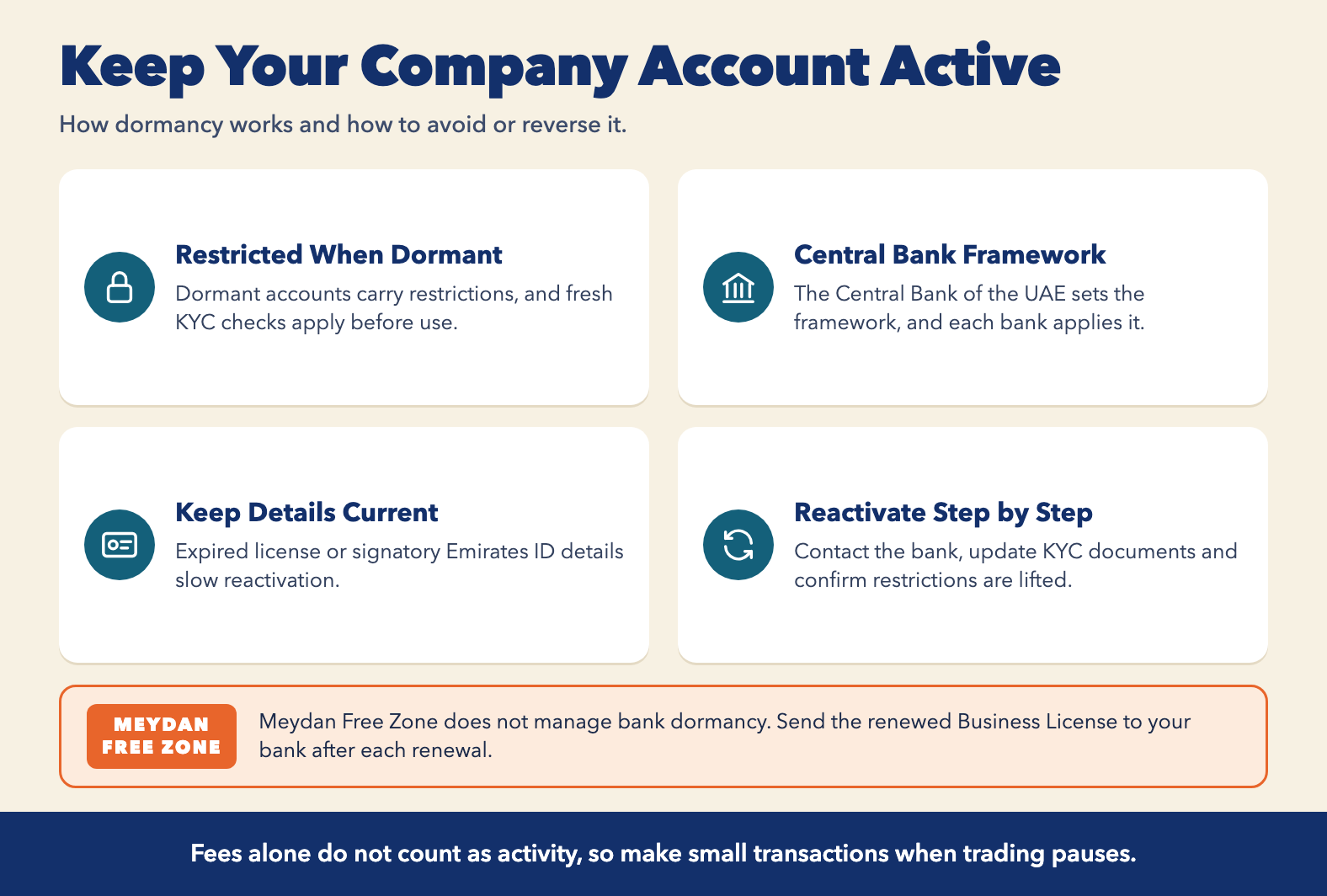
Banks are expected to try to contact the account holder as an account approaches dormancy. They then restrict activity and, if a balance stays unclaimed long enough, transfer it to the Central Bank of the UAE, which holds it until it is claimed. Company accounts also face KYC refresh checks, so authorised signatories and trade license details must stay current.
Notice, Restriction and Unclaimed Balances
The sequence is contact attempts, restriction, then unclaimed balance handling. The bank writes to the registered address or signatory. One company changed its registered email and never saw the notice, so the first it knew was a rejected payment. Check the Central Bank of the UAE site for the current procedure.
Why Company Accounts Face Tighter Checks
Corporate accounts carry AML and beneficial owner obligations, as outlined in the UAE AML KYC regulations. Expect these checks:
- Expired trade license details slow reactivation.
- An expired signatory Emirates ID blocks the request.
- Activity may be reviewed against declared turnover.
- Beneficial owner details must match current records.
Compliance Risks and Costs of an Inactive Company Account
An inactive company account can carry dormancy or maintenance fees. It can also restrict payments and disrupt payroll, VAT and Corporate Tax. Fees are set by each bank within Central Bank rules, so ask your bank what applies. The larger cost is usually delay when you need funds quickly.
Fees and Minimum Balance Penalties
- Check the bank's published tariff for any dormancy or maintenance fees.
- Minimum balance charges can erode a small balance month after month.
- A small dormant balance can reach zero through maintenance charges alone.
Tax Payments and Payroll Disruption
Obligations to the Federal Tax Authority (FTA), such as VAT and Corporate Tax, still need a working payment route. A company whose only account is restricted cannot settle a liability on time. Late payment can bring administrative penalties, covered in penalties for non-compliance in the UAE.
How to Reactivate a Dormant Company Account
To reactivate a dormant company account, contact the bank, submit updated KYC documents, confirm authorised signatories and provide a valid trade license. Make a customer-initiated transaction if required. Timelines vary by bank, so confirm the current process with your relationship manager.
Step 1: Contact the Bank and Confirm Status
- Ask for the account status, applicable fees and the document list.
- Use the relationship manager or branch of record.
- Do this before you travel or need to make an urgent payment.
Step 2: Update KYC and Signatory Documents
- Provide a valid trade license, plus signatory Emirates ID and passport.
- Update shareholder and beneficial owner details.
- Add a board resolution if signatories changed.
- Submit everything in one pack to avoid repeat requests.
Step 3: Resume Activity and Confirm Release
- Make a small transaction if the bank asks, such as a first supplier payment.
- Get written confirmation that restrictions are lifted.
- Test online banking and cards.
If the bank declines, read why business bank account applications get rejected in the UAE before reapplying.
How Meydan Free Zone Companies Can Keep Accounts Active
Meydan Free Zone companies can keep a bank account active by scheduling regular transactions and keeping license and signatory details current. Meydan Free Zone issues the Business License digitally after registration. Meydan Free Zone does not manage bank dormancy, and support never guarantees approval or an active account.
Keeping License and Signatory Details Current
Send the renewed license to the bank right after renewal. Do the same when a signatory changes. Banks refresh KYC against these records, so stale details are the most avoidable cause of delay.
Using mCore for Bank Account Support
mCore, part of Meydan Plus, covers business bank account support, company stamps, business cards and e-commerce setup. A new company can use it when opening its first account.
Essential Services for Entrepreneurs and Startups
Explore mCoreDormant Account Decisions for Founders
Founders should keep a company account active with small scheduled transactions if trading is paused, or close it formally if the company will not trade. Closing avoids fees and compliance gaps. Keeping it open preserves banking continuity. The choice depends on when you expect to restart.
Your Options at a Glance
| Feature | Keep Account Active | Close or Reactivate Later |
|---|---|---|
| Ongoing cost | Normal account charges continue, with no reopening cost. | No charges once closed, but reopening can involve fresh onboarding. |
| Admin effort | Low: a small scheduled transaction. | Higher: closure forms now, full documents later. |
| KYC refresh risk | Lower, if license and signatory details stay current. | Higher: a full KYC review applies on reactivation or reopening. |
| Payment continuity | Payments and tax settlement stay available. | No payment route until the account is restored or replaced. |
| Best suited for | Companies expecting to trade again soon. | Companies that will not trade for a long period. |
Keep, Reactivate or Close
Weigh the options before you close anything. Closing then reopening can mean fresh onboarding and a possible rejection, so keeping an account active is usually cheaper than reopening. A seasonal trader facing a quiet year can avoid dormancy by making small customer-initiated transactions at regular intervals. The table above sets out the trade-offs. For structuring, see free zone company structure for easy bank opening.
Next Steps for Founders
A dormant bank account is a process the bank runs once inactivity passes its threshold, so act before the flag appears. Keep signatory and license details current, move small amounts when trading pauses, and reactivate quickly if the flag appears. For a Meydan Free Zone company, send the renewed Business License to the bank after each renewal so its records stay current.
Ready to Launch Your Business in Dubai?
Let's Connect