

Table of Contents
Frequently Asked Questions
Is VAT due when a customer pays a deposit in the UAE?
Yes. Under Federal Decree-Law No. 8 of 2017 on VAT, a payment received before delivery creates a date of supply for the amount received. You report output tax on that amount in the return period in which the deposit arrives, not when you deliver the work.
How many days do I have to issue a tax invoice after receiving an advance payment?
A VAT-registered supplier must issue a tax invoice within 14 calendar days of the date of supply. For an advance payment, that date is normally the day you receive the money. The invoice should show the amount received and the VAT charged on it.
What happens if I invoice a client before delivering the service?
Issuing the invoice before delivery or payment can make the invoice date the date of supply for the invoiced amount. VAT then falls due in the return period of that invoice, even if no cash has arrived. The earliest of supply, invoice or payment generally sets the timing.
Does a refundable deposit attract VAT?
It depends on the contract terms. A deposit held purely as security and returned to the customer is generally not consideration for a supply. Once you keep it as payment for goods or services, VAT applies. Document the terms clearly so your treatment can be supported if the Federal Tax Authority reviews it.
How do I show an advance payment on the final invoice?
Show the full value of the supply and the VAT on it, then deduct the advance already received and taxed. The balance due is the remaining amount. This avoids charging VAT twice on the same money and keeps your invoices consistent with your ledger.
Which return period do I report an advance receipt in?
Report it in the return period that contains the date of supply for that receipt. If the customer pays in March, the VAT goes into the return covering March, even if you deliver months later. Reconcile bank receipts against your returns every period to catch missed deposits.
Do zero-rated exports follow the same timing rules for advance payments?
Yes. Zero-rated supplies follow the same date of supply rules, so a prepayment is reported in the period you receive it. The difference is the rate: 0% instead of the 5% standard rate. You still need to report it correctly and keep evidence supporting the zero-rating.
Can I correct a VAT return if I reported an advance payment late?
Yes. You can correct errors in a filed return by submitting a voluntary disclosure to the Federal Tax Authority. Correcting before the authority raises the issue is usually the safer route. Administrative penalties may still apply, so keep contracts, invoices and bank records that show the correct date of supply.
Topic Summary
What the Date of Supply Means Under UAE VAT
The date of supply is the point at which a supply is treated as made for VAT purposes. It decides which return period reports the output tax. Under UAE VAT law, it is generally the earliest of three events: supply of the goods or services, invoice issue, or payment receipt.
How VAT on Advance Payments Works in the UAE
When a customer pays in advance, VAT is due on the amount received at the time of payment, not at delivery. You report output tax on that amount in the return period of receipt. The final invoice is later adjusted for the portion already taxed. That is the core rule for advance payments.
Tax Invoice Timing and the 14-Day Rule
A supplier must issue a tax invoice within 14 calendar days of the date of supply. For an advance payment, the invoice must show the amount received and the VAT charged. Late or missing invoices can bring administrative penalties and disputes over your customer's input tax recovery.
How to Determine the Date of Supply in Five Steps
To determine the date of supply, identify the supply type, note the delivery date, record any invoice and payment dates, then apply the earliest event. Report output tax in the matching return period.
Special Rules for Continuous and Staged Supplies
Continuous supplies, such as ongoing services or construction, may have a date of supply linked to each invoice, payment due date or receipt. Where a contract sets staged payments, each stage generally creates its own date of supply. Tax then follows the payment schedule rather than project completion.
Risks, Penalties and Return Mechanics
Reporting VAT in the wrong period can lead to under-declared output tax, administrative penalties and corrections through a voluntary disclosure. Reconcile advance receipts to returns every period. Keep the contracts, invoices and bank records that support the timing you used.
What This Means for a Meydan Free Zone Company
A Meydan Free Zone company follows the same federal date of supply rules as any VAT-registered business, and the FTA administers them. mAccounting, part of Meydan Plus, offers bookkeeping and VAT registration support.
Date of Supply Under UAE VAT: When Tax Becomes Due on Advance Payments
Many founders assume VAT falls due only after they invoice or deliver. In practice, a deposit can create a VAT liability on the day it lands in your account, which may move tax into an earlier return period. This guide explains how the date of supply works for advance payments, how to invoice them and which return to report them in.
What the Date of Supply Means Under UAE VAT
The date of supply is the point at which a supply is treated as made for VAT purposes. It decides which return period reports the output tax. Under UAE VAT law, it is generally the earliest of three events: supply of the goods or services, invoice issue, or payment receipt.
The Three Triggers in the VAT Law
Federal Decree-Law No. 8 of 2017 sets the rule, and the Federal Tax Authority (FTA) administers it. The earliest event wins, not the last. Your accounting date does not override it.
Say a consultancy receives a deposit in March for work delivered in May. March is the date of supply for the amount received.
Date of Supply by Scenario
| Scenario | Date of Supply |
|---|---|
| Full prepayment before delivery | Date the full payment is received |
| Partial deposit | Date of receipt, for the amount paid only |
| Invoice issued before payment | Invoice date, if it precedes delivery and payment |
| Delivery before invoice or payment | Delivery or completion date |
| Milestone payments | Each milestone's invoice, due date or receipt, whichever is earliest |
Why Timing Affects Cash Flow
Output tax falls due in the return period of the date of supply. You may owe VAT before you've collected the full fee. A trading company that bills a part-payment at quarter end pays the VAT on it in that quarter's return. For rates and returns, see the detailed VAT guide.
How VAT on Advance Payments Works in the UAE
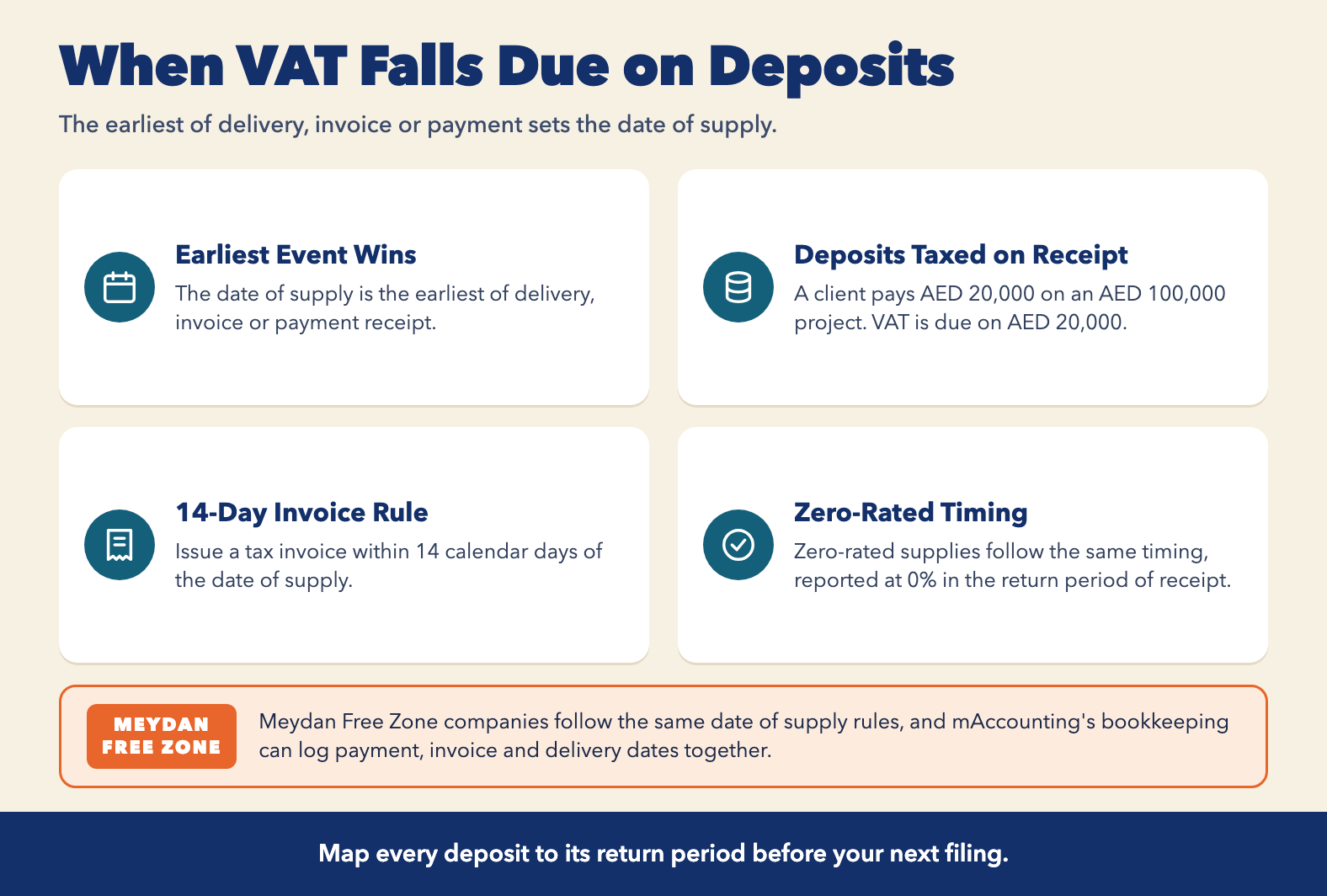
When a customer pays in advance, VAT is due on the amount received at the time of payment, not at delivery. You report output tax on that amount in the return period of receipt. The final invoice is later adjusted for the portion already taxed. That is the core rule for advance payments.
Deposits, Retainers and Part Payments
Tax applies to the amount actually received, at the 5% standard rate where the supply is standard-rated. A client pays AED 20,000 on an AED 100,000 project, so VAT is due on the AED 20,000 on receipt. Read the contract terms on refundable and non-refundable deposits, because they shape how the payment is characterised. Retainers for ongoing services follow the same logic.
Zero-Rated and Exempt Supplies
- Zero-rated supplies follow the same timing, taxed at 0%.
- An exporter of services reports a prepayment as zero-rated in the return period of receipt.
- Exempt supplies carry no output tax but still need classification.
- Mixed contracts need each element treated separately.
Cross-Border and Reverse Charge Cases
If a Dubai company prepays a foreign software vendor, it accounts for the reverse charge in the payment period. The timing follows the same earliest-event logic. Our UAE VAT reverse charge guide covers recording.
Tax Invoice Timing and the 14-Day Rule
A supplier must issue a tax invoice within 14 calendar days of the date of supply. For an advance payment, the invoice must show the amount received and the VAT charged. Late or missing invoices can bring administrative penalties and disputes over your customer's input tax recovery.
What the Advance Invoice Must Show
- Supplier and customer details, including tax registration numbers.
- Amount received and VAT charged.
- Balance outstanding against the full contract value.
- Issue date, matching your UAE tax invoice requirements.
Final Invoice After an Advance
Show the full value, then deduct amounts already taxed. A final invoice for AED 100,000 credits the AED 20,000 deposit, so VAT isn't charged twice. Match these records to your ledger.
How to Determine the Date of Supply in Five Steps
To determine the date of supply, identify the supply type, note the delivery date, record any invoice and payment dates, then apply the earliest event. Report output tax in the matching return period.
- Classify the supply. Goods, services or continuous supply. A monthly retainer is continuous.
- Record the three dates. Payment 28 March, invoice 2 April, delivery 15 May.
- Apply the earliest date. March applies to the amount paid. Partial payments set a date for that portion only.
- Issue the invoice and report. Invoice within 14 days and include the deposit in the quarter of receipt.
- Reconcile. Match bank receipts to the return. Our VAT filing services guide explains the process.
Special Rules for Continuous and Staged Supplies
Continuous supplies, such as ongoing services or construction, may have a date of supply linked to each invoice, payment due date or receipt. Where a contract sets staged payments, each stage generally creates its own date of supply. Tax then follows the payment schedule rather than project completion.
Milestone and Subscription Contracts
Each milestone or billing period creates a date. An annual software subscription paid upfront is taxed on receipt.
Retention and Disputed Amounts
Retention held back under a contract may be taxed at a different point from the main payments. The timing depends on the contract terms and the continuous supply rules. Document those terms and confirm the treatment with your adviser.
Risks, Penalties and Return Mechanics
Reporting VAT in the wrong period can lead to under-declared output tax, administrative penalties and corrections through a voluntary disclosure. Reconcile advance receipts to returns every period. Keep the contracts, invoices and bank records that support the timing you used.
Common Errors With Advance Receipts
- Waiting for the final invoice.
- Ignoring bank receipts in reconciliation.
- Treating deposits as non-taxable.
A founder who reports a deposit only after delivery under-declares the earlier period.
Correcting Mistakes
Submit a voluntary disclosure through the FTA, ideally before any review begins. See the guide to penalties for non-compliance in the UAE.
What This Means for a Meydan Free Zone Company
A Meydan Free Zone company follows the same federal date of supply rules as any VAT-registered business, and the FTA administers them. mAccounting, part of Meydan Plus, offers bookkeeping and VAT registration support.
Registration and Record-Keeping
Registration is mandatory above AED 375,000 in annual taxable supplies. Your bookkeeping should track payment, invoice and delivery dates. A Meydan Free Zone consultancy can log each deposit with a date field to prevent late reporting.
Contract and Invoice Setup Before Trading
State deposit clauses in AED and say whether prices are VAT-inclusive or exclusive. A trading company that sets deposit terms before its first sale avoids restating invoices later.
Free Business Setup Cost Calculator
Calculate NowConclusion
Tax follows the earliest of delivery, invoice or payment, so advance receipts are taxable when they arrive. Map each receipt to its return period before your next filing. For a Meydan Free Zone company, the mAccounting bookkeeping service can log payment, invoice and delivery dates together, so each deposit is reported in the right return.
Ready to Launch Your Business in Dubai?
Let's Connect