Table of Contents
Frequently Asked Questions
Can a foreign company own 100% of a subsidiary in Dubai?
Yes. A free zone subsidiary can be 100% foreign-owned, and the parent can be the sole shareholder. Meydan Free Zone licenses subsidiaries on this basis and issues the Business License, Certificate of Formation, Share Register, and Memorandum and Articles of Association digitally after registration.
Is a branch of a foreign company liable for the parent's debts?
Yes. A branch has no separate legal personality, so it is part of the parent company. Claims arising from the branch's contracts or operations can reach the parent's wider assets, which is the main reason groups with higher risk choose a subsidiary.
Does a Dubai branch pay Corporate Tax?
A branch is assessed on the profits attributable to its UAE presence. Corporate Tax is 0% on taxable income up to AED 375,000 and 9% above that, and the Federal Tax Authority (FTA) administers it. Free zone treatment depends on meeting Qualifying Free Zone Person conditions, not on holding a license alone.
Which structure is easier to close or exit?
A branch is closed by the parent, which must settle all its obligations first. A subsidiary can be liquidated or sold as a separate company, which often makes it easier to transfer to a buyer. In both cases, outstanding liabilities, visas and tax registrations must be cleared before closure.
Can a branch hire staff and sponsor visas in Dubai?
Yes, a licensed branch can employ staff and apply for residency visas under its own license. For a Meydan Free Zone company, mResidency supports residency visas, the medical fitness test, Emirates ID and medical insurance. Visa eligibility depends on the license and workspace arrangements.
Can a branch be converted into a subsidiary later?
There is no simple conversion. In practice, the group sets up a new subsidiary and moves contracts, staff and licenses across to it. This means re-papering agreements and visas, which is why groups expecting to hire locally often start with a subsidiary.
What documents does a foreign parent need for a Dubai branch?
Typically the parent's certificate of incorporation, its constitutional documents and a board resolution approving the branch. These documents are usually attested in the home country before filing. A subsidiary instead needs its own memorandum and articles, plus shareholder documents.
Do banks treat a branch and a subsidiary differently?
Often, yes. Banks review the parent's standing for a branch and may ask for parent guarantees on a subsidiary's facilities. Meydan Free Zone's mCore supports business bank account applications, but approval rests with the bank.
Topic Summary
What a Dubai Subsidiary and Branch Are
A subsidiary is a separate legal entity in Dubai, owned wholly or partly by a foreign parent. A branch is an extension of the parent company with no separate legal personality. The parent is directly responsible for a branch's obligations, while a subsidiary limits the parent's exposure to its shareholding.
Subsidiary or Branch: Liability and Legal Status
Liability is the central difference. A subsidiary ring-fences risk inside its own company, so creditors generally pursue the Dubai entity's assets. A branch exposes the parent directly, because it has no separate legal identity. Foreign groups with contract, employment or regulatory risk in the UAE usually weigh this first.
Subsidiary and Branch Costs and Compliance
Both structures carry a license fee, an office requirement, financial reporting and Corporate Tax registration. A branch needs the parent's attested documents and ongoing parent-level reporting. A subsidiary needs its own constitutional documents and accounts. Neither is automatically cheaper, so compare fees against your own activity, visas and tax position.
Branch and Subsidiary Compared Side by Side
A subsidiary suits groups that want ring-fenced risk, a local employer and wider activity scope. A branch suits groups that want a quick extension of an established parent and accept direct liability. The table above sets out the practical differences.
Four Steps to Choose the Right Structure
To choose, identify the parent's risk appetite, confirm the activity and jurisdiction, review tax, banking and document needs, then apply. Settling these first prevents a costly switch after the license is issued.
Where a Mainland Presence Changes the Picture
Mainland operations are licensed by the Dubai Department of Economy and Tourism (DET) and open the local market directly. They follow different licensing and ownership rules from free zones. Consider mainland only when customers, tenders or activities require it, and check current requirements on Invest in Dubai.
Dubai Subsidiary or Branch for a Foreign Company: Key Differences
For a foreign group entering Dubai, the structure question usually arrives before the market question. Many boards assume a branch is the quick, cheap route and a subsidiary the heavy one, yet the choice sets liability, tax position, banking and how easily you can exit. Which structure fits your group? This guide compares the two on legal status, liability, compliance and cost.
What a Dubai Subsidiary and Branch Are
A subsidiary is a separate legal entity in Dubai, owned wholly or partly by a foreign parent. A branch is an extension of the parent company with no separate legal personality. The parent is directly responsible for a branch's obligations, while a subsidiary limits the parent's exposure to its shareholding.
That is the core of the decision, and everything else follows from it. The difference between branch and subsidiary shapes contracts, tax and exit.
Subsidiary as a Separate Legal Entity
A subsidiary has its own license, share register and constitutional documents. Contracts, assets and debts sit in the Dubai company, not the parent. Shareholders can be one or several, and a free zone subsidiary can be 100% foreign-owned.
Picture a European engineering group that forms a Dubai company to hold regional contracts. It employs local staff under that company's name, and the parent stays one step removed.
Branch as an Extension of the Parent
A branch operates under the parent's name and legal identity. Parent documents, such as the certificate of incorporation, are typically required and attested. Activities must fall within the parent's own business scope.
A UK consultancy serving a single regional client is a typical case. It opens a Dubai branch under its existing name and avoids building a second company.
Subsidiary or Branch: Liability and Legal Status
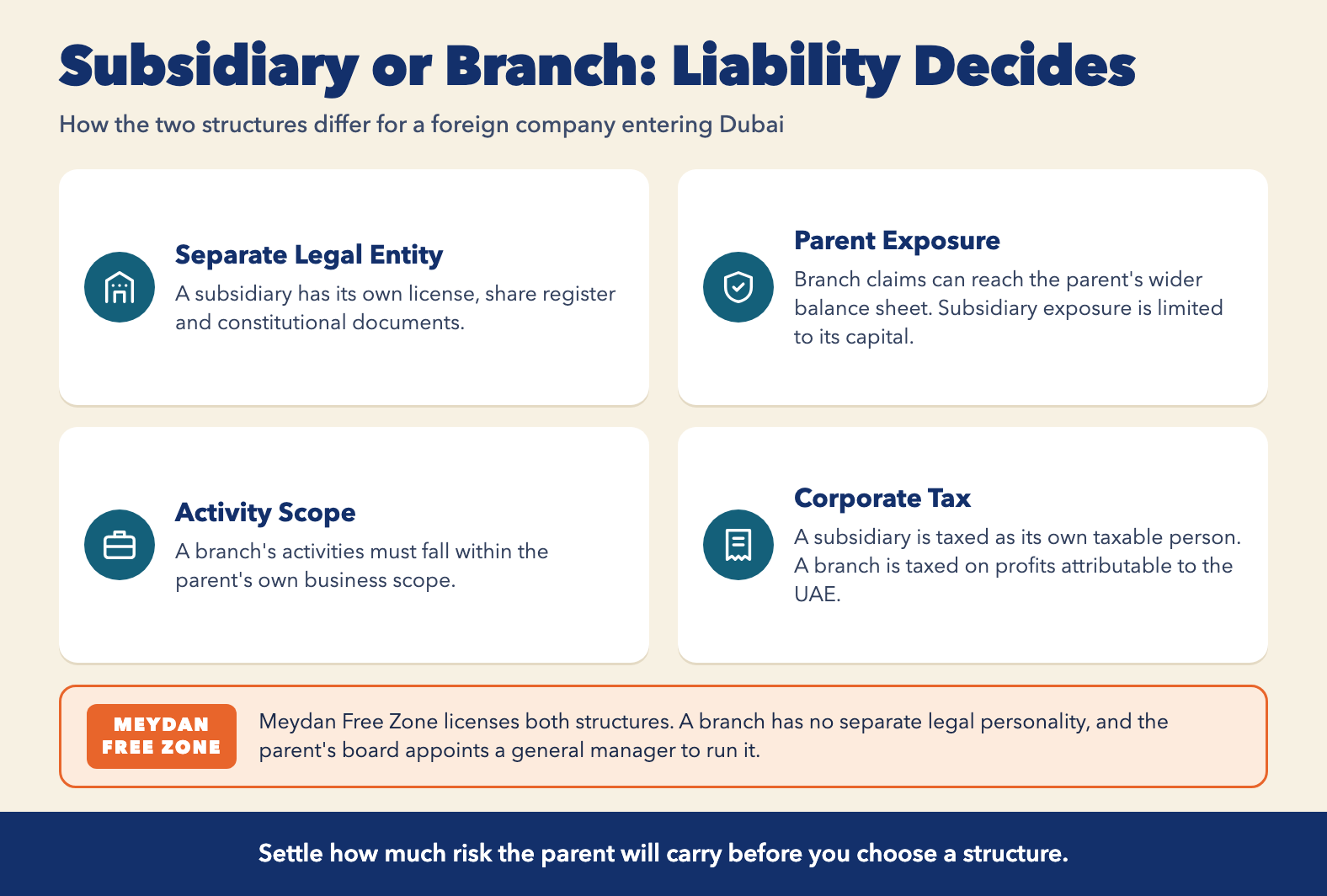
Liability is the central difference. A subsidiary ring-fences risk inside its own company, so creditors generally pursue the Dubai entity's assets. A branch exposes the parent directly, because it has no separate legal identity. Foreign groups with contract, employment or regulatory risk in the UAE usually weigh this first.
Where the Parent's Exposure Sits
Branch claims can reach the parent's wider balance sheet. Subsidiary exposure is limited to the shareholder's capital, unless the parent gives a guarantee. Banks may still ask for one on a subsidiary's credit facilities.
Take a supplier dispute over a delivery contract. With a branch, the parent is pulled into the claim. With a subsidiary, it usually isn't.
Contracts, Employment and Signing Authority
- A branch signs in the parent's name.
- A subsidiary signs in its own name.
- Staff contracts sit with whichever entity is the employer.
- Local counterparties often prefer a locally registered entity.
- Some tenders require a locally licensed contracting entity.
Subsidiary and Branch Costs and Compliance
Both structures carry a license fee, an office requirement, financial reporting and Corporate Tax registration. A branch needs the parent's attested documents and ongoing parent-level reporting. A subsidiary needs its own constitutional documents and accounts. Neither is automatically cheaper, so compare fees against your own activity, visas and tax position.
Corporate Tax Treatment
- Corporate Tax rates: 0% on taxable income up to AED 375,000 and 9% above it, administered by the Federal Tax Authority (FTA).
- A subsidiary is taxed as its own taxable person.
- A branch is assessed on profits attributable to its UAE presence. Review parent-level consequences too.
- Qualifying Free Zone Person status depends on meeting specific conditions, not on the license alone.
A trading subsidiary shows the point. Its income mix, along with the other conditions, decides whether the 0% free zone rate applies.
Dubai Subsidiary and Branch Compared
| Feature | Subsidiary | Branch |
|---|---|---|
| Legal status | Separate legal entity with its own license and share register | Extension of the parent, no separate personality |
| Liability of the parent | Limited to shareholding, unless a guarantee is given | Direct, reaching the parent's wider balance sheet |
| Permitted activities | Any licensed activity, independent of the parent's scope | Must fall within the parent's own business scope |
| Documents from the parent | Shareholder documents, memorandum and articles | Attested certificate of incorporation and board resolution |
| Corporate Tax position | Taxed as its own taxable person | Taxed on profits attributable to the UAE presence |
| Exit and closure | Liquidate or sell the company, with shares transferable | Cancel the branch license, settle obligations at parent level |
Documents, Audits and Running Costs
A branch needs attested parent documents and a board resolution. A subsidiary needs a memorandum and articles, a share register and shareholder documents. Budget for recurring costs such as renewal, visas and accounting.
Meydan Free Zone's Cost Calculator shows license and setup costs before you commit. Treat the figures as indicative, not guaranteed. A group comparing two quotes should separate the one-off setup fee from the recurring cost of audit and accounting.
Branch and Subsidiary Compared Side by Side
A subsidiary suits groups that want ring-fenced risk, a local employer and wider activity scope. A branch suits groups that want a quick extension of an established parent and accept direct liability. The table above sets out the practical differences.
Consider a manufacturer that tests the market through a branch. Once volumes grow, it moves contracts into a subsidiary.
When Each Structure Tends to Fit
- Branch: a single-client or short-term regional presence.
- Subsidiary: multi-year operations, local hiring, investor or lender involvement.
- Switching later is possible, but contracts and licenses must be re-papered.
- Say a services group expects to hire locally within a year: a subsidiary avoids restructuring.
Four Steps to Choose the Right Structure
To choose, identify the parent's risk appetite, confirm the activity and jurisdiction, review tax, banking and document needs, then apply. Settling these first prevents a costly switch after the license is issued.
Step 1: Define Risk and Activity Scope
- Decide how much liability the parent will accept.
- Match the activity to the parent's scope if choosing a branch.
- If the parent license doesn't cover logistics, use a subsidiary for that activity.
Step 2: Confirm Jurisdiction and Authority
- Decide between free zone and mainland, and identify the licensing authority.
- For customer access, review opening a mainland branch in Dubai and the role of DET.
Step 3: Review Tax, Banking and Documents
- Register for Corporate Tax with the Federal Tax Authority.
- mCore supports business bank account setup, but approval rests with the bank.
- Prepare attested parent documents for a branch, or shareholder documents for a subsidiary.
- Start attestation chains in the home country early.
Step 4: Apply and Activate
- Meydan Free Zone issues the Business License and Certificate of Formation digitally. A subsidiary also receives its Share Register and Memorandum and Articles of Association.
- Residency visas and Emirates ID follow through mResidency.
- For the branch route, see how to open a branch office in a Dubai free zone.
Where a Mainland Presence Changes the Picture
Mainland operations are licensed by the Dubai Department of Economy and Tourism (DET) and open the local market directly. They follow different licensing and ownership rules from free zones. Consider mainland only when customers, tenders or activities require it, and check current requirements on Invest in Dubai.
When Market Access Drives the Choice
Government and local tenders may require a mainland presence. A supplier to a local retail chain should test that need before choosing a structure, since requirements vary by activity and buyer.
How Meydan Free Zone Supports Either Structure
Meydan Free Zone licenses both structures. Under its Companies and Licensing Regulations 2022, a branch has no separate legal personality from its parent, and the parent's board appoints a general manager to run it. Meydan Plus adds mCore for business bank account support, mAssist for mail management, mResidency for visas and mAccounting for bookkeeping, VAT registration support and Corporate Tax support.
Free Business Setup Cost Calculator
Calculate NowConclusion
The choice between a Dubai subsidiary and a branch comes down to liability, activity scope and how long you plan to operate. A branch is a faster extension of an established parent. A subsidiary offers separation and room to grow. With Meydan Free Zone, a branch is run by a general manager appointed by the parent's board, so decide who will lead it and how much risk the parent will carry before you file.
Ready to Launch Your Business in Dubai?
Let's Connect