

Table of Contents
Frequently Asked Questions
What should a founder do first after receiving a Dubai business license?
Start with document control and the bank account process. Store the Business License, Certificate of Formation, Share Register and Memorandum and Articles of Association, which Meydan Free Zone issues digitally, in one place. Banking comes first because tax, payroll and client payments all depend on it.
Do free zone companies in Dubai need to register for Corporate Tax?
Yes. Every free zone company must register for Corporate Tax with the Federal Tax Authority, even if it expects some income to qualify for 0%. A company incorporated on or after 1 March 2024 must apply within three months of incorporation. Meydan Free Zone's mAccounting pillar covers Corporate Tax support alongside bookkeeping and VAT registration support.
When does a Dubai company have to register for VAT?
VAT registration is mandatory when taxable supplies exceed AED 375,000 over the previous 12 months, or are expected to within the next 30 days. Voluntary registration is possible from AED 187,500. Registration is handled through the Federal Tax Authority (FTA).
Can a new Dubai company start trading before its bank account is open?
Legally, the license allows the company to operate. Commercially, it is difficult, because clients, suppliers and payroll all need a bank route. Banks assess each company individually, so approval is never guaranteed. Meydan Free Zone's mCore pillar supports business bank account applications.
How soon after setup can a founder apply for a residency visa?
A founder can start residency once the company is registered and the license is issued. The process includes the residency visa application, a medical fitness test and Emirates ID. Meydan Free Zone's mResidency pillar covers all three. Visa services are priced separately from the trade license.
Which documents should a new company keep on file in the first quarter?
Keep the Business License, Certificate of Formation, Share Register and Memorandum and Articles of Association. Add bank account documents, tax registration records, visa and Emirates ID files, invoices, receipts and contracts. Company name, address and activity wording should match across every document.
Should a new company hire staff in the first 90 days?
Hire only after the bank account and payroll route work and revenue is confirmed. A founder with one signed contract should usually wait until the first invoice is paid. Free zone employment follows free zone procedures, so mainland processes should not be assumed.
How can a founder track renewal and filing dates for a new company?
Record the license renewal, tax filing, visa and insurance dates in a single compliance calendar. Assign a named owner to each date, and review the calendar around day 90. Missed dates create penalties and delays that a simple calendar prevents.
Topic Summary
What the First 90 Days for a Dubai Company Involve
The first 90 days after licensing are when a founder makes the company operational: opening a bank account, registering for tax, arranging visas, setting up accounting and recording compliance dates. Meydan Free Zone issues the Business License digitally, so this work can start as soon as the license is issued.
A Practical Sequence for the First 90 Days in a Dubai Company
Start with banking and document control, then register for tax, set up bookkeeping, arrange visas and record compliance dates. Finish by reviewing costs and operations. Each task supplies details the next one needs, such as bank statements for accounting or tax registration numbers for invoices.
Opening Banking and Securing Payment Channels
Banking is the first priority because tax, payroll and client payments depend on it. Banks assess each company individually, so approval is never guaranteed. Meydan Free Zone's mCore pillar supports business bank account applications. Prepare clear activity descriptions, source-of-funds details and consistent company documents before submitting.
Registering for Tax and Setting Up Accounting
Every company, including a free zone company, must register for Corporate Tax with the Federal Tax Authority. VAT registration is mandatory once taxable supplies pass AED 375,000. Meydan Free Zone's mAccounting pillar covers bookkeeping, VAT registration support and Corporate Tax support. Clean records from the first month make later filings faster and cheaper.
Visas, Emirates ID and Hiring Decisions
Plan residency visas early, but only apply for the number you need. Meydan Free Zone's mResidency pillar covers residency visas, medical fitness tests, Emirates ID, medical insurance, dependent visas and return permits. Hiring should follow confirmed revenue and workspace arrangements, not optimism.
Compliance Dates, Costs and Operational Review
By day 90, record every renewal and filing date, review actual costs against budget and confirm workspace compliance. License renewal, tax filings and visa renewals are a recurring cost and obligation. Missing them creates penalties and delays that a simple calendar prevents.
Conclusion
The first 90 days of a Dubai company reward execution over planning. Bank access, tax registration, visas, bookkeeping and a compliance calendar, handled in order, turn a license into a working business. List the five foundation tasks with owners and dates this week. With Meydan Free Zone, the Business License and company documents are issued digitally, so the bank and tax steps can begin as soon as the license is issued.
First 90 Days After Setting Up a Dubai Company: Key Priorities
A business license lets a Dubai company exist, but trading also needs a bank account, tax registration, visas and a bookkeeping routine. Founders who tackle these in the wrong order lose weeks to avoidable admin.
So what should you do first once the license arrives? This guide sets out a practical order for banking, tax, visas and compliance across the first 90 days, and shows how a Meydan Free Zone company fits that sequence.
What the First 90 Days for a Dubai Company Involve
The first 90 days after licensing are when a founder makes the company operational: opening a bank account, registering for tax, arranging visas, setting up accounting and recording compliance dates. Meydan Free Zone issues the Business License digitally, so this work can start as soon as the license is issued.
What You Hold After Registration
Meydan Free Zone issues the Business License, Certificate of Formation, Share Register, and Memorandum and Articles of Association digitally. Banks, tax authorities and visa processes all ask for them, so keep them in one controlled folder.
A license proves the entity exists. It doesn't make the entity operational. Say a consultant receives the license on a Monday and finds they need a bank account before the first client invoice can be paid.
First 90 Days Priority Timeline
| Period | Priority |
|---|---|
| Days 1 to 30 | Secure documents, start the bank account process, finalise invoicing details |
| Days 31 to 60 | Corporate Tax registration (within three months of incorporation), VAT assessment against AED 375,000, visa planning |
| Days 61 to 90 | Reconcile transactions, build the compliance calendar, review costs |
| Ongoing | Weekly bookkeeping and renewal tracking |
| Support | mCore (banking support), mResidency (visas), mAccounting (tax and bookkeeping) |
Why the Order of Tasks Matters
Banking, tax and visa tasks depend on one another. Delays usually come from missing documents or inconsistent details, not from the authorities. A free zone company follows its free zone's processes, so don't assume mainland steps apply.
Say a company starts visa applications before its address and activity details are final. Any later correction means resubmitting documents, which is time you can avoid losing.
A Practical Sequence for the First 90 Days in a Dubai Company
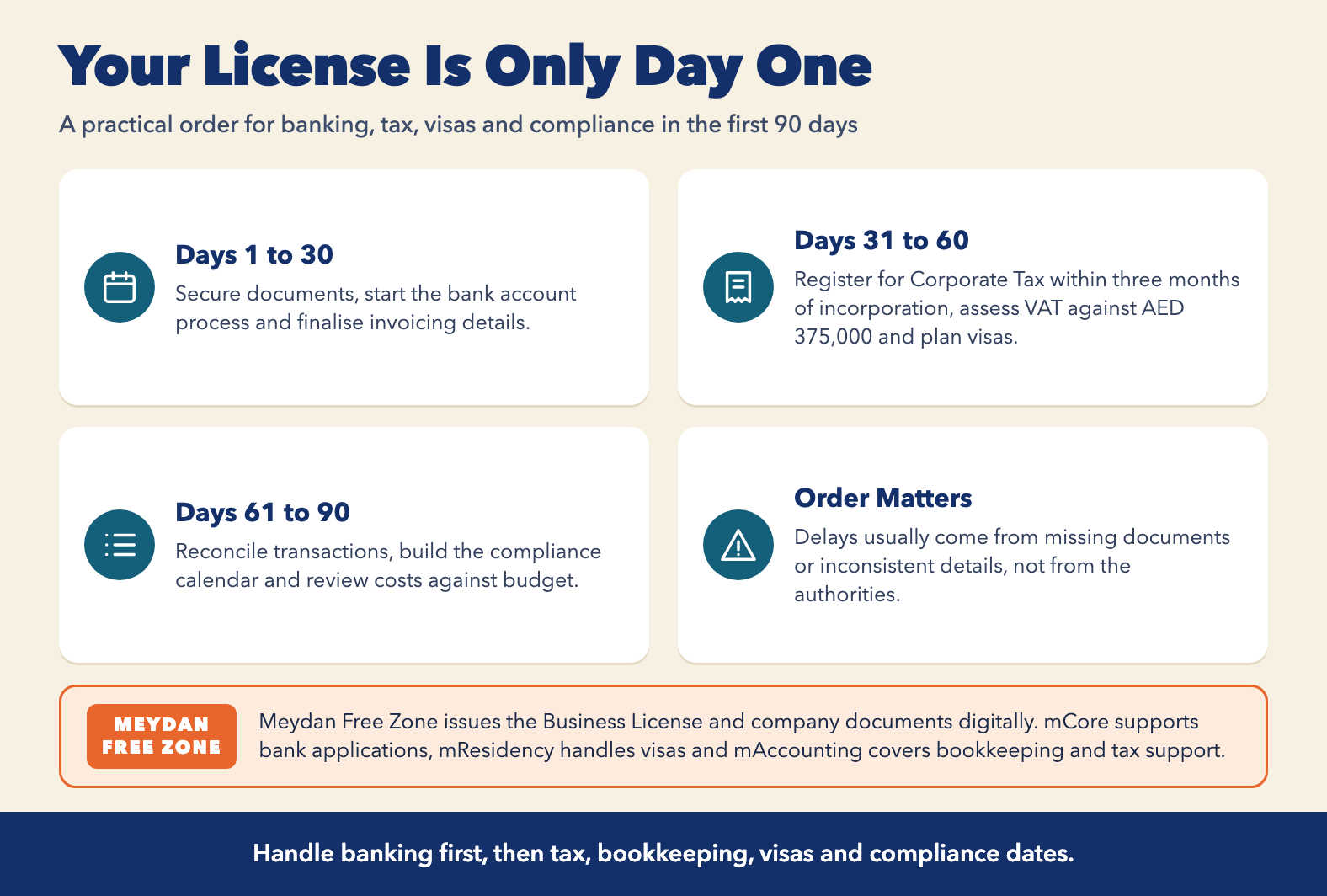
Start with banking and document control, then register for tax, set up bookkeeping, arrange visas and record compliance dates. Finish by reviewing costs and operations. Each task supplies details the next one needs, such as bank statements for accounting or tax registration numbers for invoices.
Days 1 to 30: Foundations
- Secure the licensing documents.
- Start the bank account process.
- Confirm office or workspace compliance.
- Set up invoicing details.
- Appoint an accountant or bookkeeping support.
Keep the company name, address and activity wording identical on every form. Invoice templates should carry the exact licensed name and address from the Business License.
Days 31 to 60: Tax and People
Register for Corporate Tax with the Federal Tax Authority (FTA). Under FTA Decision No. 3 of 2024, a company incorporated on or after 1 March 2024 must apply within three months of incorporation. Late registration carries an AED 10,000 penalty. VAT registration is mandatory once taxable supplies exceed AED 375,000 over the previous 12 months, or are expected to within the next 30 days. Compare projected turnover with that threshold before choosing a registration date. Plan visas for the founder and any early hires.
Days 61 to 90: Review and Lock In
Reconcile the first two months of transactions. Enter renewal and filing dates in a company compliance calendar. Check actual spending against the setup budget before month four.
Opening Banking and Securing Payment Channels
Banking is the first priority because tax, payroll and client payments depend on it. Banks assess each company individually, so approval is never guaranteed. Meydan Free Zone's mCore pillar supports business bank account applications. Prepare clear activity descriptions, source-of-funds details and consistent company documents before submitting.
What Banks Expect From a New Company
Banks in the UAE are regulated by the Central Bank of the UAE (CBUAE). They run Know Your Customer (KYC) reviews of shareholders, activity and expected transaction flows. Inconsistent details across documents are a common cause of delay.
A service company can help by explaining its expected client base and monthly transaction range in a one-page business profile. See the guide to bank account opening for document detail.
How mCore Supports the Process
mCore covers business bank account support, company stamps, business cards and E-commerce Starter, a marketplace seller-account setup service. It supports the bank application but doesn't guarantee approval. A founder can order the company stamp through mCore while the bank review is under way.
Essential Services for Entrepreneurs and Startups
Explore mCoreRegistering for Tax and Setting Up Accounting
Every company, including a free zone company, must register for Corporate Tax with the Federal Tax Authority. VAT registration is mandatory once taxable supplies pass AED 375,000. Meydan Free Zone's mAccounting pillar covers bookkeeping, VAT registration support and Corporate Tax support. Clean records from the first month make later filings faster and cheaper.
Corporate Tax and Free Zone Status
Free zone status doesn't remove the duty to register. Whether any income can be taxed at 0% depends on the company's activities and on meeting the FTA's Qualifying Free Zone Person conditions. A holding structure, for example, should confirm its position with its accountant before the first financial year closes.
VAT Threshold and Bookkeeping Routine
- VAT registration is mandatory once taxable supplies exceed AED 375,000.
- Record invoices, receipts and bank movements weekly.
- Reconcile bank statements every month.
- Use mAccounting for bookkeeping, VAT registration support and Corporate Tax support.
Visas, Emirates ID and Hiring Decisions
Plan residency visas early, but only apply for the number you need. Meydan Free Zone's mResidency pillar covers residency visas, medical fitness tests, Emirates ID, medical insurance, dependent visas and return permits. Hiring should follow confirmed revenue and workspace arrangements, not optimism.
Founder Residency First
Founder residency usually involves the visa application, a medical fitness test and Emirates ID. Visa services are priced separately from the trade license. A founder relocating with family usually secures their own residency first, then sponsors dependants. The guide on how many visas you need helps with quantities.
Timing the First Hire
Hire after the bank account and payroll route work. Free zone employment follows free zone procedures, so don't assume mainland MOHRE processes apply. A founder with one signed client contract should wait for the first paid invoice. Read more on hiring your first employee.
Compliance Dates, Costs and Operational Review
By day 90, record every renewal and filing date, review actual costs against budget and confirm workspace compliance. License renewal, tax filings and visa renewals are a recurring cost and obligation. Missing them creates penalties and delays that a simple calendar prevents.
Building a Compliance Calendar
- Record license, tax, visa and insurance dates.
- Assign a named owner to each date.
- Split duties: one partner might take tax, the other visas.
Reviewing Costs Against Budget
Compare setup estimates with real spending, and label official fees separately from estimates. List every cost line from the first quarter and flag those that repeat each year. Meydan Free Zone's Cost Calculator gives a setup-cost estimate you can check actual spending against.
Conclusion
The first 90 days of a Dubai company reward execution over planning. Bank access, tax registration, visas, bookkeeping and a compliance calendar, handled in order, turn a license into a working business.
List the five foundation tasks with owners and dates this week. With Meydan Free Zone, the Business License and company documents are issued digitally, so the bank and tax steps can begin as soon as the license is issued.
Ready to Launch Your Business in Dubai?
Let's Connect