

Table of Contents
Frequently Asked Questions
When should a UAE company recognise revenue under IFRS 15?
A company recognises revenue when it transfers control of a good or service to the customer. That can happen over time, as the customer receives the benefit, or at a point in time, such as on delivery. The amount recognised is the consideration the company expects to be entitled to.
Does IFRS 15 apply to small businesses in the UAE?
IFRS 15 applies to any entity that prepares financial statements under full IFRS, whatever its size. Smaller entities may use IFRS for SMEs, which has its own revenue section built on similar principles. Auditors and banks often expect IFRS-aligned revenue policies even from smaller companies.
How are advance payments treated under IFRS 15?
An advance payment is not revenue when received. The company records it as a contract liability, often called deferred revenue. It moves into revenue as the goods or services are delivered and control passes to the customer.
What counts as a performance obligation in a service contract?
A performance obligation is a promise to deliver a distinct good or service. A service is distinct when the customer can benefit from it on its own and it is separately identifiable within the contract. A bundle of installation and support may therefore split into two obligations.
How does revenue recognition affect UAE Corporate Tax?
UAE Corporate Tax starts from accounting income prepared under accepted accounting standards, generally IFRS. Revenue recognised under IFRS 15 therefore feeds into taxable income, subject to specific tax adjustments. Timing differences determine which tax period carries the income.
Can a company recognise revenue when it issues an invoice?
Not automatically. An invoice is a billing document, and IFRS 15 looks at whether control has passed to the customer. If the invoice is issued before delivery or performance, the amount is deferred until the obligation is satisfied.
How is variable consideration such as a rebate accounted for?
The company estimates the rebate and reduces the transaction price during the year, rather than waiting for year end. The estimate is constrained so that revenue is only recognised to the extent a significant reversal is unlikely. The estimate is updated as circumstances change.
Who administers Corporate Tax for a free zone company in the UAE?
The Federal Tax Authority administers Corporate Tax across the UAE, including for free zone companies. The free zone authority handles licensing, not tax administration. A Meydan Free Zone company files its Corporate Tax return with the Federal Tax Authority, and mAccounting offers Corporate Tax support.
Topic Summary
What IFRS 15 Revenue Recognition Means for UAE Companies
IFRS 15 is the international standard for revenue from contracts with customers. A UAE company recognises revenue when it transfers control of goods or services, in the amount it expects to receive. It applies to any entity preparing IFRS financial statements, whatever its size or industry.
Why Revenue Timing Matters
Timing drives reported profit, Corporate Tax, covenant compliance and valuation. Recognising revenue too early overstates performance, and too late understates it. Both trigger audit adjustments and weaken credibility with banks and investors.
The Five Steps of IFRS 15 Revenue Recognition
IFRS 15 uses five steps: identify the contract, identify performance obligations, set the transaction price, allocate it, and recognise revenue as each obligation is satisfied. Followed in order, they produce consistent, auditable figures.
Common IFRS 15 Scenarios for UAE Businesses
Treatment depends on contract terms. Subscriptions and retainers run over time, goods recognise at delivery, and long projects follow progress. Upfront payments sit as a contract liability until you perform.
How IFRS 15 Links to UAE Corporate Tax and Audit
UAE Corporate Tax starts from accounting income under accepted standards, generally IFRS. Revenue recognised under IFRS 15 feeds into taxable income, subject to specific adjustments.
IFRS 15 Policy for a Meydan Free Zone Company
A Meydan Free Zone company applies IFRS 15 through its own accounting policy, not through the licensing authority. Meydan Free Zone issues the Business License digitally, while mAccounting offers bookkeeping, VAT registration support, Corporate Tax support and financial audit reports.
Mistakes to Avoid When Applying IFRS 15 in the UAE
The common errors are recognising revenue on invoice date, ignoring separate performance obligations, overlooking variable consideration and keeping weak records. Each leads to audit adjustments and Corporate Tax corrections.
IFRS 15 Revenue Recognition for UAE Companies
Most founders assume revenue is booked the day an invoice goes out or cash lands. Then an auditor or bank applies IFRS 15 and the books get restated. The standard looks at when control passes to the customer, which rarely matches billing, and the gap affects audited accounts, Corporate Tax and lender confidence. This guide explains what the standard requires and how to set a revenue policy that holds up.
What IFRS 15 Revenue Recognition Means for UAE Companies
IFRS 15 is the international standard for revenue from contracts with customers. A UAE company recognises revenue when it transfers control of goods or services, in the amount it expects to receive. It applies to any entity preparing IFRS financial statements, whatever its size or industry.
The Core Principle in Plain Terms
Revenue follows control, not invoicing or payment. IFRS 15 replaced IAS 18 and IAS 11. Say a consultancy invoices AED 120,000 upfront for a twelve-month engagement. Revenue is spread across the year as the work is delivered, not booked on the invoice date.
Which UAE Companies Must Apply It
Entities reporting under full IFRS apply the standard directly. Under Ministerial Decision No. 114 of 2023, Corporate Tax payers prepare financial statements under IFRS. Those with revenue of AED 50 million or less may use IFRS for SMEs, which has its own revenue section built on similar logic. A trading company seeking a bank facility is likely to be asked for audited accounts, so its policy must match. Corporate Tax also starts from accounting income, as the Federal Tax Authority (FTA) sets out.
Why Revenue Timing Matters
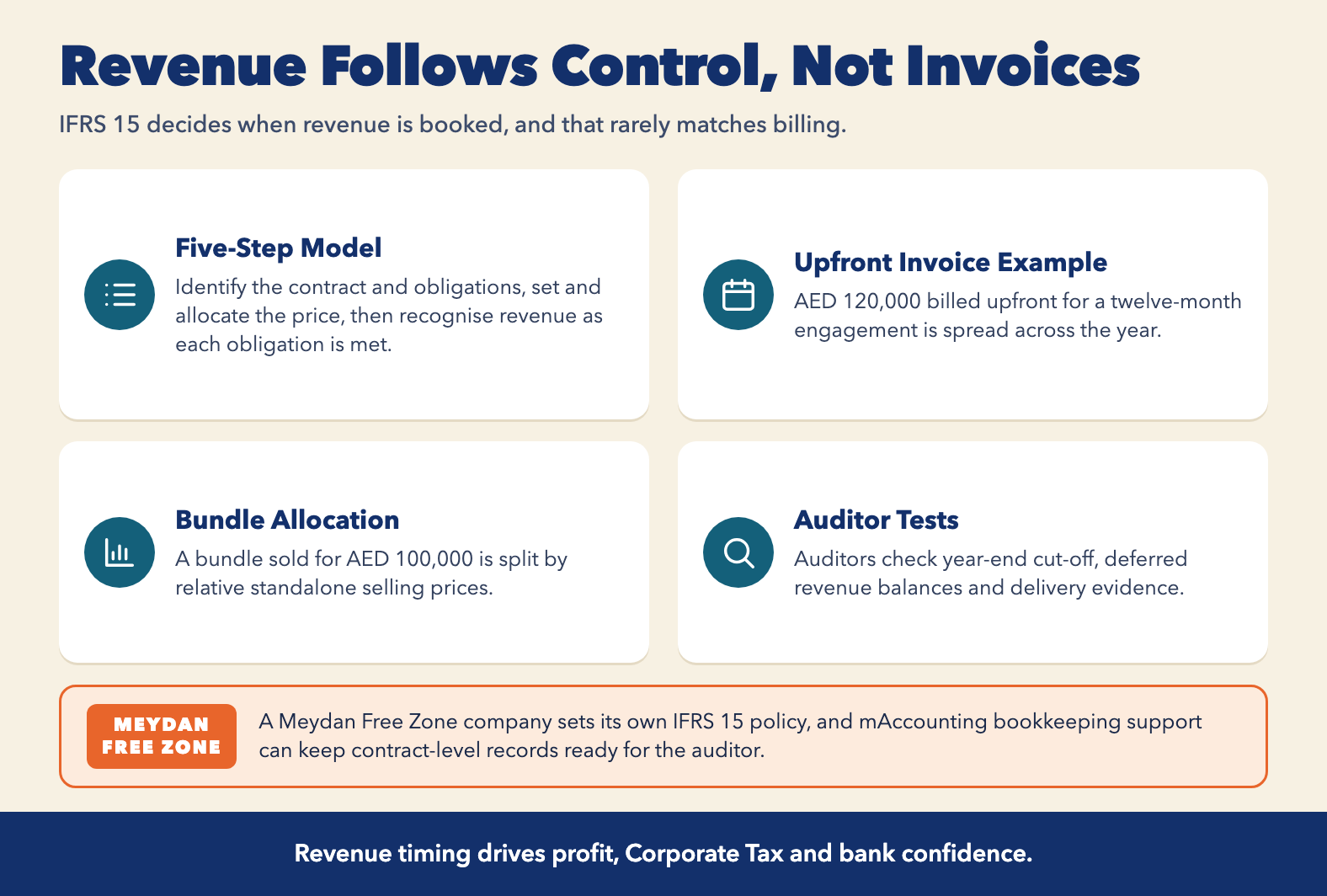
Timing drives reported profit, Corporate Tax, covenant compliance and valuation. Recognising revenue too early overstates performance, and too late understates it. Both trigger audit adjustments and weaken credibility with banks and investors.
What Founders Usually Assume
Most assume invoice date equals revenue date, or that cash received equals revenue earned. A software firm that collects annual subscriptions in January and books all of it that month is the classic case. Under IFRS, only the portion delivered so far counts.
What Auditors and Banks Actually Test
- Cut-off around year end.
- Contract terms against booked revenue.
- Deferred revenue balances.
- Delivery evidence for December invoices.
Your invoices matter here too, so review the UAE tax invoice requirements alongside your revenue policy.
The Five Steps of IFRS 15 Revenue Recognition
IFRS 15 uses five steps: identify the contract, identify performance obligations, set the transaction price, allocate it, and recognise revenue as each obligation is satisfied. Followed in order, they produce consistent, auditable figures.
Steps 1 and 2: Contract and Performance Obligations
- A contract needs approval, identifiable rights, payment terms and commercial substance.
- Distinct goods or services become separate performance obligations.
- A fit-out contractor supplying equipment and installation treats installation separately if it is distinct.
Clear drafting helps, so check your clauses against UAE contract law.
Steps 3 and 4: Price and Allocation
- The transaction price includes variable items such as rebates and penalties.
- Allocation uses relative standalone selling prices.
- A bundle sold for AED 100,000 is split across obligations in proportion to those prices.
Step 5: Recognising Revenue Over Time or at a Point in Time
- Over time applies when the customer receives benefits as you perform.
- Point in time applies when control passes, such as on delivery.
- Progress is measured by input or output methods.
Over Time vs Point in Time Revenue Recognition
| Feature | Over Time | Point in Time |
|---|---|---|
| Typical contract type | Retainers, subscriptions, long projects | One-off goods sales |
| Trigger for recognition | Customer receives benefit as you perform | Control passes to the customer |
| Common example | AED 10,000 monthly marketing retainer | Shipment of goods on delivery |
| Effect on deferred revenue | Prepayments release gradually across the term | Prepayments clear in full on delivery |
| Evidence auditors request | Billing schedules, progress reports, completion certificates | Delivery notes, incoterms, signed acceptance |
Common IFRS 15 Scenarios for UAE Businesses
Treatment depends on contract terms. Subscriptions and retainers run over time, goods recognise at delivery, and long projects follow progress. Upfront payments sit as a contract liability until you perform.
Services, Subscriptions and Retainers
A marketing agency billing AED 10,000 a month recognises AED 10,000 monthly, even if the client prepays the year. The unearned balance stays in deferred revenue. Setup fees need a test: if they buy no distinct service, they fold into the main obligation.
Trading, Projects and Variable Consideration
For goods, recognise revenue when control transfers, often tied to incoterms and delivery. A trader offering a year-end volume rebate estimates it and reduces revenue during the year, rather than waiting for the credit note.
How IFRS 15 Links to UAE Corporate Tax and Audit
UAE Corporate Tax starts from accounting income under accepted standards, generally IFRS. Revenue recognised under IFRS 15 feeds into taxable income, subject to specific adjustments.
Accounting Income as the Tax Starting Point
The FTA administers Corporate Tax at 9% on taxable income above AED 375,000. Revenue deferred into the next period moves its taxable income with it, so timing decides which year bears the tax. The UAE business tax compliance lifecycle guide shows where this fits.
Audit Evidence and Documentation
- Signed contracts and amendments.
- Delivery proof and completion certificates.
- A written revenue recognition policy.
- Records that support tax filings.
IFRS 15 Policy for a Meydan Free Zone Company
A Meydan Free Zone company applies IFRS 15 through its own accounting policy, not through the licensing authority. Meydan Free Zone issues the Business License digitally, while mAccounting offers bookkeeping, VAT registration support, Corporate Tax support and financial audit reports.
Setting the Revenue Policy Before the First Contract
Match contract terms to the recognition pattern you intend. A new consultancy that drafts milestone billing mirroring delivery stages simplifies year-end cut-off. Document your judgements on obligations and timing from day one.
Where mAccounting Fits
mAccounting is one of four service pillars of Meydan Plus (mPlus). A founder can use its bookkeeping support to keep contract-level records ready for the auditor. Revenue judgements, though, stay with the company and its auditor.
Free Business Setup Cost Calculator
Calculate NowMistakes to Avoid When Applying IFRS 15 in the UAE
The common errors are recognising revenue on invoice date, ignoring separate performance obligations, overlooking variable consideration and keeping weak records. Each leads to audit adjustments and Corporate Tax corrections.
Policy and Judgement Errors
- Treating bundles as one obligation.
- Ignoring rebates, penalties and returns.
- Applying one pattern to every contract.
A distributor that books gross sales and ignores a contractual rebate until year end overstates revenue all year.
Record-Keeping Gaps
A price change agreed by email and never documented leaves the auditor unable to support the revised figure. Missing acceptance evidence and mismatched invoice and contract terms cause the same problem. Add these checks to your company compliance calendar.
Conclusion
IFRS 15 compliance in the UAE is an execution issue, not theory. Revenue follows transfer of control, and your contract wording, billing schedule and records must support that. Founders who settle policy early face fewer audit adjustments and cleaner Corporate Tax filings. Map your expected contracts to their recognition pattern before the first one is signed. A Meydan Free Zone company can use mAccounting's bookkeeping support to keep the evidence for each one.
Ready to Launch Your Business in Dubai?
Let's Connect