







Table of Contents
Frequently Asked Questions
Can management accounts replace statutory accounts when applying to a bank?
No. Banks use management accounts to judge current trading, but they rely on formally prepared financial statements for onboarding, credit reviews and periodic checks. Management accounts have no fixed format and no external assurance. Most banks ask for both sets when assessing a facility.
Which accounting standard do companies in the UAE use for financial statements?
Companies in the UAE generally prepare statutory financial statements under IFRS, or IFRS for SMEs where it applies. Corporate Tax is calculated starting from accounting income prepared under these standards. Management accounts are not bound by IFRS and can follow any internal format.
Does a small free zone company need audited financial statements?
It depends on the rules of the licensing authority and the company's Corporate Tax position. Some businesses must submit audited statements, while others only need prepared statements and supporting records. Founders should confirm the current audit requirement before the financial year closes, so an auditor can be appointed on time.
How often should a founder prepare management accounts?
Monthly is the practical standard for most companies. It allows bank reconciliation, cash flow review and margin checks while the figures are still fresh. Trading companies with stock or a bank facility often add weekly cash reports.
Does the Federal Tax Authority require financial statements with a Corporate Tax return?
The Federal Tax Authority administers Corporate Tax and expects taxable persons to keep financial statements and supporting records that reconcile to their returns. Whether statements must be filed with the return depends on the company's circumstances and current Federal Tax Authority guidance. Prepared statements should be ready before the filing deadline either way.
Can one bookkeeping system produce both management and statutory reports?
Yes. A single, well-kept ledger can produce monthly management reports and year-end statutory statements. The chart of accounts should follow IFRS from the start, so year-end work involves adjustments rather than rebuilding records. Meydan Free Zone's mAccounting covers bookkeeping, VAT registration and Corporate Tax support for this purpose.
What records should a company keep to support its financial statements?
Keep invoices, receipts, bank statements, contracts, payroll records and the general ledger. These documents must support every figure in the statements and in any Corporate Tax return. Corporate Tax law requires these records to be kept for seven years after the end of the tax period.
Topic Summary
Why Founders Confuse Management and Statutory Accounts
Founders treat internal reports as official records because both show profit and loss. Management accounts guide decisions inside the business. Statutory accounts follow set standards and satisfy banks, auditors and the Federal Tax Authority. Mixing them up causes rejected documents and delayed bank reviews.
What Management Accounts and Statutory Accounts Mean in the UAE
Management accounts are internal reports for decision-making, in any format and on any schedule. Statutory accounts are formal statements prepared under recognised standards, usually International Financial Reporting Standards (IFRS). They are the statements external parties rely on, and the core of a company's financial reporting.
Key Differences Between Management and Statutory Financial Statements
The main differences are purpose, audience, format, standards and assurance. Management accounts serve internal decisions and carry no assurance. Statutory accounts follow IFRS, suit external readers and may need an audit.
Compliance and Risk for Financial Statements in the UAE
The Federal Tax Authority administers Corporate Tax and expects taxable persons to keep statements and supporting records. Banks apply their own due diligence under Central Bank of the UAE rules. Weak statutory accounts delay bank reviews, complicate filings and weaken your position in any dispute.
How to Prepare Both Sets of Accounts
Prepare both sets from one clean ledger. Reconcile bank accounts every month, close the year with adjustments, prepare statements under IFRS and arrange an audit if required.
How a Meydan Free Zone Company Handles Financial Reporting
A Meydan Free Zone company keeps its own books and prepares statements under free zone rules and Federal Tax Authority requirements. Meydan Free Zone offers mAccounting, covering bookkeeping, VAT registration and Corporate Tax support, so management and statutory records stay aligned.
Choosing the Right Reporting Approach
Choose based on audience and stage. Early-stage founders need monthly management accounts for cash control and annual statutory accounts for the bank and tax. As revenue, staff or lending grows, tighten the timetable and plan audit requirements before the year closes.
Management Accounts vs Statutory Accounts in the UAE
Many founders send monthly profit figures to their bank and assume they count as official financial statements. That holds until a bank, auditor or the Federal Tax Authority asks for statutory accounts. So what is the difference, and when do you need each? This guide explains what separates the two, what banks and regulators expect, and how to produce both from one set of books.
Why Founders Confuse Management and Statutory Accounts
Founders treat internal reports as official records because both show profit and loss. Management accounts guide decisions inside the business. Statutory accounts follow set standards and satisfy banks, auditors and the Federal Tax Authority. Mixing them up causes rejected documents and delayed bank reviews.
What Founders Believe Versus What Regulators Expect
The belief is that a clean monthly profit report is enough. It isn't. A trading founder who submits a spreadsheet profit and loss report to a bank is usually asked for prepared financial statements. Internal reports have no fixed format and no external assurance.
Where the Confusion Costs Time
The delay shows up at bank onboarding, periodic bank reviews and Corporate Tax record checks. It also appears in lender due diligence. A lender asking for the last full-year statements gets nothing useful from a pile of management packs.
What Management Accounts and Statutory Accounts Mean in the UAE
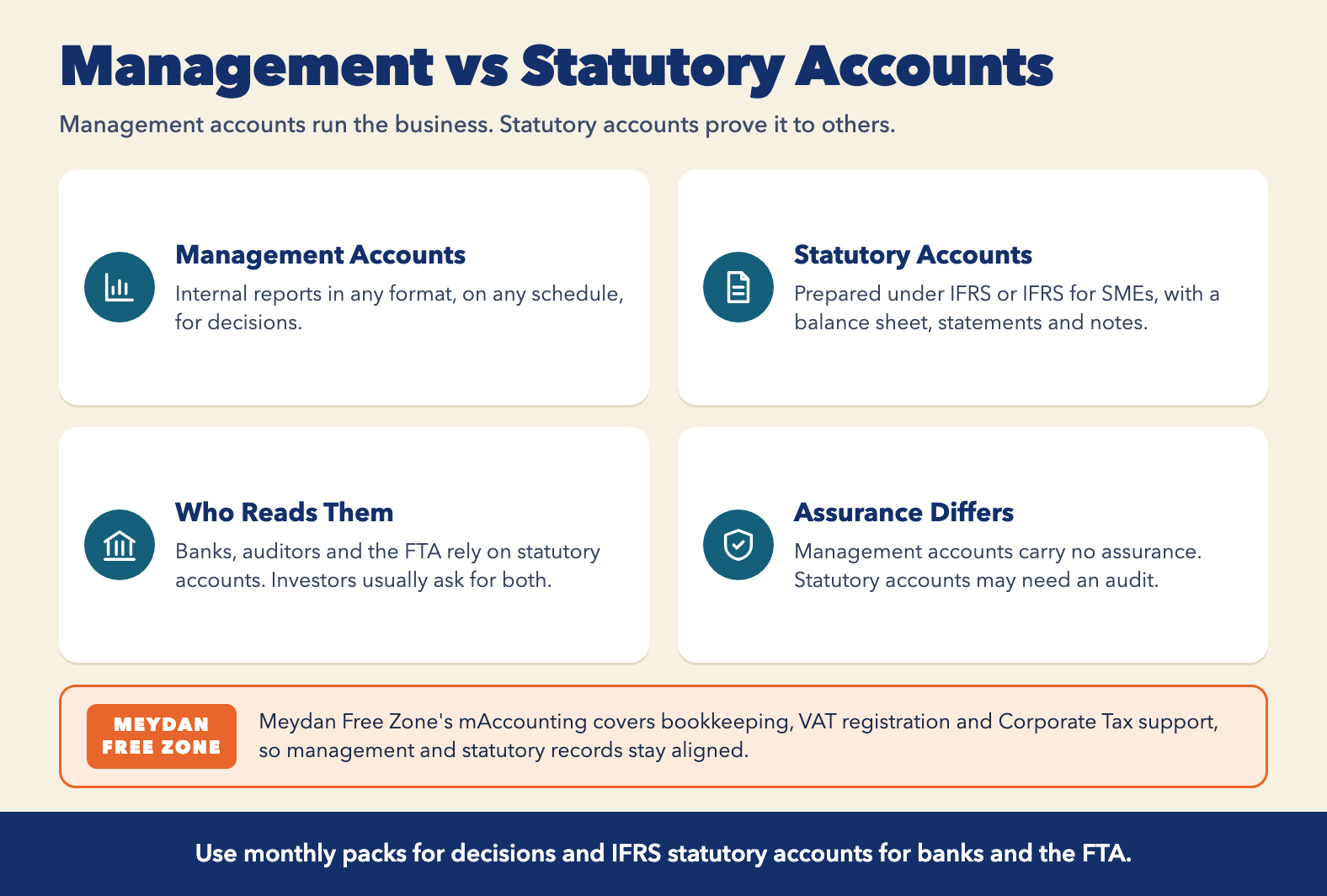
Management accounts are internal reports for decision-making, in any format and on any schedule. Statutory accounts are formal statements prepared under recognised standards, usually International Financial Reporting Standards (IFRS). They are the statements external parties rely on, and the core of a company's financial reporting.
Management Accounts Defined
These are flexible and forward-looking. A consultancy might run a monthly pack showing gross margin by client, cash flow and budget variance. The owner decides the timing and content.
Statutory Accounts Defined
They include a balance sheet, income statement, cash flow statement and notes, prepared under IFRS or IFRS for SMEs. Whether an audit applies depends on your licensing authority and Corporate Tax status. Corporate Tax law (Federal Decree-Law No. 47 of 2022) requires taxable persons to keep financial statements that support their returns, and the Federal Tax Authority (FTA) administers it.
Who Uses Each Set of Reports
- Owners and managers use management accounts.
- Banks, auditors and the FTA use statutory accounts.
- Investors usually ask for both.
- A bank reviewing a credit facility often wants audited statements plus current management accounts.
Management Accounts Compared With Statutory Accounts
| Aspect | Management Accounts | Statutory Accounts |
|---|---|---|
| Purpose | Cash control, margins and budget decisions | Compliance, tax support and external reliance |
| Audience | Owners and managers | Banks, auditors, the FTA, lenders |
| Standards and format | Any layout the business chooses | IFRS or IFRS for SMEs, prescribed statements and notes |
| Frequency | Weekly, monthly or quarterly | Annually |
| Assurance or audit | None | Auditor opinion where required |
Key Differences Between Management and Statutory Financial Statements
The main differences are purpose, audience, format, standards and assurance. Management accounts serve internal decisions and carry no assurance. Statutory accounts follow IFRS, suit external readers and may need an audit.
Purpose, Audience and Format
A founder reviewing weekly cash wants speed. A bank reading year-end notes wants consistency. That's why one has a flexible layout and the other a prescribed structure.
Standards, Frequency and Assurance
Statutory accounts run on an annual cycle and align to IFRS. An auditor's opinion adds assurance. Management reports run monthly or quarterly with no opinion attached.
Compliance and Risk for Financial Statements in the UAE
The Federal Tax Authority administers Corporate Tax and expects taxable persons to keep statements and supporting records. Banks apply their own due diligence under Central Bank of the UAE rules. Weak statutory accounts delay bank reviews, complicate filings and weaken your position in any dispute.
Corporate Tax and Record Keeping
Corporate Tax is 9% on taxable income above AED 375,000, and records must be kept for seven years after the end of the tax period. The Federal Tax Authority (FTA) expects your filed return to reconcile to prepared statements.
Banking and Due Diligence
Banks ask for statements at onboarding and at review, under due diligence rules set by the Central Bank of the UAE. Management accounts support them but don't replace them, and a review can pause until your latest statements arrive.
Cost of Getting It Wrong
Expect rework, late preparation fees and delayed renewals or facilities. Fees vary by provider, so treat any quote as an estimate in AED, not an official charge. Clean bookkeeping services in Dubai reduce that rework.
How to Prepare Both Sets of Accounts
Prepare both sets from one clean ledger. Reconcile bank accounts every month, close the year with adjustments, prepare statements under IFRS and arrange an audit if required.
- Set up bookkeeping from day one. Use a chart of accounts aligned to IFRS and capture invoices, receipts and bank feeds consistently.
- Reconcile and produce management reports. Run monthly bank reconciliation, then profit and loss, cash flow and receivables ageing.
- Close the year. Post depreciation and accruals, then prepare the balance sheet, income statement, cash flow statement and notes.
- Arrange audit and retain records. Appoint an approved auditor where required, and see financial audit reports for the audit stage. Keep records for seven years.
How a Meydan Free Zone Company Handles Financial Reporting
A Meydan Free Zone company keeps its own books and prepares statements under free zone rules and Federal Tax Authority requirements. Meydan Free Zone offers mAccounting, covering bookkeeping, VAT registration and Corporate Tax support, so management and statutory records stay aligned.
Digital Setup and Record Keeping From the Start
Fawri issues a business license in under 60 minutes for solo entrepreneurs. Meydan Free Zone then issues the Business License, Certificate of Formation, Share Register and Memorandum and Articles of Association digitally. A solo founder can start bookkeeping straight after registration with those records in hand.
Where mAccounting Fits
mAccounting sits within Meydan Plus. It covers the bookkeeping, VAT registration and Corporate Tax support behind your statements. It also offers financial audit reports, so the audit stage can stay with the same provider if your company needs one.
Free Business Setup Cost Calculator
Calculate NowChoosing the Right Reporting Approach
Choose based on audience and stage. Early-stage founders need monthly management accounts for cash control and annual statutory accounts for the bank and tax. As revenue, staff or lending grows, tighten the timetable and plan audit requirements before the year closes.
Matching Reports to Business Stage
A solo consultancy can run monthly packs. A trading company with stock often adds weekly cash reports once its first bank facility arrives.
Questions to Settle Before You Start
- Who keeps and reviews the books?
- Which year-end date suits the business?
- What will lenders and the bank ask for?
Conclusion
Management accounts run the business and statutory accounts prove it to others. Treat statutory accounts as the routine output of clean bookkeeping, not a year-end scramble. With Meydan Free Zone, mAccounting covers both bookkeeping and financial audit reports. Decide early who keeps the books, set the year-end date and confirm which reports your bank and tax position will need.
Ready to Launch Your Business in Dubai?
Let's Connect