Table of Contents
Frequently Asked Questions
Are out-of-scope supplies reported on a UAE VAT return?
Out-of-scope supplies are not reported as standard-rated, zero-rated or exempt sales. They sit outside the UAE VAT system, so they do not form part of the taxable boxes of the return. Keep the invoices and contracts on file so you can support the classification if the Federal Tax Authority asks.
How does an out-of-scope supply differ from an exempt supply?
An exempt supply falls within the UAE VAT system but carries no output VAT. An out-of-scope supply falls outside the system entirely, either because there is no supply for VAT purposes or because the place of supply is outside the UAE. The difference affects reporting and how you treat the input VAT on related costs.
Can a business recover input VAT on costs linked to out-of-scope sales?
Recovery depends on the nature of the supply the cost relates to. Costs tied to exempt supplies are generally not recoverable. If your business makes taxable and non-taxable sales, allocate shared costs by activity from the start so that you avoid adjustments at filing.
Is a service sold to a client abroad always out-of-scope?
No. A service supplied to an overseas client is usually still a UAE supply, zero-rated as an export where the conditions are met. It is out of scope only where the place of supply rules put it outside the UAE, such as some services connected to property abroad. Classify each service on its own facts and record your reasoning before you invoice.
Do out-of-scope sales count toward the VAT registration threshold?
Mandatory VAT registration applies above AED 375,000 in taxable supplies and imports over twelve months. Voluntary registration is available above AED 187,500. Supplies that are genuinely out of scope are not taxable supplies, so check the Federal Tax Authority guidance on which turnover counts.
Does a free zone company treat out-of-scope supplies differently?
No. VAT is a federal tax under Federal Decree-Law No. 8 of 2017, administered by the Federal Tax Authority. A Meydan Free Zone company applies the same classification rules as any other UAE business. Free zone status does not remove VAT obligations.
What records should a business keep for out-of-scope transactions?
Keep the invoice, the contract and proof of where the service is consumed or the goods are delivered. Add a short note stating the legal basis for the out-of-scope treatment. Meydan Free Zone's mAccounting service, part of Meydan Plus, includes bookkeeping and VAT registration support.
Who decides how a disputed supply is classified for UAE VAT?
The Federal Tax Authority is the competent authority for VAT classification in the UAE. It publishes guidance and can review a business's treatment of a supply. If a classification is unclear, resolve it with the authority or a qualified tax adviser before filing the return.
Topic Summary
Out-of-Scope Supplies Under UAE VAT Explained
Out-of-scope supplies are transactions that fall outside the UAE VAT system, either because no supply takes place for VAT purposes or because the place of supply is outside the UAE. They carry no UAE VAT and are not reported as standard-rated, zero-rated or exempt.
Out-of-Scope Versus Exempt and Zero-Rated Supplies
Zero-rated supplies are taxable at 0% and allow input VAT recovery. Exempt supplies are not taxed and block recovery. Out-of-scope supplies sit outside the UAE VAT system altogether. The difference decides how you report the transaction and whether you can recover VAT paid on related costs.
Examples of Out-of-Scope Supplies in the UAE
Common out-of-scope examples include supplies whose place of supply is outside the UAE and movements within the same legal person. Supplies between members of the same VAT group and a qualifying transfer of a business as a going concern are also outside the scope. Each depends on the facts, so check the legal basis before reporting.
How to Classify a Transaction Before You Invoice
Work through a fixed order: confirm a supply exists, establish the place of supply, check for zero-rating, check for exemption, then apply the standard rate. If the transaction falls outside the UAE under place of supply rules, treat it as out of scope and record the reasoning.
How Out-of-Scope Treatment Affects Input VAT Recovery
Input VAT linked to out-of-scope supplies is generally recoverable only where the supply would have been taxable had it been made in the UAE. Costs tied to exempt supplies are usually not recoverable. Allocate costs by activity from the start to avoid adjustments at filing.
Records and Invoicing for Out-of-Scope Supplies
Out-of-scope supplies do not appear as taxable lines in a UAE VAT return, but you must still keep clear invoices, contracts and evidence of the place of supply. Good records let you defend the classification if the FTA queries it.
What This Means for Your Founder Decisions
Settle classification before the first invoice, not at filing. Founders serving both UAE and overseas clients should map each revenue stream to a VAT treatment, set up cost allocation early and confirm registration timing against the AED 375,000 threshold.
Out-of-Scope Supplies Under UAE VAT: What They Are
VAT classification tends to cause trouble at the wrong moment: a first return, a client query or a bank review. Many founders assume that if no VAT appears on an invoice, the supply must be exempt or zero-rated, and that assumption can distort a return. This guide explains which supplies fall outside UAE VAT, how they differ from exempt and zero-rated supplies, and what that means for input VAT and records.
Out-of-Scope Supplies Under UAE VAT Explained
Out-of-scope supplies are transactions that fall outside the UAE VAT system, either because no supply takes place for VAT purposes or because the place of supply is outside the UAE. They carry no UAE VAT and are not reported as standard-rated, zero-rated or exempt.
Definition and Legal Basis
The rules sit in Federal Decree-Law No. 8 of 2017 on VAT and its Executive Regulation, administered by the Federal Tax Authority (FTA). This is a federal law, so it applies to free zone companies too. Say a UAE company sells goods that are located abroad and never enter the UAE. The place of supply is outside the UAE, so no UAE VAT is charged and the sale is not a taxable line in the return.
Why the Label Matters Commercially
The label drives return reporting and input VAT recovery. Banks and auditors read VAT returns, so misclassification invites questions. Picture a founder who marks an out-of-scope invoice as zero-rated. The return then shows a taxable supply that never existed, and the next review asks why.
The same logic applies to every out-of-scope decision. For the wider framework, see VAT in the UAE: all the details.
Out-of-Scope, Zero-Rated and Exempt Supplies Compared
| Feature | Treatment | VAT Effect |
|---|---|---|
| Standard-rated supply | Taxable at 5%, reported in the return | On an AED 10,000 invoice, AED 500 output VAT is charged |
| Zero-rated supply | Taxable at 0%, reported in the return | AED 0 charged on AED 10,000, input VAT recoverable |
| Exempt supply | Within the system but not taxed | AED 0 charged on AED 10,000, input VAT generally not recoverable |
| Out-of-scope supply | Outside the system: no supply, or place of supply abroad | AED 0 charged on AED 10,000, not shown as a taxable line |
| Input VAT recovery | Follows the nature of the related supply | Open for taxable and zero-rated, blocked for exempt |
Out-of-Scope Versus Exempt and Zero-Rated Supplies
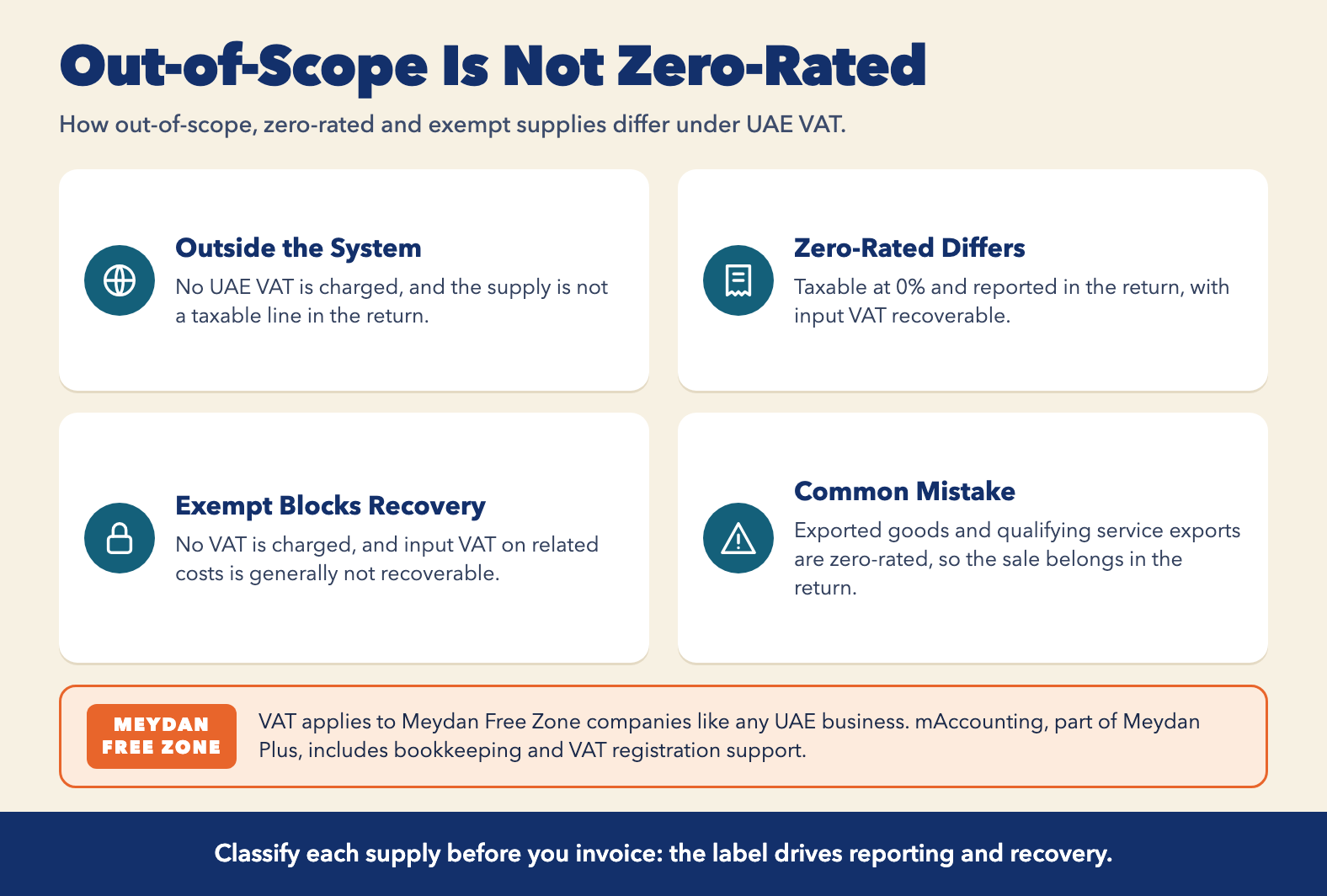
Zero-rated supplies are taxable at 0% and allow input VAT recovery. Exempt supplies are not taxed and block recovery. Out-of-scope supplies sit outside the UAE VAT system altogether. The difference decides how you report the transaction and whether you can recover VAT paid on related costs.
Where Founders Misclassify
- Treating exports of services as out-of-scope when they qualify as zero-rated.
- Treating zero-rated as exempt and losing input VAT recovery.
- Skipping a single read of the FTA guidance before the first filing.
A trading company that exports goods and labels the sale out-of-scope makes the first error. Exported goods are generally zero-rated, so the sale belongs in the return.
Examples of Out-of-Scope Supplies in the UAE
Common out-of-scope examples include supplies whose place of supply is outside the UAE and movements within the same legal person. Supplies between members of the same VAT group and a qualifying transfer of a business as a going concern are also outside the scope. Each depends on the facts, so check the legal basis before reporting.
Supplies With a Place of Supply Outside the UAE
Place of supply rules decide where a good or service is treated as supplied. Goods located abroad and services connected to property outside the UAE can fall outside the UAE system. A Meydan Free Zone design company billing a client abroad is different: its service is usually a UAE supply, zero-rated as an export where the conditions are met. Where your business receives foreign services, the UAE VAT reverse charge may apply instead.
Non-Business, Same-Entity and VAT Group Transactions
- Activity outside a taxable person's economic activity.
- Movements within a single legal person, such as a stock transfer between two locations of one company.
- Supplies between members of the same VAT group, which is treated as one taxable person.
Cases That Look Out-of-Scope but Are Not
Exports of goods and international transport are typically zero-rated. Designated Zone rules can change the treatment of some goods movements, but services follow the normal VAT rules. A goods exporter should review each sale against the zero-rating rules before the return is filed.
How to Classify a Transaction Before You Invoice
Work through a fixed order: confirm a supply exists, establish the place of supply, check for zero-rating, check for exemption, then apply the standard rate. If the transaction falls outside the UAE under place of supply rules, treat it as out of scope and record the reasoning.
A Five-Point Classification Sequence
- Confirm that a supply of goods or services is taking place.
- Establish the place of supply under UAE VAT law.
- Test for zero-rating.
- Test for exemption.
- Apply the 5% standard rate if none applies.
A freelance consultant billing a UAE client stops at step five. The same consultant billing a client abroad may stop at step two or three.
Documenting the Decision
Keep a short file note on the legal basis for each out-of-scope call. Store the contract and proof of where the service is consumed with the invoice.
How Out-of-Scope Treatment Affects Input VAT Recovery
Input VAT linked to out-of-scope supplies is generally recoverable only where the supply would have been taxable had it been made in the UAE. Costs tied to exempt supplies are usually not recoverable. Allocate costs by activity from the start to avoid adjustments at filing.
Recovery Rules in Practice
Take a company with UAE taxable sales and foreign out-of-scope sales. Shared software costs need a documented allocation across both streams. Out-of-scope treatment does not block recovery by default, but the allocation must be defensible.
Registration Thresholds and Out-of-Scope Turnover
- Registration is mandatory where taxable supplies and imports exceed AED 375,000 over the previous 12 months, or are expected to in the next 30 days.
- Voluntary registration opens above AED 187,500.
- The threshold is measured on taxable supplies, so confirm the treatment of each stream in FTA guidance.
Records and Invoicing for Out-of-Scope Supplies
Out-of-scope supplies do not appear as taxable lines in a UAE VAT return, but you must still keep clear invoices, contracts and evidence of the place of supply. Good records let you defend the classification if the FTA queries it.
Invoice Content
Describe the supply clearly, show the customer's location and show no UAE VAT where none applies. Registered businesses should also review the UAE tax invoice requirements.
Record-Keeping Support From Meydan Free Zone
VAT applies to Meydan Free Zone companies in the same way as other UAE businesses. Free zone status does not remove VAT obligations. mAccounting, part of Meydan Plus, includes bookkeeping and VAT registration support. That helps a new company keep the invoices and records its classification calls depend on.
Free Business Setup Cost Calculator
Calculate NowWhat This Means for Your Founder Decisions
Settle classification before the first invoice, not at filing. Founders serving both UAE and overseas clients should map each revenue stream to a VAT treatment, set up cost allocation early and confirm registration timing against the AED 375,000 threshold.
Mapping Revenue Streams
- List each client type and its likely treatment.
- Flag grey areas for professional review.
- A UAE client and an overseas client will often need different treatments.
Timing Registration and Setup
Plan VAT registration alongside company setup, not after the first large invoice. Track taxable turnover from day one so you can see when it nears the AED 375,000 threshold.
Conclusion
Out-of-scope treatment under UAE VAT turns on place of supply and whether a taxable supply exists at all. It differs from zero-rating and exemption in reporting and input VAT recovery. Classify each revenue stream before invoicing, keep the evidence and review grey areas with a qualified tax adviser. With Meydan Free Zone, mAccounting covers bookkeeping and VAT registration support, so your records can reflect these decisions from the first invoice.
Ready to Launch Your Business in Dubai?
Let's ConnectReferences
- Federal Tax Authority (FTA), UAE: Federal Decree-Law No. 8 of 2017 on VAT, registration thresholds and VAT guidance.