






Table of Contents
Frequently Asked Questions
Can a foreign company have a taxable presence in the UAE without an office?
Yes. Under the UAE Corporate Tax regime, a dependent agent who habitually concludes contracts for a foreign company can create a taxable presence, even with no premises. The test looks at what people do on the ground, not only at whether the company holds a lease.
Does a Meydan Free Zone company count as a permanent establishment of its foreign parent?
No. A Meydan Free Zone company is a separate UAE legal entity with its own tax position, so it is not automatically a permanent establishment of its parent. The parent's exposure depends on how it operates, including where it makes decisions and who signs contracts on its behalf.
Who decides whether a foreign company has a permanent establishment in the UAE?
The Federal Tax Authority administers Corporate Tax and assesses whether a foreign company has a taxable presence. It looks at where management and control sit, whether a fixed place of business exists, and who negotiates and concludes contracts.
Can a UAE-resident director create a taxable presence for an overseas company?
Yes, it can happen. If a director based in the UAE habitually concludes contracts or takes the company's key decisions from here, the overseas company may be treated as having a taxable presence. Holding board meetings in the UAE draws the same attention.
What Corporate Tax rate applies to a permanent establishment in the UAE?
Profits attributable to a permanent establishment fall under UAE Corporate Tax, which applies at 9% on taxable income above AED 375,000. Only the profit linked to the UAE presence is taxed, not the foreign company's worldwide income.
Do double tax treaties change the permanent establishment test?
They can. A treaty's definition of a permanent establishment may narrow or widen the domestic test, and the company's treaty residence also matters. Owners should check the specific treaty between the UAE and their home country.
What happens if a taxable presence in the UAE is not registered?
The owner may face administrative penalties from the Federal Tax Authority for late registration, late filing or missing records. Banks can also ask for evidence of tax status during due diligence, and unresolved exposure can delay account reviews.
Can a free zone company still pay 0% Corporate Tax if it has a foreign parent?
Yes, if it qualifies as a Qualifying Free Zone Person. The 0% rate applies only to qualifying income, and the company must meet the substance and activity conditions. Non-qualifying income is taxed at 9%, regardless of who owns the company.
Topic Summary
What Permanent Establishment Means in the UAE
A permanent establishment is a fixed place of business, or a dependent agent acting for a foreign company, through which that company carries on business in the UAE. Under the Corporate Tax regime, it can make a non-resident company taxable on income attributable to that presence.
How Permanent Establishment Is Assessed in the UAE
The Federal Tax Authority administers Corporate Tax and assesses whether a foreign company has a taxable presence. It looks at whether a fixed location exists, who negotiates and concludes contracts, where the company is managed and controlled, and whether a double tax treaty changes the outcome.
Tax and Compliance Consequences of a Permanent Establishment
A permanent establishment can bring attributable profits into UAE Corporate Tax, which applies at 9% above the AED 375,000 threshold. The owner must then register with the Federal Tax Authority, keep records, file returns and face administrative penalties for late or missed obligations.
How a Meydan Free Zone Structure Affects Permanent Establishment Exposure
A Meydan Free Zone company is a separate UAE legal entity, not a permanent establishment of a foreign parent. It is taxed as its own person and may qualify for 0% on qualifying income if it meets Corporate Tax conditions. The foreign parent's exposure depends on how it operates.
Practical Steps to Manage Permanent Establishment Risk
Manage this risk in five steps: map where decisions are made, review who signs contracts, choose the right legal structure, check the relevant double tax treaty, and keep records and filings in order. Reviewing these before operations begin is cheaper than correcting them after an audit.
Permanent Establishment Versus Free Zone Company Comparison
A permanent establishment is a taxable presence of a foreign company in the UAE, while a free zone company is a separate UAE legal entity with its own license-based tax position. The difference decides who files returns, which income is taxed, and whether the 0% rate can apply.
Conclusion
Permanent establishment in the UAE turns on facts on the ground, not intent. Owners who map decision-making, contract authority and structure early avoid unplanned Corporate Tax exposure and keep banking conversations simple. A Meydan Free Zone company is a separate UAE legal entity that files its own Corporate Tax return. Document where decisions are made and who signs contracts, then choose the structure that matches that reality.
Permanent Establishment Risk for Foreign Business Owners
Many foreign owners assume that running a business from abroad keeps it outside UAE Corporate Tax, but where decisions are made, who signs contracts and how staff work locally can create a taxable presence. Does your current set-up put your overseas company at risk? This guide explains how permanent establishment is assessed, what it costs if it arises and how to structure your UAE activity before it does.
What Permanent Establishment Means in the UAE
A permanent establishment is a fixed place of business, or a dependent agent acting for a foreign company, through which that company carries on business in the UAE. Under the Corporate Tax regime, it can make a non-resident company taxable on income attributable to that presence.
Fixed Place of Business Versus Dependent Agent
A fixed place covers an office, branch, warehouse or site used with some permanence. A dependent agent is a person who habitually concludes contracts on the foreign company's behalf. Independent agents acting in the ordinary course of their own business generally sit outside the test. The definitions come from Article 14 of the Corporate Tax Law and Federal Tax Authority guidance.
Take a UK consultancy whose sales manager lives in Dubai and routinely signs client contracts. No office is needed. The signing habit alone can create a taxable presence.
Why Foreign Owners Misjudge the Risk
The common error is believing that no office means no presence. Another is treating a visa or residency as if it were a tax position. It isn't. Consider an overseas founder who relocates to Dubai and runs a foreign company from a home laptop. Managing from the UAE can still create exposure, whatever the company's registered address says.
How Permanent Establishment Is Assessed in the UAE
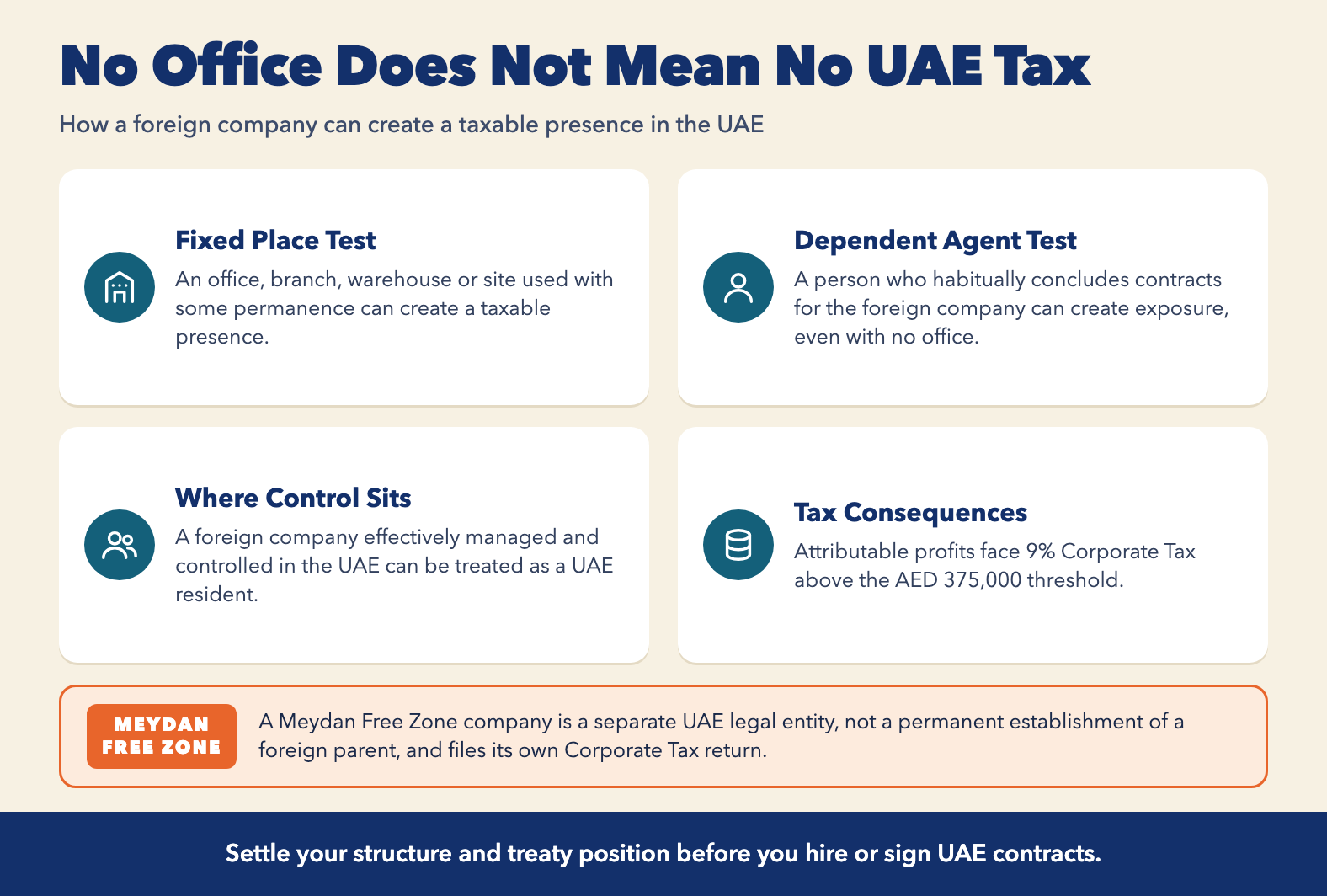
The Federal Tax Authority administers Corporate Tax and assesses whether a foreign company has a taxable presence. It looks at whether a fixed location exists, who negotiates and concludes contracts, where the company is managed and controlled, and whether a double tax treaty changes the outcome.
Management, Control and Contract Authority
Where the company is managed matters more than its registered address. A foreign company that is effectively managed and controlled in the UAE can be treated as a UAE resident, which goes further than a permanent establishment. Picture directors of a foreign holding company who hold every board meeting in Dubai. Habitual contract conclusion by a local representative draws similar attention.
The Role of Double Tax Treaties
Treaty definitions can narrow or widen the domestic test, and the foreign company's treaty residence matters. A company resident in a treaty country with a UAE sales office may get a different result from one resident elsewhere. Read the specific treaty between the UAE and the home country, such as the UK–UAE double tax treaty.
Tax and Compliance Consequences of a Permanent Establishment
A permanent establishment can bring attributable profits into UAE Corporate Tax, which applies at 9% above the AED 375,000 threshold. The owner must then register with the Federal Tax Authority, keep records, file returns and face administrative penalties for late or missed obligations.
Corporate Tax Registration and Filing
Say a foreign trading company's Dubai office becomes a taxable presence. It registers for Corporate Tax, keeps financial records and files an annual return. Only profit attributable to the UAE presence is taxed, so records that separate UAE activity from the rest matter.
Penalties and Banking Consequences
Late registration or filing attracts administrative penalties. Banks licensed by the Central Bank of the UAE also ask about tax status during due diligence, and an unresolved position can delay account reviews. Read more on penalties for non-compliance in the UAE.
How a Meydan Free Zone Structure Affects Permanent Establishment Exposure
A Meydan Free Zone company is a separate UAE legal entity, not a permanent establishment of a foreign parent. It is taxed as its own person and may qualify for 0% on qualifying income if it meets Corporate Tax conditions. The foreign parent's exposure depends on how it operates.
Separate Entity Versus Branch
A locally licensed company has its own tax position. A branch of a foreign company can create a taxable presence for the parent. A founder who forms a Meydan Free Zone company, rather than operating through an unregistered office, gets a defined entity to report on. After registration, Meydan Free Zone issues the Business License, Certificate of Formation, Share Register, and Memorandum and Articles of Association digitally. UK founders can read more on relocating a business from the UK to Dubai.
Qualifying Free Zone Person Conditions
The 0% rate applies only to qualifying income. Substance and activity conditions must be met, and non-qualifying income is taxed at 9%, according to the Federal Tax Authority. A trading entity should separate qualifying and non-qualifying revenue from the start.
Free Business Setup Cost Calculator
Calculate NowPractical Steps to Manage Permanent Establishment Risk
Manage this risk in five steps: map where decisions are made, review who signs contracts, choose the right legal structure, check the relevant double tax treaty, and keep records and filings in order. Reviewing these before operations begin is cheaper than correcting them after an audit.
Map Decisions, Contracts and Staff Activity
- Record where directors meet and decide.
- Limit contract-signing authority of UAE-based staff.
- Document what each person does.
- A foreign firm might, for example, move contract sign-off back to its home office.
Permanent Establishment Versus Free Zone Company
| Feature | Permanent Establishment of a Foreign Company | Meydan Free Zone Company |
|---|---|---|
| Legal status | Not a separate entity; a taxable presence of the foreign company | Separate UAE legal entity with its own tax position |
| Corporate Tax registration | The foreign company registers for its UAE presence | The company registers in its own name |
| Tax rate treatment | 9% on attributable profit above AED 375,000 | 0% on qualifying income; 9% on non-qualifying income |
| Substance requirements | Arises from a fixed place or dependent agent activity | Must meet substance and activity conditions for the 0% rate |
| Reporting responsibility | The foreign owner files and keeps UAE records | The company files its own return and financial records |
Align Structure, Accounting and Records
- Select the entity type that fits the activity.
- Maintain books and Corporate Tax filings.
- Use Meydan Free Zone's mAccounting for bookkeeping, VAT registration support and Corporate Tax support.
- A founder can keep Corporate Tax records current this way.
Review the Position Every Year
- Changes in staff or premises can alter the analysis.
- Reassess after new contracts or hires.
- Confirm treaty positions when they change.
- Revisit the analysis before hiring a UAE-based sales lead.
Permanent Establishment Versus Free Zone Company Comparison
A permanent establishment is a taxable presence of a foreign company in the UAE, while a free zone company is a separate UAE legal entity with its own license-based tax position. The difference decides who files returns, which income is taxed, and whether the 0% rate can apply.
What This Means for Your Decision
A formal structure gives clearer reporting. An unstructured presence creates unmanaged exposure. Decide before hiring or signing local contracts. An owner about to hire a UAE sales manager should settle the structure first, not after the first contract is signed.
Conclusion
Permanent establishment in the UAE turns on facts on the ground, not intent. Owners who map decision-making, contract authority and structure early avoid unplanned Corporate Tax exposure and keep banking conversations simple. A Meydan Free Zone company is a separate UAE legal entity that files its own Corporate Tax return. Document where decisions are made and who signs contracts, then choose the structure that matches that reality.
Ready to Launch Your Business in Dubai?
Let's Connect