

Table of Contents
Frequently Asked Questions
Do I need to be VAT-registered to use the margin scheme in the UAE?
Yes. Only a VAT-registered business can account for VAT on the margin. Registration with the Federal Tax Authority is mandatory above AED 375,000 in annual taxable supplies and voluntary from AED 187,500. A Meydan Free Zone company follows the same federal registration rules as any other UAE business.
How is VAT calculated on a used car sold at a profit?
Subtract the purchase price from the selling price to find the margin. Treat that margin as VAT-inclusive, then multiply it by 5/105 to find the VAT due. For example, a car bought for AED 20,000 and sold for AED 26,000 has a margin of AED 6,000, which produces VAT of about AED 285.71.
What happens if I sell second-hand goods at a loss?
No output VAT is due on that sale, because there is no margin to tax. The loss does not create a VAT refund or a credit against other sales. Record the purchase and sale price for the item so the figures support your return.
Can a business customer recover VAT on goods bought under the margin scheme?
No. A margin-scheme invoice does not show any VAT amount, so the buyer has no input tax to claim. Dealers who sell mainly to VAT-registered business buyers should compare this with standard treatment before choosing how to source stock.
Is VAT shown on a margin-scheme invoice?
No. The invoice must not show any VAT amount and must state that VAT was charged under the profit margin scheme. It should still carry the supplier, customer and item details that tax invoice rules require.
Can I apply the margin scheme to some items and standard VAT to others?
Yes. Eligibility depends on how each item was acquired, so a dealer can hold stock under both treatments. Items bought from private individuals, where VAT was charged earlier in the supply chain, can suit the margin scheme. Items bought from registered suppliers with recoverable VAT follow standard treatment. Both appear in the same VAT return, so keep them separate in your records.
What records should a used goods trader keep for the Federal Tax Authority?
Keep an item-level stock register showing the purchase date, source, cost, sale price and margin. Retain proof of the seller's identity, evidence of payment, evidence that VAT was charged on the goods earlier and a copy of each sales invoice. These records must support every figure on the VAT return.
Topic Summary
What the Profit Margin Scheme Means Under UAE VAT
The profit margin scheme lets a VAT-registered dealer charge 5% VAT only on the margin, meaning the selling price minus the purchase price. It covers second-hand goods, antiques and collectors' items that were already subject to VAT earlier in the supply chain.
Which Used Goods Qualify for the Profit Margin Scheme
Eligible goods are second-hand goods, antiques more than 50 years old and collectors' items, such as stamps and coins. Each item must have been subject to VAT at an earlier point, and you must hold evidence of that. Goods acquired before 1 January 2018, or never subject to VAT, do not qualify.
How to Calculate VAT Under the Profit Margin Scheme
Subtract the purchase price from the selling price to find the margin. Treat the margin as VAT-inclusive, divide by 105 and multiply by 5. A margin of AED 6,000 produces VAT of about AED 285.71. A sale at a loss creates no VAT due.
Profit Margin Scheme vs Standard VAT Treatment
Under standard treatment, a dealer charges 5% on the full price and recovers input VAT on purchases. Under the margin scheme, VAT applies only to the profit, but you cannot recover input VAT on those goods. How you bought the stock decides the right choice.
Invoice and Record-Keeping Rules for Margin Sales
Invoices for margin sales must not show any VAT amount and must state that VAT was charged under the profit margin scheme. If an invoice shows VAT, the scheme cannot be applied to that sale. Keep records per item, and indicate use of the scheme in your VAT return on EmaraTax.
What This Means for a Used Goods Trading Business
Decide your VAT treatment before buying stock, because it affects pricing and input tax recovery. Register once above the threshold and keep item-level records. Meydan Free Zone's mAccounting offers bookkeeping and VAT registration support.
Conclusion
The UAE profit margin scheme rewards dealers who know how each item was sourced. Eligibility is set per item, VAT is calculated on the margin, and the records must prove it. Map your sourcing channels against the scheme's conditions and confirm your VAT registration position. With Meydan Free Zone, mAccounting offers bookkeeping and VAT registration support, so item-level records can be in place from the first sale.
Profit Margin Scheme Under UAE VAT: How It Works for Used Goods
Resell a used car, a sofa or a watch, and the first VAT question is whether 5% applies to the full price or only to your profit. Get it wrong and you either overpay or under-report on the next return.
This guide explains how the UAE profit margin scheme works, which used goods qualify, how to calculate the VAT and what records the Federal Tax Authority expects.
What the Profit Margin Scheme Means Under UAE VAT
The profit margin scheme lets a VAT-registered dealer charge 5% VAT only on the margin, meaning the selling price minus the purchase price. It covers second-hand goods, antiques and collectors' items that were already subject to VAT earlier in the supply chain.
How the Scheme Differs From Standard VAT
Standard VAT applies 5% to the full selling price. The profit margin scheme in the UAE applies it to the profit only. That stops VAT being charged repeatedly on the same goods as they pass between traders.
Take a watch bought for AED 20,000 and sold for AED 26,000. VAT is due on the AED 6,000 margin, not on AED 26,000. The Federal Tax Authority (FTA) administers VAT and sets the conditions for using the scheme.
Who Can Use the Scheme
- Only VAT-registered businesses reselling goods bought for resale.
- Registration is mandatory above AED 375,000 of annual taxable supplies.
- Voluntary registration is available from AED 187,500.
- Eligibility follows the goods and how you acquired them, not your business type.
A used furniture trader who registered voluntarily after crossing AED 187,500 can apply the scheme to qualifying stock once registered. No prior FTA approval is needed, and the scheme can be applied item by item. If you still need to register, VAT registration support is available through Meydan Free Zone's mAccounting.
Which Used Goods Qualify for the Profit Margin Scheme
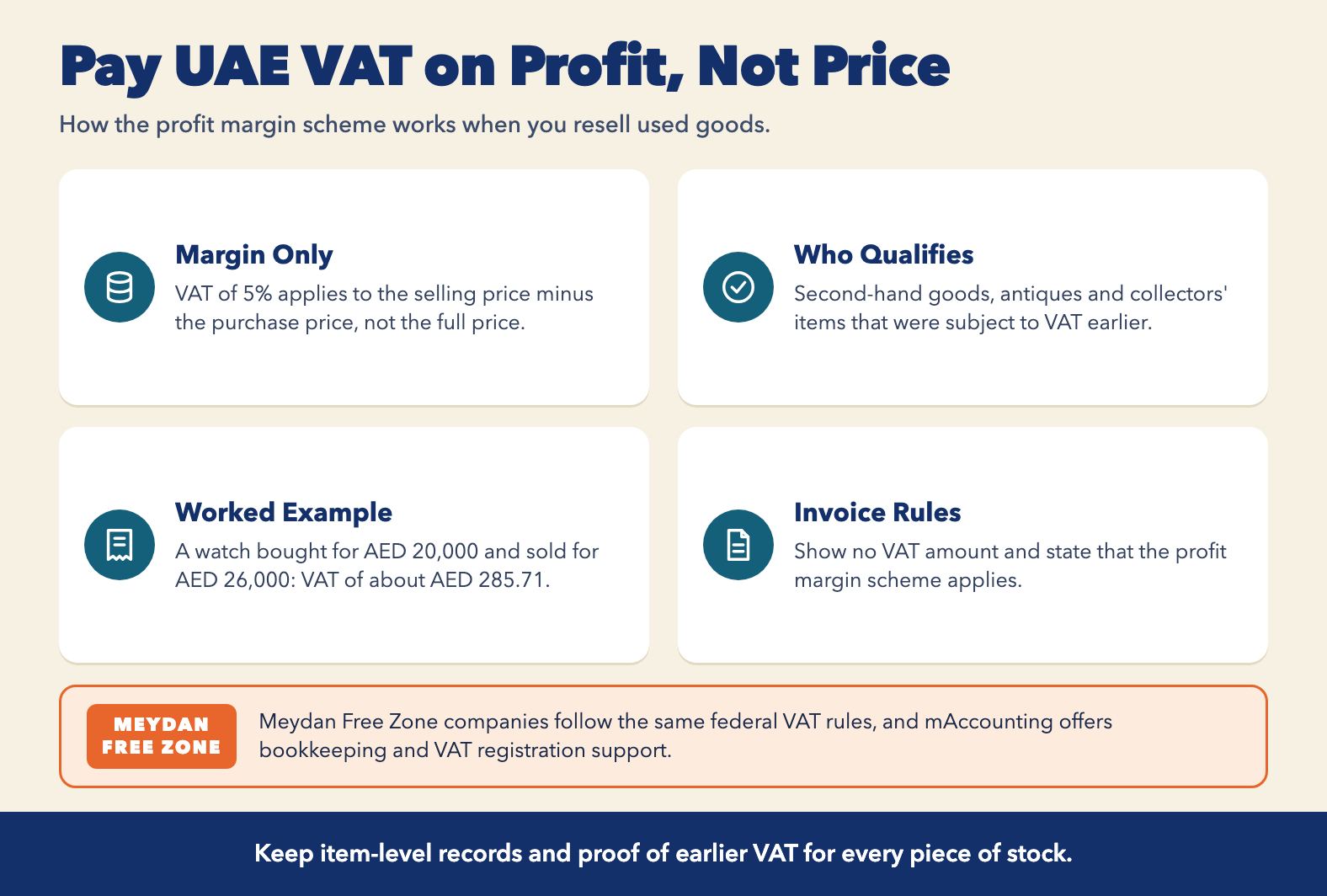
Eligible goods are second-hand goods, antiques more than 50 years old and collectors' items, such as stamps and coins. Each item must have been subject to VAT at an earlier point, and you must hold evidence of that. Goods acquired before 1 January 2018, or never subject to VAT, do not qualify.
Typical Goods Traded Under the Scheme
- Used vehicles, furniture and electrical appliances.
- Used jewellery, books and artworks.
- Items bought from private individuals, or from a dealer who also used the scheme.
A thrift store buying pre-owned items from individuals and reselling at a mark-up is the classic case. See how to start a second-hand goods retail business in Dubai for the licensing side.
Goods That Fall Outside the Scheme
Stock on which you claimed input VAT cannot use the scheme. The same applies to new goods bought from a registered supplier that charged 5%. If a dealer buys a used appliance from a registered supplier, pays VAT and recovers it, that item moves to standard treatment. Imports generally fall outside the scheme unless the import VAT could not be recovered. Check the FTA's Profit Margin Scheme guide (VATGPM1) before relying on the scheme.
How to Calculate VAT Under the Profit Margin Scheme
Subtract the purchase price from the selling price to find the margin. Treat the margin as VAT-inclusive, divide by 105 and multiply by 5. A margin of AED 6,000 produces VAT of about AED 285.71. A sale at a loss creates no VAT due.
Step 1: Record the Purchase Price per Item
- Keep purchase evidence for each item, not each batch.
- Retain proof of the seller's identity and of payment.
- Example: the watch bought at AED 20,000, backed by a signed receipt.
Step 2: Work Out the Margin
Selling price minus purchase price gives the margin. A sale at AED 26,000 against AED 20,000 leaves AED 6,000. The purchase price can include costs of acquiring the item, such as transport. Confirm FTA treatment before you deduct repair or restoration costs.
Step 3: Extract the VAT From the Margin
VAT equals the margin multiplied by 5/105. On AED 6,000 that is roughly AED 285.71. A sale below cost produces no VAT liability and no refund.
Margin Scheme and Standard Treatment at a Glance
| Feature | Profit Margin Scheme | Standard VAT Treatment |
|---|---|---|
| VAT charged on | The margin only (AED 6,000 in the watch example) | The full selling price (AED 26,000) |
| Input VAT recovery on the goods | Not available on those goods | Recoverable on purchases from registered suppliers |
| VAT shown separately on invoice | No VAT amount shown | Yes, shown as a separate amount |
| Typical stock source | Private individuals, or dealers who used the scheme | VAT-registered suppliers charging 5% |
| Record-keeping basis | Item-by-item purchase and sale register | Standard tax invoices and input tax records |
Profit Margin Scheme vs Standard VAT Treatment
Under standard treatment, a dealer charges 5% on the full price and recovers input VAT on purchases. Under the margin scheme, VAT applies only to the profit, but you cannot recover input VAT on those goods. How you bought the stock decides the right choice.
Where Each Method Suits the Dealer
The margin scheme suits stock bought from individuals, where there is no input VAT to recover. Standard treatment suits stock from registered suppliers with recoverable VAT. Buyers matter too: margin invoices show no VAT, so a business buyer cannot recover tax on them. A used car dealer selling to companies that need a VAT invoice may prefer standard treatment where eligible.
Cash Flow and Margin Impact
On the same AED 20,000 and AED 26,000 deal, output VAT is about AED 285.71 under the scheme and about AED 1,238 under standard treatment if the price is VAT-inclusive. The trade-off is lost input recovery. Mixed stock means two treatments in one return.
A Meydan Free Zone company follows the same federal VAT rules as any UAE business. Free zone location does not change eligibility.
Invoice and Record-Keeping Rules for Margin Sales
Invoices for margin sales must not show any VAT amount and must state that VAT was charged under the profit margin scheme. If an invoice shows VAT, the scheme cannot be applied to that sale. Keep records per item, and indicate use of the scheme in your VAT return on EmaraTax.
What the Invoice Must Show
- No VAT amount.
- A statement that VAT was charged under the profit margin scheme.
- Supplier, customer and item details in line with UAE tax invoice requirements.
A used sofa sold at AED 3,500 carries one price, the scheme statement and no VAT amount.
Records the Federal Tax Authority Expects
- A stock register listing item, purchase date, source, cost, sale price and margin.
- Evidence of how you acquired each item, and that VAT was charged on it earlier, such as the original tax invoice.
- Retention in line with Federal Tax Authority requirements.
What This Means for a Used Goods Trading Business
Decide your VAT treatment before buying stock, because it affects pricing and input tax recovery. Register once above the threshold and keep item-level records. Meydan Free Zone's mAccounting offers bookkeeping and VAT registration support.
Decisions to Settle Before Applying for a License
- Match the licensed activity to the goods you will trade.
- Plan your sourcing channels in advance, so mixed treatment is a choice, not an accident.
- Price for non-recoverable input VAT on margin stock.
A founder choosing between used electrical appliances and used jewellery faces different sourcing patterns, and so different VAT outcomes.
Accounting Support Through Meydan Free Zone
mAccounting, one of four Meydan Plus pillars, covers bookkeeping, Corporate Tax support and VAT registration support. A trader can use its bookkeeping service to keep item-level margin records for each return. Budget for VAT compliance as a recurring cost every return period.
Free Business Setup Cost Calculator
Calculate NowConclusion
The UAE profit margin scheme rewards dealers who know how each item was sourced. Eligibility is set per item, VAT is calculated on the margin, and the records must prove it. Map your sourcing channels against the scheme's conditions and confirm your VAT registration position. With Meydan Free Zone, mAccounting offers bookkeeping and VAT registration support, so item-level records can be in place from the first sale.
Ready to Launch Your Business in Dubai?
Let's Connect