
Table of Contents
Frequently Asked Questions
Who accounts for VAT when a foreign supplier sends an invoice without it?
The UAE buyer does, provided it is VAT-registered and the supply is taxable in the UAE. The buyer calculates 5% VAT on the invoice value and reports it as output tax in its VAT return to the Federal Tax Authority. The overseas supplier does not need to register in the UAE for this.
Is the reverse charge an extra tax on top of the supplier's price?
No. The buyer pays nothing to the supplier for the VAT element. A fully taxable business reports 5% output tax and claims the same amount as input tax in the same return, so the net effect is usually nil. A cost arises only where input tax cannot be fully recovered.
Does a business below the VAT registration threshold have to self-account?
A business that is not VAT-registered does not file VAT returns, so it has no reverse charge entry to make. Registration is mandatory once taxable supplies and imports exceed AED 375,000 a year. Voluntary registration is possible from AED 187,500, after which the reverse charge applies.
Which overseas purchases typically trigger the reverse charge?
Services bought from non-resident suppliers are the most common trigger, including software, consulting, marketing, legal and design work. These apply where the place of supply is the UAE and the supplier does not charge UAE VAT. Specified domestic supplies, such as certain precious metals, can also fall under the rule.
Where does self-accounted VAT appear in the VAT return?
It is reported in the reverse charge sections of the VAT return as output tax. The matching input tax is claimed in the expenses section if the purchase is deductible. Both entries belong in the return period in which the reverse charge liability arises.
Can input tax be reclaimed on a reverse charge purchase?
Yes, if the purchase relates to taxable business activity and the input tax is recoverable under UAE VAT rules. A fully taxable business offsets the self-accounted output tax with the same input tax. A partially exempt business can recover only the proportion linked to taxable supplies.
What records should a business keep for imported services?
Keep the supplier invoice, the contract or order, proof of payment and an internal record of the self-accounted VAT. Link each document to the VAT return period in which it was reported. These records must generally be kept for at least five years and be available if the Federal Tax Authority requests them.
Does a Meydan Free Zone company still have to apply the reverse charge?
Yes, once it is VAT-registered. Meydan Free Zone is not a VAT Designated Zone, so its companies are treated like any other UAE business for VAT. mAccounting, part of Meydan Plus (mPlus), covers bookkeeping and VAT, including recording self-accounted tax in each return.
Topic Summary
What Reverse Charge VAT in the UAE Means
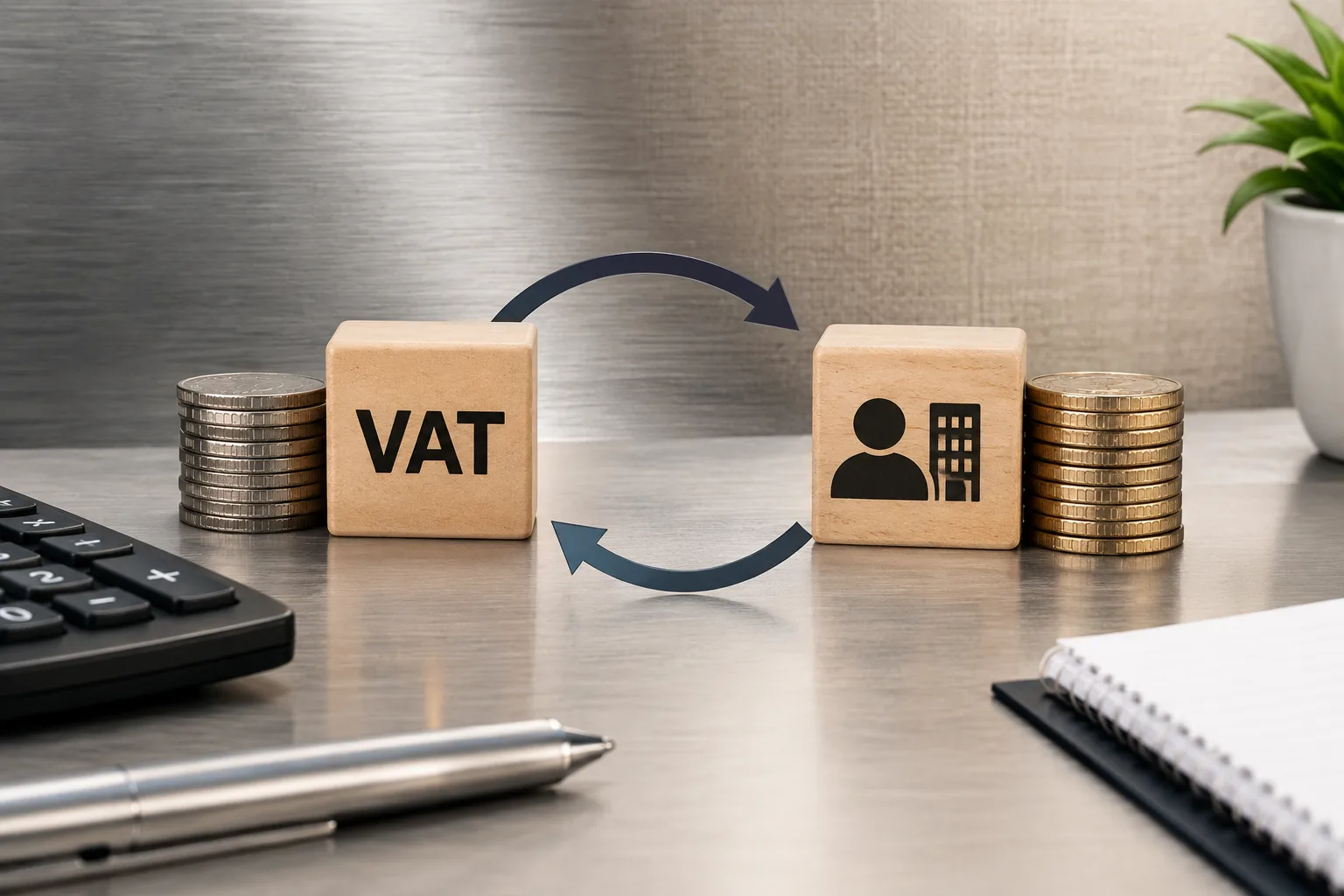
Reverse charge VAT in the UAE is a mechanism where the buyer, not the supplier, accounts for VAT on certain purchases. The registered recipient reports the output tax and claims the matching input tax in the same VAT return. It mainly applies to imported services and specified goods from non-resident suppliers.
When the Reverse Charge Applies to Your Business
The reverse charge mechanism in the UAE applies when a VAT-registered business receives taxable goods or services from a non-resident supplier not required to charge UAE VAT. It also covers specified domestic supplies, such as certain precious metals and electronic devices. You must be registered to account for it.
How to Record the Reverse Charge Mechanism in the UAE
To record reverse charge VAT in the UAE, identify the taxable purchase, calculate 5% on its value, report it as output tax, and claim the same amount as input tax if deductible. For fully taxable businesses the net effect is usually nil.
Reverse Charge Costs, Risks and Common Errors
Reverse charge VAT in the UAE is usually cash-neutral for fully taxable businesses, but errors create penalties. Typical mistakes are a missing self-accounting entry, the wrong return period, or input tax claimed on non-deductible purchases. Partially exempt businesses can bear a real cost.
Reverse Charge Compared With Standard VAT Treatment
Under standard VAT, the supplier charges VAT and the buyer pays it on the invoice. Under the reverse charge mechanism in the UAE, the supplier invoices without UAE VAT and the buyer self-accounts. Both routes reach the same 5% outcome. Only the reporting burden moves.
What Reverse Charge VAT Means for a Meydan Free Zone Company
Meydan Free Zone is not a VAT Designated Zone, so a Meydan Free Zone company is treated like any other UAE business for VAT, and the reverse charge applies once it is registered. Free zone status alone doesn't exempt you.
Conclusion
Reverse charge VAT in the UAE is a bookkeeping discipline more than a tax burden. For fully taxable businesses the effect nets out, but only if each foreign invoice is identified, taxed at 5% and reported in the right return. The FTA and your bank review records, not intentions. If you’re setting up, apply for your business license with Meydan Free Zone and plan VAT handling from day one.
Reverse Charge VAT in the UAE Explained: Key Rules and Requirements
Most founders see VAT as something they charge, never something they owe on a supplier's behalf. Then a foreign software or consulting invoice arrives with no VAT on it, and your bookkeeper asks who accounts for the tax. Under reverse charge VAT in the UAE, the answer is you.
Our guide explains what the reverse charge is, when it applies, how to record it, and how it works for a Meydan Free Zone company. Read it before applying for your business license with Meydan Free Zone, so cross-border purchases are handled correctly from day one.
What Reverse Charge VAT in the UAE Means
Reverse charge VAT in the UAE is a mechanism where the buyer, not the supplier, accounts for VAT on certain purchases. The registered recipient reports the output tax and claims the matching input tax in the same VAT return. It mainly applies to imported services and specified goods from non-resident suppliers.
Definition of the Reverse Charge Mechanism
The reverse charge mechanism in the UAE comes from Federal Decree-Law No. 8 of 2017 on VAT and its Executive Regulation. The Federal Tax Authority administers it, not customs.
Say a Dubai consultancy buys design services from a UK agency. The invoice shows no VAT. The consultancy calculates 5% on the invoice value and reports it in its own return. The UAE VAT reverse charge process is the same whatever the service.
Why the Rule Exists
Overseas suppliers are usually not registered in the UAE. Without the rule, a local supplier would charge 5% while a foreign competitor charged nothing. The reverse charge puts both on equal footing.
Common Misconceptions Founders Hold
- A founder assumes no VAT applies because the invoice shows none.
- You don't pay the VAT element to the supplier.
- It isn't an extra cost for a fully taxable business.
- It isn’t limited to services: registered importers also account for import VAT on goods through the return.
When the Reverse Charge Applies to Your Business

The reverse charge mechanism in the UAE applies when a VAT-registered business receives taxable goods or services from a non-resident supplier not required to charge UAE VAT. It also covers specified domestic supplies, such as certain precious metals and electronic devices. You must be registered to account for it.
Imported Services From Non-Resident Suppliers
The place of supply must fall in the UAE, and you must be a taxable person. Typical cases include software, consulting, marketing, legal and design services. An e-commerce founder in Dubai paying an overseas advertising platform is a common example.
Imported Goods and Specified Domestic Supplies
- VAT-registered importers account for import VAT on goods through the return under the reverse charge.
- Domestic reverse charge covers categories set by Cabinet Decision, such as gold, diamonds, hydrocarbons and certain electronic devices.
- A trader buying gold or mobile phones for resale is a typical case.
When It Does Not Apply
Zero-rated and exempt supplies fall outside the charge. So does a supplier who has already charged UAE VAT on a valid tax invoice. Unregistered businesses don't self-account, but registration is mandatory above AED 375,000 in annual taxable supplies and imports. Voluntary registration starts at AED 187,500. Our UAE VAT registration guide covers the process.
How to Record the Reverse Charge Mechanism in the UAE
To record reverse charge VAT in the UAE, identify the taxable purchase, calculate 5% on its value, report it as output tax, and claim the same amount as input tax if deductible. For fully taxable businesses the net effect is usually nil.
Step 1: Identify the Purchase and Its Value
- Check the supplier's location and whether UAE VAT was charged.
- Confirm the place of supply is the UAE.
- Convert foreign currency to AED using the Central Bank of the UAE rate where required.
Step 2: Calculate and Report the Tax
- Take an AED 20,000 invoice from an overseas consultant.
- 5% of AED 20,000 gives AED 1,000 output tax.
- Report it in the reverse charge boxes of the VAT return.
- Claim AED 1,000 as input tax if recoverable. The net payment is nil.
Step 3: Keep Documents and Invoice Details
- Retain the supplier invoice, agreement and proof of payment.
- Create an internal record of the self-accounted tax. The UAE tax invoice requirements show what details to capture.
- File each foreign invoice against its return period.
Reverse Charge Costs, Risks and Common Errors
Reverse charge VAT in the UAE is usually cash-neutral for fully taxable businesses, but errors create penalties. Typical mistakes are a missing self-accounting entry, the wrong return period, or input tax claimed on non-deductible purchases. Partially exempt businesses can bear a real cost.
Cash-Flow Impact by Business Type
A fully taxable business offsets output and input tax. A partially exempt business recovers only part of the input tax. As an illustration, if 60% of input tax is recoverable, a AED 1,000 charge costs you AED 400. Unregistered businesses have no obligation, but should watch the AED 375,000 threshold.
Frequent Reporting Mistakes
- Ignoring invoices that show zero VAT.
- Reporting in the wrong period.
- Keeping poor records for foreign suppliers.
- Finding six unreported overseas subscriptions at year-end.
Standard VAT Treatment Compared With the Reverse Charge
| Feature | Standard VAT Treatment | Reverse Charge Treatment |
|---|---|---|
| Who charges VAT on the invoice | The UAE supplier adds 5% to the invoice. | Nobody. The supplier invoices without UAE VAT. |
| Who reports the output tax | The supplier, in its own return. | The buyer, in the reverse charge boxes. |
| How input tax is claimed | From the VAT shown on the supplier's tax invoice. | From the buyer's own calculation, in the same return. |
| Typical supplier location | Inside the UAE, VAT-registered. | Outside the UAE, or a specified domestic category. |
| Bookkeeping effort for the buyer | Low. File the invoice and claim the VAT. | Higher. Calculate, record and report each invoice. |
Penalty Exposure
The FTA applies administrative penalties for incorrect returns and late payment, at the amounts it publishes. Voluntary disclosure lets you correct a prior return before the FTA finds the error. See our note on penalties for non-compliance in the UAE.
Reverse Charge Compared With Standard VAT Treatment
Under standard VAT, the supplier charges VAT and the buyer pays it on the invoice. Under the reverse charge mechanism in the UAE, the supplier invoices without UAE VAT and the buyer self-accounts. Both routes reach the same 5% outcome. Only the reporting burden moves.
That matters when comparing vendors. A UAE vendor and an overseas vendor quoting the same net price cost a fully taxable buyer the same. The overseas option adds bookkeeping work. For a partially exempt buyer, it adds irrecoverable VAT too.
What Reverse Charge VAT Means for a Meydan Free Zone Company
Meydan Free Zone is not a VAT Designated Zone, so a Meydan Free Zone company is treated like any other UAE business for VAT, and the reverse charge applies once it is registered. Free zone status alone doesn't exempt you.
VAT Status of a Free Zone Company
Designated Zone treatment applies only to qualifying goods and specified zones. Registration is with the Federal Tax Authority. A Meydan Free Zone consultancy paying an overseas firm for services follows the same steps as above.
Support Through mAccounting
Meydan Plus (mPlus) brings together Meydan Free Zone’s business support offerings, one of which is mAccounting, covering bookkeeping, VAT, Corporate Tax and payroll. Meydan Free Zone also offers VAT registration support. A solo founder licensed through Fawri, Meydan Free Zone's fully digital licensing solution issuing a business license in under 60 minutes, can hand foreign invoices to the bookkeeping team each quarter. Support is separate from licensing.
Expert Financial and Tax Compliance Services in Dubai
Explore mAccountingConclusion
Reverse charge VAT in the UAE is a bookkeeping discipline more than a tax burden. For fully taxable businesses the effect nets out, but only if each foreign invoice is identified, taxed at 5% and reported in the right return. The FTA and your bank review records, not intentions.
Review your overseas invoices and confirm each one without UAE VAT was self-accounted. If you’re setting up, apply for your business license with Meydan Free Zone and plan VAT handling from day one.
Ready to Launch Your Business in Dubai?
Let's Connect