Table of Contents
Frequently Asked Questions
Do banks in the UAE charge VAT on account maintenance fees?
Yes. Account maintenance, minimum balance and statement fees are explicit service charges, so banks add 5% VAT. An AED 100 monthly fee therefore appears on your statement as AED 100 plus AED 5 VAT.
Is interest on a business loan subject to VAT in the UAE?
Generally, no. Interest on loans, overdrafts and deposits is treated as an exempt financial service because the bank earns it through a margin. A separately stated fee, such as a loan arrangement fee, is normally taxable at 5%.
Can a company reclaim VAT paid on monthly bank fees?
A VAT-registered company can usually recover input VAT on business-related bank fees if it makes taxable supplies. It claims the amount in its VAT return for the period. A company making only exempt supplies, or one that is not registered, cannot recover it, so the VAT becomes a cost.
Is currency exchange taxable for VAT purposes in the UAE?
Currency exchange is generally exempt when the bank earns only a margin and charges no separate fee. If the bank states a commission or service fee, that fee is taxable at 5%. Check your statement to see whether the charge appears as a separate line.
Does a free zone company pay VAT on bank fees?
Yes. Free zone status does not remove VAT on fees charged by a UAE bank. A Meydan Free Zone company pays 5% VAT on explicit bank fees. If it is VAT-registered and makes taxable supplies, it can generally recover that VAT as input tax.
What happens if a bank statement does not show VAT separately?
Without a separate VAT line, you cannot support an input VAT claim. Ask the bank for a tax invoice or a statement showing the fee, the VAT amount and the bank's tax registration number. Keep these records for five years in line with Federal Tax Authority requirements.
How should a business record VAT on fees charged by an overseas bank?
UAE VAT is not charged at source on a foreign bank's fees. If the service is taxable and you are VAT-registered, you may need to self-account under the reverse charge mechanism. This means reporting both output and input VAT in the same return. Exempt financial services received from abroad generally fall outside this obligation.
Topic Summary
What VAT on Bank Charges in the UAE Means for Founders
VAT on bank charges is the 5% tax applied to explicit fees banks charge for services, such as account maintenance, transfers and card fees. Margin-based services, like interest on loans and deposits, are generally exempt. The Federal Tax Authority (FTA) sets the rules, and the treatment depends on how the bank earns the money.
Which Bank Charges Attract 5% VAT and Which Are Exempt
Account fees, transfer and remittance charges, card fees, cheque book charges, safe deposit fees and advisory fees carry 5% VAT. Interest on loans and deposits, and currency exchange without a separate fee, are generally exempt. Separately stated fees on exempt financial services, such as loan arrangement fees, are normally taxable.
How the Federal Tax Authority Treats Bank Fees
The Federal Tax Authority administers VAT under Federal Decree-Law No. 8 of 2017, while the Central Bank of the UAE regulates banks. A VAT-registered business can usually recover input VAT on bank fees if it makes taxable supplies. An unregistered business cannot, so the VAT becomes a real cost.
Five Steps to Record and Recover VAT on Bank Fees
To record and recover VAT on bank fees, confirm your VAT registration, collect bank tax invoices or statements, separate taxable fees from exempt interest, record input VAT in your books, and claim it in the return. Keep documents for five years.
VAT on Overseas and Cross-Border Bank Fees
Fees charged by a bank outside the UAE don't carry UAE VAT at source. A VAT-registered UAE business may need to self-account under the reverse charge mechanism if the service is taxable. Exempt financial services received from abroad generally fall outside this obligation.
What This Means for Your Banking and Accounting Decisions
Compare fee schedules before choosing a bank. VAT adds 5% to every explicit charge and is a recurring cost for unregistered businesses. Registered businesses can recover it. Meydan Free Zone supports business bank account applications through mCore, and offers bookkeeping and VAT registration support through mAccounting.
Conclusion
VAT on UAE bank charges follows a clear principle: explicit fees carry 5% VAT, and margin-based services are generally exempt. Accurate coding, valid bank invoices and a clear view of your registration status decide whether the VAT is recovered or becomes a cost. Before choosing a bank, request the full fee tariff and confirm your VAT position. For a Meydan Free Zone company, mCore supports the bank account application and mAccounting's bookkeeping keeps taxable fees separate from exempt interest.
VAT on Bank Charges and Financial Services in the UAE
Most founders open a UAE business account expecting VAT to apply only to what they sell, then find 5% added to account fees, card charges and transfer commissions. Banking is not simply exempt: the VAT treatment depends on how the bank charges you, not on the fact that it is a bank. This guide covers which bank charges carry VAT, how to recover it and how the reverse charge applies to overseas fees.
What VAT on Bank Charges in the UAE Means for Founders
VAT on bank charges is the 5% tax applied to explicit fees banks charge for services, such as account maintenance, transfers and card fees. Margin-based services, like interest on loans and deposits, are generally exempt. The Federal Tax Authority (FTA) sets the rules, and the treatment depends on how the bank earns the money.
Explicit Fees Versus Implicit Margins
The test is simple: is there a separately identifiable fee? A monthly account maintenance fee of AED 100 is explicit, so the bank adds AED 5 VAT. Interest earned on a deposit carries no VAT, because the bank's reward sits in the margin.
VAT Treatment of Common Bank Charges in the UAE
| Charge or Service | VAT Treatment |
|---|---|
| Account maintenance fee | Taxable at 5%. An AED 100 fee becomes AED 105. |
| Local and international transfer commission | Taxable at 5%. An AED 50 fee becomes AED 52.50. |
| Card terminal and merchant fees | Taxable at 5% on the explicit fee. |
| Interest on loans and deposits | Generally exempt, as the bank earns it through margin. |
| Currency exchange without a separate fee | Generally exempt. Any explicit fee is taxable. |
Why Banking Is Not Simply Exempt
The exemption covers specific financial services listed in the VAT Executive Regulation, not every line on a statement. A trading company that sees VAT on its card terminal fee often assumes an error. It isn't one. The fee is explicit, so it is taxable. For the wider framework, read our guide to VAT in the UAE.
Which Bank Charges Attract 5% VAT and Which Are Exempt
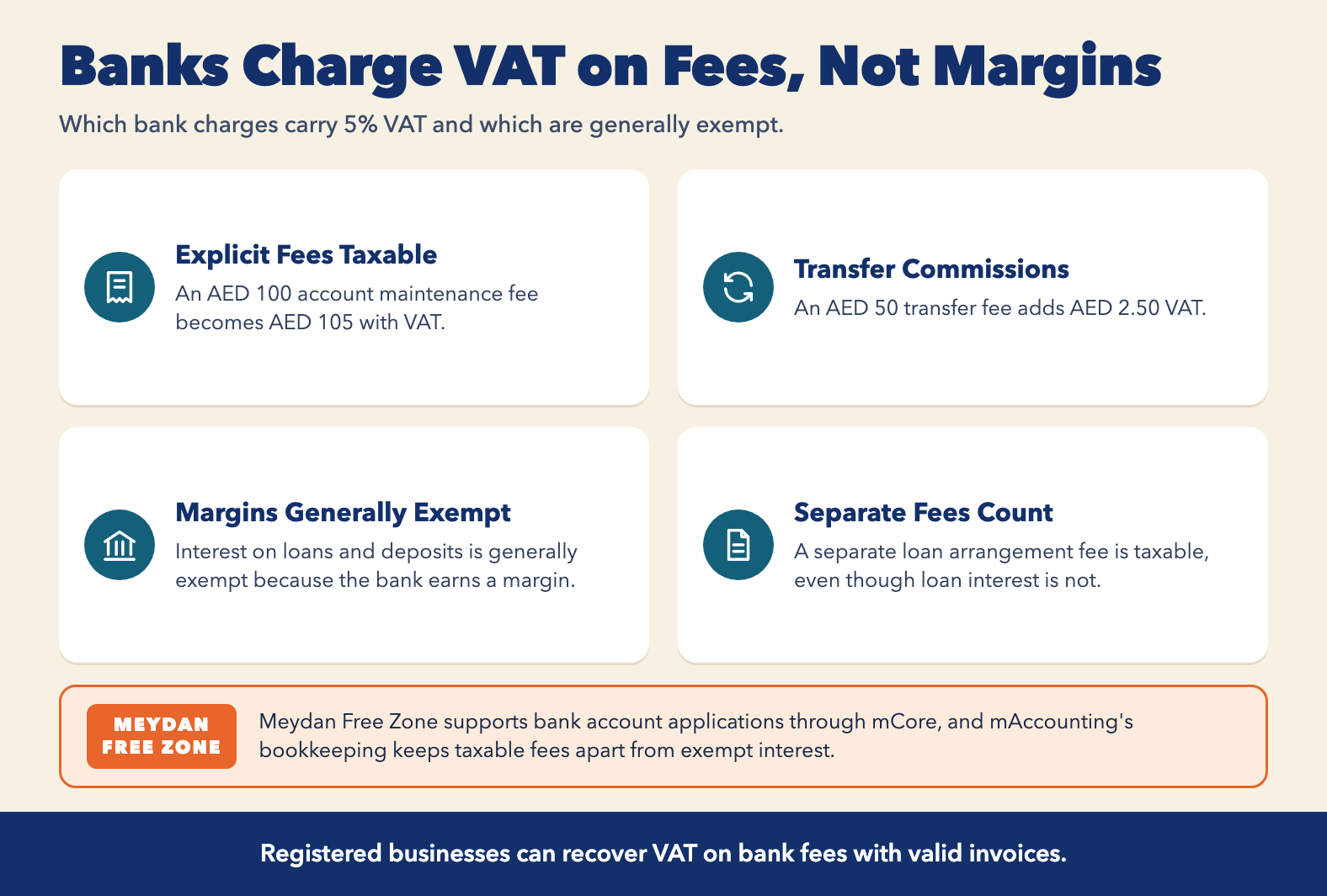
Account fees, transfer and remittance charges, card fees, cheque book charges, safe deposit fees and advisory fees carry 5% VAT. Interest on loans and deposits, and currency exchange without a separate fee, are generally exempt. Separately stated fees on exempt financial services, such as loan arrangement fees, are normally taxable.
Taxable Bank Charges
- Account maintenance, minimum balance and statement fees.
- Local and international transfer commissions.
- Card issuance, merchant terminal and payment gateway charges.
- Cheque books, returned cheque and safe deposit fees.
A founder sending an outbound transfer pays an AED 50 bank fee plus AED 2.50 VAT on that fee.
Exempt and Zero-Rated Financial Services
- Interest on loans, overdrafts and deposits is exempt where earned through margin.
- Currency exchange is exempt without a separate fee. Any explicit fee is taxable.
- Zero-rating rarely applies to routine bank fees.
- Islamic finance products are treated on equivalent terms to conventional finance.
A business loan's interest carries no VAT, but a separate loan arrangement fee does.
How the Federal Tax Authority Treats Bank Fees
The Federal Tax Authority administers VAT under Federal Decree-Law No. 8 of 2017, while the Central Bank of the UAE (CBUAE) regulates banks. A VAT-registered business can usually recover input VAT on bank fees if it makes taxable supplies. An unregistered business cannot, so the VAT becomes a real cost.
Who Can Recover Input VAT on Bank Fees
A registered consultancy recovers the VAT on its monthly account fees in its quarterly return. A business making only exempt supplies cannot. Registration is mandatory above AED 375,000 in annual taxable supplies, and voluntary from AED 187,500.
Regulator Roles: FTA and the Central Bank
The Federal Tax Authority owns VAT rules and returns. The Central Bank governs banking conduct. Free zone status doesn't remove VAT on local bank fees: a Meydan Free Zone company still pays VAT on fees charged by a UAE bank for its account.
Five Steps to Record and Recover VAT on Bank Fees
To record and recover VAT on bank fees, confirm your VAT registration, collect bank tax invoices or statements, separate taxable fees from exempt interest, record input VAT in your books, and claim it in the return. Keep documents for five years.
Step 1: Confirm Your Registration and Supply Type
Recovery depends on both. A registered e-commerce seller with taxable sales can claim input VAT on fees. A company with only exempt supplies cannot.
Step 2: Collect Valid Bank Tax Invoices
Download monthly statements or invoices. Check that the bank's tax registration number appears. A statement showing an AED 200 fee and AED 10 VAT on separate lines works. See the UAE tax invoice requirements for mandatory details.
Step 3: Separate Taxable Fees From Exempt Items
Post loan interest to finance cost with no VAT. Post the arrangement fee with 5% VAT. Never claim VAT on exempt lines.
Steps 4 and 5: Record Input VAT and Claim It in the Return
Post input VAT to the VAT receivable account. Include it in the return for the period, such as three months of fees in a quarterly return. Retain records for five years.
VAT on Overseas and Cross-Border Bank Fees
Fees charged by a bank outside the UAE don't carry UAE VAT at source. A VAT-registered UAE business may need to self-account under the reverse charge mechanism if the service is taxable. Exempt financial services received from abroad generally fall outside this obligation.
When Reverse Charge Applies
It applies to taxable services imported from a non-resident supplier. You report output and input VAT in the same return. A founder paying a foreign advisory fee to an overseas bank records it this way. The UAE VAT reverse charge guide shows how to post it.
Correspondent and Intermediary Bank Deductions
- Deductions on international transfers often appear as lump fees.
- Ask the sending bank for a breakdown.
- Keep the SWIFT advice with your books.
Say an AED 75 intermediary deduction reduces an incoming payment. Document it in the accounting file.
What This Means for Your Banking and Accounting Decisions
Compare fee schedules before choosing a bank. VAT adds 5% to every explicit charge and is a recurring cost for unregistered businesses. Registered businesses can recover it. Meydan Free Zone supports business bank account applications through mCore, and offers bookkeeping and VAT registration support through mAccounting.
Compare Bank Fee Schedules Before Applying
Ask for the full tariff and check whether quoted fees include VAT. Two banks quoting AED 50 and AED 60 per transfer cost AED 52.50 and AED 63 once VAT applies. For a company making 40 transfers a year, that is AED 2,100 against AED 2,520.
How Meydan Free Zone Supports Banking and VAT Records
mCore provides business bank account support, but approval rests with the bank. mAccounting offers bookkeeping, so a new Meydan Free Zone company can have bank fees coded correctly and kept apart from exempt interest. If you need to register, see VAT registration support.
Free Business Setup Cost Calculator
Calculate NowConclusion
VAT on UAE bank charges follows a clear principle: explicit fees carry 5% VAT, and margin-based services are generally exempt. Accurate coding, valid bank invoices and a clear view of your registration status decide whether the VAT is recovered or becomes a cost. Before choosing a bank, request the full fee tariff and confirm your VAT position. For a Meydan Free Zone company, mCore supports the bank account application and mAccounting's bookkeeping keeps taxable fees separate from exempt interest.
Ready to Launch Your Business in Dubai?
Let's Connect