Table of Contents
Frequently Asked Questions
Can a company reclaim VAT paid on employee health insurance?
A VAT-registered company can generally reclaim the 5% VAT on staff health insurance as input tax. It must make taxable supplies, hold a valid tax invoice in its own name, and use the cover for business purposes. Input tax tied to exempt supplies is apportioned, and cover with no business link is not recoverable.
Is health insurance subject to VAT in the UAE?
Most health insurance premiums are standard-rated, so the insurer charges 5% VAT and shows it on the tax invoice. Life insurance is treated differently under the VAT law. The Federal Tax Authority administers VAT, so the invoice should show the insurer's Tax Registration Number and the VAT amount in AED.
Does an unregistered business pay VAT on its insurance premiums?
Yes. The insurer still charges 5% VAT, and an unregistered business cannot recover it. Only VAT-registered businesses can claim input tax. Registration is mandatory above AED 375,000 of taxable supplies a year and voluntary from AED 187,500, so the VAT paid on premiums becomes a cost until the business registers.
Can an employer recover VAT on cover for employees' family members?
In most cases, yes. Since 15 November 2024, the amended VAT Executive Regulation allows employers to recover input tax on health insurance for employees' families, covering one spouse and up to three children under 18. Record in the employment contract who pays for dependants, and book dependant cover under its own ledger code.
What must a tax invoice for a health insurance premium show?
The invoice should show the insurer's name and Tax Registration Number, the date, the premium and the VAT amount in AED. It must also name your company as the policyholder, with a matching address. An invoice issued to a director personally can be rejected for recovery.
How does exempt income affect input VAT recovery on insurance?
A business with both taxable and exempt income cannot recover all its input tax. It recovers only the share linked to taxable supplies, and the rest is apportioned. The business should keep records that support the method it uses to calculate that share.
Do free zone companies follow the same VAT treatment for medical insurance?
Yes. The Federal Tax Authority administers VAT, and free zone status does not change the input tax rules on insurance. A Meydan Free Zone company recovers VAT on premiums if it is VAT-registered and holds proper documentation. Meydan Free Zone's mAccounting pillar offers bookkeeping and VAT registration support, and mResidency covers medical insurance.
What happens if input VAT on insurance is claimed incorrectly?
An incorrect claim makes the VAT return inaccurate and can lead to administrative penalties from the Federal Tax Authority. Common causes are a missing tax invoice, personal cover mixed with staff policies, and ignored apportionment. Correcting the error voluntarily through the FTA before an audit is cleaner than waiting.
Topic Summary
What Is VAT on Medical Insurance in the UAE?
Health insurance premiums carry 5% VAT, charged by the insurer. A VAT-registered employer can usually recover this as input tax if the cover serves a business purpose, falls within the categories the law allows, and a valid tax invoice supports the claim.
Mandatory Cover and Employer Obligations in Dubai
Dubai employers must provide health insurance for employees under the emirate's health insurance law, enforced by the Dubai Health Authority. Because the cover is a legal obligation, it supports the business-purpose test for input VAT, though you must still document the premium properly.
What Employers Can Recover on Medical Insurance
Employers can generally recover input VAT on staff medical insurance if they are VAT-registered, make taxable supplies, hold a valid tax invoice, and use the cover for business purposes. Input tax on cover with no business link, or tied to exempt supplies, is blocked or apportioned.
Steps to Claim Input VAT on Premiums
To claim input VAT on medical insurance, confirm VAT registration, obtain a compliant tax invoice, record the premium and VAT separately, decide on full or partial recovery, and include the input tax in the return for the correct period through the FTA portal.
Common Errors That Trigger Penalties
The most common errors are claiming VAT without a valid tax invoice, recovering input tax on cover with no business purpose, ignoring apportionment for exempt supplies, and posting premiums in the wrong period. Each can lead to an incorrect return and administrative penalties from the FTA.
What This Means for a Meydan Free Zone Company
A Meydan Free Zone company follows the same federal VAT rules as any UAE business, so recovery depends on registration and documentation, not location. Meydan Free Zone's mAccounting pillar offers bookkeeping and VAT registration support, and mResidency covers residence visa services and medical insurance for the same staff.
Next Steps for Employers
VAT on medical insurance in the UAE is recoverable for many registered employers, but only with a valid invoice, a clear business purpose and correct treatment of dependants or exempt supplies. Clean records decide whether a claim stands.
VAT on Medical Insurance in the UAE: What Employers Can Recover
Health insurance is a legal cost for employers in Dubai, and the 5% VAT on each premium adds up across a team. Some founders write it off as a sunk cost, while others reclaim every dirham without checking the conditions. This guide explains when a VAT-registered employer can recover that VAT through the Federal Tax Authority (FTA), what stays blocked, and how to document premiums before filing.
What Is VAT on Medical Insurance in the UAE?
Health insurance premiums carry 5% VAT, charged by the insurer. A VAT-registered employer can usually recover this as input tax if the cover serves a business purpose, falls within the categories the law allows, and a valid tax invoice supports the claim.
How the 5% Rate Applies to Premiums
Health insurance is generally a standard-rated supply, while life insurance is exempt. The insurer adds VAT to the premium and shows it on the tax invoice. Say a company pays AED 10,000 in premiums plus AED 500 VAT. That AED 500 line becomes input tax if the company is registered.
Who Can Claim Input Tax
Only VAT-registered businesses can recover input tax. Under Federal Tax Authority rules, registration is mandatory above AED 375,000 of taxable supplies a year and voluntary from AED 187,500. A consultancy below those thresholds that hasn't registered bears the VAT as a cost. If you're unsure where you stand, the UAE VAT registration guide covers the mechanics.
Mandatory Cover and Employer Obligations in Dubai
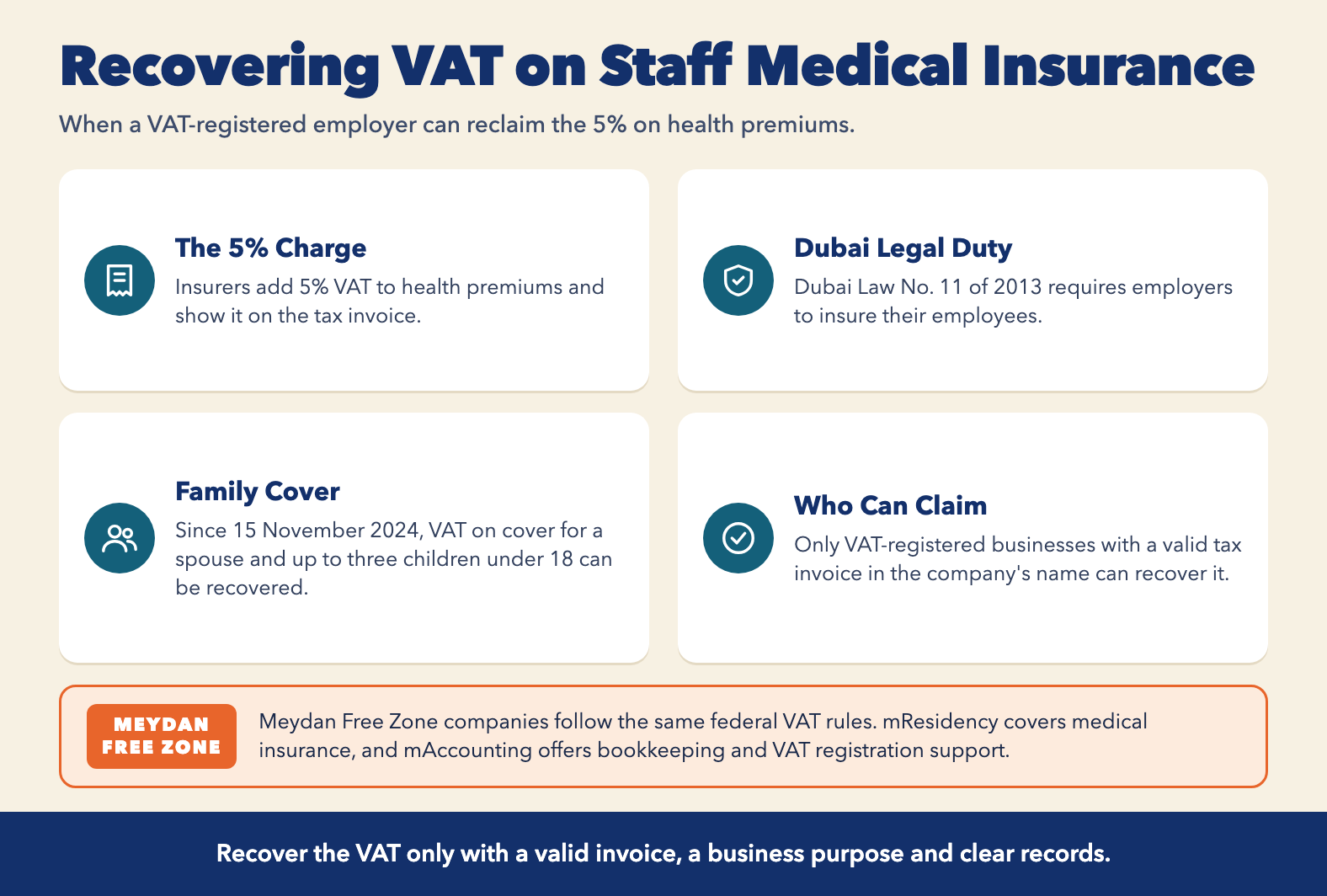
Dubai employers must provide health insurance for employees under the emirate's health insurance law, enforced by the Dubai Health Authority. Because the cover is a legal obligation, it supports the business-purpose test for input VAT, though you must still document the premium properly.
Why a Legal Requirement Supports Recovery
Dubai Law No. 11 of 2013 requires employers to insure their employees, and the Dubai Health Authority (DHA) oversees the scheme. That ties the cost directly to employment, and so to business activity. Picture a Dubai trading company insuring twelve employees during residence visa processing. The link to the business is clear. Recovery still depends on taxable supplies and valid documentation.
Employee Cover Versus Dependant Cover
- Employee cover is a clear business expense.
- Since 15 November 2024, input tax on health insurance for an employee's family (one spouse and up to three children under 18) can also be recovered.
- Your employment contract or HR policy should state who pays for dependants.
- Example: an employer pays for a manager's spouse under the package and records it in the contract.
Input VAT Treatment by Type of Medical Insurance Cover
| Feature | Typical Treatment | What to Document |
|---|---|---|
| Employee group policy | Generally recoverable in full if all supplies are taxable | Tax invoice in the company's name, staff list, policy schedule |
| Dependant cover paid by employer | Recoverable since 15 November 2024 for one spouse and up to three children under 18, if the other conditions are met | Employment contract showing the employer pays for dependants |
| Owner or director cover | Claim only where the cover is part of a documented employment arrangement | Employment terms, invoice issued to the company, not the individual |
| Business with mixed taxable and exempt supplies | Apportioned: only the share linked to taxable supplies is recovered | Apportionment calculation and the revenue split behind it |
| Unregistered business | No recovery; the VAT is a cost | Invoices for the books and a record of taxable turnover against the AED 375,000 threshold |
What Employers Can Recover on Medical Insurance
Employers can generally recover input VAT on staff medical insurance if they are VAT-registered, make taxable supplies, hold a valid tax invoice, and use the cover for business purposes. Input tax on cover with no business link, or tied to exempt supplies, is blocked or apportioned.
Conditions for Full Recovery
- The business is registered and makes taxable supplies.
- The tax invoice carries the company's name and the insurer's TRN (Tax Registration Number).
- The premium is paid and the cover is used for business.
A Meydan Free Zone trading company with taxable sales claims the 5% on its group policy in the return covering the invoice period.
When Recovery Is Restricted
Exempt supplies require apportionment of input tax. A company with both taxable and exempt income recovers only the share linked to taxable supplies. Cover for people with no business connection isn't recoverable. Blocked items are listed in the Executive Regulation to the VAT law, and FTA Decision No. 17 of 2026 sets detailed conditions for certain free employee benefits from 1 October 2026, so check both before claiming.
Steps to Claim Input VAT on Premiums
To claim input VAT on medical insurance, confirm VAT registration, obtain a compliant tax invoice, record the premium and VAT separately, decide on full or partial recovery, and include the input tax in the return for the correct period through the FTA portal.
Step 1: Check the Tax Invoice
- Insurer name, TRN, date, premium and VAT amount in AED.
- Company name and address match the policyholder.
- An invoice issued to the director personally is rejected for recovery.
The UAE tax invoice requirements list every mandatory field.
Step 2: Record and Classify the Cost
- Book premium and VAT on separate ledger lines.
- Tag employee, dependant and owner cover separately.
- Use separate codes per policy category.
Step 3: Declare in the VAT Return
- Include recoverable input tax in the return for the relevant period.
- Keep records for the legally required retention period.
- Reflect any insurer credit note in your next return. A mid-year headcount cut is a typical trigger.
Common Errors That Trigger Penalties
The most common errors are claiming VAT without a valid tax invoice, recovering input tax on cover with no business purpose, ignoring apportionment for exempt supplies, and posting premiums in the wrong period. Each can lead to an incorrect return and administrative penalties from the FTA.
Missing or Incorrect Invoices
Invoices issued to the wrong legal name fail the test. So does a premium paid by a related party without recharge documentation. A holding company that pays a subsidiary's staff cover without recharging it has no clean claim for either entity.
Treating All Cover as Recoverable
Founders often mix personal cover with staff policies. Adding a relative to the company policy and reclaiming the VAT in full is a typical case. If you find an error, a voluntary correction through the FTA is cleaner than waiting for an audit. Our guide to the best health insurance for business owners in the UAE explains how to structure owner cover.
What This Means for a Meydan Free Zone Company
A Meydan Free Zone company follows the same federal VAT rules as any UAE business, so recovery depends on registration and documentation, not location. Meydan Free Zone's mAccounting pillar offers bookkeeping and VAT registration support, and mResidency covers residence visa services and medical insurance for the same staff.
Federal VAT Rules Apply in a Free Zone
The FTA administers VAT, not the free zone authority. Free zone status doesn't change input tax rules on insurance. A services company in Meydan Free Zone registers after crossing the threshold and reclaims premiums on its staff policy like any other registrant.
Aligning Visas, Insurance and VAT Records
mResidency covers residence visa services, the medical and Emirates ID steps, and medical insurance. mAccounting offers bookkeeping, VAT registration support and Corporate Tax support. File a new hire's visa and insurance invoice together, tagged for the next return, and preparation gets faster.
Free Business Setup Cost Calculator
Calculate NowNext Steps for Employers
VAT on medical insurance in the UAE is recoverable for many registered employers, but only with a valid invoice, a clear business purpose and correct treatment of dependants or exempt supplies. Clean records decide whether a claim stands.
Review your current policies, separate employee, dependant and owner cover in the ledger, and confirm treatment before the next return. For a Meydan Free Zone company, the staff file that supports mResidency visas and medical insurance can also support the VAT claim.
Ready to Launch Your Business in Dubai?
Let's Connect