Table of Contents
Frequently Asked Questions
Is international freight zero-rated for VAT in the UAE?
Yes, transport of goods from the UAE to a destination outside the UAE, or the reverse, can be zero-rated under Federal Decree-Law No. 8 of 2017 on VAT. The carrier charges 0% VAT but still registers, files returns and reclaims input tax. The supplier must hold evidence such as a bill of lading or airway bill and customs records.
Do I charge 5% VAT on transport between emirates?
Yes. A journey that starts and ends in the UAE is a UAE supply and carries the 5% standard rate, whether it stays inside one emirate or crosses several. A shipment from Jebel Ali to Abu Dhabi is a typical example.
Which documents prove a shipment qualifies for zero rating?
Keep the bill of lading or airway bill, customs export declarations, the contract and the tax invoice showing the 0% rate and your TRN. Without this evidence, the Federal Tax Authority can refuse zero-rating on audit. You then owe the 5% from your own funds.
Does a transport company need to register for VAT if all its supplies are zero-rated?
Yes, if the business is above the threshold. Zero-rated supplies count toward the AED 375,000 mandatory registration threshold over twelve months. Voluntary registration is available from AED 187,500, and registration lets a carrier reclaim input tax.
How does the reverse charge apply when I hire a foreign freight carrier?
If a VAT-registered UAE business buys a taxable transport service from a foreign supplier, it self-accounts for the 5% VAT on its own return. The same amount is generally reclaimable as input tax when the purchase relates to taxable supplies. Both entries appear in the same return.
Does a free zone license exempt goods transport from VAT?
No. A Meydan Free Zone license does not change federal VAT treatment, and the Federal Tax Authority administers VAT for the company. Only movements involving designated zones that meet the conditions in the VAT law may fall outside VAT, so check the Federal Tax Authority's designated zone list first.
What happens if I charge the wrong VAT rate on a freight invoice?
If you under-charge VAT, you still owe the correct amount to the Federal Tax Authority from your own funds. Incorrect returns can also attract administrative penalties. Correct the return and issue a compliant tax invoice or credit note as the VAT rules require.
Topic Summary
What VAT on Transportation Services in the UAE Means
Moving goods inside the UAE is a taxable supply at the standard 5% rate, while local passenger transport is exempt. International transport that meets the conditions of Federal Decree-Law No. 8 of 2017 is zero-rated. The FTA administers both treatments, and the carrier must charge the correct rate on each invoice.
How VAT on Transportation Services in the UAE Works
The VAT treatment of transport depends on place of supply, which is where the journey starts. Transport starting in the UAE is a UAE supply. It becomes zero-rated if it ends outside the UAE, or if the goods travel into the UAE from abroad under the conditions in the VAT law. That is the core rule for goods transport.
Zero-Rated and Standard-Rated Transport Compared
Standard-rated transport carries 5% and covers journeys that start and end in the UAE. Zero-rated transport carries 0% and covers qualifying international movements. A registered carrier recovers input tax on both, but the customer's cash cost differs, so classification directly affects pricing and margins.
Steps to Determine the VAT Treatment of a Transport Job
To determine VAT on a transport job, identify the start and end points, confirm the place of supply, test for zero-rating, collect documents and issue a compliant tax invoice. Doing this before quoting avoids under-charging VAT, which the business then owes to the FTA from its own funds.
Cost, Risk and Compliance Mechanics for Transport Invoices
The main risks are charging the wrong rate, missing export evidence and mishandling imported services. A UAE business buying transport from a foreign supplier may need to self-account for VAT under the reverse charge. Registration is mandatory above AED 375,000 in annual taxable supplies and voluntary from AED 187,500.
Who Regulates Transport VAT
The FTA administers VAT across the UAE, while customs authorities and the Roads and Transport Authority (RTA) handle goods movement and transport permits. A Meydan Free Zone company follows the same federal VAT rules as any other UAE business.
What This Means for Your Business Decision
Classify routes before pricing, register once taxable supplies pass AED 375,000, and build an evidence file for each international shipment. Clear classification protects margins and reduces audit exposure.
VAT on Transportation Services in the UAE
A transport invoice looks simple until the VAT treatment turns on where the goods start and end their journey. Many traders assume all freight carries 5% VAT, or that all cross-border freight is outside VAT, and neither is correct. This guide shows how to price, invoice and reclaim VAT on goods transport so the right rate holds up in a Federal Tax Authority (FTA) audit.
What VAT on Transportation Services in the UAE Means
Moving goods inside the UAE is a taxable supply at the standard 5% rate, while local passenger transport is exempt. International transport that meets the conditions of Federal Decree-Law No. 8 of 2017 is zero-rated. The FTA administers both treatments, and the carrier must charge the correct rate on each invoice.
Standard Rate and Zero Rate in Brief
Domestic goods transport is a taxable supply at 5%. Qualifying international transport is charged at 0%, and input tax stays recoverable. Zero-rated is not exempt: the supplier still registers, files returns and reclaims input tax.
Say a Dubai trading company pays a local haulier AED 10,000 to move stock between two warehouses. The invoice carries AED 500 VAT, which the trader reclaims as input tax if registered. More detail sits in our guide to VAT in the UAE.
Goods Transport Versus Passenger Transport
Both follow the same place-of-supply and zero-rating framework, but local passenger transport is exempt. A freight forwarder handles cargo and a chauffeur company handles passengers, each on separate invoices. This guide covers goods only.
How VAT on Transportation Services in the UAE Works
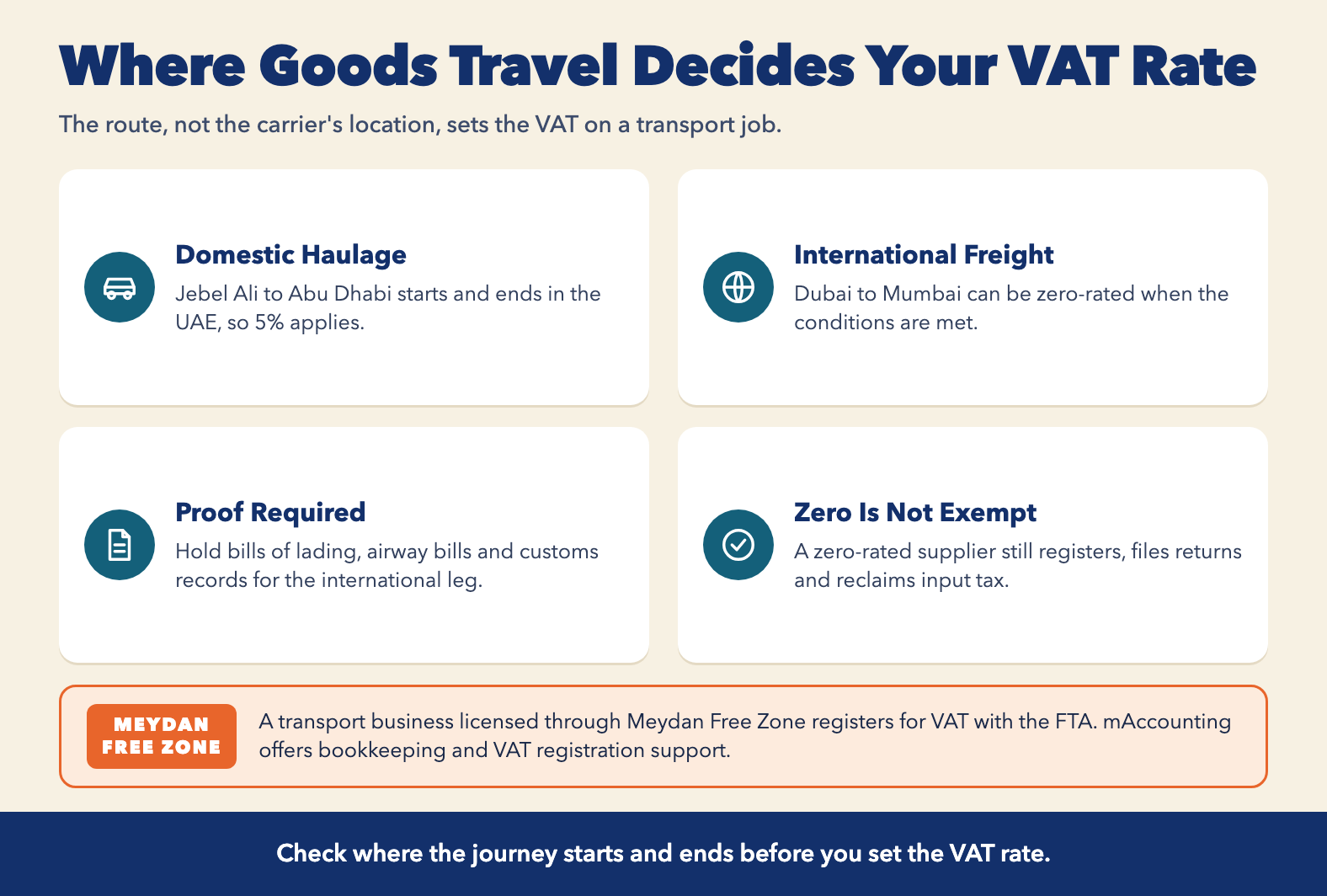
The VAT treatment of transport depends on place of supply, which is where the journey starts. Transport starting in the UAE is a UAE supply. It becomes zero-rated if it ends outside the UAE, or if the goods travel into the UAE from abroad under the conditions in the VAT law. That is the core rule for goods transport.
Place of Supply Decides the Outcome
The route matters more than the carrier's location. Domestic legs inside one emirate, or between emirates, are all UAE supplies. A shipment from Jebel Ali to Abu Dhabi starts and ends in the UAE, so 5% applies.
When International Transport Qualifies for Zero Rating
- The goods move from the UAE to a place outside it, or the reverse.
- You hold bills of lading, airway bills and customs records.
- Services directly tied to the international leg may follow the same treatment.
A Dubai exporter ships machinery to Mumbai. The freight invoice is zero-rated, supported by the bill of lading and export documents.
VAT Treatment of Common Transport Routes
| Feature | Standard-Rated (5%) | Zero-Rated (0%) |
|---|---|---|
| Typical route | Jebel Ali to Abu Dhabi, or warehouse to warehouse in Dubai | Dubai to Mumbai, or Dubai to Muscat, where conditions are met |
| Evidence needed | Contract and tax invoice | Bill of lading or airway bill, customs declaration, contract |
| Input tax recovery | Recoverable by a registered carrier | Recoverable, often creating a refund position |
| Customer cash cost | AED 21,000 on an AED 20,000 quote | AED 20,000 on an AED 20,000 quote |
| Invoice rate shown | 5% with TRN and VAT amount | 0% with TRN |
Transport Between Designated Zones
Designated zones can be treated as outside the UAE for certain goods movements, subject to Cabinet Decision conditions. Goods moving between two designated zones follow a different rule from goods moving from a designated zone to the mainland. A free zone license does not automatically take a movement outside VAT. Check the FTA's designated zone list.
Zero-Rated and Standard-Rated Transport Compared
Standard-rated transport carries 5% and covers journeys that start and end in the UAE. Zero-rated transport carries 0% and covers qualifying international movements. A registered carrier recovers input tax on both, but the customer's cash cost differs, so classification directly affects pricing and margins.
What the Difference Means for Cash Flow
An exporter-focused haulier often files returns with more input tax than output tax and claims a refund. Customers who are not VAT-registered bear the 5% on local legs as a real cost. Quote exclusive of VAT to avoid disputes. The VAT refund for companies guide covers the process.
Steps to Determine the VAT Treatment of a Transport Job
To determine VAT on a transport job, identify the start and end points, confirm the place of supply, test for zero-rating, collect documents and issue a compliant tax invoice. Doing this before quoting avoids under-charging VAT, which the business then owes to the FTA from its own funds.
- Map the route. Record origin, destination and stopovers, such as a Dubai to Muscat job.
- Apply the place of supply rule. A UAE-start job is a UAE supply even if the customer is overseas.
- Test for zero-rating and keep evidence. A missing bill of lading risks the 0% rate being refused on audit.
- Issue a compliant tax invoice. Show the rate, the TRN and the taxable amount. See the UAE tax invoice requirements.
Cost, Risk and Compliance Mechanics for Transport Invoices
The main risks are charging the wrong rate, missing export evidence and mishandling imported services. A UAE business buying transport from a foreign supplier may need to self-account for VAT under the reverse charge. Registration is mandatory above AED 375,000 in annual taxable supplies and voluntary from AED 187,500.
Registration Thresholds for Carriers and Freight Buyers
- Mandatory above AED 375,000 in supplies and imports over twelve months.
- Voluntary from AED 187,500.
- Zero-rated supplies count toward the threshold.
A start-up trucking firm with AED 400,000 of export freight must register despite charging 0%.
Reverse Charge on Imported Transport Services
A registered UAE recipient of a foreign supplier's taxable service accounts for the VAT itself. The same amount is generally reclaimable if the purchase relates to taxable supplies. Record both sides in the same return.
Penalty Exposure and Record-Keeping
Incorrect returns and late filing carry administrative penalties set by the FTA. A forwarder that cannot support zero-rating on twenty shipments must correct its returns. Treat the classification file as a recurring cost of running logistics.
Who Regulates Transport VAT
The FTA administers VAT across the UAE, while customs authorities and the Roads and Transport Authority (RTA) handle goods movement and transport permits. A Meydan Free Zone company follows the same federal VAT rules as any other UAE business.
- The FTA handles VAT registration, returns and audits.
- Customs authorities handle cargo clearance and declarations.
- The RTA regulates transport operations in Dubai.
- Meydan Free Zone issues the Business License digitally after registration.
A freight or transport support business licensed through Meydan Free Zone registers for VAT with the FTA, not the free zone. Through mAccounting, part of Meydan Plus, it can use bookkeeping and VAT registration support to keep invoices and evidence aligned with returns that mix 0% and 5% supplies. See VAT registration support.
Free Business Setup Cost Calculator
Calculate NowWhat This Means for Your Business Decision
Classify routes before pricing, register once taxable supplies pass AED 375,000, and build an evidence file for each international shipment. Clear classification protects margins and reduces audit exposure.
Pricing and Contract Terms
- Quote exclusive of VAT.
- State the assumed VAT treatment in the contract.
- Apply zero-rating only after export proof is supplied.
Choosing Your License Activity
Match the license activity to the transport service you provide, and plan VAT registration alongside license issuance. Some transport and logistics activities need a further approval from the RTA after the license is issued, so confirm the activity's conditions before you apply.
VAT on transportation services in the UAE comes down to route, evidence and invoicing. Domestic legs carry 5%, qualifying international legs are zero-rated, and the paperwork decides which treatment survives an audit. Map your main routes, confirm the treatment of each, and set up your evidence file before the first invoice. Meydan Free Zone issues the Business License digitally, so you can plan VAT registration from the day the license is issued.
Ready to Launch Your Business in Dubai?
Let's ConnectReferences
- Federal Tax Authority (FTA), UAE: Federal Decree-Law No. 8 of 2017 on Value Added Tax and VAT guidance.
- Roads and Transport Authority (RTA), Dubai: transport activity permits.