Table of Contents
Frequently Asked Questions
Can an employer deduct visa fees from an employee's salary in the UAE?
No. Under Federal Decree-Law No. 33 of 2021, recruitment and visa costs are the employer's responsibility, and an employer cannot recover them from wages. Wage deductions are allowed only on lawful grounds stated in the law, and visa recovery is not one of them. A deduction of this kind creates a complaint risk.
Who pays for the medical fitness test and Emirates ID for a new hire?
The sponsoring employer pays for both as part of the employment visa process. They sit alongside the entry permit, status change, medical insurance and residence visa issuance as employer costs. For a Meydan Free Zone company, mResidency covers the medical fitness test, Emirates ID, medical insurance and residency visas.
Is a recruitment agency fee payable by the employee or the employer?
The employer pays. Agency fees for sourcing a candidate form part of recruitment costs, which the law places on the employer and prohibits recovering from the worker. Employers should agree the agency's fee terms in writing before engaging it.
Can an employment contract make the employee repay visa costs?
Generally, no. A clause requiring repayment of visa or recruitment costs conflicts with the Decree-Law's ban on charging workers these costs. Article 9 deals separately with recruitment costs when an employee resigns during probation, so take legal advice before relying on any such clause. Offer letters should not shift these costs to the candidate.
What happens if an employee leaves soon after the visa is issued?
The employer usually absorbs the cost, as visa and recruitment expenses cannot generally be recovered from the worker. If the employee resigns during probation to join another UAE employer, the new employer compensates the original employer for recruitment costs unless agreed otherwise. Founders should treat these costs as a business risk when budgeting each hire.
Does the employer pay for visa renewal and cancellation?
Yes. Renewal of the residency visa and medical insurance, and cancellation when employment ends, are employer costs. They recur through the employment relationship, so they belong in the annual budget rather than only the initial hiring cost. Exact fees depend on the issuing authority's current schedule.
Do the same visa cost rules apply to free zone companies?
A Meydan Free Zone company processes employee visas through the free zone, and mainland MOHRE procedures should not be assumed to apply. Free zone employment rules are generally aligned with the federal labour law, and the sponsoring company carries the visa costs for its staff. Founders can estimate these costs with the Cost Calculator.
Topic Summary
What Visa Expenses Under UAE Labour Law Cover
Visa expenses under UAE labour law are the government and processing costs of bringing an employee into the country and keeping their status valid. Under Federal Decree-Law No. 33 of 2021, the employer carries recruitment and visa costs. The employee cannot be charged for them, directly or indirectly, including through salary deductions.
What the UAE Labour Law Says About Visa Costs
Federal Decree-Law No. 33 of 2021 bars employers from charging workers recruitment and employment costs, directly or indirectly. This covers visa fees, agency fees and related processing charges. You cannot deduct them from wages, and repayment clauses are generally unenforceable under the rules overseen by the Ministry of Human Resources and Emiratisation (MOHRE).
Visa Costs Employers Typically Cover
Employers typically cover the entry permit, status change, medical fitness test, Emirates ID, medical insurance and residence visa issuance. Agency fees for sourcing the candidate also fall on you. Amounts vary by authority and visa type, so budget from the issuing authority's current schedule.
Five Steps to Budget Recruitment Costs
To budget recruitment costs, list every cost category, confirm your visa quota, obtain current fee schedules, add agency charges and plan renewals. Treat these as employer costs from the start. That prevents unlawful deductions and keeps hiring aligned with cash flow.
Visa Costs for a Meydan Free Zone Company
A Meydan Free Zone company handles employee visas through its free zone arrangements, so don't assume mainland MOHRE processes apply. mResidency covers residency visas, medical fitness tests, Emirates ID, medical insurance, dependent visas and return permits. The sponsoring company still bears the employment visa costs for its staff.
Common Mistakes With Visa Costs
Common mistakes include deducting visa fees from salary, writing cost-recovery clauses into contracts, ignoring renewals and paying agencies without written terms. Each creates dispute and penalty risk.
What This Means for Your Hiring Decision
Treat visa and recruitment costs as fixed employer expenses and price them into every hire. That keeps hiring in line with the law and reduces the risk of disputes.
Who Pays Visa Costs Under the UAE Labour Law
Many founders hiring in the UAE assume visa costs can be shared with a new employee, then have to reverse that position after a labour complaint. The law places recruitment and visa costs on the employer. The gap between that rule and common practice is where disputes begin. This guide explains which costs you carry, the narrow exceptions, and how the rules play out for a Meydan Free Zone company.
What Visa Expenses Under UAE Labour Law Cover
Visa expenses under UAE labour law are the government and processing costs of bringing an employee into the country and keeping their status valid. Under Federal Decree-Law No. 33 of 2021, the employer carries recruitment and visa costs. The employee cannot be charged for them, directly or indirectly, including through salary deductions.
Defining Visa and Recruitment Expenses
Two cost types exist. Government fees cover permits, medical testing and identity cards. Agency and service charges cover sourcing and processing. Recruitment costs under the law include both. You are the sponsor, so the cost follows you.
Say a founder hires a marketing manager and asks them to repay the visa fee from the first salary. That breaches the law.
Why the Misconception Persists
Informal cost sharing was common in some sectors, and some offer letters still shift costs to the candidate. An offer letter might state the candidate pays for the medical test and Emirates ID. Such a clause is unlikely to be enforceable, because contract wording cannot override the Decree-Law.
What the UAE Labour Law Says About Visa Costs
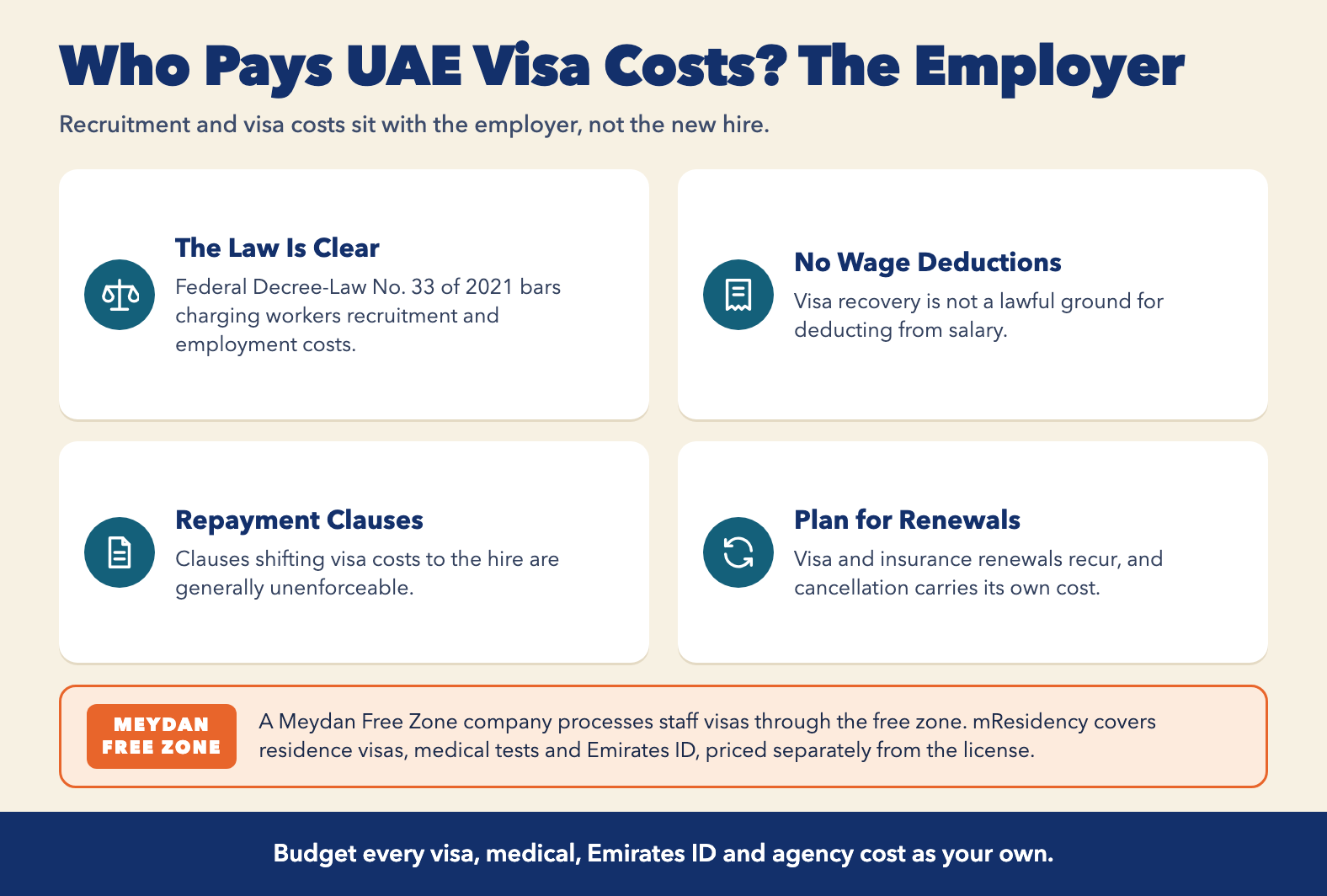
Federal Decree-Law No. 33 of 2021 bars employers from charging workers recruitment and employment costs, directly or indirectly. This covers visa fees, agency fees and related processing charges. You cannot deduct them from wages, and repayment clauses are generally unenforceable under the rules overseen by the Ministry of Human Resources and Emiratisation (MOHRE).
The Employer's Obligation Under Federal Law
The rule applies to the private sector governed by the Decree-Law. If a hire leaves within weeks, you usually absorb the visa fees as a business loss, not a debt owed by the employee. The probation rules add one twist: if a probationer moves to another UAE employer, the new employer compensates you for recruitment costs unless agreed otherwise.
Who Bears Common Visa and Recruitment Costs
| Cost Item | Responsible Party | Practical Note |
|---|---|---|
| Entry permit and status change | Employer | The sponsor pays, with no repayment clause |
| Medical fitness test | Employer | Part of residency processing |
| Emirates ID | Employer | Not recoverable from wages |
| Medical insurance | Employer | A recurring cost, renewed with the visa |
| Recruitment agency fee | Employer | Never charged to the candidate |
Wage Deductions and Repayment Clauses
- Deductions are limited to lawful grounds.
- Visa recovery is not a lawful ground.
- A fee deducted in month one creates complaint risk.
- Wage records must match the contract.
Where Employees May Bear Personal Costs
Keep this narrow. A candidate who attests a degree personally before applying pays for that step. Visa and recruitment costs, however, stay with the employer.
For wider context, see Dubai labour law and Meydan Free Zone.
Visa Costs Employers Typically Cover
Employers typically cover the entry permit, status change, medical fitness test, Emirates ID, medical insurance and residence visa issuance. Agency fees for sourcing the candidate also fall on you. Amounts vary by authority and visa type, so budget from the issuing authority's current schedule.
Core Government and Processing Costs
- Entry permit and status change.
- Medical fitness test and Emirates ID.
- Health insurance, a recurring cost.
- Residence visa issuance.
A two-person startup should price these per hire before offering contracts.
Recurring and Renewal Costs
Visa and insurance renewals return every cycle, and cancellation carries its own cost when an employee leaves. A founder who forgets renewals is likely to exceed the hiring budget in year two. Read the guide to employment visa cancellation in the UAE before you plan exits.
Five Steps to Budget Recruitment Costs
To budget recruitment costs, list every cost category, confirm your visa quota, obtain current fee schedules, add agency charges and plan renewals. Treat these as employer costs from the start. That prevents unlawful deductions and keeps hiring aligned with cash flow.
- List every cost category. Permit, medical, Emirates ID, insurance, residence visa and agency fees. A trading company keeps one cost sheet per hire.
- Confirm your visa quota. Quota depends on your license and office arrangement. A founder with a flexi-desk planning two hires checks eligibility first, using the guide on the number of visas for company setup.
- Obtain current fee schedules. Use the issuing authority's published fees and keep estimates separate from official figures.
- Add agency charges. Agency fees stay with you. Request written terms, and never recover the invoice from the hire.
- Plan renewals. Put visa and insurance renewals in the annual budget.
Visa Costs for a Meydan Free Zone Company
A Meydan Free Zone company handles employee visas through its free zone arrangements, so don't assume mainland MOHRE processes apply. mResidency covers residency visas, medical fitness tests, Emirates ID, medical insurance, dependent visas and return permits. The sponsoring company still bears the employment visa costs for its staff.
Free Zone Versus Mainland Processes
Free zones set their own employment regulations, generally aligned with the federal labour law, so confirm the cost rules with Meydan Free Zone. Visa services are priced separately from the trade license, so budget them apart from license fees.
Using mResidency to Plan Costs
Founders can use the Cost Calculator to estimate visa-related running costs. For the application route, see the guide to employment visa applications in the UAE.
Free Business Setup Cost Calculator
Calculate NowCommon Mistakes With Visa Costs
Common mistakes include deducting visa fees from salary, writing cost-recovery clauses into contracts, ignoring renewals and paying agencies without written terms. Each creates dispute and penalty risk.
Unlawful Deductions and Contract Clauses
Such clauses are unlikely to hold and invite complaints. A small employer facing a complaint over one deducted fee is likely to have to refund it and lose time on the case.
Underbudgeting Renewals and Cancellations
Renewals are hidden recurring costs, and missing them can leave a cash shortfall in year two. Our breakdown of hidden company formation costs in Dubai shows where else budgets slip.
What This Means for Your Hiring Decision
Treat visa and recruitment costs as fixed employer expenses and price them into every hire. That keeps hiring in line with the law and reduces the risk of disputes.
Add visa cost to cost-per-hire. A founder comparing two employees against one contractor should include permits, insurance and renewals in the employee total. Keep receipts and agency invoices, and align contracts with Federal Decree-Law No. 33 of 2021. A file of paid invoices resolves a query quickly.
Map your expected hires, confirm your visa quota and price every visa-related cost from the start. For a Meydan Free Zone company, visa services are priced separately from the trade license, so the visa line belongs in every hiring budget.
Ready to Launch Your Business in Dubai?
Let's Connect