Table of Contents
Frequently Asked Questions
1. What is the UAE cold chain logistics market size in 2025?
The UAE cold chain logistics market was valued at approximately USD 0.71 billion in 2025 and is projected to reach around USD 1.15 billion by 2030, reflecting steady annual growth driven by food imports and pharmaceutical demand. Broader 2024 market estimates place the total sector closer to USD 2.5 billion, with continued infrastructure expansion under the UAE’s National Food Security Strategy.
2. Why is cold chain logistics critical for Indian exports to the UAE?
Cold chain logistics is critical because the UAE imports over 90% of its food and enforces structured inspection protocols at entry points such as Jebel Ali. Temperature deviations, documentation inconsistencies, or pesticide residue breaches can result in shipment holds or rejection. For Indian exporters, most cold chain failures originate upstream in India, not at the UAE port.
3. What are the Maximum Residue Limit (MRL) requirements for exporting vegetables to the UAE?
The UAE enforces strict Maximum Residue Limit standards aligned with GCC food safety regulations. Imported produce must comply with approved pesticide residue thresholds, and non-compliant consignments may be held or rejected upon inspection. Indian exporters are expected to conduct batch-level MRL testing and ensure phytosanitary documentation aligns with declared shipment details.
4. How long does sea freight take from India to Dubai?
Sea freight from Nhava Sheva or Mundra to Jebel Ali typically takes 6–18 days. This transit time provides Indian exporters with a competitive advantage for perishable goods, supporting shelf-life preservation under cold chain logistics UAE requirements.
5. Why do consignments get rejected at UAE ports?
Consignments are most commonly rejected due to MRL non-compliance, mismatches in phytosanitary documentation, weight or lot number discrepancies, temperature excursions during transit, or missing or expired MOCCAE permits and FIRS registrations. Prevention requires strict pre-shipment documentation checks and continuous temperature monitoring from pack house to port.
6. Should an Indian exporter set up a UAE company or use a local distributor?
Using a distributor is generally more efficient at low shipment volumes, particularly during initial market entry. As volumes increase, establishing a UAE trading entity can provide greater control over pricing, buyer relationships, and compliance records. Setting up through Meydan Free Zone allows exporters to obtain a business license and operate through a structured UAE company, subject to alignment with the appropriate trading activity.
Topic Summary
1. Cold Chain Overlooked in Strategic Planning
For many Indian exporters, the cold chain is perceived merely as an operational task managed by logistics providers or pack houses. This narrow viewpoint neglects its strategic significance in maintaining product quality from farm to destination, potentially undermining export success.
2. Temperature Control Impacts Consignment Integrity
Temperature instability during transit often leads to consignments being discounted, delayed, or outright rejected. Such issues frequently originate well before the shipment arrives at the port, underscoring the necessity of vigilant temperature monitoring throughout the supply chain.
3. Documentation Consistency is Equally Crucial
Apart from temperature regulation, inconsistent or inaccurate documentation can cause significant hurdles at customs and import checkpoints. Proper record-keeping and compliance with international standards are imperative to prevent avoidable rejections and delays.
4. Post-Harvest Losses in Indian Horticulture are Substantial
Research by ICAR-CIPHET highlights that post-harvest losses for fruits and vegetables in India can range between 18% to 30%, largely due to inadequate cold chain infrastructure. This translates into considerable economic loss and reduced export competitiveness.
5. Investing in Cold Chain Infrastructure Yields Returns
Strengthening cold chain capabilities—including refrigerated storage, transportation, and real-time temperature tracking—not only preserves product quality but also builds exporter credibility in global markets. A strategic focus on cold chain management is essential for enhancing the overall performance of temperature-sensitive exports.
Cold Chain Logistics UAE: How Indian Exporters Can Upgrade for UAE Markets
A frozen seafood exporter in Kochi losing shipments to temperature breaks somewhere between the port and the Dubai warehouse, a dairy producer in Gujarat wanting to ship beyond a handful of trusted local buyers, a pharmaceutical distributor needing a cold chain that a regulator will actually sign off on: all three are chasing the same fix, a cold chain built to survive the UAE's inspection process rather than one that only looks good on paper back in India.
This guide covers the scale of the UAE's dependence on imported food, where Indian exporters lose product before it ever reaches a shelf, and how a properly structured UAE entity closes that gap.
Key Stats at a Glance
[blockCTABizSetupRemotely]
Why Cold Chain Compliance Decides Whether You Get Paid
The UAE imports over 90% of its food, and with around 4.36 million Indian residents forming the largest expatriate group in the country, Indian exporters already have a built-in customer base before a single new relationship is built.
What decides whether that opportunity turns into repeat business is whether your product survives the trip: post-harvest losses in India already run from 4.58% to 15.88% depending on the produce category, per ICAR-CIPHET, and every one of those percentage points is lost before your goods even reach a UAE port.
UAE inspection at the point of entry does not create weaknesses in your cold chain, it reveals ones that were already there, so the work that actually protects your shipment happens well before the container reaches Dubai, in how you handle, pack, and monitor temperature from the moment produce leaves the farm or factory floor.
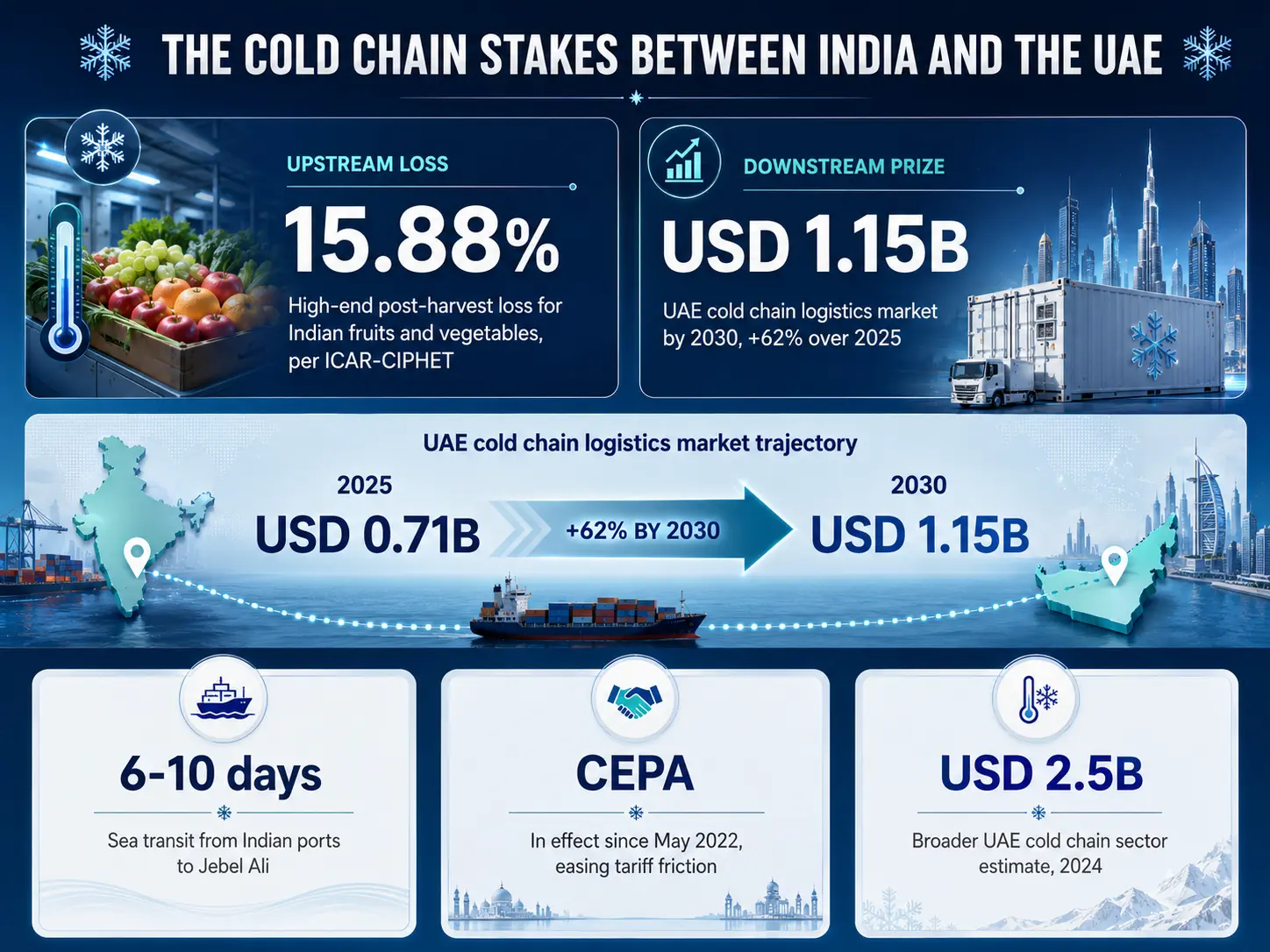
Source: ICAR-CIPHET via Mordor Intelligence India Cold Chain Report, Nexdigm UAE Cold Chain Market Research, and UAE Ministry of Economy CEPA documentation, via Mordor Intelligence
Who Your Customers Will Be
Your customer base spans supermarket chains and food distributors needing a supplier who can guarantee a documented, unbroken cold chain, pharmaceutical and healthcare distributors needing temperature-sensitive goods handled to a standard regulators will accept, and hospitality and food service buyers needing consistent, reliable delivery on a recurring schedule.
The UAE cold chain market is worth around USD 0.71 billion in 2025 and set to reach around USD 1.15 billion by 2030, growth built directly on the country's over 90% dependence on imported food, giving an Indian exporter with a properly managed cold chain a market that keeps expanding rather than one that is already saturated.
Distributor Model or Your Own UAE Entity
Selling only through a distributor needs no local setup, but the distributor ends up owning your cold chain documentation and your buyer relationships along with it. A UAE-registered company puts that control back in your hands, letting you manage your own compliance record, deal directly with supermarkets and distributors, and invoice in AED rather than routing every payment through a third party.
[blockCTACostCalculator]
Step-by-Step Setup Guide
- Step 1, register your UAE company: Choose a trading activity matched to your product category, food, pharmaceutical, or general cold chain goods.
- Step 2, map your cold chain from origin to Jebel Ali: Document temperature control at every handoff point, since sea freight from ports such as Nhava Sheva or Mundra typically takes 6 to 10 days and can run as long as 18 in some cases.
- Step 3, cut your post-harvest losses at the source: Improved handling and storage in India before export directly reduces the 4.58% to 15.88% loss range reported by ICAR-CIPHET.
- Step 4, prepare your documentation for UAE inspection: Build records that hold up to scrutiny at the point of entry rather than assuming they will pass on reputation alone.
- Step 5, secure your storage and distribution capability in the UAE: A local cold storage partner or your own facility keeps your product properly handled after it clears customs.
- Step 6, open your corporate bank account: A UAE entity with its own account lets you invoice buyers directly in AED from the outset.
Compliance and What You Need in Place
Cold chain documentation
UAE inspection checks whether your temperature control was maintained at every stage, so build a documented, auditable record from the point produce leaves India through to Jebel Ali, since gaps here get caught at the border rather than quietly overlooked.
Reducing losses at the source
India's post-harvest loss rate of 4.58% to 15.88%, per ICAR-CIPHET, is largely preventable with proper handling and storage before export, so treat this as a cost-saving step rather than an unavoidable one.
Anti-money laundering compliance
This activity carries no sector-specific anti-money laundering registration or reporting duties beyond the standard compliance framework that applies to all UAE businesses.
VAT registration
VAT registration is mandatory once your taxable turnover crosses AED 375,000 annually, so build this into your financial planning as your UAE sales grow.
Storage and distribution reliability
Buyers judge a cold chain exporter on consistency, not on a single good shipment, so build redundancy into your storage and distribution plan so a single delay does not cost you a long-term buyer relationship.
Ongoing renewals
Renew your license every year, keep your cold chain documentation current, and keep your MOHRE registrations up to date if you employ staff.
Market Opportunity
The UAE's over 90% dependence on imported food, combined with a cold chain market growing from around USD 0.71 billion in 2025 to around USD 1.15 billion by 2030, gives an Indian exporter a market with both scale and clear direction of travel. With around 4.36 million Indian residents already forming the UAE's largest expatriate group, demand for familiar Indian produce and products runs deeper than a purely commercial calculation would suggest.
An exporter who fixes cold chain weaknesses at the source, cutting into India's 4.58% to 15.88% post-harvest loss range, captures more saleable product per shipment before it even reaches a UAE port, directly improving margin rather than only chasing volume. A UAE-registered company that owns its own cold chain documentation and buyer relationships is well placed to win the kind of recurring, high-trust contracts that a distributor-only relationship rarely delivers.
Conclusion
Cold Chain Logistics for Indian Exporters in the UAE is a workable business for an exporter ready to fix compliance at the source rather than hope it passes inspection on arrival. A UAE-registered company gives an Indian exporter direct control over documentation, buyer relationships, and AED invoicing in a market that keeps growing on the back of the country's need for imported food.
[blockCTAContact]
References