Table of Contents
Frequently Asked Questions
1. Can a British aromatherapy brand sell into the UAE without a local company?
Yes, but cross-border selling creates friction at every stage — from invoicing and payment collection to product registration and vendor onboarding. Most hospitality and retail buyers in the UAE prefer or require locally registered suppliers.
2. What licenses does a British wellness brand need to operate in Dubai?
A UAE trade license covering the relevant business activities — such as trading in cosmetics, wellness consultancy, or e-commerce. Through Meydan Free Zone, up to three activity groups can be combined under a single license, and the Fawri license is issued in under 60 minutes.
3. Do aromatherapy products need to be registered in the UAE?
Yes. Under Cabinet Decision No. 10 of 2022, aromatherapy products fall under the Emirates Conformity Assessment Scheme (ECAS), which requires compliance with safety, labelling, and quality standards. A UAE-registered entity simplifies this process significantly.
4. How long does it take to set up a wellness business in Dubai?
Through digital-first free zone structures like Meydan Free Zone, a business license can be issued in under 60 minutes. Banking, product registration, and operational setup follow, with timelines depending on the complexity of the product range.
5. Does a British wellness brand need a physical office in Dubai?
No. Free zone structures like Meydan Free Zone allow businesses to operate without a physical office, keeping fixed costs low while maintaining the ability to contract, invoice, and register products locally.
6. Can a Dubai entity support sales across the wider GCC?
Yes. Many UAE-based buyers manage procurement across Saudi Arabia, Oman, Qatar, and other GCC markets. A local entity allows British brands to contract centrally and expand a single client relationship into multi-market distribution.
7. Is the UAE aromatherapy market large enough to justify setup costs?
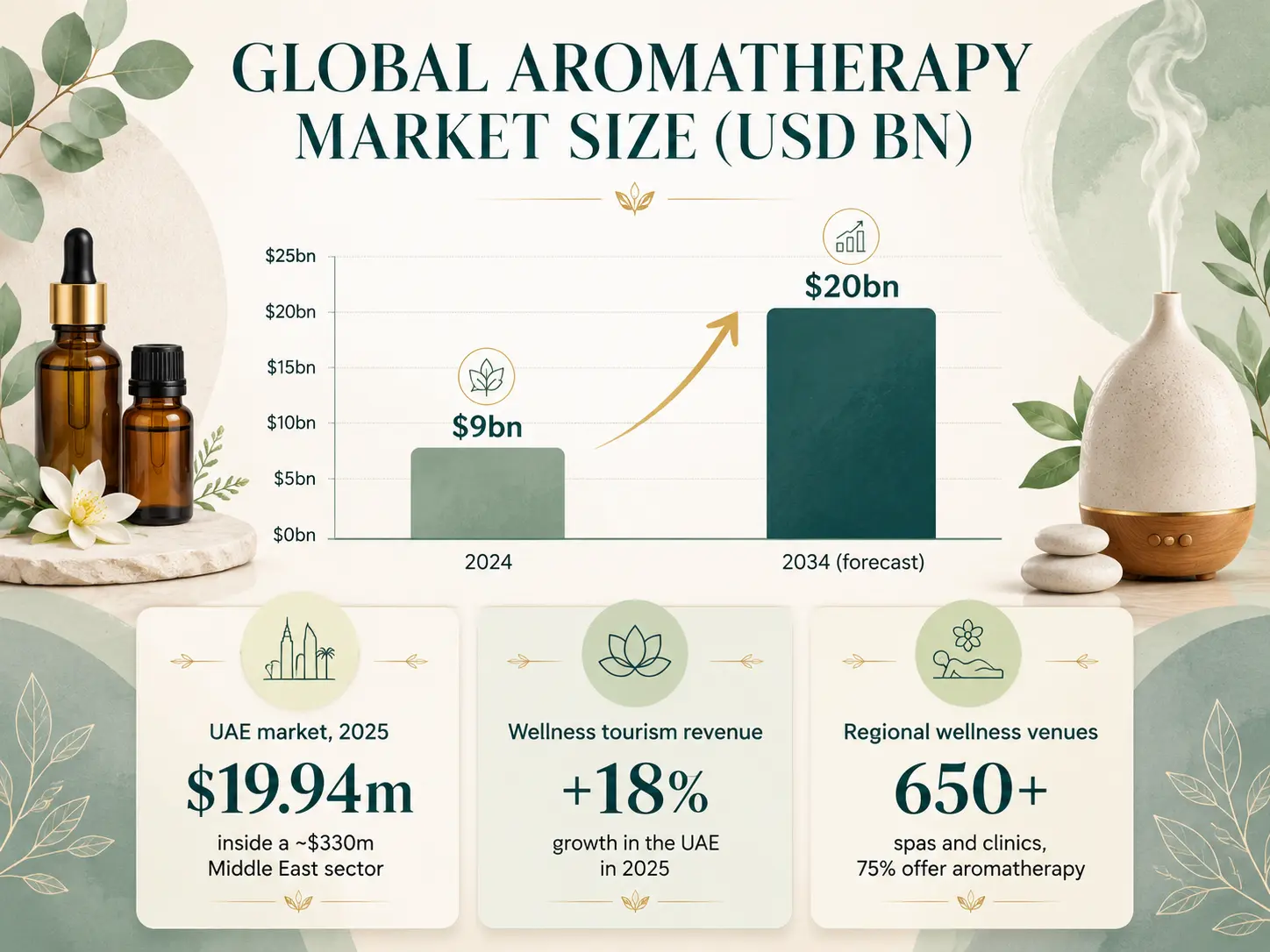
The UAE aromatherapy market is forecast at USD 19.94 million in 2025, within a Middle East sector valued at approximately USD 330 million. With wellness tourism revenue growing 18% in 2025 and over 650 wellness facilities featuring aromatherapy, the demand is established and expanding.
Topic Summary
1. Integrated Role in Hospitality and Wellness Industry
Aromatherapy in Dubai is far from niche; it is a core component embedded within hospitality, medical wellness, and consumer retail sectors. With the UAE and Saudi Arabia collectively operating over 650 wellness resorts and spa clinics in 2023, 75% of these establishments include aromatherapy treatments, underscoring its widespread acceptance and growing demand.
2. Surging Wellness Tourism and Revenue Growth
The wellness tourism market in the UAE is expanding rapidly, with wellness tourism revenue increasing by 18% in 2025. This surge reflects a broader regional commitment to developing high-end wellness experiences, where aromatherapy is a critical element in attracting and retaining discerning international visitors.
3. Investment in World-Class Wellness Facilities
Dubai’s unveiling of the USD 545 million Therme Dubai resort epitomises the city’s dedication to premium wellness infrastructure. Such large-scale investments provide an ideal platform for aromatherapy products and services, aligning with the luxury and therapeutic standards expected by clientele.
4. Strategic Suitability of British Aromatherapy Brands
British aromatherapy brands, renowned for their heritage, quality control, and scientifically-backed formulations, perfectly meet Dubai’s market requirements. Their established reputation and adherence to regulatory standards complement the UAE’s focus on authenticity and efficacy within wellness treatments.
5. Cultural Appreciation and Market Accessibility
British brands benefit from the UAE’s openness to international trade and cultural appreciation for luxury health products. The English language compatibility and shared emphasis on professional standards facilitate smoother market entry and position British aromatherapy products favourably among both consumers and industry professionals in Dubai.
Introducing British Aromatherapy and Wellness Essentials to Dubai
A British aromatherapy brand with a loyal following at home and a product line ready to travel, a wellness founder watching Dubai's spa and hotel sector grow and wondering how to get formulations onto those shelves, an organic skincare maker hearing that UAE customers pay a premium for real quality: all three are looking at the same opportunity, and all three run into the same lesson early on, that the formulations were never the problem, the business structure was.
This guide covers the market opportunity for British aromatherapy brands in Dubai, what UAE regulators need from you, and how you set the business up here.
Key Stats at a Glance
The UK-to-Dubai Opportunity for Aromatherapy
Dubai's wellness sector has grown fast enough to pull in USD 545 million of investment through the Therme Dubai project alone, and wellness tourism revenue is on track to grow 18% in 2025, giving an aromatherapy brand a market that keeps expanding rather than levelling off.
The UAE and Saudi Arabia together host over 650 wellness facilities, and 75% of them already feature aromatherapy in some form, so the demand is proven, the question for a British brand is how to reach it properly.
British brand positioning carries real weight with Dubai customers, who associate UK-made wellness products with rigorous quality and honest formulation standards, and organic certification gives a brand a further edge in a market where customers pay close attention to what goes into a product marketed for skin and wellbeing use.
Who Your Customers Will Be
Your customer base spans the spas, hotels, and wellness centres that make up the UAE's 650-plus wellness facilities and want a proven British formulation to build a treatment menu around, independent wellness practitioners who need product they can trust for client-facing work, and retail customers buying directly once your brand has UAE market presence and proper product registration in place.
The UAE aromatherapy market is worth USD 19.94 million in 2025, sitting inside a wider Middle East sector worth around USD 330 million, and wellness tourism revenue growing 18% this year points to a customer base that keeps expanding rather than staying flat, giving a British aromatherapy brand a market with both scale and real momentum behind it.
Meydan Free Zone or a Direct UK Structure
Selling into Dubai from the UK only works through a distributor, and while this needs no local setup, it means the distributor, not you, owns the product registration and the customer relationship. A Meydan Free Zone entity lets you register your own products, deal directly with spas and hotels, and keep 0% corporate tax on qualifying UAE income, and the digital setup process moves quickly once your documents are ready.
[blockCTACostCalculator]
Step-by-Step Setup Guide
- Step 1, book your trade name: Check availability through your chosen free zone authority, confirming your activity covers wellness and cosmetic product trading.
- Step 2, prepare your setup documents: Passport copies of shareholders and directors and a business plan summary covering your product range.
- Step 3, get your initial approval and license: Meydan Free Zone's fast digital process moves quickly once your documents are complete.
- Step 4, get ECAS conformity assessment: Products need to meet the Emirates Conformity Assessment Scheme standard under Cabinet Decision No. 10 of 2022 before they reach the UAE market.
- Step 5, register your products with Dubai Municipality: This registration step covers cosmetic and wellness products and needs to be completed before commercial sale.
- Step 6, check UAE Ministry of Health and Prevention rules if you offer treatments: The alternative medicine licensing pilot launched in 2023 may apply if your business delivers aromatherapy treatments rather than only selling product.
Compliance and What You Need in Place
Third-party approval
ECAS conformity assessment under Cabinet Decision No. 10 of 2022 and Dubai Municipality product registration both apply to this activity, so build both steps into your launch timeline before you commit to a retail or wholesale date.
Ministry of Health and Prevention pathway
A 2023 pilot opened a licensing route for alternative medicine practice, so check whether your business model, product sales alone or product sales alongside treatments, falls under this pathway.
Professional standards
IFPA standards give your brand a recognised quality marker that Dubai's spas and wellness centres look for when choosing a new supplier, so building your formulation and practitioner training against this standard strengthens your pitch to commercial buyers.
VAT registration
VAT registration is mandatory once your taxable turnover crosses AED 375,000 annually, so build this into your financial planning as your UAE sales grow.
Anti-money laundering compliance
This activity carries no sector-specific anti-money laundering registration or reporting duties beyond the standard compliance framework that applies to all UAE businesses.
Ongoing renewals
Renew your license every year, keep your ECAS and Dubai Municipality registrations current, and keep your MOHRE registrations up to date if you employ staff.
Market Opportunity
The UAE aromatherapy market is worth USD 19.94 million in 2025 within a wider Middle East sector worth around USD 330 million, and with 75% of the region's 650-plus wellness facilities already featuring aromatherapy, the demand side of this market is well established rather than speculative.
Wellness tourism revenue growing 18% this year and a USD 545 million investment in the Therme Dubai project alone point to a sector that keeps pulling in capital and customers rather than plateauing.
A British brand that registers its own products and deals directly with spas and hotels through a Meydan Free Zone entity keeps the customer relationship and the margin that would otherwise go to a distributor, and organic certification alongside IFPA-standard formulation gives that brand a real edge with buyers who pay close attention to ingredient quality.
Direct control over UAE product registration also means a brand can move faster when it wants to expand its range or respond to a specific spa's treatment menu.
Wellness facilities across the UAE and Saudi Arabia give a British aromatherapy brand a regional market to grow into once a Dubai base is established, rather than a single-city ceiling on growth. An operator who gets ECAS and Dubai Municipality registration right from the outset avoids the delays that cost a brand its first-mover advantage in a fast-growing category.
Conclusion
British Aromatherapy Market Entry in Dubai is a workable move for a brand ready to trade directly rather than through a distributor. Meydan Free Zone's fast setup, tax position, and direct market access give a UK aromatherapy brand a practical route into the UAE's growing wellness sector.
[blockCTAContact]
References