

Table of Contents
Frequently Asked Questions
1. What is a Dubai holding company?
A Dubai holding company owns shares in subsidiary businesses, receives dividends and keeps ownership separate from day-to-day trading. It gives founders a single ownership layer above several companies or assets, without trading directly itself.
2. What is the difference between a holding company and an SPV?
A holding company is designed for long-term ownership of several companies or assets. An SPV is created for one specific property, project, investment or transaction, helping isolate its ownership, financing and risk.
3. Can a Dubai holding company own a UK limited company?
Yes. A Dubai holding company can own a UK limited company, but the UK shares must be transferred or exchanged properly. Founders should review valuation, capital gains, Stamp Duty and shareholder restrictions before restructuring.
4. Does a Dubai holding company qualify for 0% corporate tax?
No. A Dubai free-zone holding company does not automatically qualify for 0% corporate tax. It must meet Qualifying Free Zone Person conditions, maintain adequate substance and earn qualifying income under the UAE corporate tax rules.
5. How do you set up a holding company through Meydan Free Zone?
To set up through Meydan Free Zone, first map the group, define whether the entity will hold companies or one asset, choose the correct activity (holding company or investment code), confirm shareholders, incorporate digitally and transfer assets only after tax review.
Topic Summary
1. Initial Simplicity of a Single UK Limited Company
Most British founders commence their entrepreneurial journey with a single limited company. This streamlined structure requires maintaining one set of accounts and receiving profits through a single entity, reflecting the straightforward nature of an emerging business.
2. Evolving Business Structures as Growth Occurs
As the business expands, the original structure often becomes insufficient. The emergence of multiple trading activities or the combination of intellectual property with commercial operations typically necessitates the creation of separate entities to manage distinct risks and assets.
3. Strategic Use of Holding Companies in Dubai
Dubai offers an attractive jurisdiction for holding companies due to favourable tax policies, strategic location, and robust legal frameworks. For UK founders, establishing a holding company or Special Purpose Vehicle (SPV) in Dubai can facilitate efficient ownership management, asset protection, and international expansion.
4. Facilitating Targeted Investment through SPV
Investors generally prefer equity stakes in specific ventures rather than the entire business group. SPVs in Dubai enable UK founders to isolate individual projects or subsidiaries, making it simpler to grant equity participation and attract investment without compromising the whole enterprise.
5. Complex Ownership Decisions as Businesses Mature
With growth, ownership arrangements transition from mere formality to critical strategic decisions. UK founders must thoughtfully consider the advantages of Dubai-based holding companies and SPVs for optimising governance, tax planning, and investor relations amid increasing operational complexity.
UK Holding Companies & SPVs in Dubai for Founders
Almost no British founder needs a holding company at the start. One limited company, one set of accounts, one place the profit lands. The structure fits the business. It stops fitting as you grow. One trading company becomes two. Intellectual property ends up beside commercial risk. An investor wants equity in one venture, not the whole group. At that point ownership stops being a formality and becomes a decision, and increasingly, UK founders are making it in Dubai.
By the end of March 2026, 10,334 active British companies were registered with the Dubai Chamber of Commerce, more than four times the 2020 figure, according to Dubai Chambers.¹ The UK-GCC Free Trade Agreement, signed in May 2026 as the Gulf's first with a G7 nation, has only sharpened the case.²
A holding company in Dubai gives UK founders a clean ownership layer above their businesses. An SPV is narrower: it walls off one asset, project or transaction. Neither is a tax shortcut, and treating them as one is where founders come unstuck.
The vehicle matters more than the speed of setting it up, and a holding structure needs 100% foreign ownership, corporate or multiple shareholders, and the right activity on the license, all of which Meydan Free Zone supports through a 100% digital process.
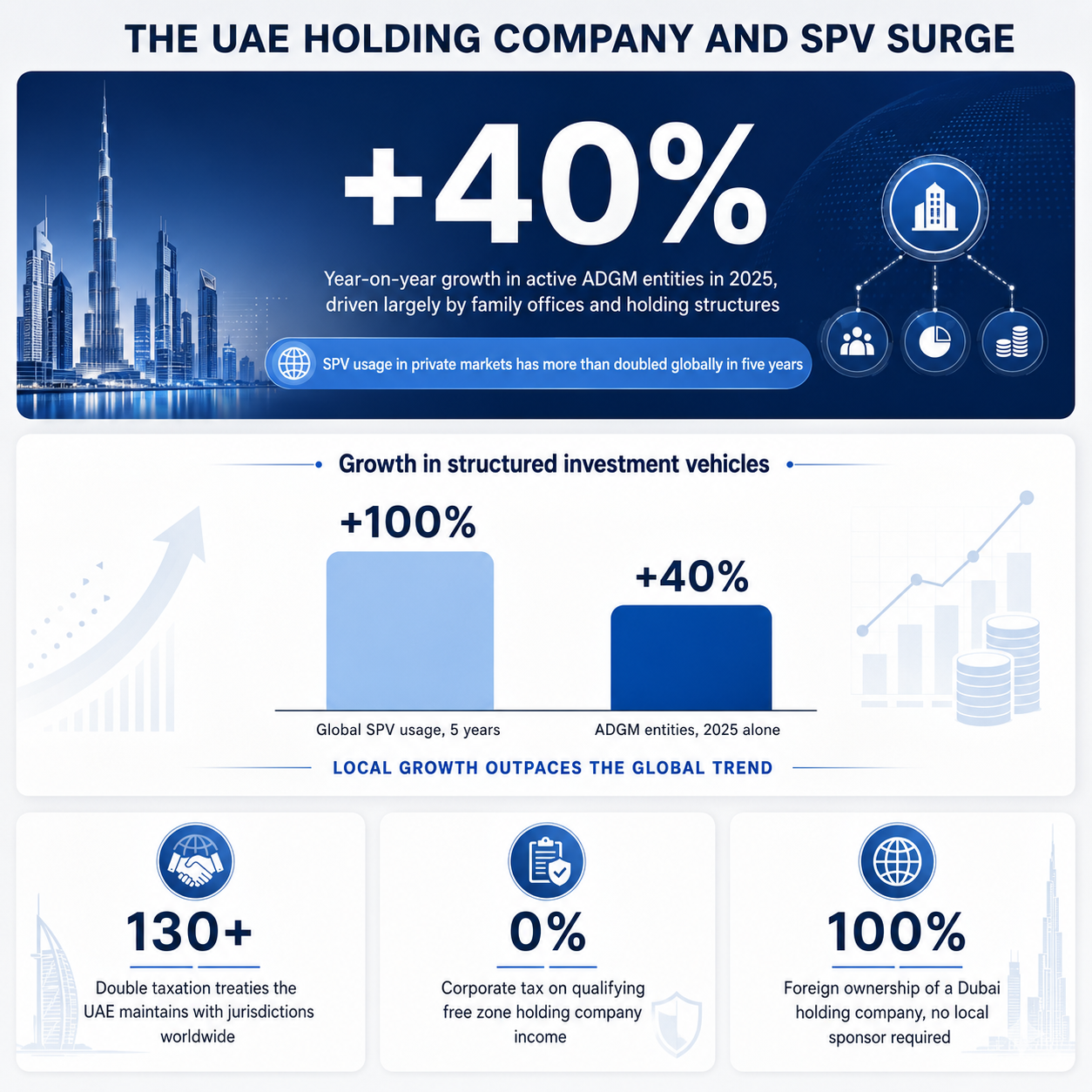
Source: Gulf News MCA UAE SPV Market Report 2026, ADGM Registration Statistics 2025, and UAE Ministry of Finance Double Taxation Treaty Network, via Gulf News
What a Dubai Holding Company Actually Does
A holding company sits above other companies. Its job is to own them, not to trade.
The subsidiaries do the commercial work. They employ people, sign contracts and carry the risk. The holding company simply owns their shares and receives dividends when profit is paid up. For UK founders, the appeal is practical. A group structure lets you:
- Ring-fence risk: A claim against one company does not threaten the whole group.
- Protect what's valuable: Brand, IP or property sits away from the trading entity.
- Sell cleanly: You can offload one subsidiary without unpicking the rest.
- Bring in investors: They take equity in one venture, not everything you own.
UK founders build these at home for the same reasons. What Dubai adds is the parent itself, and how it is treated once it sits there:
- 100% foreign ownership: No local partner above your group; you keep full control.
- No personal income tax: Dividends you eventually draw as the owner are not taxed at UAE level, unlike UK dividends.
- Efficient dividend flow-up: Distributions from UAE subsidiaries are exempt from corporate tax, and qualifying foreign dividends and gains can be too. Where a free-zone holding company meets the conditions, that income is taxed at 0%, against 9% on anything that falls outside them.
At Meydan Free Zone, passive ownership maps to a specific business activity code:
| Activity | Code | What it allows | What it does not allow |
|---|---|---|---|
| Holding Companies | 6420.00 | Owning shares in subsidiary companies, receiving dividends, and holding IP or investments | Running the subsidiaries, making operational decisions, trading directly, or charging them for management services |
What an SPV Does Differently
A holding company is built to own a group. An SPV is built around one purpose.
That purpose might be a property, acquisition, joint venture or standalone project. Rather than sitting inside the main trading company, the asset and its obligations go into a separate vehicle created for that deal alone.
For a UK founder, that separation makes it easier to:
- Bring an investor into one transaction, not the wider group
- Attach financing and contracts to the specific asset
- Sell the project or vehicle on its own
- Keep one higher-risk venture away from the operating companies
Use each for what it's designed to do:
- Holding company to organise long-term ownership of the group
- SPV when one deal needs its own boundary
- Neither when one clean operating company still solves everything, structure should follow need, not ambition
What a UK-to-Dubai Structure Can Look Like
A founder operating across both markets could build the group like this:
| Founder → Dubai Holding Company → UK Ltd + UAE operating company + project SPV |
Each entity has a distinct role:
| Entity | Role |
|---|---|
| Dubai holding company | Owns the shares in the companies beneath it |
| UK Ltd | Serves UK customers, employs UK staff, pays UK tax on UK profits |
| UAE operating company | Handles UAE and international trading activity |
| Project SPV | Holds one property, investment, joint venture or acquisition |
But none of this happens just because the Dubai parent exists. Placing an existing UK Ltd beneath it means transferring or exchanging your shares, which can trigger:
- A valuation and share-transfer documents
- UK capital-gains and Stamp Duty exposure
- Shareholder-agreement and lender restrictions
Map the ownership chain before you form the parent, not after.
Navigating UK Tax With a Dubai Holding Company
A Dubai parent does not lift the underlying UK business out of the UK tax system.
The UK Ltd stays UK-incorporated. It keeps filing UK accounts and returns, and its UK profits stay UK-taxed. Ownership changing above it does not change that.
Your personal position is separate again. The UAE charges no personal income tax on dividends, but if you remain a UK tax resident, UK tax can still apply when profits reach you personally.
The Dubai holding company also has to be run as a UAE company in fact, not just on paper. A UAE address and trade license are not enough. HMRC looks at where the company's highest-level decisions are genuinely made, and if that is Britain, it can treat the company as a UK tax resident regardless of where it is registered.
Substance that supports a UAE position include:
- Board meetings genuinely held, and minuted, in the UAE
- Directors with real control, not just ratifying decisions taken elsewhere
- Proper UAE accounting records and a UAE bank account
The holding company changes who owns the group. It does not change where the subsidiaries trade, where the group is run, or where you are personally taxed.
How to Set Up a Holding Company or SPV Through Meydan Free Zone
The order matters: decide what sits where before you incorporate anything.
[blockAccordionSteps]
In Conclusion
Most UK founders arrive here the same way: not by chasing Dubai, but by outgrowing a structure that once fitted. One company became a group. A side project became an asset worth protecting. An investor wanted one venture, not the whole estate. A holding company brings order to the first; an SPV draws a line around the second.
For a British founder, the value is in the groundwork: map the group, decide where the parent will genuinely be managed, and understand the UK capital-gains and residence position before a share moves.
Get that right and Dubai gives you a credible ownership layer above what you have built, keeping risk contained and growth easier to reach.
When you are ready to map yours, talk to a Meydan Free Zone setup adviser.
Footnotes
¹ Dubai Chambers, Active British companies in Dubai, 10,334 active British companies were registered with the Dubai Chamber of Commerce by the end of March 2026, more than four times the 2,402 recorded at the end of 2020, 2026.
² Gulf Cooperation Council–United Kingdom, UK-GCC Free Trade Agreement, the UK signed a Free Trade Agreement with the GCC on 20 May 2026, the bloc's first with a G7 nation, 2026.