
Table of Contents
Frequently Asked Questions
1. How long does it take German nationals to get an Emirates ID?
For most German nationals, the Emirates ID follows the residence sequence and usually takes around one to three weeks once the residence file is active. The timeline depends on the emirate, appointment availability, medical clearance, and whether your passport, name, photo, and sponsor records all match cleanly.
2. Do German nationals need to be in the UAE for biometrics?
Yes. German nationals can prepare parts of the residence process in advance, but biometrics and the medical fitness test must be completed in the UAE at approved centres. The Emirates ID is not a standalone application, so these steps only make sense once the residence file is active and ready for them.
3. What documents should German nationals prepare before getting an Emirates ID?
Bring a valid passport, your entry permit or status change record if relevant, a compliant passport photo, and the sponsor-linked residence application details. If you are applying through an investor or corporate route, make sure the company or shareholder records match your passport exactly to avoid corrections and delays.
4. Can you open a bank account before the Emirates ID card arrives?
Sometimes, but it depends on the bank and the stage of your residence file. Some banks may proceed once your residence visa is approved or your Emirates ID number is visible in the system, while others wait for the physical card, so it is smart to check the bank’s current policy before relying on it.
5. What happens if you miss your medical screening or biometrics appointment?
Missing either appointment can delay the whole file because each stage unlocks the next one. You will usually need to rebook, and if the residence file is not at the correct stage when you attend, the visit can be wasted, so it is best to track portal updates, SMS notices, and sponsor messages closely.
Topic Summary
1. Start With Residency, Not Biometrics
The Emirates ID follows your residency route, so German citizens should begin with the sponsor file, entry permit or status change, and ICP record. If you book later steps too early, delays pile up fast.
2. Get Your Documents Aligned
Before you do anything, check that your passport details, sponsor records, photo, and contact information match exactly. Small mismatches in names, passport numbers, or phone details are one of the most common reasons a file stalls.
3. Follow the Six-Step Sequence
The smooth route is simple: confirm the residency category, submit the file, complete the medical test, attend biometrics, track approval, then confirm card delivery or collection. Treat each stage as a gate, because one step unlocks the next.
4. Know What the EID Unlocks
Your Emirates ID is more than an identity card. It becomes the key reference for banking, SIM registration, leasing, government portals, clinic records, and many daily admin tasks that are hard to finish without a live ID number.
5. Track Status Like a Project
Do not rely on memory or scattered screenshots. Keep one simple tracker with your receipt number, medical status, biometrics booking, approval updates, and delivery notice so you can respond quickly if ICP asks for a correction.
6. Budget for Fees and Rework
The direct cost depends on visa length, sponsor route, medical centre, and any service support, but the hidden cost is delay. Missed appointments, repeat transport, and postponed bank or telecom setup often cost more than the official fees.
7. Know When You Are Done
The process is only complete when residency is active, the Emirates ID number works in live systems, and the physical card is issued or delivered. Once that happens, update your bank, employer, telecom account, and lease records right away.
Getting Your Emirates ID (EID): Complete Guide for German Nationals
The Emirates ID is the card that turns a Dubai residence visa into a working daily life. Banking, telecoms, healthcare, government portals and school registration all run through it. The card fee itself is modest, at AED 100 per year of validity, which is €23.
This guide explains what the Emirates ID unlocks, where it sits in the residency sequence, how the application works, what it costs, and how the digital version gets you moving before the physical card arrives.
Key Facts at a Glance
What the Emirates ID Unlocks
The card is the primary proof of identity inside the UAE. It is accepted at government offices, hospitals, banks and telecom providers.
Day to day, it is what you need to:
- Open and operate a corporate or personal bank account
- Register for utilities, mobile and internet services
- Access healthcare and register with clinics
- Enrol children in school with KHDA registration
- Sign a tenancy contract and register a vehicle
- Use UAE Pass, the national digital identity app
German founders often notice the difference immediately. Processes that need paperwork and appointments elsewhere take a card tap here. The card carries a chip holding your biometric data and personal details, which is why it works as identification across so many services.
Where the Emirates ID Sits in the Residency Sequence
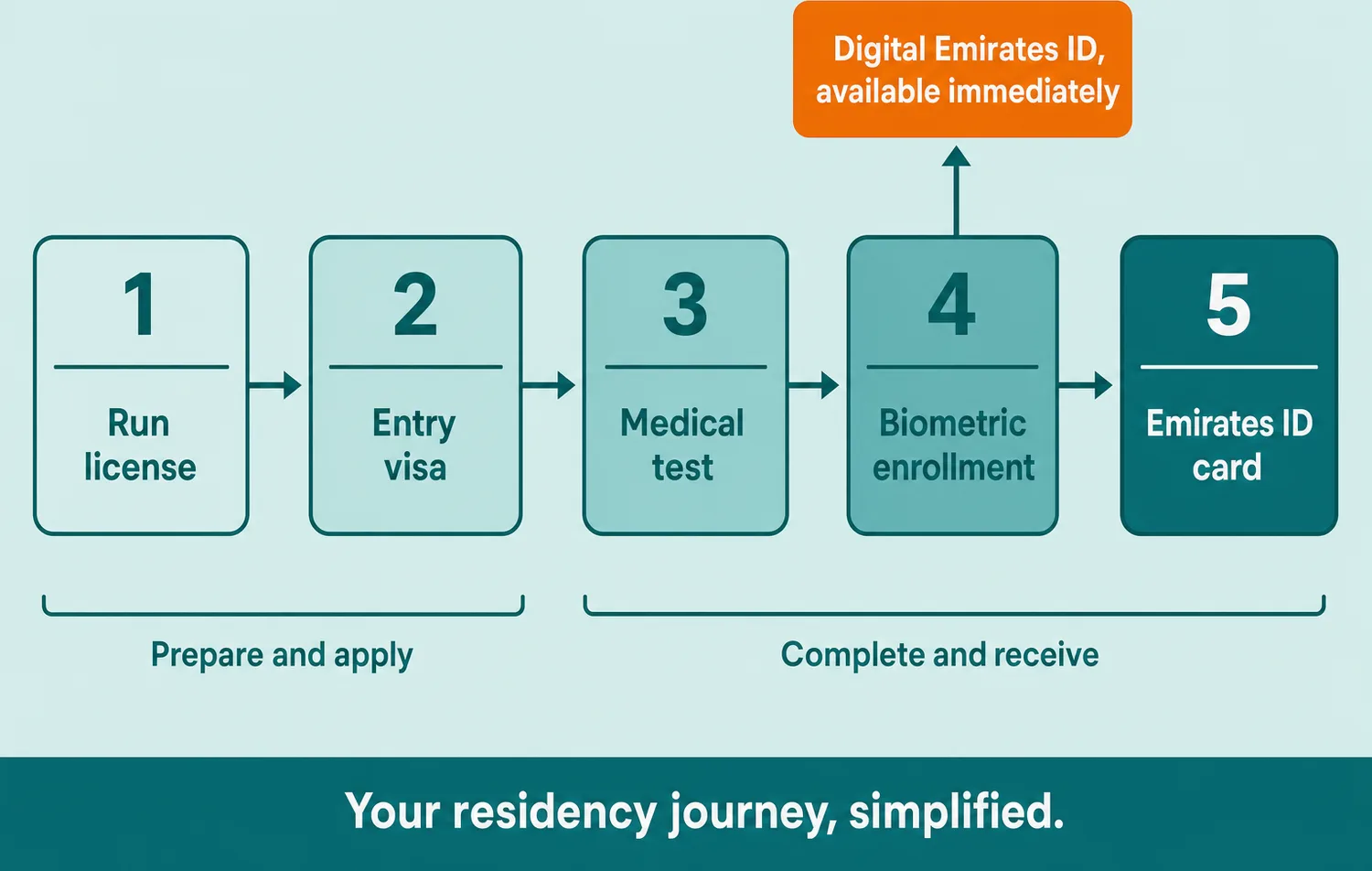
The order is fixed, and each stage triggers the next.
- The trade license is issued. A Meydan Free Zone standard license starts at AED 12,500, which is €2,875 per year.
- The investor visa is initiated once company ownership is registered.
- The medical fitness test is completed in Dubai, involving a blood test and a chest X-ray.
- Emirates ID biometrics are captured, covering fingerprints and a photograph.
- The residence visa and Emirates ID are issued together.
mResidency runs this whole sequence, and processing takes about 5 to 7 working days. Transport to appointments can be arranged, which removes the guesswork about where to go on a first visit to Dubai.
The Application Steps
Applications are submitted through ICP Smart Services, either on the portal at icp.gov.ae or through the UAEICP mobile app. Accredited typing centres handle submissions too.
The sequence looks like this:
- The application is submitted with passport and visa details
- Fees are paid online or at the centre
- A biometrics appointment is attended at an ICP service centre
- The card is produced and delivered
Biometrics are captured in person, and this is the part that requires being in Dubai. The appointment itself is short, covering fingerprints and a photograph. Children under 15 are exempt from fingerprinting, so family appointments move quickly.
Progress can be tracked through ICP using the application number, and SMS updates confirm each stage.
Fees and Validity
The card fee scales with the length of your residence visa. Longer visas mean a higher one-off fee and fewer renewals.
Service fees sit alongside the card fee and vary by channel. Applying online through ICP Smart Services carries one rate, and accredited typing centres carry their own, typically a smaller amount. ICP also offers instalment plans through partner banks on transactions above AED 500, at 0% interest over three to twelve months.
[blockCTACostCalculator]
The Digital Emirates ID and UAE Pass
The digital card is the part German founders appreciate most.
Your Emirates ID number becomes active in the ICP system immediately after biometrics, before the physical card is printed. A digital Emirates ID is then available through the UAEICP app straight away. That means banking applications, government portals and telecom sign-ups can proceed while the card is still in production.
UAE Pass builds on this. It is the national digital identity app, and it lets you sign documents and access hundreds of government services from your phone. Registration uses your Emirates ID details.
Keep the physical card for immigration and border control, where it is still the document requested. The card is delivered once printed, and progress is confirmed by SMS at each stage.
Family Cards and Renewals
Every family member on a residence visa holds their own Emirates ID, including children. Dependant visas for a spouse and children are handled through mResidency alongside the main investor visa, so the family moves through the sequence together.
Renewals follow the residence visa. When the visa is renewed, the Emirates ID renewal follows in the ICP system, and the renewal window opens up to six months before expiry. Many renewals for existing residents process without a fresh biometric capture, which keeps the second cycle simpler than the first.
Bringing It Together
The Emirates ID follows naturally from the license and the visa. Set up the company, let mResidency initiate the investor visa, complete the medical and biometrics on one trip to Dubai, and the card follows within about 5 to 7 working days.
The digital version arrives sooner still, so banking and government services open up straight after biometrics. To start the sequence that leads to your Emirates ID, contact the Meydan Free Zone team.
[blockCTAContact]