Table of Contents
Frequently Asked Questions
Does moving to Dubai eliminate all Indian tax obligations?
No. Seeking specialist advice before you proceed is not optional. Indian-source income — rental income, dividends from Indian companies, and capital gains on Indian assets — remains taxable in India regardless of UAE residency. Moving eliminates Indian tax only on income genuinely generated through a UAE structure, and only once Indian tax residency is formally exited.
How many days must an Indian founder spend in the UAE to become a UAE tax resident?
Under Cabinet Decision No. 85 of 2022, individuals must spend at least 183 days annually in the UAE to qualify for a Tax Residency Certificate. Without a UAE TRC, claiming UAE tax residency in Indian filings carries significant risk and the India-UAE DTAA protections cannot be activated.
What is the deemed residency trap under Section 6(1A) of the Indian Income Tax Act?
Indian citizens earning above INR 15 lakh who are not liable to tax in any other country are deemed Indian residents under Finance Act 2020. A founder whose UAE Free Zone company qualifies for 0% corporate tax and who draws no salary may inadvertently trigger this rule, resulting in Indian tax on worldwide income despite holding UAE residency.
Can a UAE Free Zone company qualify for 0% corporate tax if the founder is of Indian origin?
Yes, origin is irrelevant. The Qualifying Free Zone Person framework under Federal Decree-Law No. 47 of 2022 requires adequate UAE substance, qualified employees, core income-generating activities conducted in the UAE, and qualifying income. A flexi-desk arrangement alone does not establish sufficient substance to defend the 0% rate.
What happens to Indian capital gains tax when an NRI sells shares in an Indian company?
Capital gains on Indian assets are taxable in India regardless of where the seller is resident. The India-UAE DTAA does not protect this income category. A founder who sells their stake in an Indian startup after relocating to Dubai will still pay Indian capital gains tax on that transaction.
Topic Summary
India Tax Residency Must Be Formally Exited
Seeking specialist advice to address Indian tax exit obligations before the process starts is not optional. A founder spending more than 182 days in India remains an Indian tax resident regardless of UAE company ownership — the UAE structure delivers no tax benefit in that scenario.
UAE Offers Zero Personal Income Tax — With Conditions
The UAE does not levy personal income tax, and dividends drawn from a UAE company are yours to keep at the federal level, but only with genuine substance, a clean residency position, and formal Indian tax residency exit done.
Section 6(1A) Deemed Residency Catches High Earners
Indian founders earning above INR 15 lakh who are not liable to tax in any other country are deemed Indian residents under Finance Act 2020. Founders qualifying for UAE's 0% corporate tax rate may inadvertently trigger this provision — creating full Indian tax exposure.
UAE Tax Residency Certificate Is Non-Negotiable
A UAE Tax Residency Certificate from the Ministry of Finance activates DTAA protections. Without 183+ days of UAE physical presence annually and genuine substance, claiming UAE tax residency in Indian filings carries significant risk.
Indian Capital Gains Tax Follows You to Dubai
The India-UAE DTAA does not protect capital gains on Indian assets. A founder selling shares in an Indian startup after relocating to Dubai still pays Indian capital gains tax — the UAE structure provides no protection for this income category.
Permanent Establishment Risk Erases the Tax Benefit
Managing a UAE company's key decisions from India — signing contracts, directing staff, attending client meetings — creates a Permanent Establishment in India. Profits attributable to Indian operations become taxable in India at Indian corporate tax rates regardless of where the company is registered.
Indian Filing Obligations Continue After Departure
NRIs with Indian-source income above INR 2.5 lakh must file Indian income tax returns annually. Indian bank accounts must be converted to NRO or NRE status — continuing to operate resident savings accounts after becoming an NRI is a FEMA violation independent of tax obligations.
India Tax vs UAE Tax: What Indian Entrepreneurs Should Know Before Moving to Dubai
India taxes resident individuals on worldwide income at rates reaching 30%. Surcharges push effective rates above 35% for higher earners. A founder in Bangalore earning INR 2 crore a year faces a combined burden well above that once cess is factored in. The UAE is different. It levies no personal income tax. Salaries and dividends drawn from a UAE company are yours to keep at the federal level. But there are conditions. You need genuine substance, a clean residency position, and a clear understanding of India's rules for non-residents.
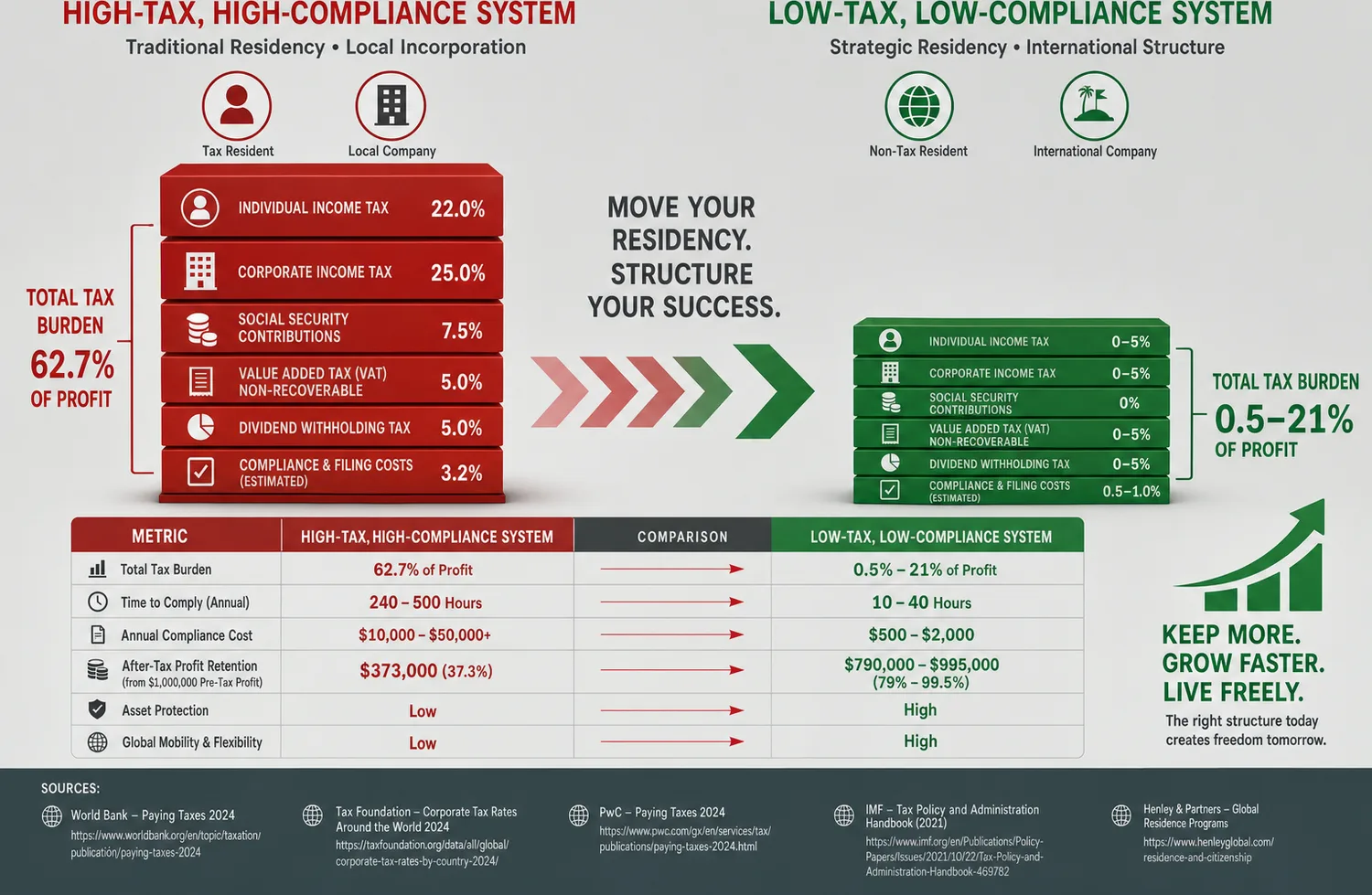
The comparison only delivers real benefit under two conditions. Indian tax residency must be formally exited. And UAE substance must be established. A Trade License alone achieves nothing on the Indian side.
[blockCTAmResidency]
India vs UAE: A Direct Tax Comparison
What Most Indian Founders Discover Too Late
Seeking specialist advice to address Indian tax exit obligations is not optional. Do it before the process starts. The most common compliance gaps cost founders significantly:
- Deemed residency trap: A founder earns INR 20 crore and sets up a UAE Free Zone company that qualifies for 0% tax. They draw no salary. This may trigger Section 6(1A). They are deemed an Indian resident because they are not liable to tax anywhere else.
- Permanent Establishment risk: Key decisions may be made from India. Contracts signed there. Client meetings held there. Indian tax authorities can then argue a PE exists. That makes UAE profits taxable in India at Indian rates.
- Capital gains exposure: A founder sells their stake in an Indian startup for INR 10 crore after relocating to Dubai. They will pay Indian capital gains tax on that transaction. The UAE structure provides no protection for this income category.
- Ongoing Indian filing obligations: NRIs with Indian-source income above INR 2.5 lakh must file Indian returns annually. Indian bank accounts must be converted to NRO or NRE status. Failing to do so is a FEMA violation, separate from tax obligations.
[blockCTAmAccounting]
Steps Before the Move
Step 1: Assess Indian tax exit obligations. Map every Indian income source: salary, rental income, dividends, and capital assets. File a final Indian return as a resident for the year of departure. Review your shareholding in Indian companies. Retaining control while directing operations from India can maintain Indian corporate tax exposure.
Step 2: Choose the right UAE structure. A flexi-desk arrangement alone does not establish substance. Consider a founder in Bangalore who does it properly. They define the license activity in Dubai. They maintain 200+ UAE days a year. They hold a TRC from the Ministry of Finance. And they file UAE corporate tax returns on schedule. This founder is in a fundamentally different compliance position from one who treats the UAE entity as a shell.
Step 3: Register for UAE Corporate Tax and VAT reporting obligations. All UAE businesses must register with the Federal Tax Authority. Registration is mandatory whether or not taxable profits exceed the AED 375,000 threshold. Factor in recurring fees for year one. These include annual Trade License renewal, visa renewal every two years, health insurance as a required condition of UAE residency, and UAE corporate tax and VAT filing costs.
The full process can run from three to six months when done correctly. Use the Meydan Free Zone Setup Cost Calculator to get a detailed cost breakdown. And address Indian tax exit obligations before the process starts, not as a parallel task.
Conclusion
The UAE's zero personal income tax is real. But it is not automatic. The benefit depends on getting the structure right. You must formally exit Indian tax residency. You must build genuine UAE substance. And you must stay clear of traps like deemed residency, Permanent Establishment, and capital gains exposure on Indian assets.
Done properly, the move gives Indian founders a clean, low-tax base to grow from. Done carelessly, it leaves them taxed in both countries. The difference is planning. Map your Indian exit obligations early, choose a UAE structure with real substance, and register for corporate tax and VAT on schedule.
Meydan Free Zone gives you the setup layer for that base. It offers full foreign ownership, a digital company formation process, and support across licensing, banking, and residency. Pair it with proper tax advice on the Indian side, and you move from high-tax exposure to a compliant UAE position.
[blockCTACostCalculator]