
Table of Contents
Frequently Asked Questions
Is car insurance mandatory in Dubai?
Yes. Under UAE Federal Law No. 6 of 2007, third-party liability insurance is compulsory for all registered vehicles. The RTA will not register or renew a vehicle without a valid policy from a licensed insurer.
How much does car insurance cost in Dubai?
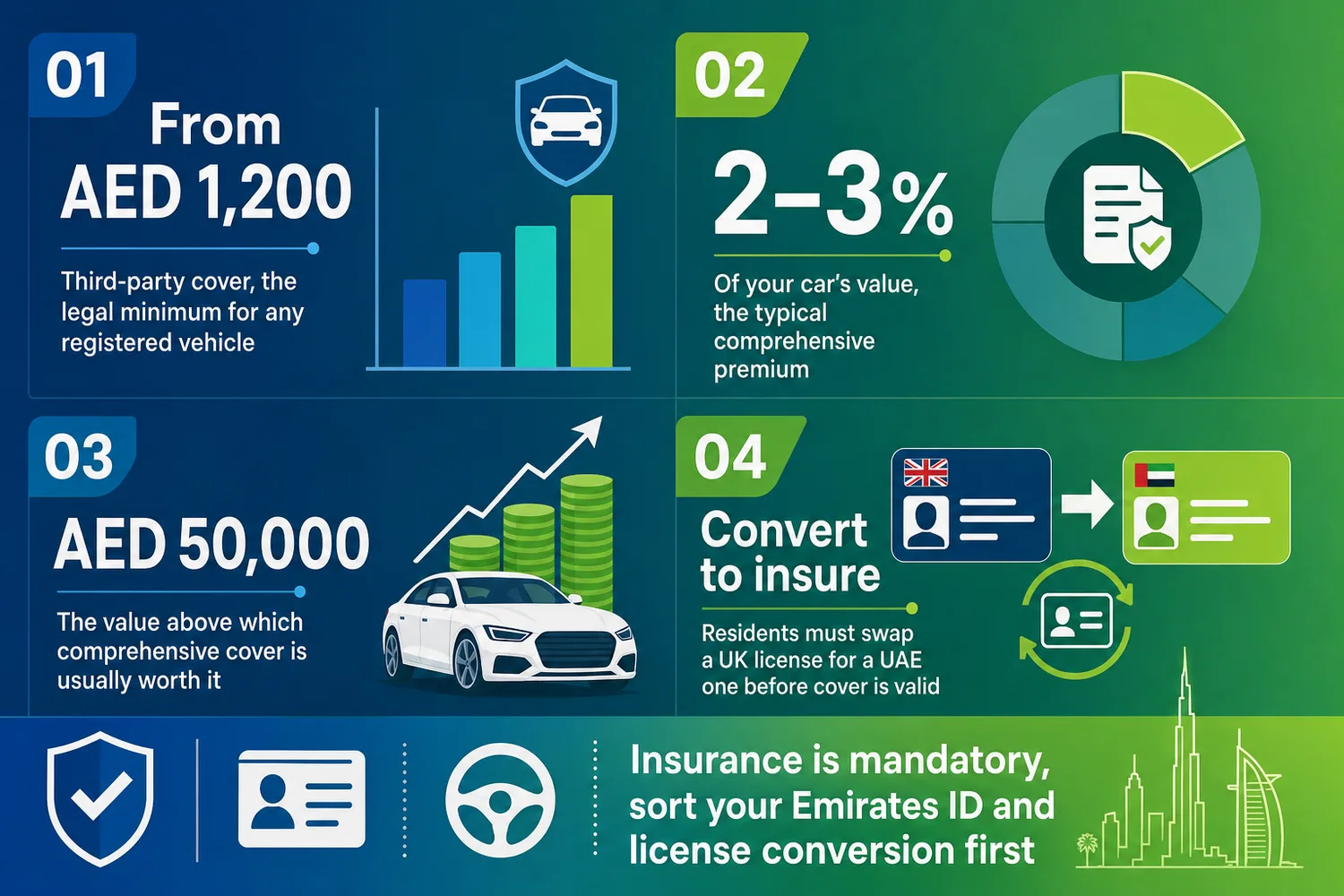
Third-party cover runs about AED 1,200 to 5,000 a year, and comprehensive AED 2,500 to 12,000 or more. Comprehensive is usually priced at 2 to 3 percent of the car's market value.
Can I drive in Dubai on a UK driving license?
As a visitor, yes. As a resident, no. Once residency is stamped, you must convert your UK license to a UAE one at the RTA. Driving on an unconverted license voids your insurance.
Does my UK no-claims bonus transfer to Dubai?
Not automatically. UAE insurers weight local claims history most, so premiums often start higher. A no-claims letter from your UK insurer, dated within 12 months, can help lower your opening premium.
What is the difference between third-party and comprehensive cover?
Third-party covers damage to others only and is the legal minimum. Comprehensive also covers your own vehicle, theft and fire. Comprehensive is usually best for cars worth over AED 50,000.
Topic Summary
Car Insurance Is a Legal Requirement
Car insurance in Dubai is mandatory under UAE Federal Law No. 6 of 2007. The RTA will not register or renew a vehicle without a valid policy from a Central Bank-licensed insurer — making it non-optional for every UK driver on the road.
Third-Party vs. Comprehensive Cover
Third-party liability is the legal minimum, covering damage you cause to others. Comprehensive cover adds protection for your own vehicle against accidents, theft, and fire. Most British drivers commuting daily opt for comprehensive given the vehicle's value and use.
Car Insurance Dubai Cost: What to Expect
Car insurance Dubai cost ranges from roughly AED 1,200 for basic third-party cover to AED 12,000 or more for comprehensive policies on higher-value vehicles. UK drivers without a UAE claims history typically start at higher rates in year one.
Your UK No-Claims History Still Counts
Most Central Bank-licensed UAE insurers accept a no-claims letter from your UK insurer as evidence of driving history. Presenting one before approaching insurers can reduce your opening premium meaningfully — sometimes by several hundred dirhams annually.
Add-Ons Worth Considering
GCC cover extends your policy across Saudi Arabia, Oman, Kuwait, Bahrain, and Qatar for roughly AED 150–300 per year. Agency repair and roadside assistance are also worth adding, particularly given Dubai's extreme summer heat and long driving distances.
Key Exclusions British Drivers Miss
Off-road driving without a specific add-on, any alcohol-related incident, and using a private vehicle for unlicensed commercial transport all void a standard UAE motor policy. The UAE operates a zero-tolerance drink-driving law with no exceptions.
Residency Comes Before Insurance
To purchase motor insurance in your own name, you need a UAE residence permit, Emirates ID, and a converted UAE driving license. A Meydan Free Zone trade license is the foundation — it triggers the investor visa that unlocks everything else, including vehicle registration.
Car Insurance in Dubai, UAE: Costs, Coverage and Obligations for British Drivers
Dubai is a city built for driving. Public transport exists, but for most residents, a car is closer to necessity than luxury. Car insurance is a legal requirement enforced at the point of vehicle registration with the Roads and Transport Authority (RTA). Without valid cover, you cannot register a vehicle or legally drive on UAE roads.
This guide covers what UK drivers need to know: the two cover types, what car insurance Dubai cost looks like in real numbers, the rules that apply specifically to British residents, and the documents you need to get insured.
Key Facts at a Glance
| Is insurance mandatory? | Yes. Required before vehicle registration or renewal with the RTA. |
|---|---|
| Cover types available | Third-party liability (legal minimum) and comprehensive. |
| Typical annual cost range | AED 1,200–AED 5,000 for third-party; AED 2,500–AED 12,000+ for comprehensive. |
| What British drivers need | Emirates ID, valid UAE driving license, vehicle registration card (Mulkiya). |
| Minimum legal cover | Third-party liability. Driving without it carries fines, black points, and possible impoundment. |
Is Car Insurance Mandatory in Dubai?
Yes. UAE Federal Law No. 6 of 2007 makes third-party liability insurance compulsory for all registered vehicles. The RTA will not register or renew a vehicle without a valid policy certificate from a licensed insurer.
Driving without insurance carries real consequences. Fines run from AED 500 upward, and repeat offences carry vehicle impoundment. Black points are added which regulates all motor policies issued in the country. A UK policy, or a short-term international extension from a British insurer, does not satisfy UAE registration requirements.
Third-Party vs Comprehensive Cover
Both cover types are available to residents. Here is how they compare.
| Feature | Third-Party Liability | Comprehensive Cover |
|---|---|---|
| Legal minimum requirement | Yes | Yes (exceeds minimum) |
| Covers damage to others | Yes | Yes |
| Covers your own vehicle | No | Yes |
| Theft and fire protection | No | Yes |
| Approximate annual cost | AED 1,200–AED 5,000 | AED 2,500–AED 12,000+ |
| Best suited to | Older or lower-value vehicles | Newer vehicles, daily drivers, financed cars |
If your vehicle is worth more than AED 50,000, comprehensive cover is usually the right call. Third-party saves money upfront but leaves a significant asset unprotected. Most British drivers accustomed to fully comprehensive policies at home find the comprehensive product here broadly comparable in structure.
Free Business Setup Cost Calculator
Calculate NowWhat Car Insurance Costs
Car insurance Dubai cost is typically calculated as a percentage of the vehicle's market value, usually between 2% and 3% for comprehensive policies. Third-party cover is priced lower and more fixed.
In 2026, typical annual ranges are:
- Third-party liability: AED 1,200–AED 5,000 (roughly £252–£1,050)
- Comprehensive: AED 2,500–AED 12,000+ (roughly £525–£2,520)
Several factors affect your premium:
- Vehicle make, model, age, and market value
- Driver age (under 25 attracts higher premiums regardless of UK experience)
- Claims history in the UAE (not the UK) carries the most weight with local insurers
- Cover type chosen (third-party vs comprehensive)
- Add-ons selected (agency repair, GCC cover, roadside assistance)
- Voluntary excess level (a higher excess reduces the annual premium)
Agency repair is one add-on worth knowing about. It routes repairs to an authorised dealership and typically adds 15–25% to the base premium. For newer or warranty-covered vehicles, it is often worth the extra cost.
What British Drivers Should Know
A few things work differently for British drivers, and knowing them upfront saves money.
Converting your UK license is the easy part. British nationals get a direct swap, with no theory or road test:
- Residents must convert. A UK license is fine for visitors only.
- Driving as a resident on an unconverted license voids your insurance.
Your no-claims history is where people lose out. Years of clean UK driving do not carry over on their own:
- UAE insurers weight local claims history most, so premiums often start higher.
- A no-claims letter from your UK insurer can soften that, ask for one before you leave.
A little planning cuts the cost noticeably:
- Compare at least three Central Bank-licensed insurers.
- A higher voluntary excess brings the annual premium down.
What You Need to Get Insured
Have these ready before approaching insurers:
- Emirates ID (required by all insurers)
- Valid UAE driving license (converted from your UK license at the RTA)
- Vehicle registration card (Mulkiya) or purchase agreement for a newly acquired vehicle
- No-claims letter from your UK insurer (dated within 12 months)
- Passport copy
Policies are typically issued digitally. The insurance certificate is then submitted to the RTA for vehicle registration. Keep a digital and physical copy in the vehicle at all times, traffic checks are routine.
Insurance Starts With Residency
Car insurance, registration and an Emirates ID all depend on one thing first: UAE residency. For a founder, that residency comes from setting up a company. Here is how the pieces connect:
- The company comes first: A trade license from AED 12,500 (€2,521) at Meydan Free Zone can make you eligible for residency, with a Fawri option at AED 15,000 (€3,026), issued in under 60 minutes, for those who want speed.
- Residency follows: mResidency coordinates your investor visa, medical test and Emirates ID in one process.
- The Emirates ID unlocks the rest: It is the document you need to convert your UK license, register a car and buy resident motor insurance.
- Then everything falls into order: License conversion, vehicle registration and insurance all follow once your residency is in place.
The takeaway is simple. Sort the company and residency first, and the driving side, license, car and cover, slots in behind it.
Conclusion
Car insurance in Dubai is mandatory, and the framework is clear. The Central Bank of the UAE licenses all insurers, the RTA enforces cover at registration, and driving without a valid policy carries fines, black points, and potential impoundment.
If you are relocating to Dubai as a British entrepreneur, the foundation comes first: a licensed company, then residency, then your Emirates ID, license conversion, and motor insurance. Explore the Dubai residence services at Meydan Free Zone and use the Cost Calculator to model your setup cost before you arrive.
Ready to Launch Your Business in Dubai?
Let's Connect







.webp)

%20Startups%20in%20Dubai%20.webp)