

Table of Contents
Frequently Asked Questions
1. How does UAE residency through company formation work?
UAE residency through company formation works by setting up a company in the UAE that acts as your visa sponsor. Once your trade license is issued and your immigration file is activated, you can apply for a residence visa. The process includes completing medical fitness testing, biometrics, and Emirates ID registration, after which the visa is stamped into your passport and your residency becomes active.
2. What is the difference between a Free Zone and a Mainland company?
A Free Zone company is typically suited for international business activities and operations outside the UAE market. A Mainland company is required if you want to trade directly within the UAE or work on government contracts. Both structures generally allow 100% foreign ownership, but they differ in trading scope, regulatory requirements, office setup, and visa allocation rules.
3. What are the main steps to get a UAE residency visa?
The UAE residency visa process begins after company formation and follows a structured approval path that includes trade licensing, immigration registration, and visa issuance. Once the company is established, an entry permit is issued, allowing the in-country process to begin. This is followed by medical testing, biometrics, and Emirates ID registration, and concludes with visa stamping and residency activation.
4. What documents do I need to start?
To begin the process, you typically need a valid passport with at least six months’ validity, a passport-sized photograph, and basic personal details such as contact information and residential address. Some jurisdictions may also request additional documents such as a CV or a brief outline of your intended business activity.
5. How much does it cost and how long does it take?
Company setup costs vary depending on jurisdiction, visa allocation, and office requirements, with Free Zone packages generally starting from around AED 15,000–20,000. The initial company formation process usually takes 1–2 weeks, while the full residency visa process may take several additional weeks depending on approvals and documentation.
6. What are the tax considerations for UAE residents?
The UAE does not impose personal income tax, meaning salaries and dividends are generally tax-free. However, a 9% corporate tax applies to business profits above AED 375,000, and VAT at 5% applies to businesses that meet the registration threshold.
Topic Summary
1. How Company Formation Leads to Residency
UAE residency through company formation works by establishing a business that acts as your visa sponsor. Once your trade license is issued and the immigration file is active, you become eligible to apply for a residence visa. This structure directly links your residency to your business activity, giving you control over your visa status in the UAE.
2. Choosing Between Free Zone and Mainland Company
The choice between Free Zone and Mainland determines how and where your business can operate. Free Zone companies are generally suited for international business activities and operations outside the UAE market, while Mainland companies allow you to trade directly within the UAE and take on government contracts. Both structures typically offer 100% foreign ownership, but differ in terms of operational scope, regulatory framework, and market access.
3. UAE Residency Visa Process
The UAE residency visa process follows a structured sequence that begins after company formation. Once the trade license is issued and the immigration file is opened, an entry permit is granted to initiate the visa process. This is followed by in-country requirements including medical fitness testing, biometrics, and Emirates ID registration. The process concludes with visa stamping, after which residency becomes fully active.
4. Budget and Timeline Overview
Costs and timelines vary depending on jurisdiction, visa allocation, and office requirements. A typical Free Zone company setup starts from around AED 15,000, while the overall process from application to visa issuance usually takes between three to six weeks depending on approvals and documentation.
5. Tax and Banking Considerations
Once the business is established, compliance becomes an important consideration. A corporate tax of 9% applies to profits above AED 375,000, while VAT at 5% applies to businesses that meet the registration threshold. Opening a corporate bank account is also a key requirement to fully operate and manage business transactions in the UAE.
How to Get UAE Residency Through Company Formation in Dubai, UAE for UK Expats
For UK expats looking to relocate to the UAE, securing services/finance through company Formation is a well-trodden and efficient sequence. This is a well-established and legitimate pathway where you establish a new company in the UAE, which then acts as your sponsor for a residence visa. In essence, your own business provides the legal basis for you to live and work in the country. The mechanics are logical: once your company is legally formed and has its trade license, it can open an "Immigration File," allowing it to apply for visas for its owners, partners, and employees.
Your company sponsors you for a residence visa, and you complete the necessary in-country steps. This includes a medical fitness test, biometrics capture, and Emirates ID application. The final step is the stamping of the services/finance visa in your passport. This structure gives you control over your status, leveraging your entrepreneurial plans to build a life in the UAE.
Who This Route Fits Best
This residency route is a perfect fit for a specific type of UK expat. It's ideal for consultants, freelancers, tech entrepreneurs, and digital nomads who don't rely on a physical UAE storefront. If you provide services to clients internationally while serving clients across the Middle East or Asia. However, if you are looking to tap into the UAE's thriving market, a different setup might be better. A classic example.
It's also a great option for those seeking a tax-efficient base from which to manage investments or conduct activities outside the UAE. The key is that you have a legitimate business purpose; this is a practical route, not a shortcut. You need to run a genuine company, which makes this path ideal for founders and business owners committed to building something real in the region.
Key Milestones in Order
The process is logical and checkpoint-driven, where each stage builds on the last, so missing a step isn't an option. Think of it as building a house; you need a solid foundation before putting up the walls. Understanding the sequence helps prevent costly mistakes and manage your timeline effectively, especially if you have travel or business commitments: You first register the legal entity and receive your trade license and other corporate documents.
- Immigration File Opening: The newly formed company opens its file with the immigration authorities.
- Entry Permit Issuance: Immigration issues an entry permit for you. With this permit, you can proceed. If you're outside, you'll use the entry permit to enter the UAE.
- In-Country Process: You complete a medical fitness test, and biometrics (fingerprints and photo), and apply for your Emirates ID card.
- Visa Stamping: Your passport is submitted, and the services/finance visa is stamped inside, officially confirming your status.
Choose the Right Jurisdiction and Business Activity
Free Zone vs. Mainland at a Glance
One of the most crucial decisions you'll make is choosing between a Free Zone or a Mainland company. Each has distinct rules regarding ownership, office space, the scope of business you can conduct, and visa eligibility. For most UK expats, especially those in consulting or tech, a Free Zone is often a perfect fit as it allows 100% foreign ownership and is geared towards activities with international clients.
A mainland company allows you to trade directly within the local UAE market and take on government contracts. However, this often comes with more complex setup requirements. The right choice depends entirely on your business model. If you want to trade with customers within the UAE, a mainland setup might be necessary. If your clients are outside the country, a Free Zone offers the best combination of cost, ease of setup, and 100% ownership.
Match the Activity to the License
Your business activity is the cornerstone of your application. You can't just pick a generic "consulting" license; you must select a specific activity from a government-approved list. This choice dictates the type of license you get (e.g., professional, commercial, industrial), which jurisdictions you can set up in, and even your office requirements. For instance, an e-commerce business has different licensing needs than a management consultant.
Getting this right from the beginning is a critical step. Answering these questions upfront helps you find the right fit. Do you need a physical office, or will a flexi-desk suffice? How many visas will you need for yourself and any potential employees? Making these decisions made upfront prevents early delays and ensures your business is compliant from day one. It's wise to assess your requirements before you start the paperwork.
Table: Jurisdiction Comparison
| Feature | Free Zone Company | Mainland Company |
|---|---|---|
| Ownership | 100% Foreign Ownership allowed | 100% Foreign Ownership (for over 1,000 commercial activities) |
| Business Scope | Primarily international and within the designated Free Zone; limited local trade | Unrestricted market access across all Emirates and international trade |
| Office Requirement | Flexible options available, including "smart desks" or virtual offices | Mandatory physical office space with a verified Ejari lease |
| Visas | Quota is strictly tied to the office size and chosen package | More flexible quotas based on MOHRE assessments and business needs |
| Government Work | Generally ineligible to bid for government contracts | Full eligibility to bid for government tenders and contracts |
Follow These 6 Steps to Secure Status
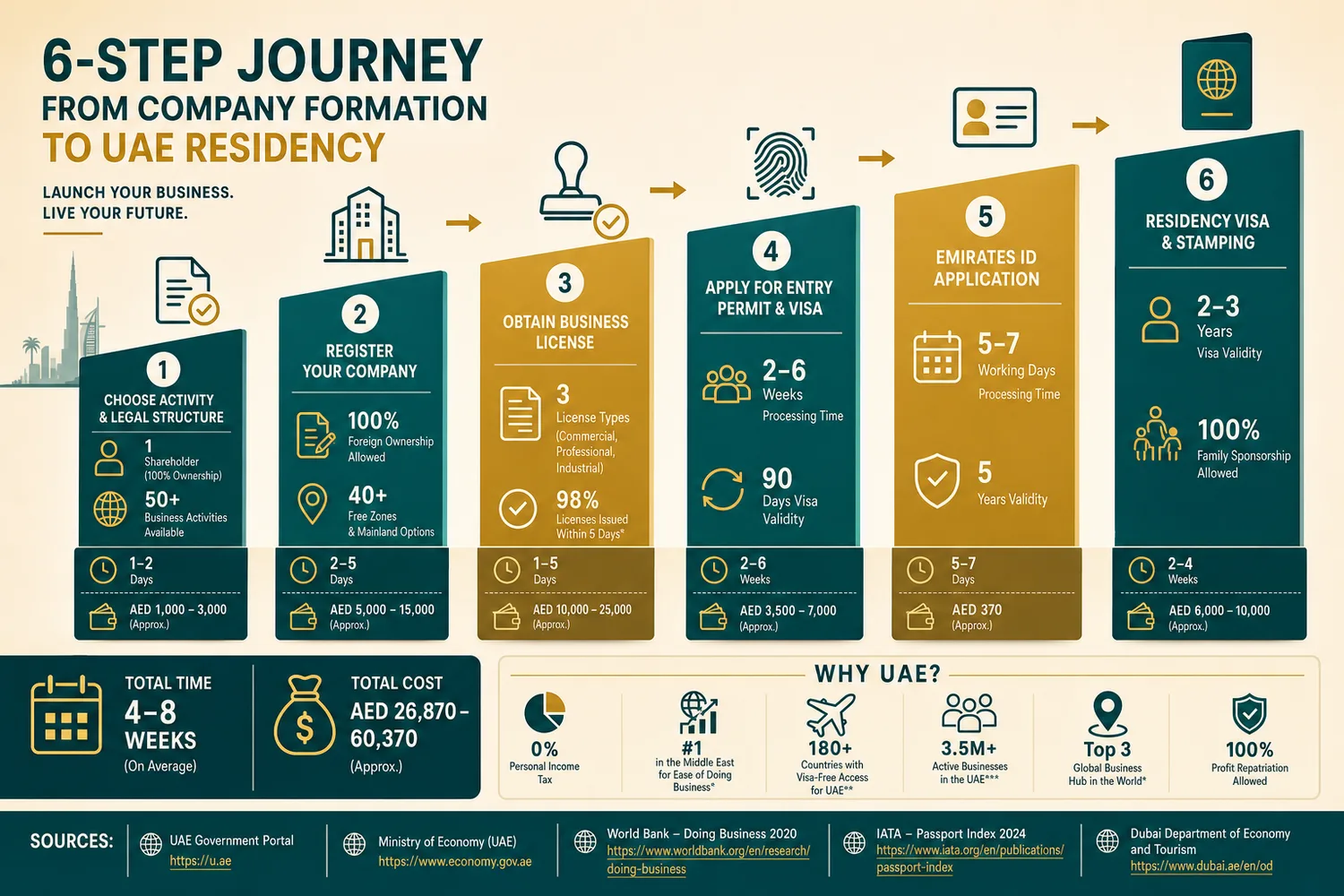
Following these steps in the correct order is crucial for a smooth process. Each stage unlocks the next, creating a clear path from initial decision to having your Emirates ID in hand.
1. Define Your Activity and Gather Documents
Before getting into any paperwork, you must clearly define your business activity. This decision impacts everything that follows. You'll need a clear, colour copy of your passport (with at least six months' validity) and a high-quality digital photograph with a white background. You should also have your current address, email, and phone number ready. Having these basic documents prepared helps prevent simple delays right at the beginning.
2. Choose a Jurisdiction and Reserve the Name
Once you've chosen a jurisdiction, the next step is to submit your application and reserve your company name. You'll typically provide three proposed company names in order of preference. The authority will check for availability and approve one. Your choice will determine the scope of business you can conduct, your office requirements, and your visa eligibility. For many UK expats, packages tailored to consultants and international businesses.
3. Obtain the Trade License and Company Documents
With an approved name and initial approvals in place, you’ll sign the relevant application form and pay fees to get your license. The authority will then issue your official company documents. These typically include the Trade License, Certificate of Formation, and Memorandum of Association. These documents are proof that your company legally exists and can operate within its specified business activity. This is a huge milestone, but it's not the end of the journey.
4. Open the Immigration File and Complete Medical and ID Steps
With the trade license in hand, the company can open its Immigration File, also known as the Establishment Card. This is a critical milestone that bridges the gap between company formation and the residency process. Without this file, your company cannot sponsor anyone. Once issued, the company can apply for your entry permit. The process requires you to complete biometrics, an Emirates ID application before undergoing a medical fitness test, which screens for communicable diseases. After passing, you proceed to the final visa stamping.
Costs, Timeline, and Required Checkpoints
Main Cost Drivers
The total costs to get UAE residency through company Formation vary significantly based on the jurisdiction you choose, the license activity, the visa allocation you need, and the visa package. A simple setup often costs between AED 20,000 and AED 35,000 for the first year with one visa. However, more complex setups or those in premium jurisdictions can cost over AED 50,000. The primary cost drivers include the jurisdiction's fees, fees for opening the immigration file, and the one for the medical and Emirates ID.
Realistic Timeline Benchmarks
You need a realistic plan for both time and money. While some steps are quick, the entire sequence from start to finish requires patience.
- Company Formation: This typically takes 5-10 business days once all documents are submitted correctly.
- Immigration File & Entry Permit: This can take another 5-7 business days.
- In-Country Process (Medical, Biometrics, ID, Stamping): This part can range from 3-5 business days for express services to 10-15 business days for standard processing.
In total, a realistic timeline is 3-6 weeks, assuming no delays. Opening a corporate bank account can add another 2-4 weeks to your operational timeline.
Banking, Tax, and Ongoing Administration
Open a Business Bank Account
Getting your trade license is a huge milestone, but it's not the end of the journey; your company needs a bank account to operate. Opening a business bank account in the UAE requires careful preparation. Due to strict anti-money laundering (AML) and Know Your Customer (KYC) regulations, banks need to see a genuine business with a clear purpose. You'll need your corporate documents, passport and visa copy, and often a brief business plan or profile.
Be prepared to explain your business model, expected revenue, and key clients. Banks want to account for legitimate business, so having a professional online presence and clear documentation helps immensely. The process can take several weeks, so it's best to start as soon as your license and Establishment Card are issued.
Review Tax and Reporting Obligations
As of June 2023, a federal Corporate Tax of 9% applies in the UAE, with a 0% rate on taxable income up to AED 375,000 [2]. This is essential to ensure you remain compliant with your obligations from day one. Additionally, Value Added Tax (VAT) at 5% is mandatory for Businesses with annual revenues over AED 375,000. You must register with the Gov.ae and file regular returns.
For UK expats, the most significant benefit is the 0% tax on personal income; dividends drawn from your UAE company are yours to keep. However, it's crucial to correctly manage your tax residency status with HMRC to ensure you aren't liable for UK tax on your UAE income. Professional advice on this is highly recommended.
Plan Renewals and Recordkeeping
Your trade license, Establishment Card, and Emirates ID all have expiry dates and require renewal. Typically, the license is renewed annually, and the services/finance visa every two years. You also need to factor in these recurring fees to maintain your company and residency without interruption. Missing renewal deadlines can result in fines and legal complications.
Good administration is key to long-term success. You must stay on top of compliance, maintain proper accounting records, and keep all your corporate documents organized. This not only ensures you avoid penalties but also makes future dealings with banks, authorities, and clients much smoother.
Success Criteria
Success isn't just about getting the visa; it's about being fully operational and compliant. You'll know you've successfully navigated the UAE residency through company formation process when:
- Your company is fully licensed and legally registered.
- Your Establishment Card is active.
- Your services/finance visa is stamped in your passport.
- Your Emirates ID is issued and in your possession.
- Your corporate bank account is opened and functional.
- You have a clear plan for annual renewals and tax compliance.
Next Actions
Ready to move forward? Don't get overwhelmed. Focus on the immediate next steps you can take this week to build momentum:
- Define Your Business: Write a one-paragraph description of exactly what your company will do. This is your foundation.
- Gather Your Documents: Find your passport and get a clear digital copy and a fresh passport-style photo. Having these ready saves time.
- Seek Expert Advice: Contact a reputable company formation specialist. Ask for a detailed, itemized quote that covers all government and service fees
With these initial steps completed, you'll be well on your way to making your move to the UAE a reality.
Citations
[1] The Official Portal of the UAE Government. (2023). Set up a business. Government. Retrieved from [https://u.ae/en/information-and-services/business/set-up-a-business](https://u.ae/en/information-and-services/business/set-up-a-business)
[2] Gov.ae. (2023). *Corporate Tax*. The Official Portal of the UAE Government. Retrieved from [https://u.ae/en/information-and-services/finance-and-investment/taxation/taxation/corporate-tax)
[3] World Bank. (2020). *Doing Business 2020*. World Bank Group. Retrieved from [https://archive.doingbusiness.org/en/data/exploreeconomies/united-arab-emirates](https://archive.doingbusiness.org/en/data/exploreeconomies/united-arab-emirates)