
Table of Contents
Frequently Asked Questions
Is healthcare free in Dubai for British expats?
No. Dubai has no NHS equivalent for expats. Health insurance is mandatory and tied to your residence visa, so you pay through a policy, often with a small co-pay on top.
How much is health insurance in Dubai?
The basic mandatory package starts around AED 320 a year (about £68). Comprehensive plans cost more, from a few thousand dirhams up to AED 20,000 or more, depending on cover.
Will my UK health insurance work in Dubai?
No. A standard UK private policy is for UK residents and will not cover you as a Dubai resident. You need a DHA-approved local plan or a dedicated international policy.
Are waiting times shorter in Dubai than the NHS?
Usually, yes. Dubai's private system often lets you see a specialist within days, with no GP referral needed, which is much faster than typical NHS waits for non-urgent care.
Do I need residency before getting healthcare in Dubai?
Yes. Health insurance is a visa requirement, so you need residency first. For founders, a Meydan Free Zone company can be formed in under 60 minutes and provides access to UAE residency, with mResidency handling the visa and Emirates ID.
Topic Summary
NHS vs Dubai: Two Fundamentally Different Systems
The NHS is tax-funded and free at the point of use. Healthcare in Dubai runs on mandatory private insurance tied to your residency. For Brits, the shift is structural, not just financial — and understanding it early prevents costly gaps.
Mandatory Insurance Starts From AED 600 a Year
Every Dubai resident must hold a DHA-approved policy. Basic cover starts from around AED 600 annually, with mid-tier plans running AED 5,000–15,000. Without valid insurance, your residence visa cannot be issued or renewed.
Specialist Access Without a GP Referral
Dubai's private hospitals let you book a cardiologist, dermatologist or specialist directly — often within 48–72 hours. NHS average GP wait times exceeded 18 days in 2025. For Brits used to referral queues, this is a genuine upgrade.
World-Class Facilities and JCI Accreditation
Dubai attracted over 630,000 medical tourists in 2024. Hospitals like Mediclinic City Hospital hold Joint Commission International accreditation — the same standard applied to leading private hospitals globally. Quality is not a concern.
Your Trade License Is the Gateway to Resident Healthcare
A Dubai Trade License from AED 12,500 is the legal starting point for residency. Without it, Brits remain on tourist status with no access to mandatory insurance or resident healthcare rights. The license triggers everything that follows.
NHS Entitlement Changes Once You Relocate
Non-residents are not entitled to free NHS treatment. GHIC cards are not valid in the UAE. Brits who relocate should notify HMRC, update their GP registration status, and hold private travel insurance for return visits to the UK.
The 0% Tax Environment Offsets Insurance Costs
A UK contractor earning £120,000 pays roughly £35,000 in income tax and National Insurance. In Dubai, the same income is untaxed. An AED 12,000 mid-tier insurance premium becomes a fraction of that annual saving — the maths works clearly in your favour.
Healthcare in the UK vs Dubai: Costs, Quality and Care Comparison
If you are moving from the UK to Dubai, healthcare is one of the first things you will think about. You have grown up with the NHS, where care is free at the point of use, so Dubai's private, insurance-based system feels very different at first.
Dubai does not have an NHS. Health insurance is not optional here, it is the law, and it is tied to your visa. Once you understand how it works, most British expats find the care fast, modern and easy to access. This guide walks you through the costs, the quality and the practical steps.
Key Differences at a Glance
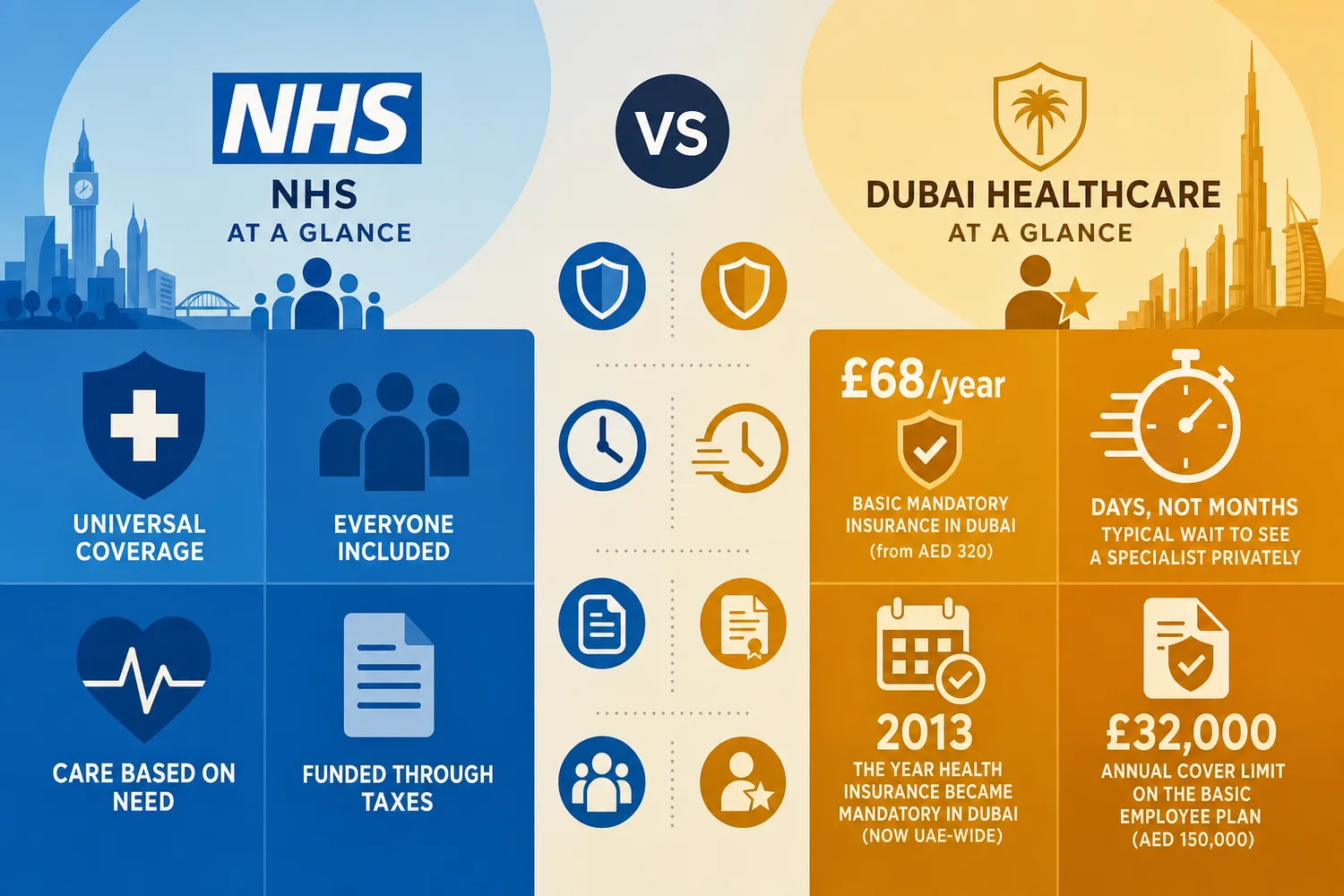
Here is how the two systems compare on the things that matter most to you.
| Factor | United Kingdom (NHS) | Dubai |
|---|---|---|
| How it is funded | Taxes and National Insurance | Private health insurance, which is mandatory |
| Cost at the point of use | Free for most care | Paid through insurance, often with a co-pay |
| Is it a visa requirement | No | Yes, you cannot get residency without it |
| Typical waiting times | Can be long for non-urgent care | Specialists often seen within days |
| Who regulates it | NHS and CQC | Dubai Health Authority (DHA) |
How Healthcare Works in Dubai
In the UK, you register with a GP and the NHS covers your care. Dubai works the other way round. You buy insurance first, and that insurance decides where you go and what you pay.
Dubai runs two sides, both overseen by the Dubai Health Authority. Public hospitals like Rashid, Dubai and Latifa offer strong care, but they mainly serve Emirati citizens. Expats can use them, yet most Brits use private hospitals and clinics for day to day care. The private side is where the speed and the international feel come from.
The one rule you cannot skip: health insurance is mandatory. Under Dubai Health Insurance Law No. 11 of 2013, every resident must hold a valid policy, and since January 2025 this applies across all seven emirates. No insurance means no residence visa.
What Healthcare Costs in Dubai
This is where the systems feel most different. In the UK you pay through tax and rarely see a bill. In Dubai you pay through a policy, and sometimes a small charge on top.
Here are the everyday numbers to plan around.
| Basic mandatory insurance | From around AED 320 a year (about £68) for the standard UAE package |
|---|---|
| Employee minimum plan (EBP) | Annual cover limit of AED 150,000 (about £32,000) |
| Public consultation | Around AED 100 to 200 (about £21 to £42) |
| Private consultation | Around AED 300 to 700 (about £64 to £150) |
| Comprehensive plan | From a few thousand dirhams up to AED 20,000 or more a year |
Two points British expats often miss. First, the basic Essential Benefits Plan is cheap, but it is limited. It has an annual cap and a narrow hospital network, which can fall short if something serious happens. Second, treatment for pre-existing conditions is usually excluded for the first six months on basic plans, so buy the right level of cover before you need it.
Free Business Setup Cost Calculator
Calculate NowQuality and Waiting Times
Dubai's private system is fast. You can often see a specialist within days, and you usually do not need a GP referral first. You book the specialist directly.
The quality is high. Private hospitals use modern kit, many doctors are trained in the UK, the US or Europe, and staff speak English. The DHA regulates the whole system and sets the standards every insurer and hospital must meet. Your medical records follow you through the DHA's Nabidh system, so different clinics can see your history.
The trade off is money, not standards. Care is quick and modern, but you pay for the level of cover you choose. Pick too basic a plan and you may find the fast, private care you expected sits outside your network.
How to Set Up Your Healthcare in Dubai
Getting covered is part of getting settled, and it follows a clear order.
- Step 1, sort your residency: Your health insurance is tied to your residence visa, so the company and visa come first.
- Step 2, get insured: Arrange a DHA-approved policy that suits you. If you are employed, your employer must provide at least the minimum cover by law.
- Step 3, link it to your Emirates ID: Your Emirates ID is becoming the main patient identifier, so make sure your policy is linked to it, or it may show as inactive.
- Step 4, register with a clinic: Choose a hospital or clinic inside your insurance network for routine care.
For British founders, this is where Meydan Free Zone fits in. A Meydan Free Zone company gives you the residence visa that makes insurance and healthcare access possible. Through mResidency, you get help with the visa, the medical test and the Emirates ID. Your standard UK private policy will not cover you as a Dubai resident, so plan for a local or international plan instead.
Is Healthcare Better in the UK or Dubai?
There is no single winner, because the two systems are built on different ideas.
Where the UK wins
The NHS is free at the point of use, and nobody is turned away for lack of money. For long-term, complex or very expensive conditions, that safety net is hard to beat.
Where Dubai wins
Dubai is fast. Short waits, direct access to specialists, modern private hospitals and English-speaking staff make everyday care easy. As long as you hold a good plan, you rarely wait.
For most working British expats and founders, the speed and comfort of Dubai's private care is a genuine upgrade on NHS waiting times. The key is choosing the right level of cover, not the cheapest one.
Conclusion
Healthcare in Dubai is not free like the NHS, but it is fast, modern and high quality once you are properly covered. The system runs on insurance, that insurance is tied to your visa, and the level you choose decides the care you get.
Get your residency in place, choose a plan that matches your needs rather than the legal minimum, and link it to your Emirates ID. Do that, and you will find healthcare in Dubai one of the smoother parts of your move.
Ready to Launch Your Business in Dubai?
Let's Connect


%20Startups%20in%20Dubai%20.webp)