Table of Contents
Frequently Asked Questions
What does this activity cover?
It covers buying fabric in bulk and selling it on to other businesses. Woven, knitted and non-woven cloth are all included.
Can I sell fabric by the metre to the public?
No. Retail sale of fabric sits under a separate code, 4751.01.
Can I trade raw textile fibres?
No. Textile fibres sit under class 4669 and need their own activity.
Can I sell yarn and household linen too?
Yes. The class also covers yarn, household linen, haberdashery and clothing.
Do I need third-party approval?
No. This activity does not require third-party approval to obtain a business license from Meydan Free Zone.
Topic Summary
Dubai Sits at a Global Fabric Trade Crossroads
Dubai's geographic position places it between Asian mills in India, China, Bangladesh, and Turkey and buyers across Europe and Africa. This makes it a natural hub for fabric importers looking to supply regional markets efficiently.
A Market With Billions in Import Opportunity
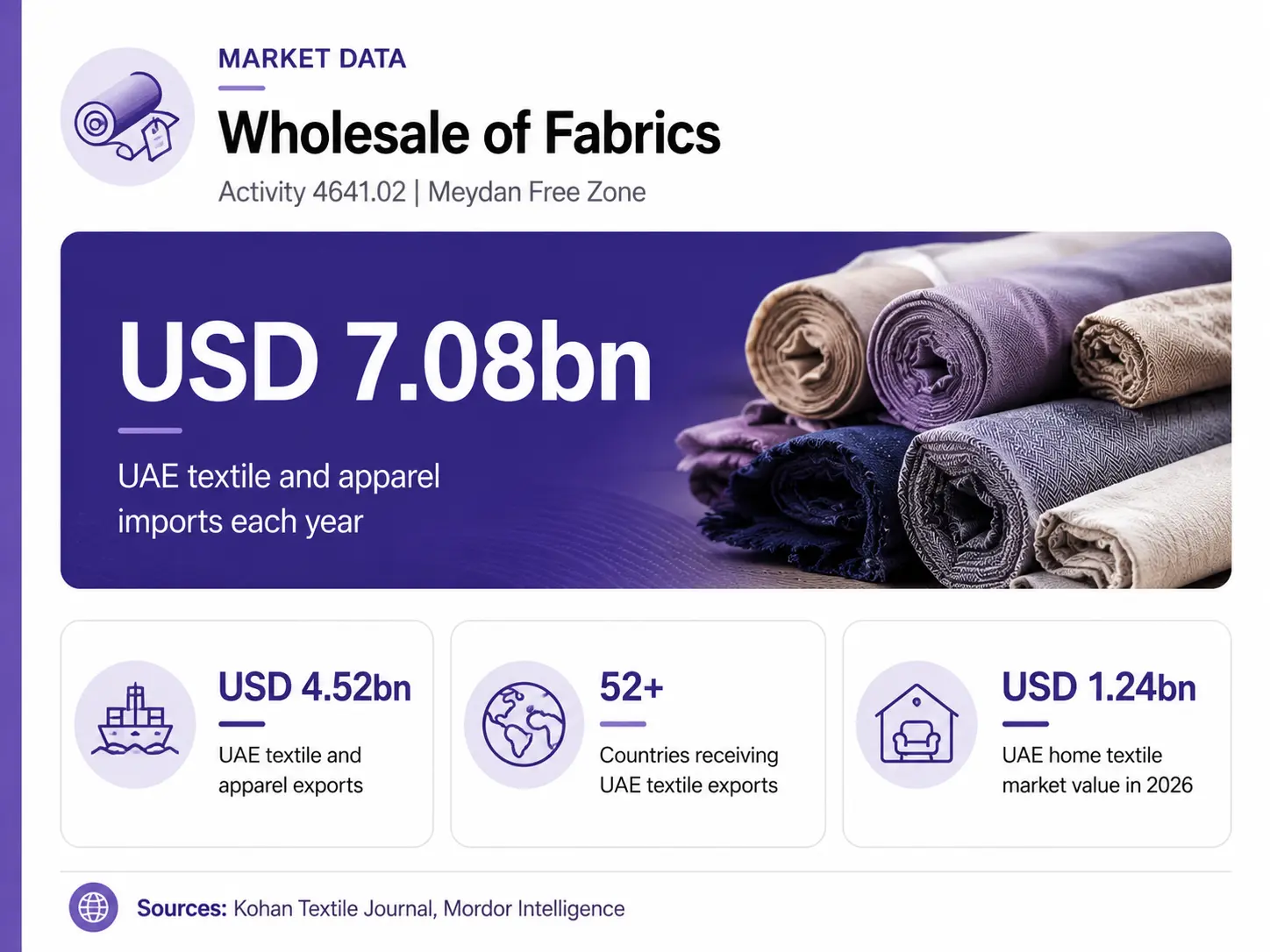
The UAE imports around USD 7.08 billion in textiles and clothing annually while exporting about USD 4.52 billion, leaving a significant domestic supply gap. That gap represents the core customer base a Dubai fabric wholesaler can serve.
Your Buyers Are Businesses, Not the Public
Wholesale fabric suppliers sell by the roll, bolt, or bundle to garment makers, fashion designers, tailors, interior firms, and retailers. You sit between the mill and the maker, holding stock so your trade buyers do not have to.
The Sector Is Projected to Reach USD 56 Billion
The Dubai Chamber of Commerce has placed the UAE clothing and textile sector on a trajectory toward USD 56 billion in value. This growth signals strong long-term demand for both local supply and re-export routes.
Know Exactly What Your License Covers
A wholesale fabric activity license covers bulk buying and importing of woven, knitted, and non-woven cloth, warehousing, and supply to trade buyers. It does not cover raw textile fibres, retail sales to the public, or manufacturing processes like weaving or dyeing.
Meydan Free Zone Requires No Third-Party Approval
Setting up this wholesale activity through Meydan Free Zone does not require third-party regulatory approval to obtain a business license. The activity is also not subject to Anti-Money Laundering compliance requirements, simplifying the setup process.
How to Become a Wholesale Fabric Supplier in Dubai with Meydan Free Zone?
Fabric wholesale means buying cloth in bulk and selling it on to businesses. Your buyers are garment makers, fashion designers, tailors, interior firms and retailers. You sell by the roll, the bolt or the bundle. You sit between the mill and the maker, and you carry the stock so your buyers do not have to.
Dubai is built for this trade. The UAE imports about USD 7.08 billion of textiles and clothing a year and exports about USD 4.52 billion[1]. The gap between those two numbers is the domestic market you would supply. Around 170 garment and cloth makers work across Dubai, Sharjah and Abu Dhabi[1], and UAE textile goods reach more than 50 countries[2].
The city's position does the rest. Dubai sits between the mills of Asia and the buyers of Europe and Africa. Fabric arrives from India, China, Bangladesh and Turkey, and moves out again across the region[3]. The Dubai Chamber of Commerce has put the UAE clothing and textile sector on track to reach USD 56 billion[4]. For a wholesaler, that means both a local customer base and a re-export route out.
[blockCTATradeLicense]
A Market That Imports More Fabric Than It Sends Out
A Dubai fabric wholesaler works in a market where the UAE imports about USD 7.08 billion of textiles and clothing and exports about USD 4.52 billion. Around 170 garment and cloth makers operate across the country, and UAE textile goods reach more than 50 export markets.
Who is this activity for?
[blockCTABizSetupRemotely]
What this activity covers
This code covers wholesale trade in fabric, sold in bulk to other businesses. The class guidelines set a wider scope across textiles and clothing.
- Bulk buying of woven, knitted and non-woven cloth
- Import and re-export of fabric through UAE ports
- Warehousing, cutting to length and breaking bulk for buyers
- Supply to tailors, garment makers, uniform firms and fit-out teams
- Wider textile wholesale allowed under the same class, including yarn and linen
Product scope
[blockFaqsCategory]
What falls outside this activity
This activity does not cover raw textile fibres, which the class guidelines place under class 4669. Jewellery and leather goods sit under class 4649. Selling fabric by the metre to the public is retail trade and needs a retail activity instead. Weaving, dyeing or finishing the cloth is manufacturing under its own code.
In short, you can import and sell finished cloth in bulk, but not raw fibre, and not to the public.
[blockCTAmPlus]
Compliance
Third-party Approval
This activity does not require third-party approval to obtain a business license from Meydan Free Zone.
Anti-money Laundering Compliance
This business activity is not subject to AML compliance requirements.
Footnotes
1. Kohan Textile Journal, UAE Textile Market Overview, 2025.
2. Mordor Intelligence, UAE Home Textile Market Size, Share and Industry Analysis, January 2026.