Table of Contents
Frequently Asked Questions
What is the Weighing & Measuring Services licence in Dubai
The Weighing & Measuring Services licence operates under activity code 7490.85 and authorises businesses to provide calibration, testing, and certification of weighing and measuring instruments used across trade, industry, and logistics. This includes servicing scales, flow meters, fuel dispensers, and industrial measurement equipment.
The activity also extends to consultancy on measurement accuracy and regulatory compliance for sectors where precision is critical, such as food processing, fuel distribution, pharmaceuticals, and manufacturing. It sits within ISIC Division 74 — Other Professional, Scientific and Technical Activities.
Who needs a Weighing & Measuring Services licence in Dubai
Any business entity providing measurement-related services commercially in Dubai requires this licence. The following types of operations are specifically covered:
- Calibration laboratories and independent metrology service providers
- Equipment maintenance firms serving industrial or logistics clients
- Importers or distributors of weighing and measuring instruments requiring after-sales service authorisation
- Third-party inspection companies offering measurement verification as part of a broader quality assurance offering
Operating without the correct licence exposes a business to immediate regulatory risk under Dubai's licensing framework.
Which regulatory bodies govern this licence
At the emirate level, the Dubai Department of Economy and Tourism (DED) governs the issuance of this licence for mainland operations. At the federal level, metrology and calibration activities are further governed by the Emirates Metrology Institute, which sets standards for instrument accuracy and conformity assessment across regulated industries.
Businesses handling trade measurement instruments used in commercial transactions involving fuel, food, or pharmaceuticals may also require additional approvals from the relevant sector authority before commencing operations.
What is the difference between a mainland and free zone licence for this activity
A mainland licence issued by DED allows direct client engagement across Dubai and the wider UAE without a local service agent for professional activities. This is particularly important if your clients are spread across multiple sectors and geographies.
Meydan Free Zone offers 100% foreign ownership, zero corporate tax on qualifying income, and faster incorporation for service-based businesses, with typically lower setup costs for lean operations. However, free zone entities serving mainland clients in regulated measurement activities should confirm any additional requirements before proceeding.
How long does it take to obtain a Weighing & Measuring Services licence in Dubai
The estimated setup time for a Weighing & Measuring Services licence is 5–10 working days, depending on the jurisdiction chosen and whether all required documentation is submitted correctly at the outset.
Delays can occur if additional sector-specific approvals are needed — for example, from authorities overseeing fuel, food, or pharmaceutical measurement — so it is advisable to confirm all regulatory requirements before submitting your application.
What is the activity code and ISIC classification for this licence
The activity is registered under activity code 7490.85 with the name Weighing & Measuring Services. It is classified under ISIC Division 74 — Other Professional, Scientific and Technical Activities, which covers specialised technical services that carry equivalent professional responsibility to engineering, accounting, or legal categories but do not fall neatly within those fields.
The licence type is classified as Professional / Commercial and is issued under the jurisdiction of Mainland Dubai (DED) or Meydan Free Zone.
Are there VAT obligations for businesses holding this licence
VAT registration is mandatory once a business's taxable turnover exceeds AED 375,000. This threshold applies to all UAE-based businesses, including those holding a Weighing & Measuring Services licence.
The Federal Tax Authority (FTA) governs VAT compliance, registration, and filing obligations across the UAE. Businesses should factor VAT registration timelines and ongoing compliance requirements into their operational planning from the outset.
Why is demand for weighing and measuring services strong in Dubai
Dubai's position as a global trade hub means demand for weighing and measuring services is structural rather than cyclical. Ports, warehouses, retail chains, and healthcare supply chains all depend on instruments that are regularly verified and maintained to ensure accuracy and legal compliance.
Sectors such as food processing, fuel distribution, pharmaceuticals, and manufacturing require precision measurement as a non-negotiable operational requirement. The breadth of Dubai's industrial and logistics base means calibration and metrology service providers have a wide and consistent client base across the emirate.
Weighing & Measuring Services License in Dubai
Every trade transaction, fuel pump, and industrial process in Dubai depends on certified weights and measures. Someone has to provide that calibration work. That someone needs the right license to do it legally.
This guide covers what a weighing and measuring services license covers, who regulates it, how to set up, and whether a free zone or mainland structure fits your operation.
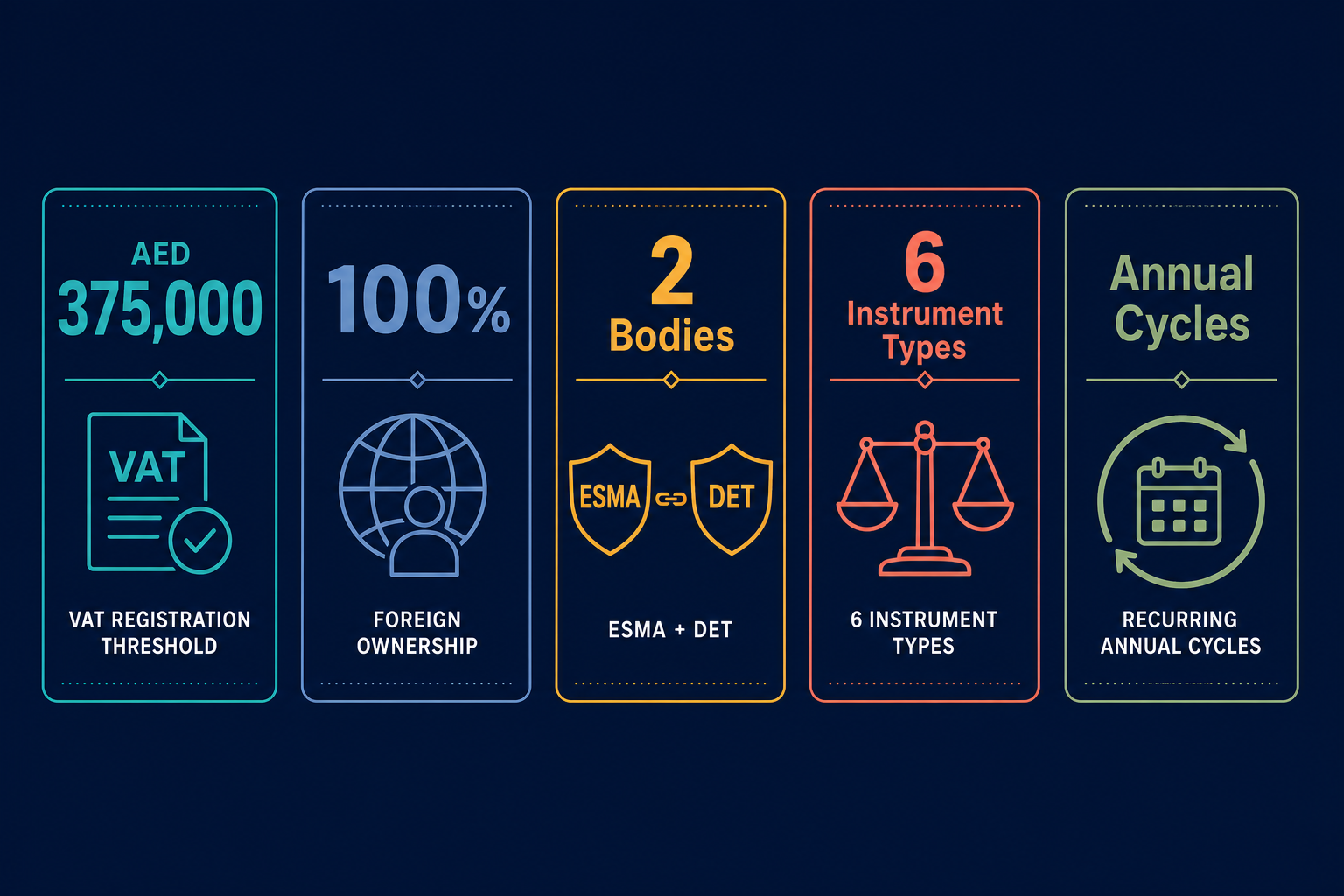
Key Stats at a Glance
| Regulatory authority (national) | Emirates Authority for Standardisation and Metrology (ESMA) |
|---|---|
| Local enforcement | Dubai Municipality |
| License issuing body (mainland) | Dubai Department of Economy and Tourism (DET) |
| License category | Professional / Industrial Services |
| Foreign ownership | 100% permitted – Invest in Dubai |
| VAT registration threshold | AED 375,000 annual turnover – Federal Tax Authority |
| Staff registration | Ministry of Human Resources and Emiratisation (MOHRE) |
What This License Covers and Who Regulates It
A weighing and measuring services license covers the calibration, testing, repair, and certification of weighing and measuring instruments. It is a technical activity. You are not just selling scales. You are verifying that instruments used in trade and industry give accurate, legally defensible readings.
ESMA sets the national rules. Dubai Municipality enforces them locally. If you want to operate commercially, you need ESMA accreditation on top of your trade license. The two are separate processes and both are mandatory before you take on paying clients.
The instruments this license covers include:
- Industrial scales and weighbridges used at ports and logistics hubs
- Fuel dispensers at petrol stations
- Utility meters for water, gas, and electricity
- Laboratory balances used in pharmaceutical and food testing
- Retail weighing equipment used in supermarkets and wholesale markets
For mainland operations, DET issues the license. The activity sits under the professional or industrial services category depending on whether your work is field-based or lab-based. Check the exact activity code with DET or through the Meydan Free Zone business activities list before you commit to a structure, because the wrong code creates problems at the ESMA accreditation stage.
One practical point: calibration work carried out at a client's premises, rather than in a fixed lab, may need additional approval from Dubai Municipality. Confirm this before you start quoting for on-site contracts.
Your Clients and the Market You Are Entering
The client base here is broad and largely institutional. These are not one-off buyers. They run on annual calibration cycles, which means recurring revenue once you are on their approved vendor list.
Your main clients will include:
- Petrol stations, which need certified fuel dispenser checks at regular intervals
- Supermarkets and food retailers, which must have retail weighing equipment verified
- Ports and logistics operators, where weighbridge accuracy affects trade documentation
- Manufacturing plants, which need process measurement equipment certified for quality control
- Hospitals and pharmaceutical companies, where laboratory balance accuracy is a regulatory matter
- Government inspection bodies, which run their own verification programmes
Dubai's trade volume supports consistent demand. The emirate handles enormous flows of goods through its ports and logistics corridors, and every shipment that is weighed or measured commercially needs certified equipment behind it. According to DP World, the scale of port activity in the region continues to grow, which directly feeds demand for calibration services across the supply chain.
Government tenders are a real opportunity here, but they come with conditions. You need approved vendor status before you can bid, and that status depends on holding valid ESMA accreditation. Private sector clients want the same. Nobody in this sector hires an uncertified provider. The barrier to entry is real, and that is exactly what protects your position once you are established.
Mainland vs Free Zone: Which Structure Works
This is the most important structural decision you will make. Get it wrong and you will either be locked out of government contracts or paying for a mainland setup you did not need.
| Factor | Mainland (DET) | Free Zone (Meydan Free Zone) |
|---|---|---|
| Client access | Full UAE market, including government bodies | Mainly international clients and import/export activity |
| On-site calibration work in Dubai | Permitted | Requires a dual-license or mainland partner arrangement |
| Office requirement | Physical office or approved lab space required | Flexi-desk options available |
| Foreign ownership | 100% permitted | 100% permitted |
| Setup cost | Generally higher due to office and approval requirements | Lower entry cost; Dubai Trade License from AED 12,500 |
| Best suited for | On-site field calibration, government tenders, local retail clients | Instrument import/export, international clients, lab-based testing for overseas markets |
A mainland license from DET lets you work directly with UAE government bodies, local petrol station chains, and retail groups. If your business model is field calibration across Dubai, mainland is the right structure.
A free zone setup through Meydan Free Zone works well if you are importing or distributing calibrated instruments, running a lab that serves international clients, or building a business that does not depend on direct UAE government contracts. Some operators run a dual structure: a free zone entity for international trade and a mainland entity for local field work.
If you are not yet certain which model fits, use the cost calculator to compare total setup costs before you commit.
Free Business Setup Cost Calculator
Calculate NowStep-by-Step Setup Guide
- Step 1, book your trade name: Use the DET e-Services portal for a mainland company, or the Meydan Free Zone portal for a free zone one. Check your company name availability before you go further to avoid delays.
- Step 2, choose your activity code: Confirm the code covers calibration, testing, and repair of weighing and measuring instruments. The wrong code will create problems at the ESMA accreditation stage.
- Step 3, submit your initial application: Include your business plan, proof of qualified staff, and details of your proposed lab or premises. DET or Meydan Free Zone will review and issue initial approval.
- Step 4, get pre-approval from Dubai Municipality: For on-site calibration work in Dubai, Dubai Municipality pre-approval is needed before your trade license is issued. This step confirms your premises and technical setup meet local standards.
- Step 5, secure your premises: Your lab or office space must meet ESMA standards. This includes adequate space, environmental controls, and secure storage for reference standards. A flexi-desk is not enough for a calibration lab.
- Step 6, register staff with MOHRE: Hire qualified metrologists or calibration technicians. MOHRE registration is needed for all employees. Keep records of qualifications and training for ESMA audit purposes.
- Step 7, collect your trade license: Once premises, staff, and pre-approvals are in place, your trade license is issued.
- Step 8, apply for ESMA accreditation: This is a separate process from the trade license. ESMA will audit your lab, your equipment traceability records, your staff qualifications, and your quality management system before granting accreditation. You cannot operate commercially without it.
Compliance, Kit, and Ongoing Duties
Getting the license and accreditation is the start, not the finish. This is a regulated activity with ongoing duties that you need to manage actively.
ESMA accreditation renewal
ESMA accreditation is not permanent. It runs on renewal cycles and is subject to periodic audits. If your quality management system lapses or your equipment records fall out of order, you risk suspension. Plan for audit preparation as a routine operational task, not a one-off event.
Equipment traceability
Your calibration kit must itself be traceable to national or international measurement standards. This means your reference standards need to be calibrated by a recognised national metrology institute. Keep certificates current and on file. ESMA will check these during audits.
Staff qualifications
Staff must hold recognised metrology qualifications. Keep records of every technician's credentials and any continuing professional development. If a qualified technician leaves, you need a replacement in place before you take on new contracts, not after.
VAT registration
Once your annual turnover crosses AED 375,000, you must register for VAT with the Federal Tax Authority. Calibration services provided to UAE-based clients are standard-rated. Keep proper records from day one, even if you are below the threshold initially. VAT registration support is available through mAccounting if you need it.
Breaking the rules
Issuing false calibration certificates, using untraced reference standards, or operating without valid ESMA accreditation carries serious consequences. Fines, license suspension, and damage to your name in a market where reputation is everything. The client base in this sector is small and well-connected. One compliance failure travels fast.
Market Opportunity
Dubai's position as a regional trade hub creates steady, structural demand for certified measurement services. Petrol stations, ports, food retailers, and manufacturers all run on annual calibration cycles. That means predictable, recurring revenue for a properly set-up operator.
Government spending on infrastructure and industrial development continues to grow. New facilities need new calibration programmes. Existing ones need ongoing verification. The Ministry of Economy and Tourism, Establishing companies confirms that national standardisation and quality assurance remain priorities under UAE industrial policy, which supports long-term demand for accredited metrology services.
The barriers to entry are real: ESMA accreditation takes time, qualified staff are not easy to find, and reference equipment is expensive. But those same barriers protect your position once you are through them. A well-run calibration business with strong ESMA accreditation and a clean compliance record builds client relationships that last years, not months.
If you want to manage your setup remotely before relocating, Meydan Free Zone supports remote business setup in Dubai, which lets you get the company structure in place while you finalise your premises and staffing locally.
Conclusion
A weighing and measuring services license in Dubai is a regulated, technically specific activity. The entry requirements are real: ESMA accreditation, qualified staff, traceable equipment, and the right premises. But those requirements are also what makes the market defensible once you are in it.
Choose your structure carefully. If you are doing field calibration across Dubai, you need a mainland license. If you are importing instruments or serving international clients, a free zone setup through Meydan Free Zone works well. Some operators need both.
Speak to Meydan Free Zone to confirm the right license structure and activity code for your calibration or metrology business before you start. Getting this right at the beginning saves time, cost, and compliance problems later.
Ready to Launch Your Business in Dubai?
Let's ConnectReferences
- Invest in Dubai
- Federal Tax Authority (FTA)
- Dubai Department of Economy and Tourism (DET) e-Services
- Ministry of Human Resources and Emiratisation (MOHRE)
- DP World
- Ministry of Economy and Tourism, Establishing companies