

Table of Contents
Frequently Asked Questions
Does the UAE corporate governance code apply to private companies?
The formal code comes from the Capital Market Authority, formerly the Securities and Commodities Authority, and covers public joint stock companies, so it does not bind private SMEs directly. Private companies are governed by the Commercial Companies Law, their Memorandum and Articles of Association, and their licensing authority's rules. Banks and regulators still expect private companies to show similar discipline in records, decisions and ownership.
Who issues governance rules for public joint stock companies in the UAE?
The Capital Market Authority (CMA), which replaced the Securities and Commodities Authority on 1 January 2026, issues governance rules for public joint stock companies in the UAE. These rules cover areas such as board responsibilities, disclosure and accountability. A private SME can use them as a benchmark, but they are not a legal requirement for its structure.
Does an SME in the UAE need a board of directors?
Most private SMEs do not need a formal board in the way a listed company does. Many are run by a manager or by the shareholders under the Memorandum and Articles of Association. What matters is that roles, signing authority and decision-making are written down, whether or not a board exists.
What records should a UAE company keep to show good governance?
A company should keep its constitutional documents, a current Share Register, signed written resolutions and accounting records. It should also hold ultimate beneficial owner details and any shareholders' agreement. Banks and authorities ask for these documents during due diligence and filings.
Is a shareholders' agreement mandatory for a UAE company?
No, a shareholders' agreement is generally not mandatory for a private company. It is still a practical tool because it sets out decisions, exits, deadlock handling and reserved matters. It complements the Memorandum and Articles of Association and does not replace them.
How do beneficial owner rules relate to company governance?
Beneficial owner rules require a company to know and record the individuals who ultimately own or control it. This links directly to governance because ownership records must match the Share Register and constitutional documents. Changes in ownership or control need to be recorded and reported, which supports bank due diligence.
What happens if a UAE company keeps poor ownership records?
Poor ownership records can delay bank reviews, cause disputes between partners and expose the company to administrative penalties. The size of any penalty depends on the specific law breached and the authority that enforces it. The more common cost is lost time and repeated corrections.
How does a Meydan Free Zone company evidence who can sign on its behalf?
Meydan Free Zone issues the Business License, Certificate of Formation, Share Register, and Memorandum and Articles of Association digitally after registration. The Memorandum and Articles of Association set out powers and authority, which a bank can review. A written resolution can then confirm specific signatories for a given purpose.
Topic Summary
What a Corporate Governance Code Means for a UAE SME
A corporate governance code sets out how a company is directed and controlled: who decides, who is accountable, and how records and disclosures are handled. In the UAE, the formal governance rules for public joint stock companies come from the Capital Market Authority, formerly the Securities and Commodities Authority. Private SMEs apply its principles voluntarily or through other laws.
Which Rules Apply to a UAE SME
A UAE SME is governed mainly by the Commercial Companies Law, its constitutional documents, and the rules of its licensing authority. Corporate Tax, beneficial ownership and accounting rules add further duties. The listed-company code is a benchmark, not a legal requirement, for most private companies, and it still shapes how counterparties judge you.
Ownership Records and Reporting Duties
UAE companies must keep accurate ownership records, including a Share Register and details of the ultimate beneficial owner. Changes in ownership or control must be recorded and reported to the licensing authority. Accurate records support bank due diligence and reduce the risk of penalties.
Five Governance Practices Every SME Should Put in Place
An SME can build workable governance in five moves: define roles and signing authority, document decisions in written resolutions, keep ownership records current, maintain proper accounting records, and set a regular review of compliance duties. These steps work without a formal board and bring listed-company governance principles down to private-company scale.
Cost and Risk of Weak Governance
Weak governance in a UAE SME leads to delayed bank onboarding, shareholder disputes, administrative penalties and tax filing errors. The cost is rarely one large fine. It is usually lost time, frozen decisions and repeated corrections. Penalties depend on the specific law breached, as our guide to penalties for non-compliance in the UAE explains.
How Governance Works for a Meydan Free Zone Company
A Meydan Free Zone company is registered digitally and receives its Business License, Certificate of Formation, Share Register, and Memorandum and Articles of Association electronically. Those documents form the governance baseline for a private company.
Conclusion
The UAE's formal corporate governance code is written for public companies, but the discipline it describes is what banks, regulators and partners expect from any SME. Execution matters more than theory: written authority, current records and clean accounts.
Corporate Governance Basics for a UAE SME
Say a founder runs a profitable Dubai trading company with two shareholders and no written rules on who signs what. It works until a bank asks for a resolution or a partner wants out.
Does governance really apply to a private small or medium-sized enterprise (SME), and what does it take in practice? This guide explains which rules reach an SME, what weak governance costs and how to set up a workable structure.
What a Corporate Governance Code Means for a UAE SME
A corporate governance code sets out how a company is directed and controlled: who decides, who is accountable, and how records and disclosures are handled. In the UAE, the formal governance rules for public joint stock companies come from the Capital Market Authority, formerly the Securities and Commodities Authority. Private SMEs apply its principles voluntarily or through other laws.
Where the Formal Code Applies
The Capital Market Authority (CMA), which replaced the Securities and Commodities Authority on 1 January 2026, sets governance rules for public joint stock companies. A limited liability company is not bound by that listed-company code directly.
That doesn't mean no expectations exist. A founder who assumes governance is irrelevant often finds out otherwise when a bank requests board resolutions and proof of signatory authority.
Why Principles Still Reach Private Companies
Banks, investors and regulators look for clear decision-making and records. The principles are accountability, transparency, fairness and oversight.
For a time-poor founder, the payoff is practical: fewer disputes and faster approvals. Take a two-partner company with a written signing authority. Its bank account opening is far less likely to stall on questions about who can sign.
Which Rules Apply to a UAE SME
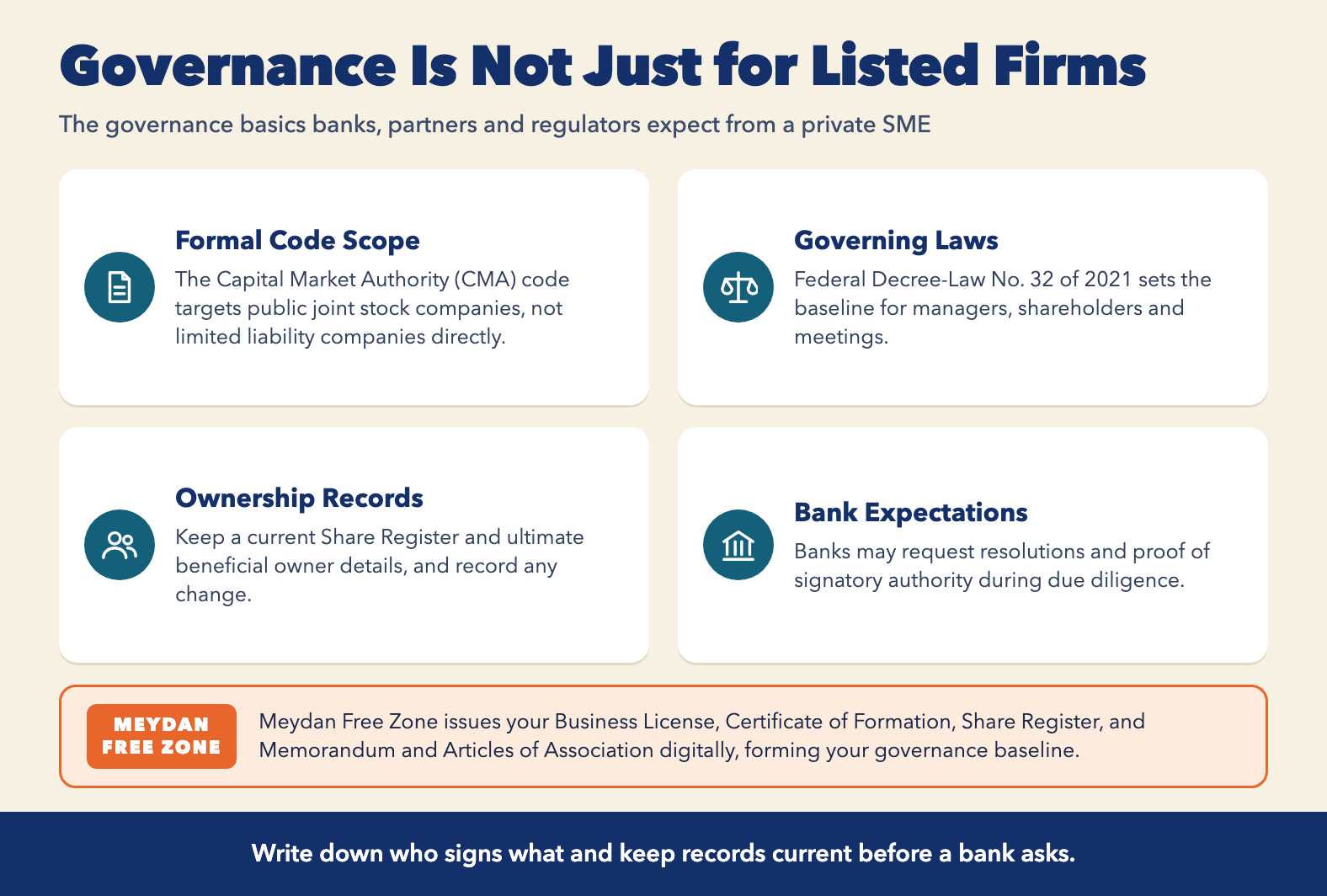
A UAE SME is governed mainly by the Commercial Companies Law, its constitutional documents, and the rules of its licensing authority. Corporate Tax, beneficial ownership and accounting rules add further duties. The listed-company code is a benchmark, not a legal requirement, for most private companies, and it still shapes how counterparties judge you.
Commercial Companies Law and Constitutional Documents
Federal Decree-Law No. 32 of 2021 on Commercial Companies sets the baseline for managers, shareholders and meetings. Your Memorandum and Articles of Association define powers and voting. A sole shareholder who keeps the Share Register current avoids awkward questions at a bank review.
Federal, Emirate and Free Zone Responsibilities
- Federal law sets company, tax and anti-money-laundering duties.
- Emirate-level rules apply to mainland licensing.
- A free zone authority sets its own rules for amendments and records.
- The Federal Tax Authority (FTA) handles Corporate Tax and VAT, not licensing.
A free zone founder should check the licensing authority's rules before amending anything, rather than assuming mainland procedure.
Ownership Records and Reporting Duties
UAE companies must keep accurate ownership records, including a Share Register and details of the ultimate beneficial owner. Changes in ownership or control must be recorded and reported to the licensing authority. Accurate records support bank due diligence and reduce the risk of penalties.
Share Register and Beneficial Owner Details
Cabinet Decision No. 109 of 2023, which replaced Cabinet Decision No. 58 of 2020, sets the beneficial ownership framework. Our guide to ultimate beneficial owner requirements in the UAE covers who must be recorded.
Keep the register aligned with your Memorandum and Articles of Association. Picture two partners who agree a share transfer verbally and never record it. The gap surfaces during a bank review, when the paperwork names someone who no longer owns the shares.
Governance Tools and What Each One Controls
| Governance Tool | What It Controls |
|---|---|
| Memorandum and Articles of Association | Company powers and voting |
| Shareholders' agreement | Exits, deadlock and reserved matters |
| Written resolutions | Evidence of decisions |
| Share Register | Legal record of ownership |
| Accounting records | Tax and audit evidence |
Shareholder Rights in Writing
A shareholders' agreement covers decisions, exits and dispute handling. It complements your Memorandum and Articles of Association and does not replace them. Read more on shareholders' agreements in the UAE. A 60/40 partnership, for instance, can set reserved matters that need both partners' consent, so the majority holder can't act alone.
Five Governance Practices Every SME Should Put in Place
An SME can build workable governance in five moves: define roles and signing authority, document decisions in written resolutions, keep ownership records current, maintain proper accounting records, and set a regular review of compliance duties. These steps work without a formal board and bring listed-company governance principles down to private-company scale.
- Define roles and signing authority.Separate owner, manager and authorised signatory duties in writing. Set spending limits, such as a cap above which the manager needs shareholder approval.
- Record decisions in written resolutions. Use shareholder and manager resolutions for major actions, such as authorising a bank account opening. Store signed copies in one place.
- Keep ownership records current. Update the Share Register and beneficial owner details after any change, such as a new investor joining.
- Maintain accounting and tax records.Corporate Tax applies at 9% on taxable income above AED 375,000, as set out by the FTA. A trading company that reconciles its books every month finds annual filings far easier.
- Review compliance duties on a schedule. A quarterly check of license renewals, filings and registers catches gaps early.
Cost and Risk of Weak Governance
Weak governance in a UAE SME leads to delayed bank onboarding, shareholder disputes, administrative penalties and tax filing errors. The cost is rarely one large fine. It is usually lost time, frozen decisions and repeated corrections. Penalties depend on the specific law breached, as our guide to penalties for non-compliance in the UAE explains.
Banking, Tax and Regulatory Exposure
Bank due diligence expects clear ownership and authority, in line with Central Bank of the UAE anti-money-laundering expectations. A company that can't evidence who controls it faces a delayed review. Late or inaccurate filings carry administrative penalties set by the relevant authority.
Partner Disputes and Exit Problems
Missing exit terms and deadlock mechanisms turn disagreements into stalemates. Two partners who dispute a profit distribution with no written policy have nothing to point to. Disputes drag on when decisions were never documented.
How Governance Works for a Meydan Free Zone Company
A Meydan Free Zone company is registered digitally and receives its Business License, Certificate of Formation, Share Register, and Memorandum and Articles of Association electronically. Those documents form the governance baseline for a private company.
Documents That Form the Governance Baseline
Digital issuance keeps your records in one place. A founder can use the digital Memorandum and Articles of Association to confirm signing authority when a bank asks.
Support for Accounting and Compliance Records
Meydan Plus mAccounting covers bookkeeping, Corporate Tax support and financial audit reports. A small trading company can outsource bookkeeping so filings are ready on time. mCore adds business bank account support and a company stamp, though support doesn't guarantee bank approval.
Free Business Setup Cost Calculator
Calculate NowConclusion
The UAE's formal corporate governance code is written for public companies, but the discipline it describes is what banks, regulators and partners expect from any SME. Execution matters more than theory: written authority, current records and clean accounts.
Review your signing authority, Share Register and shareholder terms this quarter. A Meydan Free Zone company already holds its Share Register and Memorandum and Articles of Association in digital form, so start there. Then decide which gaps to close before the next bank review or ownership change.
Ready to Launch Your Business in Dubai?
Let's Connect